• العربية
  • فارسی
Brand
  • Iran Insight
  • Politics
  • Economy
  • Analysis
  • Special Report
  • Opinion
  • Podcast
  • Iran Insight
  • Politics
  • Economy
  • Analysis
  • Special Report
  • Opinion
  • Podcast
  • Theme
  • Language
    • العربية
    • فارسی
  • Iran Insight
  • Politics
  • Economy
  • Analysis
  • Special Report
  • Opinion
  • Podcast
All rights reserved for Volant Media UK Limited
volant media logo

India tells US it needs Iran, Venezuela crude to offset Russian cuts

Sep 25, 2025, 14:07 GMT+1

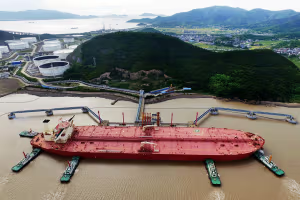
Indian officials have told the Trump administration that any significant reduction in Russian oil imports would require Washington to allow purchases from sanctioned suppliers Iran and Venezuela, Bloomberg reported.

A delegation in Washington this week voiced New Delhi’s position in meetings with US officials, stressing that simultaneously cutting Russian, Iranian and Venezuelan flows would risk driving up global prices, the reported cited people familiar with the talks as saying.

India, the world’s third-biggest crude importer, meets nearly 90% of its oil needs from abroad. Its refiners have relied on discounted Russian barrels to ease costs after sanctions curbed Moscow’s wider trade, while Iranian and Venezuelan oil could offer similar discounts.

Commerce Minister Piyush Goyal said this week India wanted to increase US oil and gas purchases, but added that “our energy security goals will have a very high element of US involvement.”

India halted Iranian oil imports in 2019 and stopped buying Venezuelan crude this year as US sanctions tightened.

Replacing those supplies with Middle Eastern barrels would be more expensive, officials said.

Most Viewed

US terminates green cards of 3 Iranians tied to Islamic Republic
1

US terminates green cards of 3 Iranians tied to Islamic Republic

2
PODCAST

Worst outcome is Islamic Republic’s survival, ex-CIA official says

3
ANALYSIS

Iran brings unusually broad team to US talks to blunt future blame

4
INSIGHT

Tehran sends tough message but keeps diplomacy door open

5

Zoroastrian religious figure arrested in Iran

Banner
Banner

Spotlight

  • Tehran sends tough message but keeps diplomacy door open
    INSIGHT

    Tehran sends tough message but keeps diplomacy door open

  • Worst outcome is Islamic Republic’s survival, ex-CIA official says
    PODCAST

    Worst outcome is Islamic Republic’s survival, ex-CIA official says

  • Why the Iran-US truce is more likely to buy time than peace
    ANALYSIS

    Why the Iran-US truce is more likely to buy time than peace

  • Engaged but uncommitted: China watches Iran and US fight and talk
    ANALYSIS

    Engaged but uncommitted: China watches Iran and US fight and talk

  • A truce for the world, a reckoning for Iran’s economy
    ANALYSIS

    A truce for the world, a reckoning for Iran’s economy

  • Why the world failed to bypass the Strait of Hormuz
    ANALYSIS

    Why the world failed to bypass the Strait of Hormuz

•
•
•

More Stories

West races to build cheap drones modelled on Iran’s Shahed - WSJ

Sep 25, 2025, 12:46 GMT+1

Western militaries and defense firms are racing to develop low-cost attack drones modelled on Iran’s Shahed after the weapon’s use in Ukraine showed how mass-produced unmanned aerial vehicles can overwhelm air defenses, the Wall Street Journal reported on Wednesday.

The Journal said the Shahed-136’s simple delta wing, propeller engine and composite body enable cheap manufacturing, with Russian-built versions priced at about $35,000 to $60,000 each, compared with Western systems that can cost hundreds of thousands to more than $1 million.

“If you do get into a war, you need deep, deep pockets,” Lt. Gen. André Steur, commander of the Royal Netherlands Air and Space Force, told the paper.

The article, written by Alistair MacDonald, said Russia has deployed Shaheds in large salvos -- sometimes alongside missiles -- to saturate Ukrainian air defenses, prompting US and European companies to field look-alike designs.

At a Pentagon event this summer, 18 American-made drone prototypes were on display, the paper reported, including SpektreWorks’ Lucas and Griffon Aerospace’s Arrowhead, both of which mirror the Shahed’s delta planform and are aimed at mass production.

Western manufacturers argue that higher performance can justify higher unit prices. “If twice as many SkySharks hit their target, then it is much cheaper than a Shahed,” Mike Gascoyne, founder of Britain’s MGI Engineering, told the Journal, describing his SkyShark as able to fly at about 280 miles per hour compared with roughly 115 mph for a Shahed-136.

Analysts and defense officials told the Journal that cheap, one-way loitering munitions deployed in swarms present a strategic challenge because they force defenders to expend costly interceptors.

“Cheap, long-range precision saturation strikes are one of the greatest threats to international security,” James Patton Rogers of the Cornell Brooks Tech Policy Institute was quoted as saying.

The Journal also cited defense industry figures saying some companies are now selling Shahed-like target drones so air-defense units can train against swarm attacks.

Hugo Coqueret, a business development manager at European missile maker MBDA, was quoted saying, “Mass produced at a fraction of the cost of a cruise missile, it will tire out the enemy’s defense.”

Western governments have imposed rounds of sanctions on Iranian drone producers and procurement networks, blaming Tehran for supplying drones to Russia and to regional armed groups.

China’s Indonesian oil imports raise suspicions of Iranian trade - Bloomberg

Sep 25, 2025, 10:17 GMT+1

China has sharply increased crude imports declared from Indonesia in recent months, an unusual surge that points to possible new workarounds for Iranian oil exports, Bloomberg reported on Wednesday.

Customs data show 2.7 million tons of Indonesian crude -- around 630,000 barrels per day -- arrived in August, far exceeding Indonesia’s average output of 580,000 bpd in 2024, most of which was consumed domestically. The flows followed a sharp jump in July.

China, the biggest buyer of Iranian oil, officially reported no imports from Tehran since mid-2022. In the meantime, it buys more oil from Malaysia than the country produces. In the past two months, shipments from Malaysia -- often used for ship-to-ship transfers and rebranded cargoes -- have dropped more than 30%.

Analysts say operators are now shifting tactics.

“This is just part of a continuing evolution of the operators’ tactics, hiding what they’re doing,” said Charlie Brown, a senior adviser at United Against Nuclear Iran. “They’re still doing ship-to-ship transfers in the same area off Malaysia; the basic trade pattern remains the same.”

Vessel-tracking data show tankers including the Aquaris, Yuhan, Pola and Pix signaled calls at Indonesia’s Kabil port near Singapore -- a hub not connected to crude exports but close to established transfer zones off Malaysia. These tankers later discharged cargoes in Chinese ports such as Qingdao, Rizhao and Dalian.

  • Sanctions snapback to boost China’s access to cut-price Iranian oil - Reuters

    Sanctions snapback to boost China’s access to cut-price Iranian oil - Reuters

  • Sanctions and graft decimated Iran oil revenues, ex-Treasury official says

    Sanctions and graft decimated Iran oil revenues, ex-Treasury official says

Bloomberg cited the Aquaris as receiving Iranian crude from the sanctioned Sorion tanker before unloading in Qingdao in June. The Yuhan and Pola followed similar patterns, according to data from Vortexa and Kpler.

Queries to Indonesia’s energy ministry, Pertamina, Kabil port, and China’s foreign ministry went unanswered, Bloomberg reported.

China’s reliance on Iranian oil has provided Tehran with a crucial economic lifeline as US sanctions continue to target the trade.

The looming return of UN sanctions on Iran is unlikely to curb its oil exports but could boost China’s refiners, who already take nearly 80% of Tehran’s 1.6 million barrels per day at steep discounts, Reuters reported on Wednesday.

Iran’s Persian carpet exports collapse 95% under sanctions

Sep 25, 2025, 08:53 GMT+1

Iran’s centuries-old carpet industry, once a symbol of cultural prestige and a $2 billion export powerhouse, is unraveling under US sanctions, shifting consumer tastes and rising competition, industry officials and traders say.

Exports of handmade rugs, which stood at more than $400 million in 2017, fell to just $41.7 million in the year to March 2025, according to customs data -- a drop of over 95% from their peak in the early 1990s, AFPreported.

The collapse followed Washington’s 2018 reimposition of sanctions, cutting off the US market that once bought more than 70% of Iranian carpets.

“During the unkind and cruel US sanctions, we lost our biggest buyer,” said Zahra Kamani, head of Iran’s National Carpet Center.

Germany, the UAE, Japan and China are now Iran’s top destinations, but volumes remain a fraction of past levels.

Rivals including India, China, Nepal, Turkey and Pakistan have captured global market share, with some rugs even imported back into Iran, traders said.

  • Iran's Handwoven Carpet Exports Plummet Amid Sanctions

    Iran's Handwoven Carpet Exports Plummet Amid Sanctions

  • Iran’s carpet exports unravel with 90% plunge

    Iran’s carpet exports unravel with 90% plunge

  • Iran's Persian Carpet Exports Drop Drastically

    Iran's Persian Carpet Exports Drop Drastically

At least two million Iranians, many of them rural women, depend on carpet-weaving but earn only a few dollars a day. “We are losing even part of our domestic market due to imports,” Tehran trader Hamed Nabizadeh told AFP.

With tourism also in decline, fewer foreign visitors buy rugs, and even those who do are deterred by price tags of $30,000 or more for silk carpets.

Officials insist revival is possible. Trade Minister Mohammad Atabak said in June that new trade and currency policies could help resuscitate exports.

Analysts argue adapting designs to modern décor trends, using social media for sales and branding carpets more effectively may be key.

But with Iran’s currency plunging, many families at home are turning to cheaper factory-made rugs, and a centuries-old craft risks fading into a relic of the past.

GOP senator urges European allies to press forward with Iran sanctions

Sep 24, 2025, 21:18 GMT+1
•
Marzia Hussaini

Republican Senator John Cornyn called on European allies to support and intensify sanctions against Iran, calling it a leading state sponsor of terrorism and an aggressor.

The United Kingdom, France and Germany last month triggered the so-called "snapback" of international sanctions on Tehran which are set to take effect on September 28.

"We need our European allies to step up and agree that these sanctions are critical," Cornyn told Iran International.

"Iran is the number one state sponsor of terrorism. Thank goodness President Trump disrupted their nuclear weapons program. But their attitude and conduct remain unchanged, and these sanctions are entirely justified," the Texas senator said.

Cornyn’s push follows a letter led by Senator Jim Risch and signed by 50 Senate Republicans last week. The letter praised the UK, France, and Germany for re-activating the UN sanctions on Iran and urged sustained pressure until Tehran’s nuclear program is fully dismantled.

The move reflects growing United States concerns over Iran’s nuclear progress and its support for proxy groups across the region.

At the UN General Assembly on Wednesday, Iranian President Masoud Pezeshkian accused the US of betraying trust, particularly after its 2018 withdrawal from the JCPOA nuclear deal, and stressed Iran’s willingness to pursue diplomacy to resolve the crisis.

Pezeshkian denied that Iran has ever sought nuclear weapons, despite the US and Israeli assertions in June that Tehran was racing toward a bomb.

"I hereby declare once more that Iran has never sought and will never seek to build a nuclear bomb," Pezeshkian said.

Addressing European powers, Pezeshkian accused Germany, Britain, and France of acting in bad faith by reinstating UN sanctions.

"The three European states, having failed through a decade of bad faith and by supporting military aggression to subdue the proud people of Iran, at the behest of the United States, sought to reinstate terminated UN Security Council resolutions through pressure, coercion, and blatant abuse," the Iranian president said.

French President Emmanuel Macron also met with Pezeshkian on the sidelines of the UN meeting, warning that time was running out. "An agreement remains possible — only hours left; it is up to Iran," Macron posted on X.

Iran’s rial weakens on fears of looming snapback sanctions

Sep 24, 2025, 10:19 GMT+1

The Iranian rial fell sharply on Wednesday as markets braced for the reimposition of UN sanctions under the snapback mechanism, with the US dollar trading above 1,074,000 rials on the open market, more than 2% higher than a day earlier.

Sterling climbed to 1,440,000 rials, while the price of the “Emami” gold coin rose 3.5% to 1,070,000,000 rials, reflecting heightened demand for hard assets amid economic uncertainty.

On Tuesday, Iran’s central bank governor Mohammadreza Farzin sought to reassure business leaders that the country’s foreign exchange and gold reserves remain secure.

Also on Wednesday, Oil Minister Mohsen Paknejad said that reimposition of UN sanctions will not add "new burdensome restrictions" on the country’s oil sales.

"In the last years, we have faced such severe restrictions from the unjust and unilateral US sanctions that, in practice, [UN sanctions] won't add much to this situation," Paknejad said after a cabinet meeting.

The oil and petrochemical sector contributed roughly a quarter of Iran’s GDP in 2024, making continued exports critical to Tehran’s economy as sanctions loom.

Reuters also reported on Wednesday that the revival of sanctions is unlikely to halt Tehran’s vital crude exports but could hand Chinese refiners a lucrative advantage, giving them greater access to discounted Iranian oil.