• العربية
  • فارسی
Brand
  • Iran Insight
  • Politics
  • Economy
  • Analysis
  • Special Report
  • Opinion
  • Podcast
  • Iran Insight
  • Politics
  • Economy
  • Analysis
  • Special Report
  • Opinion
  • Podcast
  • Theme
  • Language
    • العربية
    • فارسی
  • Iran Insight
  • Politics
  • Economy
  • Analysis
  • Special Report
  • Opinion
  • Podcast
All rights reserved for Volant Media UK Limited
volant media logo
EXCLUSIVE

Iran’s struggle for justice lights the way forward, Nobel laureate says

Sep 17, 2025, 21:00 GMT+1Updated: 00:39 GMT+0
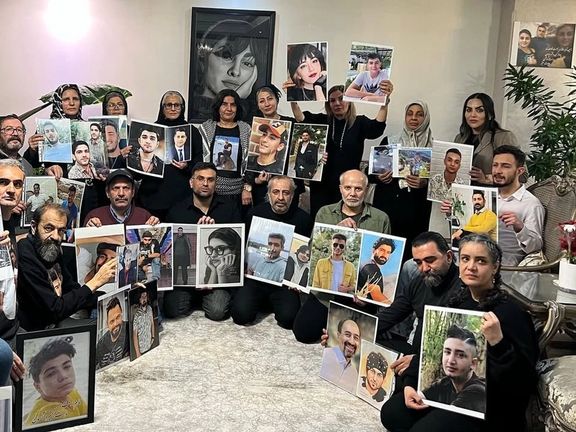
Families of protestors killed in Iran's 2022 protests gather in solidarity, Tehran, January 2025

Nobel laureate Narges Mohammadi praised Iranian civil society on the third anniversary of Mahsa Amini’s death in morality police custody, saying victims' families have kept the pursuit of justice alive by turning grief into a force for change.

In an exclusive editorial for Iran International, Mohammadi said the slogan Woman, Life, Freedom which became the mantra of the protest movement ignited by her death carries forward a decades-old struggle for human rights in Iran.

"From the image of the Khavaran mother standing tall over an unmarked grave, to the embrace of Mahsa Jina Amini’s parents in a hospital corridor as they endured her final moments in pain and tears, countless scenes have been created that will remain eternal in the history of our nation’s quest for justice," Mohammadi said, referring to mass graves for dissidents executed in 1988.

"In the wasteland of injustice and oppression, justice-seeking is a lamp to light the way, a hope in the darkness of despair, and an effort to resist defeat and passivity," Mohammadi wrote.

She traced a continuous line of activism from executions since the Islamic Republic's earliest days and the so-called chain murders of intellectuals inside Iran in the nineties to student protests, the Green Movement, 2017 and 2019 demonstrations and most recently the Women, Life, Freedom movement.

"Our society, in its pursuit of justice and its struggle to expose oppression and discrimination so that history cannot erase them, stands among the greatest in the world,” Mohammadi said.

Iran’s human rights situation remains dire according to watchdogs, with widespread state surveillance, arbitrary arrests and harsh crackdowns on political activists, journalists and women’s rights defenders.

Ethnic and religious minorities face systemic discrimination, international and Iran-focused rights groups say, and the ruling system continues to suppress protests and civil society movements with imprisonment, torture and executions.

Read the full text: Focus on Society and Justice, by Narges Mohammadi

Most Viewed

Ghalibaf defends Iran-US talks amid hardline backlash
1
INSIGHT

Ghalibaf defends Iran-US talks amid hardline backlash

2
INSIGHT

100 days after carnage: Iran economy reels from war, inflation, unemployment

3
INSIGHT

A nation in limbo: 100 days after the massacre, has the world moved on?

4
ANALYSIS

From instability to influence: Pakistan’s pivotal role in US-Iran diplomacy

5
ANALYSIS

100 days on: why Iran’s January protests spread across social classes

Banner
Banner

Spotlight

  • War-hit homeowners feel abandoned as Iran’s reconstruction aid fades

    War-hit homeowners feel abandoned as Iran’s reconstruction aid fades

  • 100 days on: the anatomy of Iran’s January crackdown
    INSIGHT

    100 days on: the anatomy of Iran’s January crackdown

  • Ghalibaf defends Iran-US talks amid hardline backlash
    INSIGHT

    Ghalibaf defends Iran-US talks amid hardline backlash

  • 100 days on: why Iran’s January protests spread across social classes
    ANALYSIS

    100 days on: why Iran’s January protests spread across social classes

  • From instability to influence: Pakistan’s pivotal role in US-Iran diplomacy
    ANALYSIS

    From instability to influence: Pakistan’s pivotal role in US-Iran diplomacy

  • A nation in limbo: 100 days after the massacre, has the world moved on?
    INSIGHT

    A nation in limbo: 100 days after the massacre, has the world moved on?

•
•
•

More Stories

Erasing memory: Tehran squeezes Woman, Life, Freedom families

Sep 17, 2025, 16:58 GMT+1
•
Maryam Sinaiee

Iranian authorities have led a systematic campaign to silence the families of those killed and executed amid the Woman, Life, Freedom protest movement—denying public mourning, arresting relatives and subjecting mourners to threats and intimidation.

From the earliest days after the death of Mahsa Amini in morality police custody three years ago, family memorials and funerals became focal points for renewed protest.

Victims' kin insist that remembrance itself is a form of resistance, and safeguarding the right to mourn is central to winning truth and justice.

In Iran, funerals and anniversaries have long been potent political tools. They gather people across social and geographic divides, create moments of public memory and sustain narratives of grievance and solidarity.

The 2022–23 protests frequently reignited during burials and 40-day mourning periods. Since then, authorities have continued to dismantle these anniversary rituals through arrests, intimidation, legal harassment and tight security controls at cemeteries where the victims are buried.

Families who refuse to forget

Despite these pressures, families persist. They gather at cemeteries, share photos and videos on social media, and hold private ceremonies to honor their loved ones. Many celebrate birthdays and New Year holidays at graves, bringing cakes, flowers, and posting images online as quiet acts of resistance.

Like previous years, Mahsa Amini’s father, Amjad Amini, published a defiant message on September 14 in remembrance of his daughter on Instagram.

“The memory and demand for justice for Mahsa and the other slain protesters will never be forgotten,” he wrote.

Menaced for mourning

The case of Mashallah Karami demonstrates the lengths to which the state will go to scotch remembrances. His son, Mohammad-Mehdi Karami, along with co-defendant Mohammad Hosseini, was executed in January 2023 for alleged involvement in the death of a Basij militia member in Karaj in central Iran. They denied the charges.

Karami’s father, a street vendor who campaigned relentlessly for his son and Hosseini, was arrested in August 2023 during a security raid. Authorities froze the family’s bank accounts and repeatedly destroyed plaques commemorating the men.

He now serves an eight-year and ten months sentence in prison on fabricated charges of money laundering and obtaining property through illegitimate means, on top of fines and asset confiscations. His appeals for a retrial were rejected by the Supreme Court this month.

Similarly, Mohammad Javad Zahedi, 20, from Sari in northern Iran, was shot dead in September 2022 while on his way to a pharmacy, his body showing close to a hundred pellet wounds.

His mother, Mahsa Yazdani, launched a social media campaign demanding justice but was arrested ahead of the first anniversary of his death.

She was sentenced to 13 years in prison, including a mandatory five-year term, on charges of insulting sacred values and inciting people to disrupt national security, insulting the Supreme Leader and propaganda against the system.

Her sentence was later commuted to home detention with an electronic ankle bracelet, and she was finally released in March after serving two years.

Lawyers in the dock

Legal defenders of these families have also faced persecution.

Saleh Nikbakht, winner of the European Parliament’s Sakharov Prize in 2023, who represented Mahsa Amini’s family, was sentenced to one year in prison for interviews with Persian-language media outside Iran and cooperation with hostile states.

Another lawyer, Khosrow Alikordi, was likewise sentenced to one year in prison for propaganda in favor of opposition groups. He represented the prosecuted members of Abolfazl Adinehzadeh’s family.

Adinehzadeh, a seventeen-year-old student, was shot with over 70 pellets in Mashhad during the protests.

Several of his family members, including his father and sister were charged with propaganda against the system. They had been detained at his gravesite on the first anniversary of his death.
Accountability for Iran hangs on UN mission’s future

Sep 17, 2025, 15:34 GMT+1
•
Roozbeh Mirebrahimi

The United Nations fact-finding mission on Iran, created after mass protests were crushed in 2022, has emerged as a rare instrument of accountability whose survival now rests on the political and financial will of the international community.

For decades, oversight of Iran’s human rights record was limited to a Special Rapporteur whose reports carried weight but lacked teeth.

The new mission, however, was built not only to observe but to investigate, document and preserve evidence for criminal prosecutions—evidence that could one day bring Iranian officials before international or national courts abroad.

In just two years, it has produced thousands of pages—legal findings, testimonies and analyses on women’s and minority rights.

Together, the effort paints a grim picture of systematic human rights violations in Iran, some amounting to crimes against humanity.

Limited mandate

That phrase matters. It elevates abuses from the realm of “domestic affairs” to international crimes the world cannot ignore. It also affirms what Iranian civil society has long argued: repression is not episodic but systemic.

Yet the mission has faced constraints by design.

Its initial mandate was limited to the protests and crackdowns after death of a young woman, Mahsa Amini, in morality police custody in September 2022.

That scope left little room to probe earlier waves of dissent such as the December 2017 protests or the bloody crackdown of November 2019, despite clear evidence of the same patterns of violence and impunity.

Only in March did the Human Rights Council expand the mandate, acknowledging that accountability cannot be sliced into timeframes convenient for perpetrators.

The United Nations itself is under financial strain and political pressure from states wary of setting precedents for scrutiny. Iran continues to deny all allegations, dismissing international scrutiny as “Western interference.”

Against erasure

The mission is vital for two reasons. First, it amplifies the voices of victims and families silenced inside Iran. Second, it builds a legal infrastructure for future prosecutions, whether under universal jurisdiction abroad or in tribunals yet to be created.

These records matter: they are the antidote to impunity, preserving memory when a government seeks erasure.

On the third anniversary of the “Woman, Life, Freedom” movement, the question is whether the international community will provide the political and financial backing to keep this mechanism alive.

Civil society has done its part—collecting testimonies, documenting abuses, and risking lives for the truth. Governments must now ensure this work does not wither under budget cuts or diplomatic fatigue.

In an era of deep cynicism about international institutions, this mission is a rare instrument that offers both hope and a pathway toward justice.

US Republicans push E3 to enforce return of UN sanctions on Iran

Sep 17, 2025, 14:16 GMT+1

Fifty Senate Republicans wrote to the foreign ministers of the UK, France and Germany, urging them to press ahead with the reinstatement of United Nations sanctions on Iran, Jewish Insider reported on Wednesday.

“While we back diplomatic efforts to restore Iran’s compliance with its International Atomic Energy Agency (IAEA) commitments, the international community should not allow hollow gestures and cynical threats from Tehran to stop the snapback process,” the lawmakers wrote.

“Sanctions relief should only be negotiated after snapback is fully implemented.”

The letter, led by Senate Foreign Relations Committee Chairman Jim Risch, said that dismantling Iran’s nuclear program, restoring full IAEA inspections and halting Tehran’s support for proxy groups and ballistic missiles should be the “minimum” bar for any relief.

The senators called for the closure of Iranian banks in Europe and tougher action against oil sales to China, arguing that “closing off the regime’s financial pathways will curb the regime’s aggression.” They thanked the E3 for their “leadership” in triggering the mechanism.

The appeal comes after EU foreign policy chief Kaja Kallas warned Wednesday that “the window for finding a diplomatic solution” was closing fast. Germany also said Tehran has yet to take the “reasonable and precise actions necessary” to extend the UN resolution underpinning the 2015 nuclear deal.

Under the process, UN sanctions on Iran will automatically return by late September unless the Security Council votes otherwise.

US designates four Iran-backed militias as terrorist groups

Sep 17, 2025, 13:45 GMT+1

The United States on Wednesday designated four Iran-aligned militias as foreign terrorist organizations, a statement by Secretary of State Marco Rubio said.

The groups are Harakat al-Nujaba, Kataib Sayyid al-Shuhada, Harakat Ansar Allah al-Awfiya, and Kataib al-Imam Ali.

“These militias have conducted attacks on the US Embassy in Baghdad and on bases hosting US and coalition forces, typically using front names or proxy groups to obfuscate their involvement,” Rubio said in a statement. He said the designations support President Donald Trump’s directive to impose maximum pressure on Iran and cut off revenue to its regional proxies.

Sanctions target oil and crypto networks

The move followed fresh Treasury sanctions on Tuesday against four Iranian nationals and more than a dozen companies and individuals in Hong Kong and the United Arab Emirates, accused of moving funds for Iran’s military through oil sales and cryptocurrency.

“Iranian entities rely on shadow banking networks to evade sanctions and move millions through the international financial system,” Under Secretary for Terrorism and Financial Intelligence John Hurley said. “Under President Trump’s leadership, we will continue to disrupt these key financial streams that fund Iran’s weapons programs and malign activities in the Middle East and beyond.”

Treasury said the networks laundered hundreds of millions of dollars through front companies and digital assets to finance Iran’s ballistic missile and drone programs and to support allied groups including Hezbollah.

Separately, the State Department said it revoked a sanctions waiver for Afghanistan-related projects at Iran’s Chabahar Port, effective September 29. The exemption, in place since 2018, was meant to facilitate trade and reconstruction projects for Afghanistan but will now end, exposing operators and investors to penalties under the Iran Freedom and Counter-Proliferation Act.

Regional security deal with Iraq

The measures come as Iran has sought to expand its regional influence through new security understandings. Last month, Ali Larijani, Secretary of Iran’s Supreme National Security Council, said a new memorandum with Iraq was meant to “preserve stability” and prevent foreign powers from destabilizing the region.

The agreement commits both sides to prevent individuals or third countries from using one another’s territory to threaten security, Larijani said, linking it to lessons from the June war with Israel. Iraq later described the arrangement as a border protocol rather than a broader pact, while Washington warned it risked undermining Iraqi sovereignty.

Iran-backed groups have also been in the spotlight after the release of Israeli-Russian academic Elizabeth Tsurkov in Baghdad earlier this month.

Tasnim, an outlet linked to Iran’s Revolutionary Guards, reported her freedom came in a prisoner exchange for two members of the “resistance,” a term used in Tehran to refer to allied armed groups.

Tsurkov, a Princeton University student abducted in 2023, was believed to have been held by Kataib Hezbollah, one of the groups long accused of attacks on US and Israeli targets in Iraq. US President Donald Trump confirmed her release on Tuesday, saying she had been tortured during her captivity.

Iran ex-hijab enforcer gets lashes in sex scandal, escapes execution on legal twist

Sep 17, 2025, 11:18 GMT+1

An Iranian court has sentenced Reza Seghati, the former head of the Ministry of Culture and Islamic Guidance in Gilan province, to 100 lashes and exile in connection with a widely publicized same-sex scandal that cost him his post.

According to Iranian outlets including Ensaf News, the court found Seghati (also Seqati) guilty of “lavat tafkhizi,” a same-sex act defined under Iran’s Islamic penal code as non-penetrative sexual contact between men.

Both Seghati and the other man seen in a leaked video were handed 100 lashes and prison exile terms of one and two years respectively, reports said.

Iran’s penal code prescribes severe punishments for same-sex relations, including flogging and, in cases of penetrative intercourse or repeat offenses, the death penalty. Rights groups have long criticized these provisions, but Iranian authorities say they are enforcing Islamic law.

  • Hijab Official In Iran Fired Over Same-Sex Video

    Hijab Official In Iran Fired Over Same-Sex Video

  • Iranian MP Calls For Death Of Hijab Official Over Same-Sex Video

    Iranian MP Calls For Death Of Hijab Official Over Same-Sex Video

  • Sex Scandals Continue To Discredit Iran’s Clerical Regime

    Sex Scandals Continue To Discredit Iran’s Clerical Regime

  • Iran Tries To Quell Scandal Over Official’s Same-Sex Video

    Iran Tries To Quell Scandal Over Official’s Same-Sex Video

The scandal began in July 2023 when a video surfaced online allegedly showing Seghati engaged in sexual activity with another man. The leak led to his dismissal from office and triggered a political storm due to his past role as a vocal enforcer of Iran’s mandatory hijab rules.

Ensaf News, citing an image of the judgment, also reported that the son of a former senior Gilan official was sentenced to 10 years in prison and exile for orchestrating what authorities described as a criminal network that used secretly recorded videos to discredit rivals. Other defendants are said to remain under investigation.