• العربية
  • فارسی
Brand
  • Iran Insight
  • Politics
  • Economy
  • Analysis
  • Special Report
  • Opinion
  • Podcast
  • Iran Insight
  • Politics
  • Economy
  • Analysis
  • Special Report
  • Opinion
  • Podcast
  • Theme
  • Language
    • العربية
    • فارسی
  • Iran Insight
  • Politics
  • Economy
  • Analysis
  • Special Report
  • Opinion
  • Podcast
All rights reserved for Volant Media UK Limited
volant media logo

G7 charges of repression abroad ‘politically motivated,’ Iran says
Sep 14, 2025, 08:24 GMT+1Updated: 00:42 GMT+0
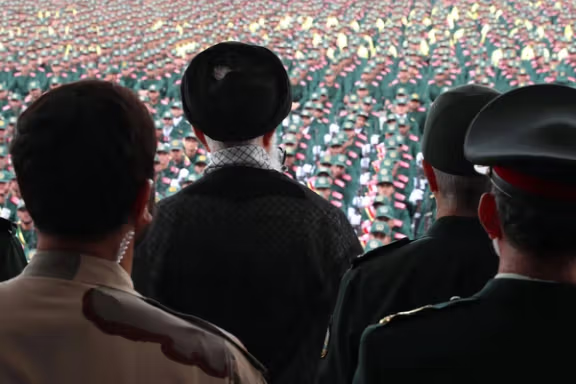
Iran's Supreme Leader Ali Khamenei along with his military commanders

Tehran on Sunday rejected a joint statement by G7 members and partners accusing Iran of assassination plots, kidnappings, and harassment of dissidents overseas.

“The allegations are sheer projection and a distortion of reality,” Iran’s foreign ministry said in a statement.

The governments behind the statement—particularly the United States, Britain, France, and Germany—were responsible for “unlawful and destabilizing conduct” in West Asia, read the statement.

G7 statement

The G7 Rapid Response Mechanism, which includes Canada, France, Germany, Italy, Japan, the United Kingdom, the United States, and the European Union, along with Australia and New Zealand, issued the statement on Friday.

“Iranian intelligence services have increasingly attempted to kill, kidnap, and harass political opponents abroad, following a disturbing and unacceptable pattern of transnational repression, and clearly undermining state sovereignty,” the group said.

“Other malign activities include operations to obtain and disclose the personal information of journalists and attacks designed to divide societies and intimidate Jewish communities.”

“We will continue to safeguard our sovereignty, keep our communities safe, and defend individuals from the overreach of foreign governments trying to silence, intimidate, harass, harm, or coerce them within our borders,” the G7 added.

Iran dismissed the accusations. “The governments involved should correct their mistaken and criminal policies instead of deflecting responsibility,” the foreign ministry said.

Iranian security institutions act “only in defense of national stability,” it added.

Examples of Iranian operations abroad

Western officials have pointed to multiple cases in recent years. In 2018, European security services foiled a plot to bomb a rally of Iranian opposition figures near Paris. In 2021, US prosecutors charged four Iranian operatives in a plot to kidnap Iranian-American activist Masih Alinejad from New York.

British authorities have also reported multiple threats against Iran International journalists and opposition groups based in the UK, prompting police protection measures.


Most Viewed

100 days after carnage: Iran economy reels from war, inflation, unemployment
1
INSIGHT

100 days after carnage: Iran economy reels from war, inflation, unemployment

2
INSIGHT

Ghalibaf defends Iran-US talks amid hardline backlash

3
INSIGHT

A nation in limbo: 100 days after the massacre, has the world moved on?

4
ANALYSIS

From instability to influence: Pakistan’s pivotal role in US-Iran diplomacy

5
ANALYSIS

100 days on: why Iran’s January protests spread across social classes

Banner
Banner

Spotlight

  • War-hit homeowners feel abandoned as Iran’s reconstruction aid fades

    War-hit homeowners feel abandoned as Iran’s reconstruction aid fades

  • 100 days on: the anatomy of Iran’s January crackdown
    INSIGHT

    100 days on: the anatomy of Iran’s January crackdown

  • Ghalibaf defends Iran-US talks amid hardline backlash
    INSIGHT

    Ghalibaf defends Iran-US talks amid hardline backlash

  • 100 days on: why Iran’s January protests spread across social classes
    ANALYSIS

    100 days on: why Iran’s January protests spread across social classes

  • From instability to influence: Pakistan’s pivotal role in US-Iran diplomacy
    ANALYSIS

    From instability to influence: Pakistan’s pivotal role in US-Iran diplomacy

  • A nation in limbo: 100 days after the massacre, has the world moved on?
    INSIGHT

    A nation in limbo: 100 days after the massacre, has the world moved on?

•
•
•

More Stories

Creative defiance keeps ‘Woman, Life, Freedom’ alive, Nobel laureate says

Sep 13, 2025, 22:42 GMT+1

Iranian people have kept the Woman, Life, Freedom movement alive through creative acts three years after its eruption, shaping society in ways that continue to unfold, Nobel Peace Prize laureate Narges Mohammadi told Iran International on Saturday.

“The movement is alive and ongoing, and its vitality is visible in society’s very fabric,” Mohammadi said in an interview marking the third anniversary of Iran’s 2022 protests that started with the death in morality police custody of Mahsa “Jina” Amini.

“When I walk in the streets, the presence of women with voluntary dress (hijab) reflects part of the transformation.”

The change has come from “the power and resistance of the people,” not from decisions of the Islamic Republic, she added.

Mohammadi said Iranian women have gained new power to shape their own lives, driving deep changes in society—some visible in daily life, others yet to be recognized or fully understood.

Grassroots change, diminished state control

The prominent activist said the movement has persisted through creative tactics and subtle acts of defiance.

“People do not need to constantly be in the streets and protests,” she said. “Society uses creative and very effective actions and reactions that demonstrate the movement’s vitality.”

“The Islamic Republic no longer has the same power even to hold official events,” she said. “The visible presence of women without hijab has often wrested the scene away from the organizers.”

Mahsa Amini’s death on 16 September 2022 sparked the protests that grew into a nationwide call for rights under the slogan Woman, Life, Freedom.

Mohammadi, repeatedly jailed for her activism, has spent more than a decade behind bars and faced sentences totaling over 36 years and 154 lashes.

Awarded the Nobel Peace Prize in 2023, she remains under medical leave from prison and continues to advocate for women’s rights and democracy.

Europeans will ‘lose it all’ if UN sanctions reinstated, Araghchi warns

Sep 13, 2025, 22:00 GMT+1

Iranian Foreign Minister Abbas Araghchi warned on Saturday that Britain, France, and Germany risk “losing everything” if they move ahead with restoring UN sanctions on Tehran through the so-called snapback mechanism.

"It is not just that the E3 has no legal, political, or moral entitlement to invoke "snapback", and that even if they did, "use or lose it" doesn't work," Araghchi said in a post on X.

"It's that the correct expression for the E3's dilemma is "use it *and* lose it". Or better yet, "use it and lose it *all*"," he said, without providing further details.

The three European powers triggered the snapback process on August 28 under Resolution 2231, demanding Iran return to talks, grant wider access to inspectors, and account for its missing uranium stockpiles.

Sanctions will be automatically reimposed within 30 days unless the Security Council votes otherwise.

Tehran has rejected the move. Speaking on state TV Thursday, Araghchi said Iran’s stockpile of enriched uranium remained intact despite Israeli and US airstrikes in June.

“Our enriched uranium is buried under the rubble of bombed nuclear facilities,” he said, marking the first official acknowledgment the material survived.

The Supreme National Security Council would decide on Iran’s response if sanctions return, he added without giving details.

The UN nuclear watchdog (IAEA) reported earlier this month that Iran’s 60% enriched uranium stockpile rose nearly eight percent before the June strikes, reaching 440.9 kilograms.

Reuters reported in June that most of the enriched uranium at Iran’s Fordow facility appeared to have been moved days before the attacks.

The United States on Wednesday urged Iran to take “immediate and concrete action” to meet its nuclear safeguards obligations, warning the IAEA board may need to act if Tehran fails to cooperate.

Charlie Kirk urged Trump in Oval Office to avoid war with Iran, Carlson says

Sep 13, 2025, 16:45 GMT+1

Slain conservative activist Charlie Kirk had privately pressed President Donald Trump in the Oval Office not to launch a war against Iran, even while donors aligned with him opposed that stance, US right-wing commentator Tucker Carlson said.

Kirk was one of the only people close to Trump who raised the risks of escalation, Carlson said at the Megyn Kelly Show on Friday.

“He went to the Oval Office and said, ‘Sir, I totally understand and think Iran’s really bad. But a war with Iran is something that could really hurt our country,’” Carlson said.

He added that Kirk showed him “intense” donor messages criticizing his position but argued he stuck to it because “he was for doing the right and wise and difficult thing.”

Kirk, founder of the conservative youth group Turning Point USA, was killed by an unknown assassin on Wednesday. He had expressed mixed views on Iran over the years.

In 2020, after the US killing of Iranian general Qassem Soleimani on Trump’s order, he warned against deeper involvement, saying: “Iran is an evil regime … Critical we remain restrained and disciplined against another endless, reckless war in the region. NO WAR with Iran!”

In the midst of Israel's 12-day war against Iran in June, and before the US airstrikes, Kirk cautioned that Iran’s size, history, and resilience made open war a dangerous prospect.

“They were a great power for a thousand years. Not even the Romans could defeat Persia,” he told Newsmax on June 20.

Yet his stance shifted when Trump ordered strikes on three Iranian nuclear sites, known as Operation Midnight Hammer. While other conservative allies questioned the wisdom of the move, Kirk applauded it.

"America stands with President Trump," he wrote on X. "President Trump has been navigating this quite well in fact, he could potentially declare victory," he added in a video testimonial posted online.

Iran parliament holds emergency session on Cairo accord with IAEA

Sep 13, 2025, 12:06 GMT+1

The Iranian parliament on Saturday convened an emergency meeting with Foreign Minister Abbas Araghchi to review the government’s new cooperation agreement with the International Atomic Energy Agency (IAEA) signed in Cairo.

"The lawmakers had questions and concerns that are legitimate and stem from their supervisory role, which they must exercise, and we also have a duty to provide answers," Araghchi told reporters after the meeting.

Lawmakers were supposed to seek explanations on how the accord, signed in Cairo on Tuesday, complies with legislation suspending cooperation with the agency after June's conflict with Israel.

"In today’s session, some of these concerns were raised, and there was consultation on how to move forward more effectively, neutralize the enemies’ tricks in political and international arenas against the people, and safeguard the country’s interests," Araghchi said.

He described the meeting with lawmakers as "very good, constructive, and scientific."

More than 60 MPs earlier backed a request for a special session with Foreign Minister Abbas Araghchi and Supreme National Security Council secretary Ali Larijani to provide clarification. The move came after parliament went into recess until September 27, prompting criticism that oversight was being avoided.

Conservative MP Hamed Yazdian, who initiated the request, said the session was needed to assess “the extent of conformity of the Cairo agreement with the law passed by parliament.”

Strong criticism of Grossi

The deal has sparked sharp reactions from hardline lawmakers. Javad Hosseini-Kia called IAEA chief Rafael Grossi “a Mossad agent” and urged that he be arrested if he enters Iran.

Another MP, Mohammadreza Mohseni-Sani, said inspectors “have no right” to enter Iran until damaged nuclear facilities are restored, warning that if UN sanctions are reimposed under the “snapback” mechanism, parliament would pursue leaving the Nuclear Non-Proliferation Treaty (NPT).

Some lawmakers, such as Ahmad Bakhshayesh, have argued Iran should no longer limit itself to peaceful nuclear activities, while others, including Mahmoud Nabavian, have branded the Cairo accord a “cursed agreement.”

By contrast, former nuclear chief Ali Akbar Salehi has described it as “positive” but cautioned that time is running out for diplomacy.

Araghchi insists the Cairo accord safeguards Iran’s interests and is consistent with the law suspending cooperation. He said it recognizes Tehran’s security concerns, guarantees Iran’s rights, and “creates no access” for inspectors at this stage.

Any monitoring, he added, would only be discussed later with approval from the Supreme National Security Council.

The debate in Tehran comes as France, Germany, and Britain have triggered the UN “snapback” mechanism, which could restore sanctions at the end of September. One of their conditions for pausing the process is renewed IAEA access, a demand the United States and European Union have also emphasized.

Australia and New Zealand voice support for Iranian women on Mahsa Amini anniversary

Sep 13, 2025, 11:49 GMT+1

Australia and New Zealand marked the third anniversary of Mahsa Amini’s death with statements to Iran International reaffirming their support for Iranian women and condemning human rights violations by the Islamic Republic.

“Australia stands with women and girls in Iran and supports their struggle for equality and empowerment,” a Department of Foreign Affairs and Trade spokesperson said on Thursday. “We remain gravely concerned by Iran’s persecution of women and girls and the use of violence to enforce mandatory hijab compliance.”

Canberra would continue pressing Tehran to uphold its human rights obligations, including accountability for “perpetrators of past and ongoing human rights violations,” the spokesperson added.

Since September 2022, Australia has sanctioned 65 individuals and entities tied to the suppression of protests that erupted after Amini’s death in police custody.

New Zealand voices concern

New Zealand’s Ministry of Foreign Affairs and Trade issued a parallel message to Iran International, expressing extreme concern over the situation inside Iran.

“New Zealand remains extremely concerned by the human rights situation in Iran, including restrictions on freedom of expression, violence and discrimination affecting women and girls, and ongoing repression of religious and ethnic minorities by Iranian authorities,” said a Ministry of Foreign Affairs and Trade spokesperson.

Wellington said it would maintain a policy of restricted engagement with Tehran and continue raising its concerns in all relevant international fora and in direct bilateral engagement.

The 22-year-old Mahsa Amini died in the custody of the morality police in September 2022. Her death sparked nationwide demonstrations under the banner Woman, Life, Freedom, met with arrests, executions, and a crackdown denounced by Western governments.