• العربية
  • فارسی
Brand
  • Iran Insight
  • Politics
  • Economy
  • Analysis
  • Special Report
  • Opinion
  • Podcast
  • Iran Insight
  • Politics
  • Economy
  • Analysis
  • Special Report
  • Opinion
  • Podcast
  • Theme
  • Language
    • العربية
    • فارسی
  • Iran Insight
  • Politics
  • Economy
  • Analysis
  • Special Report
  • Opinion
  • Podcast
All rights reserved for Volant Media UK Limited
volant media logo
ANALYSIS

Why Iran’s hopes for Chinese and Russian investment don’t add up

Dalga Khatinoglu
Dalga Khatinoglu

Oil, gas and Iran economic analyst
Sep 10, 2025, 15:58 GMT+1Updated: 01:14 GMT+0
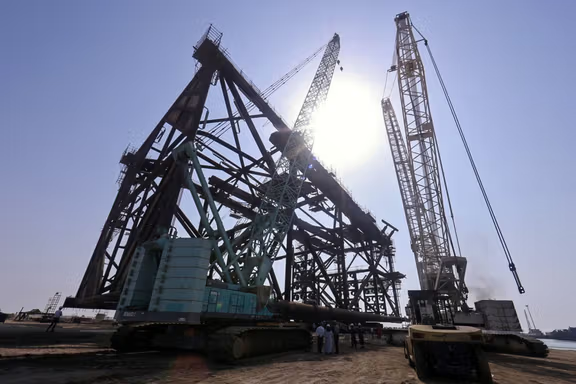
A massive new jacket is loaded to be installed on a barge at Phase 11 of South Pars in the Persian Gulf, Bushehr, Iran, August 26, 2025

Tehran’s optimism about fresh Chinese and Russian investment may be more aspirational than realistic.

Just days after returning from the Shanghai Cooperation Organization (SCO) summit—where he met senior Russian and Chinese officials—Iran’s president Masoud Pezeshkian told Supreme Leader Ali Khamenei that Moscow and Beijing had agreed to invest in Iran.

Despite such assurances, the record suggests that neither has been willing or able to channel significant capital into Iran’s struggling economy.

Iran also faces a persistent flight of domestic wealth, likely to accelerate if United Nations sanctions are reimposed in the coming weeks.

Between 2014 and 2024, the country’s capital account balance was negative $123 billion, or an average of $12 billion leaving each year, according to Central Bank data.

Pezeshkian, fresh from his high-profile trip to China, may hope to offset that outflow with allies’ money. But the numbers are not on his side.

China: reluctant partner

The last major Chinese commitment came in 2016, when state-owned CNPC signed a $600 million contract to develop Phase 11 of the South Pars gas field.

When US president Donald Trump withdrew from the nuclear deal in 2018, CNPC walked away without investing a cent.

In 2021, Tehran signed a 25-year cooperation agreement with Beijing, supposedly worth $400 billion—an average of $16 billion in annual Chinese investment.

Yet official Chinese data show that between 2021 and 2023, Chinese companies invested about one percent of that figure.

Looking further back, China’s cumulative direct investment in Iran between 2003 and 2023 totaled just $1.1 billion—around $110 million annually.

UN Trade and Development (UNCTAD) data put Iran’s net foreign direct investment (FDI) inflows during the same period at nearly $23 billion, meaning China’s share was under 5 percent.

Russia: troubled source

Iran’s hopes for Russian capital look equally shaky.

Over the past decade, Tehran has signed dozens of agreements with Russian companies such as Gazprom, but none have materialized.

Gazprom alone posted more than $21 billion in net losses between January 2023 and June 2025 amid Western sanctions over Russia's war in Ukraine and has canceled many of its foreign projects.

Russia itself is bleeding investment. According to UNCTAD, the stock of foreign direct investment in Russia fell from $522 billion in 2021 to $216 billion last year.

For the first time, China made no new investments in Russia in the first half of 2025.

Russian Central Bank data confirm this massive flight of foreign capital, alongside a parallel outflow of Russian private wealth abroad.

Taken together, these figures explain why Pezeshkian’s assurances to Khamenei likely ring hollow.

Neither Russia nor China appear to be in a position to bankroll Iran. For now, Tehran’s hopes of outside investment remain more a matter of political rhetoric than economic reality.


Most Viewed

Ghalibaf defends Iran-US talks amid hardline backlash
1
INSIGHT

Ghalibaf defends Iran-US talks amid hardline backlash

2
VOICES FROM IRAN

Bread shortages, soaring prices strain households in Iran, residents say

3
ANALYSIS

From instability to influence: Pakistan’s pivotal role in US-Iran diplomacy

4
ANALYSIS

100 days on: why Iran’s January protests spread across social classes

5

War-hit homeowners feel abandoned as Iran’s reconstruction aid fades

Banner
Banner

Spotlight

  • Iran crackdown reaches cemeteries as graves of slain protesters defaced
    EXCLUSIVE

    Iran crackdown reaches cemeteries as graves of slain protesters defaced

  • Iran diplomacy wobbles as factions compete to avoid looking soft on US
    INSIGHT

    Iran diplomacy wobbles as factions compete to avoid looking soft on US

  • The politics of pink: how Iran uses cuteness to rebrand violence
    ANALYSIS

    The politics of pink: how Iran uses cuteness to rebrand violence

  • Bread shortages, soaring prices strain households in Iran, residents say
    VOICES FROM IRAN

    Bread shortages, soaring prices strain households in Iran, residents say

  • 100 days on: the anatomy of Iran’s January crackdown
    INSIGHT

    100 days on: the anatomy of Iran’s January crackdown

  • Ghalibaf defends Iran-US talks amid hardline backlash
    INSIGHT

    Ghalibaf defends Iran-US talks amid hardline backlash

•
•
•

More Stories

Israel's Qatar strikes aim to intimidate Iran but unsettle Arab states

Sep 10, 2025, 10:50 GMT+1

Tuesday’s strike on the leadership of the Iran-backed Palestinian group Hamas in Doha aims to intimidate Tehran but also sows unease among Arab states, Israeli and American experts told Iran International.

The airstrikes on Tuesday apparently sought to assassinate Hamas's leadership and negotiating team, drawing condemnation from Qatar and its Arab neighbors.

They seemed to miss their intended targets, killing a Qatari security official and five lower-ranking Hamas personnel.

Miri Eisin, a retired colonel in the Israeli military who served in the intelligence establishment, said the attacks' upshot for Israel remains unclear, but even if unsuccessful sends a message of strength to Iran.

“This is actually something that shows Israel’s intelligence prowess. Even if the operation wasn’t successful and the leaders of Hamas left a few minutes before, we still know where they were,” she said.

“It makes everyone go ‘oh my god, Israel has amazing intelligence and operational capabilities and that threatens Iran’," Eisin added.

A 12-day surprise Israeli campaign against Iran in June battered the Islamic Republic's military and nuclear infrastructure and killed hundreds of civilians and military personnel along with several top nuclear scientists.

Israeli leaders mooted assassinating Iran's Supreme Leader Ali Khamenei but apparently made no attempt to do so, while Iran's President Massoud Pezeshkian, the parliament speaker and the judiciary chief survived an attack.

32 Israelis were killed in Iranian counterattacks, even as Israeli attacks on Iranian air defenses appeared to give Israeli planes free reins in enemy skies.

“They see that we have Qatar, and anywhere in Iran," Eisin said. "That’s very threatening and has an intimidating effect on Tehran. However, it also intimidates a lot of our other allies like the UAE and Bahrain.”

Those two Persian Gulf states had opened formal relations with Israel in the so-called Abraham Accords in 2020, but both condemned the attacks.

Qatar’s Emir Sheikh Tamim bin Hamad Al Thani condemned what he called a “reckless criminal attack” in a phone call with US President Donald Trump according to an official readout, adding it was “a flagrant violation of its sovereignty and security."

Trump told reporters he was "very unhappy about it, very unhappy about every aspect."

'Loose cannon'

Former Israeli military intelligence chief, Danny Citronowicz, said the move may bring diplomatic fallout and that Iran may now seek to exploit the strikes to drive a wedge between the Persian Gulf powers and Israel.

“It makes Israel seem like a loose cannon so it’s something Israel must take into consideration,” Citronowicz said. “The possible risk of spillover will worry the UAE and Saudi Arabia. Iran will now be able to pressure these countries with connections to Israel and exploit this to push their own agenda.”

Saudi Arabia is widely seen as the an ultimate diplomatic prize for Israel's drive to normalize its relations with regional powers. The world's top oil exporter is weary of Iran's regional policies but has said it will not recognize Israel until a Palestinian state is established.

Benham Ben Taleblu, an Iran expert at the US think tank the Foundation for the Defense of Democracies (FDD), told Iran International that the strikes conveyed that Israel is prepared to carry out assassinations despite diplomatic risks.

"Israel’s strike against Hamas leaders in Doha is yet another sign to the Islamic Republic and its Axis of Resistance that its terrorist leaders will not be be safe hiding in plain sight," he said.

However, the Iranian-American director of FDD"s Iran program said Iran will capitalize on the Doha attack for its political gains.

"Tehran is trying to spin the attack as a growing ring of Israeli aggression and part of quest for hegemony, which is quite rich for a regime which just orchestrated a multi-front war against Israel," he added.

US says Iran’s new tax law adds to people's financial woes

Sep 9, 2025, 18:54 GMT+1

The US State Department, in a rare comment on Iran’s domestic financial policy, criticized a new law imposing capital gains taxes on real estate, vehicles, foreign currency, precious metals and cryptocurrencies, saying it would add to citizens’ hardships.

“By taxing the very assets people depend on for financial stability, the regime’s policies place an even greater burden on them,” it said in a statement posted on its Persian-language account on X Tuesday.

It said this decision "clearly demonstrates the regime’s disregard for the welfare of its citizens."

"Years of economic mismanagement and corruption have severely devalued Iran’s currency and forced many Iranians to rely on these assets as a hedge against inflation," the statement added.

The criticism comes as Iran introduced a new law making inflation partly taxable.

Iran’s President Masoud Pezeshkian formally signed the tax bill last month, after it was passed by parliament in late June.

The law targets capital gains on real estate, vehicles, gold, jewelry, silver, platinum, foreign currency and even cryptocurrencies. However, the law imposes tax not only on capital gains but also on half of the inflation-driven increases to asset prices.

Iran faces one of the highest inflation rates in the region. According to the International Monetary Fund's estimates, the annual inflation rate has averaged above 42% since 2020.

Since 2021, when the late-president Ebrahim Raisi took to power, the Iranian government’s tax revenues increased by over 300%.

Experts say inflation is one reason behind the increase in taxes, but argue that even after adjusting for inflation, the government should have raised taxation by at most 160%, not 326%.

Why Iran's rulers fear change more than war

Sep 9, 2025, 15:58 GMT+1
•
Ata Mohamed Tabriz

Facing a grinding crisis and mounting calls at home to change course before disaster strikes, Iran’s rulers still speak in a language that suggests they prefer the risks of war to the uncertainties of reform.

Supreme Leader Ali Khamenei on Sunday warned of an enemy plot to impose a harmful “no war, no peace” stalemate on Iran.

He alluded to the widespread fears of renewed conflict but stopped short of addressing them directly.

The “dangerous” limbo—as he called it—will be broken either by peace or by war. Yet peace would require a dramatic shift he has rejected in both word and deed, leaving only one option, even if not stated openly.

Why war seems manageable

For Tehran, war offers a chance to present itself as a power “standing firm against the enemy.”

That narrative rests on two premises: exaggerating the damage inflicted on Israel while recasting Iran’s own losses as “sacrifice” and “resilience.” This ability to redefine reality makes war appear containable, even when the battlefield balance tilts against Iran.

Conflict also strengthens institutions like the Revolutionary Guards and Basij, which dominate not only security but much of Iran’s economy and politics.

External crises bring them bigger budgets, wider powers, and a firmer grip on the state. Sustained tension, even without outright war, keeps them central to decision-making.

Bureaucratically, war simplifies governance.

An external threat sidelines factional disputes, concentrates power in one command center, and allows sensitive decisions to be postponed. In such conditions, obedience to central authority becomes the overriding principle.

Why change is riskier

Unlike war, which has a clear adversary and defined parameters, internal change is unpredictable.

The leadership knows genuine reform could set off a chain of fresh demands that quickly spiral out of control—especially when combined with external pressure. For a system built on concentrated power and tight social control, this is far riskier than conflict it believes it can at least spin through propaganda.

History reinforces this fear.

The Soviet collapse is interpreted in Tehran as the direct result of political liberalization. At home, the reform movement of the 1990s triggered demands that Khamenei deemed intolerable, ending in repression.

These experiences mean even cautious proposals—from economists or technocrats—are viewed as existential threats.

The IRGC and other power centers oppose change not only for security reasons but because their vast economic interests are at stake. Reform would mean redistribution of both power and wealth, making them natural adversaries of any shift.

A managed crisis—or a trap?

From Tehran’s perspective, war is “manageable”: it mobilizes security and propaganda, strengthens key institutions, and produces a narrative of defiance. Change, by contrast, has no clear enemy, no obvious tools of control, and no reliable endpoint.

Yet relying on crisis as a survival strategy carries its own risks.

Each confrontation further depletes Iran’s economic and social capacity. Emigration, a shrinking middle class, and crumbling infrastructure all show that the politics of permanent crisis may deliver short-term cohesion but erodes long-term survival.

The essential question is how long a state can balance on the edge of crisis before that very crisis slips out of control.

The answer is uncertain. What is clear is that the Islamic Republic still believes change, not war, is the greater danger to its survival.

Calls for Larijani to lead nuclear talks may signal push for rethink

Sep 9, 2025, 00:30 GMT+1
•
Behrouz Turani

A proposal to return control of Iran’s nuclear negotiations to the Supreme National Security Council (SNSC) has highlighted the growing influence of its new chief, Ali Larijani—and a potential readjustment of Tehran’s negotiation strategy as UN sanctions loom.

Supporters of the move argue that only the SNSC can bring coherence to policymaking, uniting rival political factions in a way the Foreign Ministry cannot.

That case was made most clearly in a rare joint commentary by moderate journalist Mohammad Ghoochani and conservative commentator Mohammad Mohajeri, published September 7 in the centrist daily Ham Mihan.

“(The council) is the only body capable of coordinating between the military, diplomats, revolutionaries, reformist and conservative politicians, the President and the Supreme Leader, or indeed between the government and the people,” they wrote.

Notably, they criticized the continued involvement of former SNSC secretary Ali Shamkhani in the nuclear talks and dismissed the idea of handing the file to Foreign Minister Abbas Araghchi, arguing that Iran could no longer afford the stagnation of recent years.

A day after the joint editorial, Iran’s former ambassador to Germany, Alireza Sheikh Attar, told the conservative daily Farhikhtegan that Larijani had been appointed on September 5 to oversee Iran’s entire nuclear dossier.

If confirmed, Larijani would once more take center stage in tough negotiations in the weeks ahead.

Regroup or rethink?

Although final authority rests with Khamenei, the emphasis on the Council’s coordinating role by Ghoochani and Mohajeri may point to Larijani’s potential to nudge the Leader toward a definitive decision on engagement with Washington.

Khamenei appeared to be abandoning his “neither war nor talks” line in his meeting with President Masoud Pezeshkian and his cabinet. The state of “no war, no peace,” he said, was “the enemies’ plan” and harmed the country.

Hints of movement are already emerging.

Conservative diplomat Alireza Sheikh Attar suggested on Monday that decisions have been made about resuming talks with the United States, possibly coupled with a request to delay activation of the snapback mechanism until negotiations yield results.

Whether these shifts mark a genuine rethink or simply a bureaucratic reshuffle remains uncertain.

Council on the rise?

The proposal by the two prominent editors also reflects frustration at the Council’s long decline.

Created in 1990 amid post-war turmoil, the SNSC was designed as a mechanism for cohesion, tasked with protecting national interests and reconciling state institutions with public needs.

Its first secretary, Hassan Rouhani, held the post for 16 years and was credited with pragmatism, particularly in preventing new wars.

The nuclear dossier was assigned to the Council in the early 2000s, but under president Mahmoud Ahmadinejad control shifted to the foreign ministry—and effectively to Ahmadinejad himself, whose chaotic management eventually forced Khamenei to open backchannels of his own.

Larijani’s return has been welcomed by moderates as a potential revival of rational governance, though his occasional firebrand remarks—such as threats against IAEA chief Rafael Grossi—have raised doubts.

Larijani may bring new energy to the Council. The question is whether he can direct diplomacy in ways others could not or his ascent merely repackages decisions that still flow from the top.

Iranian farmer hangs himself in public over economic woes, rights group says

Sep 8, 2025, 16:17 GMT+1

A farmer hanged himself on Monday outside the local agriculture department headquarters in Kahnuj in southeastern Iran in protest over mounting economic pressures, local rights group Haalvsh reported.

The farmer was identified as Reza Qalandari, a resident of Langabad village in Kahnuj, Kerman province.

"He had come under severe pressure due to his inability to pay the fine for renewing his agricultural motor permit and the denial of his fuel quota by the agriculture department," Haalvsh reported, citing an unnamed source.

The report added that his death shocked locals, with many describing it as a symbol of the authorities’ failure to address the struggles of farmers from the ethnic Baluch minority from which he hailed.

Iran is currently grappling with water shortages and widespread power outages amid high summer temperatures, while also dealing with recovery efforts following a 12-day war with Israel and its aftermath.

Sanctions, corruption and economic mismanagement have contributed to widespread economic hardship and market instability as Iran's currency the rial has lost over 90% of its value since US sanctions were reimposed in 2018.

A poll by Iran's leading economic newspaper Donya-ye Eqtesad last month showed that a vast majority of Iranians are dissatisfied with the government's economic policies, as costs of living soar and the value of the Iranian currency slips.

Specialist doctor dies by suicide

On the same day in Saravan, Sistan and Baluchestan province, Dr. Akram Shiri, an internal medicine specialist at Iranmehr Hospital, was found dead in her dormitory after taking medication, Haalvsh reported, marking the second suicide reported in southeastern Iran on Monday.

"The doctor’s body was found around 12:00 noon in the hospital dormitory. Reports indicate she went into cardiac arrest after taking medication and lost her life," Haalvsh reported, citing an unnamed source.

Her death is the latest in a series of suicides among Saravan medical staff over difficult working conditions, the report added.

In 2023, two emergency physicians, Dr. Fatemeh Rezaeipour and Dr. Mehran Khosravanian, also died by suicide within a month, and in April this year a Baloch nurse at Iranmehr Hospital took his own life.

Haalvsh's report said that their colleagues blame heavy workloads and punishing conditions for the repeated tragedies.

Experts have attributed the increased suicides in Iran to the systemic reluctance and neglect of Iranian authorities to address workers' conditions.

Last year, The Iranian Psychiatric Scientific Association highlighted an increase in suicides among medical professionals, saying that 16 medical residents took their own lives the previous year.