Visiting lecturer, Paris School of International Affairs (PSIA)
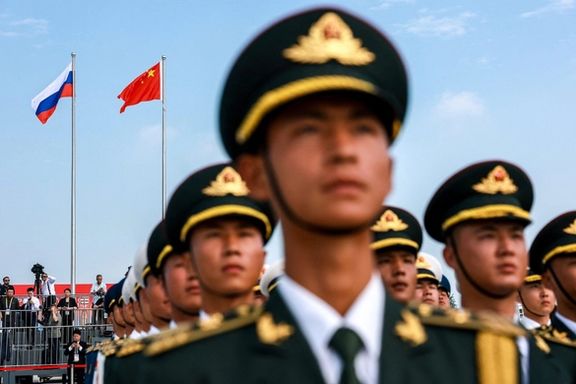
Chinese guards of honour take part in a ceremony to welcome Russian President Vladimir Putin, who arrives at an airport to attend the Shanghai Cooperation Organisation (SCO) summit in Tianjin, China August 31, 2025.
Tehran’s sharpening nuclear clash with the West and embrace of Beijing and Moscow have brought it to a crossroads, where choices this month may decide the future of Iran’s rulers and the ruled.
The formal start of the UN “snapback” process to restore sanctions, the latest critical report by the International Atomic Energy Agency (IAEA), and President Masoud Pezeshkian’s high-visibility diplomacy at the Shanghai Cooperation Organization (SCO) summit together mark a decisive moment for Tehran.
The most immediate challenge is the likely restoration of UN snapback sanctions before 28 September.
European governments argue the trigger is Iran’s sustained non-compliance with key limits in the 2015 Joint Comprehensive Plan of Action (JCPOA) over the past six years. Tehran rejects that position, insisting the E3 forfeited standing by failing to deliver promised economic normalization after Washington’s 2018 withdrawal.
Whatever the legal briefs, reinstated measures would effectively return Iran to a Chapter VII-related sanctions framework, with all the familiar consequences: renewed constraints on arms transfers, reinforced financial isolation, and fresh layers of economic restrictions that have already strained household incomes and the broader investment climate.
Scrutiny intensifies
New IAEA findings have sharpened scrutiny of Iran’s program.
The agency signaled fresh shortfalls in cooperation, pointing to unexplained inventories of enriched uranium at levels exceeding JCPOA caps.
International Atomic Energy Agency (IAEA) Director General Rafael Grossi visits Iran's nuclear achievements exhibition, in Tehran, Iran, April 17, 2025.
A confidential tally circulated to member states indicated Iran holds about 441 kilograms of uranium enriched to 20% or higher – enough, by the agency’s rule of thumb, to yield material for around ten nuclear devices if further refined.
Director General Rafael Grossi has said there is no sign of diversion, but emphasized the need for verification and timely documentation – something Iranian officials have yet to provide.
Rather than escalate immediately, the Secretariat has kept contacts open in hopes of restoring routine access. Two reports to the IAEA’s 35-nation Board of Governors underline the urgency: inspections must resume “without delay,” and the buildup of highly enriched stocks remains a “serious concern.”
Eastward turn accelerates
It is against this tightening sanctions and verification backdrop that President Pezeshkian’s China tour looms large.
Over a week of meetings – most prominently with Xi Jinping in Beijing and Vladimir Putin in Tianjin – Tehran sought to translate a long-advertised “Look East” doctrine into concrete political and economic ballast.
Iranian officials pressed for more than sympathetic rhetoric: Moscow and Beijing are backing Iran’s claim that snapback is legally void but, crucially, Tehran hopes they avoid implementing any reimposed UN measures.
For China and Russia, the ask is non-trivial. Skirting U.S. and European unilateral sanctions is one thing; openly discounting UN obligations is another, with implications for their global positioning.
Russian President Vladimir Putin and Iranian President Masoud Pezeshkian attend a ceremony to sign an agreement of comprehensive strategic partnership between the two countries, at the Kremlin in Moscow, Russia January 17, 2025
Still, Pezeshkian delivered a message calibrated for both audiences at once.
He reaffirmed Iran as a “reliable friend” to China, echoing Supreme Leader Ali Khamenei’s priority on eastern partnerships. He also stressed Tehran’s readiness to operationalize the 25-year agreement with Beijing across energy, infrastructure, and technology.
The session with Putin amplified the signal: in Tehran’s view, China and Russia are no longer transactional partners of convenience, but strategic anchors to confront Western pressures.
Roadblocks remain
The SCO summit in Tianjin provided the showcase for this reorientation. Now a full member, Iran leaned into the organization’s language of sovereignty, non-interference, and resistance to unilateralism.
Yet the question of deliverables hangs over the pageantry.
Iran’s earlier eastward experiments, notably under Mahmoud Ahmadinejad, yielded less than the rhetoric promised. Banking bottlenecks, compliance risks for major companies, and the gravitational pull of Western markets on Chinese firms limited follow-through.
Whether today’s geopolitical alignment—and the higher stakes of great-power competition—change those cost-benefit calculations is the live test.
For Tehran, success will be measured not in communiqués but in sustained energy sales, credible financing channels, technology transfers, and visible progress on infrastructure that can withstand sanctions headwinds.
Iran's supreme leader Ali Khamenei meets top officials including president Masoud Pezeshkian and judiciary chief Gholamhossein Mohseni Ejei
Future hangs in balance
Inside Iran, the “Look East” pivot has sparked an energetic debate.
Hardline outlets herald the emergence of an “Eastern front” that validates decades of resistance to Western dominance. But reformist and moderate voices warn that the country risks swapping one form of dependence for another.
Their critique is less civilizational and more structural: if Iran becomes overly reliant on Moscow and Beijing for markets, capital, and diplomatic cover, it could re-create the asymmetries of influence that the 1979 Revolution sought to overturn.
In this reading, the pivot is a pragmatic hedge, but also a bargain that may constrain policy autonomy over time.
The central uncertainty is whether the “Look East” approach can move beyond symbolism and episodic deals to furnish the durable economic and technological lifelines Iran needs.
If it can, Tehran may blunt the effect of renewed UN measures and stabilize growth on an alternative platform. If it cannot, the pivot risks devolving into a slogan that masks deepening isolation and narrowing options.
As September advances toward the snapback deadline, Tehran stands at a genuine crossroads.
Choices made now – on access for inspectors, on the pace and level of enrichment, on the specificity of commitments with China and Russia – will shape not only Iran’s nuclear trajectory and economic survival, but also the character of its grand strategy for the remainder of Khamenei’s tenure.
International Atomic Energy Agency (IAEA) logo and Iranian flag is seen in this illustration taken June 16, 2025.
A new round of talks between an Iranian delegation and the International Atomic Energy Agency will be held in Vienna on Friday, Iran’s ambassador to international organizations in the city said, according to state media.
Reza Najafi said the negotiations continue consultations on defining cooperation “within the framework of parliament’s law under new conditions.” He added the talks will determine “a new form of cooperation between Iran and the IAEA.”
Following Israeli and US military strikes on Iran in June, parliament passed a bill suspending cooperation with the IAEA and imposing new restrictions on inspections. Any arrangement for renewed access must now be approved by Iran’s Supreme National Security Council, and no agreement for inspections or resumption of the IAEA’s broader work has yet been reached.
On Thursday, Foreign Minister Abbas Araghchi met EU foreign policy chief Kaja Kallas in Doha. Araghchi said the European move to restore UN sanctions was “illegal and unjustifiable” and stressed that Tehran expects the EU “to play its role in fulfilling its responsibilities to neutralize moves against diplomacy.”
The two sides agreed to continue consultations in the coming days and weeks.
IAEA warns on uranium stockpile
The International Atomic Energy Agency said this week that Iran’s inventory of uranium enriched to 60% remains “a matter of serious concern” because inspectors lost visibility after the June war.
In a confidential report seen by reporters, the agency said Iran had 440.9 kilograms of 60% enriched uranium as of June 13, an increase of more than 30 kilograms since May. That material is only a short step from weapons-grade levels. The total stockpile stood at nearly 9,875 kilograms.
The report also confirmed that two inspectors mistakenly took documents from the Fordow site back to Vienna, which the agency called an “error” but not a security breach. Tehran subsequently barred them from returning.
Grossi urges quick progress
IAEA chief Rafael Grossi told Reuters that another round of talks with Iran would take place in Vienna this week and said the issue “cannot drag on for months.”
“It would be ideal to reach an agreement before next week,” Grossi said, stressing the need to verify that Iran’s highly enriched uranium remains under control. “I believe there is a general understanding that the material is likely still there, but it must be verified.”
Grossi added: “We have reminded our Iranian counterparts that domestic laws create obligations for Iran, not the IAEA.”
Limited access after war
Since the June conflict, inspectors have only been allowed into the Bushehr nuclear power plant, where they observed a fuel replacement in late August. Bushehr operates with Russian assistance and was not struck during the war.
Iran’s atomic energy chief Mohammad Eslami confirmed that inspectors entered the country with authorization from the Supreme National Security Council. He accused the IAEA leadership of acting under Western pressure, saying, “Our enemies always find excuses to pressure the Iranian nation.”
Snapback sanctions in play
The European powers Britain, France and Germany triggered the UN “snapback” mechanism on August 28, seeking to restore sanctions lifted under the 2015 nuclear deal. They demanded that Iran return to talks, grant inspectors wider access, and account for its uranium stockpile.
The snapback mechanism, created under Resolution 2231, automatically restores sanctions after 30 days unless the UN Security Council votes otherwise. The provision expires in October.
Tehran has rejected the step, with officials warning that Iran could even withdraw from the Nuclear Non-Proliferation Treaty if pressure mounts further.
Tehran’s approach to diplomacy may be best summed up by a Persian phrase: refusing with one hand and accepting with the other. But does the moribund economy show that the equivocating strategy has finally run out of road?
Britain, France and Germany last week triggered the so-called snapback mechanism which is due to reinstate UN sanctions by month's end, sending Iran’s fragile economy into a tailspin.
Iran’s currency, the rial, now trades at more than one million to the dollar, having lost nearly a third of its value since Donald Trump won the US presidential election last November.
Even the country’s private sector has sounded the alarm, but fast regretted it.
The Iran Chamber of Commerce—an institution run by business elites under heavy state oversight—published a report warning that UN snapback sanctions could spark a “deep crisis,” with inflation hitting 90 percent and GDP shrinking by three percent.
The report was swiftly deleted. Tasnim News, tied to the Revolutionary Guards (IRGC), blasted it as “dangerous and inflammatory,” saying it could fuel panic and speculative inflation.
Within hours, IRGC intelligence officers raided the Chamber, interrogated staff, and pressured the board into silence. It was yet another display of the regime’s instinct: shoot the messenger.
Official bravado
Government officials have chosen defiance over honesty.
Deputy Foreign Minister for Economic Diplomacy Hamid Qanbari declared that Iran’s “economy is so big and self-sufficient that it will not break under sanctions.”
Oil Minister Mohsen Paknejad admitted snapback could tighten restrictions on oil exports but boasted that “our hands are not tied.”
The message is meant for domestic consumption, but Iranians have heard it before: decades of promises that sanctions are survivable, even beneficial. Few believe it now.
Rial’s dead cat bounce
The rial’s collapse has not been a straight line.
On March 24 it hit a historic low of nearly 1.1 million to the dollar. But in April, as Tehran and Washington engaged in Oman-mediated nuclear talks, the currency clawed back 31 percent.
Officials convinced themselves they could entice the Trump administration into a deal that would preserve Iran’s nuclear leverage, maintain funding for regional proxies, and leave intact its growing missile and drone programs.
But surprise Israeli strikes on June 12 torpedoed the talks, upended markets and erased the rial’s temporary gains, initiating the next slide.
An economy in ruins
Iran’s economic woes go beyond currency freefall. Inflation and joblessness are grinding daily life, while water shortages, blackouts and environmental crises repeatedly halt basic activity.
Public anger simmers but has not so far erupted.
Meanwhile, Tehran’s military capacity has been gutted. Missile stockpiles are depleted, air defenses degraded, and armed allies from Gaza to Lebanon weakened by repeated blows. Once a symbol of strength, Iran’s arsenal is now a reminder of vulnerability.
And yet, the clerical establishment shows no sign of recalibrating.
Faced with looming UN sanctions, domestic crisis and international isolation, it clings to the illusion that a mix of propaganda, repression and tactical stalling can buy survival.
Talk therapy as diplomacy
For years, Tehran has treated negotiations less as a path to resolution than as a pressure valve—a way to appear engaged, delay enforcement and test the patience of counterparts.
That strategy may have worked when the global community was divided or distracted. It no longer does.
The snapback mechanism is proof: Europe has abandoned its posture of indulgence, siding with Washington in reimposing penalties.
Iran’s rulers now face the consequences of years spent refusing with one hand and pretending to accept with the other.
For ordinary Iranians, the result is an ever-shrinking future: savings vaporized, wages worthless and hope steadily eroded.
Tehran remains content to offer the world more of the same—talk therapy instead of genuine negotiation, illusion instead of strategy—while hoping for divine intervention.
Iran’s Deputy Foreign Minister Saeed Khatibzadeh has denied reports quoting him as saying the likelihood of fresh conflict with Israel was “very high,” the ISNA news agency reported on Friday.
Some outlets, including IRGC-affiliated Tasnim, had cited Khatibzadeh as making the remark during a visit to Baghdad. He told ISNA he did not use that phrasing in his interview.
Khatibzadeh said Israel “has violated all norms and international laws for two years” and that Iran’s response to recent attacks had been “painful.”
He added that the fighting “changed realities on the ground, particularly on the nuclear issue, and the International Atomic Energy Agency was unable to protect Iranian facilities.”
The June conflict began with a surprise Israeli strike on Iranian military and nuclear sites on June 13. Tehran said 1,062 people were killed, including 786 military personnel and 276 civilians. Israel said it killed more than 30 senior Iranian security officials and 11 nuclear scientists. Iran retaliated with missile strikes that killed 31 civilians and one off-duty Israeli soldier.
Khatibzadeh said Iran could target “any location” in Israel during the war and accused Tel Aviv of relying on “terror and media manipulation.”
Iran vows escalation if war returns
Parliament Speaker Mohammad Bagher Ghalibaf said last month that Iran would abandon restraint if another war erupts. “In the next possible war, our restraint will end. New geographic areas and targets will be added to our response,” he told lawmakers. He warned that the conflict could also expand “into economic and political arenas.”
Ghalibaf said Iran’s armed forces had addressed weaknesses exposed in June and pointed to naval missile drills as a signal meant to prevent “enemy miscalculation.”
Israeli voices call for striking Iran’s leadership
In Israel, former defense minister Yoav Gallant said the country must prepare for another round and ensure that Supreme Leader Ali Khamenei is killed if fighting resumes. “Although Khamenei was not eliminated in this round, his elimination must be part of any plan of the State of Israel if a campaign against us is launched,” Gallant told Channel 12.
Gallant said Iran will rebuild some of its strength, particularly its missile arsenal, and warned Israel must be ready for a different war.
Israeli Prime Minister Benjamin Netanyahu and US President Donald Trump also mooted killing Khamenei at the height of the June conflict, and Trump hinted at favoring regime change in Tehran.
The United Nations flag is seen at UN headquarters in New York City, New York, US.
The United States is considering new restrictions on foreign delegations attending this month’s UN General Assembly, including measures that would further limit the movements of Iranian diplomats in New York, the Associated Press reported on Friday.
One proposal would prevent Iranian officials from shopping at wholesale clubs such as Costco and Sam’s Club without State Department permission. The AP said such stores have long been favored by Iranian diplomats, who buy large quantities of goods unavailable in Iran and send them home.
Three years ago, footage of then-President Ebrahim Raisi’s delegation in New York drew wide attention on social media, showing aides loading piles of goods with US retail labels into a truck outside their hotel.
The internal memo seen by AP also outlined possible curbs on delegations from Sudan, Zimbabwe and Brazil.
The report follows the Trump administration’s decision to revoke visas for Palestinian President Mahmoud Abbas and more than 80 officials, blocking them from the UN meeting. Palestinian diplomats accredited to the UN mission were allowed to remain.
Security review for Iran
The State Department said last week that visas for Iran’s UNGA delegation are subject to a security review. In response to a query from Iran International, a spokesman said Washington “will not waver in upholding American law and the highest standards of national security and public safety in the conduct of our visa process.”
The spokesman added that ensuring foreign visitors pose no threat to US national security “remains a paramount priority.” The Department declined to say whether Iranian officials will be issued visas this year, citing visa confidentiality rules.
The decision to admit President Masoud Pezeshkian and his delegation last year drew criticism from Iranian diaspora groups and activists, despite their movements being restricted to a few blocks around the UN headquarters.
In 2019, then-Foreign Minister Mohammad Javad Zarif was granted a visa under similar limits. The US has also refused visas in past years, including to Iran’s 2014 UN ambassador nominee over his role in the 1979 embassy takeover.
Syria waiver highlights contrast
The AP memo said the Trump administration last week lifted long-standing travel restrictions on Syria’s delegation to the UN. The move followed the ouster of President Bashar Assad last year and Washington’s effort to integrate Damascus into the Middle East.
Mourners chant at the funeral of IRGC commanders killed by Israel during the 12-day war, Tehran, Iran, June 28, 2025
The postwar debate over Israeli infiltration of Iran’s security and political system has added another layer to contentions in Tehran, with warnings and accusations directed at some hard-liners and radical insiders.
Concerns have intensified as politicians on both sides beat the drums of a possible new war following the activation of the trigger mechanism by European powers which could reimpose international sanctions by month's end.
"Infiltration of Iran’s security organizations cannot be ignored,” former lawmaker Mohammad Ali Pourmokhtar told Khabar Online on Wednesday. “It has now become clear that infiltrating agents were involved in some of the attacks on military establishments."
He stressed that infiltrators often operate from within: "They gain trust by posing as insiders, allowing them to advance their agendas … (they) often disguise themselves as true believers in the system, and sometimes as radicals."
Revolutionary Guards commander and former MP Mansour Haghighatpour echoed the sentiment. "The people should be vigilant and suspicious of those who race ahead of the revolution and chant radical slogans," he said on Wednesday.
His remark, a rare swipe at hardliners who cloak themselves in revolutionary zeal, underscored how the infiltration debate is feeding into wider factional infighting.
No official explanation
Despite such warnings, no major counter-intelligence breakthroughs have been reported beyond the swift execution of a nuclear scientist accused of betraying slain colleagues to Israel.
Instead, blame has shifted to Afghan refugees, social media vulnerabilities and figures within the intelligence community, adding more confusion than clarity.
Family members of some slain commanders said the victims did not use smartphones or social media—though it later emerged that some of their bodyguards did.
What has most stunned officials is the depth of Israel’s penetration.
Drones used in the assassinations were reportedly built or assembled inside Iran by Israeli agents, who vanished without a trace after their mission.
One reason Supreme Leader Khamenei has avoided public appearances and even meetings with insiders is his likely deep mistrust of suspected infiltrators in the security apparatus.
Pourmokhtar warned that infiltration can reach the very top: "Sometimes infiltrators operate in the deeper layers of government, figures unknown to the public, yet capable of influencing top-level decisions."
‘In whose interest?’
Last week, security chief Ali Larijani acknowledged the problem as a “serious matter,” adding that Iran “had painful weaknesses" in the war with Israel.
The debate has also spilled into parliament, where critics have accused hardliners of damaging national security by advancing extreme policies, citing a recent urgent move to pull Iran from the nuclear Non-Proliferation Treaty.
Lawmaker Ahmad Bakhshayesh Ardestani admitted: "The triple-urgency bill to exit the NPT was a gift to Trump." Abbas Goudarzi, spokesperson for the presidium, added: "Withdrawing from the NPT is a matter of governance, and the Majles cannot decide on it independently."
Reformist outlet Fararu went further, accusing parliament’s National Security and Foreign Relations Committee of driving confrontational policies.
It pointed to the committee’s push to raise enrichment levels, promote aggressive rhetoric, and even table a motion to withdraw from the Non-Proliferation Treaty—moves it said are justified as bargaining tools but fail to deter war.
"Does the committee act to ensure national security," it asked, "or does it work against it?"