• العربية
  • فارسی
Brand
  • Iran Insight
  • Politics
  • Economy
  • Analysis
  • Special Report
  • Opinion
  • Podcast
  • Iran Insight
  • Politics
  • Economy
  • Analysis
  • Special Report
  • Opinion
  • Podcast
  • Theme
  • Language
    • العربية
    • فارسی
  • Iran Insight
  • Politics
  • Economy
  • Analysis
  • Special Report
  • Opinion
  • Podcast
All rights reserved for Volant Media UK Limited
volant media logo

Iran’s president moots slashing budget for lackluster agencies
Sep 4, 2025, 19:36 GMT+1Updated: 01:37 GMT+0
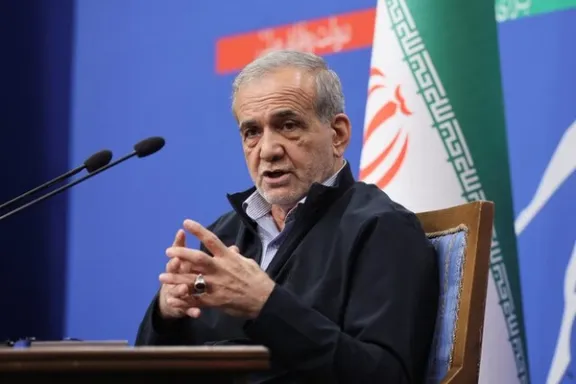
Iran's President Masoud Pezeshkian attends a press conference in Tehran, Iran, September 16, 2024

Iranian President Masoud Pezeshkian on Thursday criticized the lack of a merit-based system in public management and threatened to cut the budgets of underperforming government bodies.

His comments appeared aimed at addressing widespread frustration with rising costs of living and other woes set to deepen if European powers succeed in triggering international sanctions on Iran due at the end of the month.

Speaking at a meeting with the board of Iran’s Academy of Medical Sciences, Pezeshkian raised concerns over the management of resources in healthcare and other public services.

“Why should the country’s resources be handed over without reason to institutions and bodies that have no benefit or usefulness? If we correct this situation, we will have no problem in securing resources,” state media cited Pezeshkian as saying.

Pezeshkian, a cardiac surgeon by profession, argued that a merit-based system should be introduced in governance, adding that bureaucrats in the capital should not get complacent.

“Many protests stem from the fact that individuals and groups have not received their fair share, and parts of society feel their rights have not been fulfilled. Meanwhile, a few in the capital, imagining themselves to be all-knowing, make decisions for everyone,” he said.

“If appointments were made on the basis of merit and justice, all people would step forward with a sense of responsibility,” he added.

Iran is currently grappling with energy shortages, struggling to provide water and electricity nationwide.

A recent study of hospital managers, conducted this year, highlighted structural problems in public sector management that may reflect broader governance issues.

“Managers at senior, mid-level, and frontline levels lack adequate training in core management competencies, such as strategic planning, resource management, and leadership skills,” the study found.

Using the Management Competency Assessment Partnership (MCAP) tool, the survey covered managers at 162 public hospitals across 19 provinces.

While focused on healthcare, the findings point to systemic shortcomings across the public sector, including outdated recruitment practices and limited investment in professional management training.

“When an organization produces no output, why should it receive money from the taxpayers and treasury? The people should not have to pay the price for the incompetence of managers,” Pezeshkian said.

“One of our problems is that we view everything politically and, instead of solving issues, everyone seeks to change people,” he added.

Iran ranks among the most corrupt countries globally, scoring 23 out of 100 and placing 151st of 180 countries in the 2024 Corruption Perceptions Index (CPI) by Transparency International.

Former Iranian president Hassan Rouhani on Wednesday called for the exit of intelligence and security forces from the economy on Wednesday in a rare sweeping call for reform by a former key player in Tehran's political and security establishment.


Most Viewed

Ghalibaf defends Iran-US talks amid hardline backlash
1
INSIGHT

Ghalibaf defends Iran-US talks amid hardline backlash

2
ANALYSIS

From instability to influence: Pakistan’s pivotal role in US-Iran diplomacy

3
ANALYSIS

100 days on: why Iran’s January protests spread across social classes

4

War-hit homeowners feel abandoned as Iran’s reconstruction aid fades

5

Iran says no decision yet on talks as Pakistan prepares to host US team

Banner
Banner

Spotlight

  • Iran diplomacy wobbles as factions compete to avoid looking soft on US
    INSIGHT

    Iran diplomacy wobbles as factions compete to avoid looking soft on US

  • The politics of pink: how Iran uses cuteness to rebrand violence
    ANALYSIS

    The politics of pink: how Iran uses cuteness to rebrand violence

  • Bread shortages, soaring prices strain households in Iran, residents say
    VOICES FROM IRAN

    Bread shortages, soaring prices strain households in Iran, residents say

  • 100 days on: the anatomy of Iran’s January crackdown
    INSIGHT

    100 days on: the anatomy of Iran’s January crackdown

  • Ghalibaf defends Iran-US talks amid hardline backlash
    INSIGHT

    Ghalibaf defends Iran-US talks amid hardline backlash

  • From instability to influence: Pakistan’s pivotal role in US-Iran diplomacy
    ANALYSIS

    From instability to influence: Pakistan’s pivotal role in US-Iran diplomacy

•
•
•

More Stories

UK government pledges to thwart Iranian threats on its soil

Sep 4, 2025, 17:26 GMT+1

The British government on Thursday said it was determined to frustrate what it called escalating Iranian threats to people on UK soil, citing cyberattacks and the use of criminal proxies to carry out attacks.

"The Government has long recognised there is a persistent and growing physical threat to people posed by Iran to the UK. Direct action against UK targets has substantially increased over recent years," the government wrote.

The report came in the form of point-by-point responses to a July 10 Parliamentary Intelligence and Security Committee on Iran which said Iran poses one of the gravest state-based threats to British national security, on par those from Russia and China.

"We have taken significant steps to ensure the safety of UK citizens and ensure our
world-leading law enforcement and intelligence agencies have the tools they need to
disrupt and degrade the threats that we face from Iran," the government added.

'Degrading interference'

The UK government cited its designation of the Iranian state in its entirety on the enhanced tier of its new Foreign Influence Registration Scheme (FIRS). The move means that anyone working for or directed by the Iranian state to conduct activities in the UK must declare those activities or face up to five years in prison.

“This includes members of the Islamic Revolutionary Guard Corps (IRGC). FIRS is a critical disruptive tool for the UK,” the report said.

“We are conducting extensive work to understand and degrade Iranian interference and malign influence activity in the UK, looking at potential vectors of concern, including cultural centers and educational facilities that may have links to the Iranian government or support its political objectives,” the report added.

The original parliamentary report concluded Iran is increasingly willing to carry out assassinations, espionage and cyber attacks within the United Kingdom

Tehran's embassy in London at the time rejected the allegations as "baseless, politically motivated and hostile claims."

Use of criminal gangs

The government confirmed parliament's findings that Iranian intelligence has developed close ties with criminal gangs "to expand the capability of its networks and obscure their involvement in malign activity."

“We continue to work with our allies to better understand, expose, and condemn Iranian actions—and to bring Iranian-linked criminals to justice wherever in the world they may be,” it added.

The government added that cyber espionage is “almost certainly a core and enduring objective” of Iranian state-linked cyber activity.

“Iranian-linked cyber actors also have access to several powerful disruptive and destructive tools at their disposal,” the government response said.

Asked by parliament to consider the feasibility of proscribing Iran's Islamic Revolutionary Guard Corps as a terrorist organization, the government declined to specify if the move was under consideration.

"The Government recognises the serious threat posed by the Islamic Revolutionary Guard Corps," adding that it was dedicated to implementing recommendations "to create a new State Threats Proscription-like Tool."

Legislation to advance that mechanism would be it advanced when parliamentary time allows, it added, without elaborating.

Iran drills revive fears of disruption in Strait of Hormuz, think tank says

Sep 4, 2025, 10:58 GMT+1

Iran retains the ability to endanger freedom of navigation in the Strait of Hormuz, where about one-fifth of the world’s oil exports pass, an Israeli security think tank said after Tehran’s latest naval drills.

Persian Gulf exercise as warning

In August, Iran staged its first major naval exercise since the June war with Israel. The two-day drill covered the Strait of Hormuz, the Gulf of Oman and the Indian Ocean. State media showed launches of Qadir and Nasir anti-ship missiles, Ababil drones and electronic warfare systems.

“Iran used this exercise to demonstrate that it can target both military and commercial vessels,” Alma Research and Education Center wrote in a report. Footage of a drone tracking a container ship was described as a direct warning to global shipping companies.

  • Iran stages missile drills, warns of stronger response in any new war with Israel

    Iran stages missile drills, warns of stronger response in any new war with Israel

  • Iran mine preparations raised US alarm over Hormuz closure – Reuters

    Iran mine preparations raised US alarm over Hormuz closure – Reuters

Khamenei representative raises oil price threat

The assessment comes after a representative of Supreme Leader Ali Khamenei urged restrictions on Western shipping in the strait. Hossein Shariatmadari, editor of the hardline Kayhan newspaper, told the state broadcaster last week that such a move could drive oil prices to $200.

“We can impose restrictions against the United States, France, Britain and Germany in the Strait of Hormuz and not allow them to navigate,” Shariatmadari said. “Just by announcing such a restriction, the oil price will surge to $200, and the biggest economic blow will be dealt to the enemy.”

  • Oil could hit $200 if Hormuz Strait closed, Khamenei representative warns

    Oil could hit $200 if Hormuz Strait closed, Khamenei representative warns

  • Iran considering closing Strait of Hormuz, lawmaker suggests

    Iran considering closing Strait of Hormuz, lawmaker suggests

Global warnings

Western governments have said any closure would have severe consequences. US Secretary of State Marco Rubio said in June that it would be “economic suicide” for Iran.

European Union foreign policy chief Kaja Kallas called the idea “extremely dangerous,” while British Foreign Secretary David Lammy said it would be “a monumental act of self-harm.”

Iran has never attempted a full closure of the Strait of Hormuz, but it has repeatedly seized merchant ships in the Persian Gulf. Security analysts say its mines, fast boats, missiles, and special forces give it multiple options to disrupt global commerce.

In reform plea, ex-president Rouhani urges military to quit economy

Sep 3, 2025, 19:52 GMT+1

Former Iranian president Hassan Rouhani has called for the exit of intelligence and security forces from the economy in a rare sweeping call for reform by a former key player in Tehran's political and security establishment.

“To fulfill the people’s will, let the armed forces stick to their core duties—nothing else. The economy isn’t their job. Propaganda, domestic politics or foreign policy aren’t either,” Rouhani said in a video message posted on his official website on Wednesday.

Rouhani argued that if the Islamic Republic expected its people's support against American and Israeli foes, it must deliver on its promises and avoid corruption.

“An intelligence agency involved in business or trade isn’t intelligence,” Rouhani said.

Reform attempts

The state dominates the economy through oil, banking, and strategic industries, while the IRGC plays a major role in commerce, limiting private sector freedom.

Calls for reform gained the fore during the presidency of Mohammad Khatami from 1997 to 2005, but the momentum waned and gave way to the rise of hardline governments such as that of Mahmoud Ahmadinejad.

Rouhani, his successor, adopted a more pragmatic stance and championed a 2015 nuclear deal which earned him the ire of hardliners and has been shut out of high-profile politics since.

A protege of Akbar Hashemi Rafsanjani, a founding father of the Islamic Revolution, Rouhani was a longtime head of Iran's powerful Supreme National Security Council before his presidency.

Despite his fall from favor, Rouhani is among the few figures considered a potential successor of 86-year-old Supreme Leader Ali Khamenei, though his chances have likely ebbed in recent years amid opposition by conservatives.

Popular will

Rouhani also suggested Iran's courts were beholden to entrenched interests, undermining society.

“People want an independent judiciary," he added. "To strengthen domestic governance, this is the path.”

In Iran, the judiciary is closely aligned with theocratic principles, often prioritizing state ideology and well-connected figures over impartiality.

Courts enforce strict Islamic laws, regulate social behavior, mandate the Islamic veil and police public expression.

Rouhani said solidarity between Tehran and its people he says was won in a brief war this summer could be deepened if authorities pursued a measured foreign policy.

“If we do all this and avoid unnecessary foreign policy conflicts or enmities, we’ll have a strong, unified nation standing behind its leadership,” he added.

Since the June 24 ceasefire between Iran and Israel following 12 days of conflict, Tehran has increasingly embraced nationalist symbols, including imagery and figures from the pre-Islamic era, both in public and during state broadcasts.

IAEA sounds alarm on Iran’s near-weapons-grade uranium stockpile

Sep 3, 2025, 15:36 GMT+1

The UN nuclear watchdog says Iran’s inventory of highly enriched uranium is “a matter of serious concern" as it has no visibility on the country's activities since Israeli strikes in June.

In a confidential report leaked to reporters on Wednesday, the International Atomic Energy Agency (IAEA) said Iran's stock of near-weapons grade uranium increased almost eight percent before Israel attacked its nuclear facilities on June 13.

The report shows Iran had 440.9 kilograms (972 pounds) of uranium enriched up to 60%, marking a 7.9% increase since the UN nuclear watchdog’s previous report in May.

"During this reporting period, the Agency lost continuity of knowledge in relation to the current inventories of nuclear material in Iran ...which urgently needs to be addressed," the report said.

It also confirmed for the first time that two of its inspectors took documents from the Fordow site back to Vienna, calling it an "error" that led to Iran withdrawing their designation.

"The incident did not involve any breach of confidentiality," IAEA asserted, lamenting Tehran's decision to bar the inspectors involved from returning to the country.

"While these pages contained some description of the interior of the facility, they did not include content that compromised the security of the facility," the report added.

'Can't wait for months'

IAEA chief Rafael Grossi told Reuters on Wednesday that another round of talks with Iran is due in Vienna this week and emphasized the need to investigate and verify Iran’s highly enriched uranium stockpile.

"It’s not something that can drag on for months,” Grossi told Reuters. “It would be ideal to reach an agreement before next week."

Since US military strikes on three major Iranian nuclear sites on June 22, IAEA inspectors have only accessed another site that was left unscathed - the Bushehr nuclear power plant.

Following Israeli and other military strikes on Iran, the Iranian parliament passed a bill imposing restrictions on inspection and access cooperation with the IAEA.

Any new cooperation mechanism must now be approved by Iran’s Supreme National Security Council, and no agreement for inspections or resumption of IAEA work has been reached.

"We have reminded our Iranian counterparts that domestic laws create obligations for Iran, not the IAEA," Grossi said.

Grossi stressed the need to investigate Iran’s highly enriched uranium stockpile, saying no evidence suggests significant movement of the material.

“I believe there is a general understanding that the material is likely still there, but it must be verified. Some could have been lost,” he said. “We have no indications of major material movement.”

Following the activation of the UN sanctions snapback mechanism by France, Germany and the United Kingdom last week, Tehran warned of an unspecified response.

Kallas brands China, Russia, Iran and North Korea an ‘autocratic alliance’

Sep 3, 2025, 13:12 GMT+1

The leaders of China, Russia, North Korea and Iran who appeared together at a Beijing military parade formed an “autocratic alliance” challenging the rules-based order, EU foreign policy chief Kaja Kallas said on Wednesday.

“While Western leaders gather in diplomacy, an autocratic alliance is seeking a fast track to a new world order,” Kallas told reporters in Brussels. “Looking at President Xi standing alongside the leaders of Russia, Iran and North Korea in Beijing today, these aren’t just anti-Western optics: This is a direct challenge to the international system built on rules.”

Xi projects power in Beijing

The comments came as Chinese President Xi Jinping stood flanked by Russian President Vladimir Putin and North Korean leader Kim Jong Un in Tiananmen Square for a showpiece military parade. Iranian President Masoud Pezeshkian was also present, joining more than 25 world leaders at the commemoration of Japan’s surrender in World War II.

Xi warned that humanity faced a choice between “peace or war, dialogue or confrontation” as he oversaw displays of hypersonic missiles, underwater drones and fighter jets. The parade featured tens of thousands of troops in a spectacle that China framed as a symbol of global solidarity with the developing world.

Iran joins sanctioned leaders on stage

For Iran, Pezeshkian’s attendance highlighted its growing alignment with Beijing and Moscow. His presence followed months of speculation after he did not appear at Russia’s Victory Day parade in May, despite Tehran’s deepening security and energy ties with Moscow. The absence then sparked domestic debate in Iran over how its relationship with Russia was being perceived.

Iranian officials have stressed they are seeking to use “every diplomatic capacity” in the East to ease pressure from sanctions and revive leverage in nuclear talks. Standing alongside Xi, Putin and Kim placed Pezeshkian visibly within a bloc of leaders under Western sanctions.

Trump reacts as Kremlin plays down

US President Donald Trump, who was not at the parade, wrote on social media: “Please give my warmest regards to Vladimir Putin and Kim Jong Un as you conspire against the United States of America.” The Kremlin rejected the idea, saying Putin was not conspiring against Washington.





