• العربية
  • فارسی
Brand
  • Iran Insight
  • Politics
  • Economy
  • Analysis
  • Special Report
  • Opinion
  • Podcast
  • Iran Insight
  • Politics
  • Economy
  • Analysis
  • Special Report
  • Opinion
  • Podcast
  • Theme
  • Language
    • العربية
    • فارسی
  • Iran Insight
  • Politics
  • Economy
  • Analysis
  • Special Report
  • Opinion
  • Podcast
All rights reserved for Volant Media UK Limited
volant media logo
ANALYSIS

Months in the making, sanctions snapback still stuns Iran's elite

Behrouz Turani
Behrouz Turani

Iran International

Aug 29, 2025, 22:15 GMT+1Updated: 02:25 GMT+0
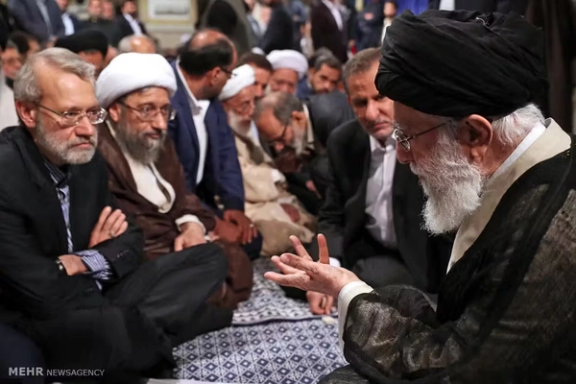
Iran's Supreme Leader Ali Khamenei (right) and Iran's top security official Ali Larijani (left)

A day after three European states triggered a UN mechanism that reimposes international sanctions on Iran, the move appeared to wrongfoot Tehran's establishment despite months of warnings.

Iran's new Security Chief, Ali Larijani, seemed to misread the immediacy of the threat in an interview days before the diplomatic setback.

In an interview with Supreme Leader Ali Khamenei's official website on August 22, Larijani insisted that China and Russia could shield Iran against the snapback threat.

"This issue is currently under review domestically, and as far as I know, some countries are making efforts to negotiate in order to prevent it from happening. Russia and China also hold a different position. They're acting as obstacles."

Larijani is a seasoned politician, but less savvy figures, including state-appointed Friday prayer leaders, also contributed to the confusion with their remarks.

In Shiraz, Friday Prayers imam Lotfollah Dejkam offered a revisionist take on world history, saying: "Europeans have been defeated by Iran several times, and they are likely to experience an even bigger defeat as a result of the snapback."

Ahmad Alamolhoda, the Friday Prayers Imam of Mashhad, appeared to downplay the seriousness of the likely economic pain due to be wrought by sanctions.

Iranians, he said, who rushed to capital markets to buy gold and foreign currency in anticipation of further devaluation of the Iranian rial were "simpletons."

Many commentators questioned the leadership's broader understanding of the nuclear deal and the international frameworks governing it.

Among the critics was Heshmatollah Falahatpisheh, former head of the Iranian parliament's National Security and Foreign Relations Committee, who condemned fellow politicians for their impulsive reactions.

In a post on X, he specifically addressed members of parliament who had tabled a triple-urgency motion calling on the Islamic Republic to exit the Non-Proliferation Treaty. Ironically, despite attaching the highest urgency label to the bill, lawmakers postponed its discussion until Saturday, as Friday is a public holiday in Iran.

"Exiting NPT, closing Strait of Hormuz and producing an atomic bomb! For years, the nation has been paying the price for the nonsense you still repeat on (state TV)," Falahatpisheh wrote.

"You believed your own nonsense, which has prevented any rationality and initiative to get out of the deadlocks," he added.

Meanwhile, the promise of diplomatic roads not taken was examined anew.

In an interview with the Entekhab website, Mahmoud Vaezi, chief of staff to former President Hassan Rouhani, revealed that during Rouhani's final days in office, he had asked his successor, President Ebrahim Raisi, to allow him to broker a deal with the United States to revive the 2015 nuclear agreement.

According to Vaezi, Raisi insisted on reviving the agreement under his own administration. Rouhani argued that even if his government signed the deal, the revenue from oil sales would benefit the incoming government.

Nonetheless, Raisi rejected the proposal, and negotiations with the United States ran aground.

Most Viewed

Ghalibaf defends Iran-US talks amid hardline backlash
1
INSIGHT

Ghalibaf defends Iran-US talks amid hardline backlash

2
VOICES FROM IRAN

Bread shortages, soaring prices strain households in Iran, residents say

3
ANALYSIS

From instability to influence: Pakistan’s pivotal role in US-Iran diplomacy

4
ANALYSIS

100 days on: why Iran’s January protests spread across social classes

5

War-hit homeowners feel abandoned as Iran’s reconstruction aid fades

Banner
Banner

Spotlight

  • Iran crackdown reaches cemeteries as graves of slain protesters defaced
    EXCLUSIVE

    Iran crackdown reaches cemeteries as graves of slain protesters defaced

  • Iran diplomacy wobbles as factions compete to avoid looking soft on US
    INSIGHT

    Iran diplomacy wobbles as factions compete to avoid looking soft on US

  • The politics of pink: how Iran uses cuteness to rebrand violence
    ANALYSIS

    The politics of pink: how Iran uses cuteness to rebrand violence

  • Bread shortages, soaring prices strain households in Iran, residents say
    VOICES FROM IRAN

    Bread shortages, soaring prices strain households in Iran, residents say

  • 100 days on: the anatomy of Iran’s January crackdown
    INSIGHT

    100 days on: the anatomy of Iran’s January crackdown

  • Ghalibaf defends Iran-US talks amid hardline backlash
    INSIGHT

    Ghalibaf defends Iran-US talks amid hardline backlash

•
•
•

More Stories

Snapback and survival: sanctions gauntlet further imperils Tehran

Aug 29, 2025, 20:50 GMT+1
•
Shahram Kholdi

The sands of time fall swiftly through the glass, and with each passing day the Islamic Republic of Iran is borne closer to the fateful hour: 18 October 2025, when a 2015 nuclear deal finally expires.

What was once heralded as a diplomatic triumph—a landmark nuclear agreement that promised peace in our time—now stands battered, its legal scaffolding trembling beneath the weight of defiance, duplicity and exhaustion.

In these waning weeks, the world confronts a choice of historic consequence. Shall sanctions be restored, snapping back with the force of law? Will diplomacy, extended yet again, provide a further lease on life to a faltering compact? Or will events-military, political, or economic overtake deliberation and hurl the region into crisis?

To speak plainly: snapback is no illusion. Contrary to misreporting, there is no "30-day prerequisite" before the mechanism may be activated.

The Council requires no incubation period. Once a party files notification of "significant non-performance," the thirty-day clock begins. Unless a fresh resolution is passed, the sanctions of a bygone decade automatically return-immediately, inexorably and beyond veto.

Europe's gambit

The E3—Britain, France and Germany—have already pulled the lever. In their formal notice, they declared Iran to be in "significant non-performance" of its obligations. This, procedurally, is the point of no return.

Unless Moscow can secure nine votes for its draft, and unless Washington refrains from veto, the sanctions of yesteryear will rise again like specters.

For Europe, this is both an act of law and of frustration. Years of oscillation—inspectors expelled, enrichment concealed, commitments broken-have eroded the credibility of diplomacy.

The E3, once patient custodians of compromise, now stand as executioners of its failure.

Moscow's shield, Beijing's hedge

Earlier last week, before E3 notify the UN of their intention to "trigger the snapback à la UNSCR 2231", Russia and China had already stepped into the breach by a draft resolution to extend October 18, 2025, expiry date of UNSCR 2231.

Moscow's draft resolution, tabled before the Security Council, proposes a six-month extension of 2231 to April 2026, granting Tehran a stay of execution.

It is a tactical gambit: stall the clock, suspend deliberation and deny Europe the satisfaction of reimposed sanctions. For Russia, it is one more lever in its great game against the West, wielding Iran as both pawn and partner.

China, ever cautious, has lent its support. Beijing's foreign ministry denounces snapback and extols dialogue, yet behind closed doors its diplomats speak with candor.

If Moscow's extension fails, they admit, China may be resigned to the automatic return of sanctions. For all its rhetoric, Beijing is loath to be cast as breaker of the Council's law. In this careful hedging lies recognition: once triggered, snapback is a machine that runs of itself.

Khamenei's defiance

In Tehran, Supreme Leader Ayatollah Khamenei responded with thunder. In a speech days ago, he rejected outright the prospect of direct negotiations with the United States, branding the dispute "unsolvable."

He warned that Israel, ever the adversary, may seize the moment to again strike Iranian facilities. His words were defiance clothed as prophecy, meant to steel his people and to warn his foes.

Yet, however loud the thunder, the storm advances. Sanctions gnaw at Iran's economy. The rial buckles. Inflation devours. To millions of Iranians, Khamenei's words are less shield than sentence.

Even as the Leader railed, International Atomic Energy Agency inspectors returned to Iran for the first time in months, resuming limited work at Bushehr. It was no great opening: they were kept from Fordow, Natanz and other contested sites.

But it was something. Director General Rafael Grossi hailed the step as "an early indication of progress," though with Churchillian caution: "full cooperation," he warned, "remains a work in progress".

Iran presented the move as magnanimity; parliamentarians denounced it as betrayal. Yet the fact remains: Tehran, sensing peril, cracked open the door.

The transformation ultimatum

There is yet a more radical road. Under the hammer of snapback, with Moscow's shield broken and Beijing resigned, Khamenei may, like Khomeini before him, bow to survive.

He could proclaim a volte-face: accept spontaneous inspections anywhere in Iran; relocate enrichment to a consortium abroad—in the United Arab Emirates or Qatar—or cede it wholly to Russia.

The Leader could pledge compliance with the Financial Action Task Force and thereby grant external auditors full access to Tehran's banking system.

Khamenei might even agree to dismantle the Revolutionary Guards, curtail ballistic missiles and drones and to watch, powerless, as Lebanon advances toward the disarmament of Hezbollah and Iraq presses its own militias into submission.

Already Israeli strikes on Iran's allies in Yemen, with senior Houthi officials reported killed.

Were all this to unfold, Iran would face not mere concession, but transformation. A kleptocratic, hybrid theocracy would be stripped of its praetorian guard, its financial opacity and its regional claws.

History shows that regimes so hollowed seldom survive. This, then, would be snapback not as sanction, but as sentence.

Iran denies report of attack on Qur'an reciter accused of child abuse

Aug 29, 2025, 11:02 GMT+1

Iranian authorities denied reports that Saeed Toosi, a Qur’an reciter accused of sexually abusing underage boys, was shot in the city of Mashhad on Friday.

The prosecutor of Mashhad Hassan Hemmati Far said the story first appeared in a social media post by a truck driver in the city of Fasa and quickly spread. He said security, police and intelligence services investigated the report and found it to be baseless.

Iranian state broadcaster IRIB had earlier reported that Toosi was shot by unidentified gunmen in Mashhad and was hospitalized in critical condition. It gave no further details.

IRGC-affiliated Tasnim News also dismissed the reports as unconfirmed rumors, but said a competent authority should clarify the matter.

This came after Khorasan Daily reported that Toosi had been wounded and hospitalized. Earlier, his brother told the outlet there had been a physical attack.

Toosi gained national recognition after winning two international Qur’an recitation competitions and performing at events attended by Supreme Leader Ali Khamenei.

However, in 2016, at least ten men came forward accusing him of sexual abuse during their teenage years, often while traveling with him for religious training or competitions. The allegations were first aired on Voice of America Persian, after judicial proceedings in the country stalled.

Despite an initial indictment, the case was later dismissed, prompting outrage from activists and victims who accused the judiciary of protecting a figure close to the establishment. Toosi denied all allegations, calling them “bogus and total lies.”

Iran moves to curb media reports that could fuel panic over UN sanctions

Aug 29, 2025, 08:14 GMT+1

Iran’s Ministry of Culture and Islamic Guidance has issued a confidential directive to domestic media, instructing outlets to limit coverage of the European move to trigger the UN snapback mechanism and avoid content that could cause public concern or market instability.

Confidential order restricts tone and content

The directive, sent to newsroom chiefs and editors, outlines six points aimed at controlling how the issue is reported. It calls on newsrooms to avoid “emotional,” “crisis-oriented,” or “provocative” headlines and urges editors to present the snapback as a manageable development. The stated goal is to preserve “psychological calm” in society.

Media are specifically told to refrain from publishing content that highlights economic risks, such as inflation, currency devaluation, or the potential impact on gold and foreign exchange markets. Such coverage, the ministry warns, could increase inflationary expectations or contribute to public anxiety.

Instructions call for emphasis on Iran’s resilience

Instead, the directive advises the use of regional experts and commentary that frames the snapback as a sign of European weakness or dependence on the United States. Media are encouraged to highlight Iran’s ability to withstand sanctions and emphasize the country’s “strength in facing pressure.”

The publication of reports that suggest a negative or uncertain outlook for the future is discouraged. Outlets are instructed to “avoid portraying a bleak future” and to focus instead on narratives of continuity and resistance.

Coverage of Western policy encouraged, not domestic impact

According to the directive, media should shift their focus toward criticizing Western governments and highlighting what it describes as contradictions and internal crises in Europe and the US.

The guidance advises against reporting that could fuel debate over the domestic implications of renewed UN sanctions or revive concerns over Iran’s access to oil revenues and currency reserves. No timeline was provided for how long these restrictions should remain in place.

Recent economic reporting limited after new warnings

The directive follows recent domestic reports warning that snapback sanctions could worsen inflation and further weaken the rial. Earlier this week, the Tehran Chamber of Commerce projected that the dollar could reach 1.65 million rials under pessimistic scenarios. That report was later downplayed under apparent pressure from security agencies.

As Iran International exclusively reported, members of the chamber’s international affairs team were questioned this week by the IRGC’s intelligence unit over the economic forecast, and senior officials were instructed not to speak publicly about it.

The Ministry of Culture has not officially commented on the new guidelines. Iranian state media and major news agencies have so far reported the snapback process using neutral language and limited economic analysis.

Part of broader restrictions on public discourse

The new instructions come amid heightened sensitivity within Iranian institutions over public reaction to international developments. The approach reflects a broader pattern of preemptive media control during major diplomatic or economic events.

Iranian media outlets operate under oversight from multiple government agencies, including the Ministry of Culture, the Supreme National Security Council, and intelligence bodies. Directives such as this one are typically circulated in private and not publicly acknowledged.

Snapback is West's least worst option, former US official says

Aug 28, 2025, 19:29 GMT+1

"Triggering snapback at this juncture is the right decision. Iran remains far out of compliance with its JCPOA and safeguards obligations and there is no near term prospect of any nuclear deal, especially given that Iran refuses to meet with the U.S." former US National Security Council director for counterproliferation Eric Brewer said.

"It is not a decision to be celebrated. One can catalog the list of policy failures that led us to this place, not least of which is the U.S. withdrawal from the JCPOA. Nor is snapback some panacea that will cause Iranian capitulation," Brewer, also a former deputy national intelligence officer for weapons of mass destruction, wrote on X.

"Indeed, there will likely be a major gap between the sanctions that exist on paper and their implementation by key players in practice," added Brewer, who is currently vice president at the Nuclear Threat Initiative.

"Snapback, should it happen, is more about avoiding loss rather than trying to secure immediate strategic gain. It’s a least worst option."

Iran response to snapback move bodes friction ahead, WSJ reporter says

Aug 28, 2025, 18:06 GMT+1

Wall Street Journal reporter and veteran nuclear diplomacy watcher Laurence Norman wrote on Thursday that Iran's reaction to a European move to renew UN sanctions was measured but that diplomatic confrontation looms.

"Iran tells E3 to back a Russian plan to extend 2231 with no SnapBack provision and no real Iranian steps to meet conditions," he wrote on X. "If they were gonna do that, they wouldn’t have triggered SnapBack. That suggests diplomatic confrontation."

"Iran SnapBack statement full of attacks on E3 and reiteration of what Tehran says is illegal and baseless move by Europeans. But relatively light on specific threats. Says will “seriously undermine” talks with IAEA, though that’s vaguer than @Gharibabadi comments earlier," he added, referring to Iran's deputy foreign minister.

"And (Iran) warns of an “appropriate” response. So all options remain open. But it’s not closing off any immediate diplomatic paths. Which is worth at least noting."