• العربية
  • فارسی
Brand
  • Iran Insight
  • Politics
  • Economy
  • Analysis
  • Special Report
  • Opinion
  • Podcast
  • Iran Insight
  • Politics
  • Economy
  • Analysis
  • Special Report
  • Opinion
  • Podcast
  • Theme
  • Language
    • العربية
    • فارسی
  • Iran Insight
  • Politics
  • Economy
  • Analysis
  • Special Report
  • Opinion
  • Podcast
All rights reserved for Volant Media UK Limited
volant media logo

Iraq, Lebanon to host Iran’s new security chief in first foreign trip

Aug 11, 2025, 07:43 GMT+1Updated: 04:31 GMT

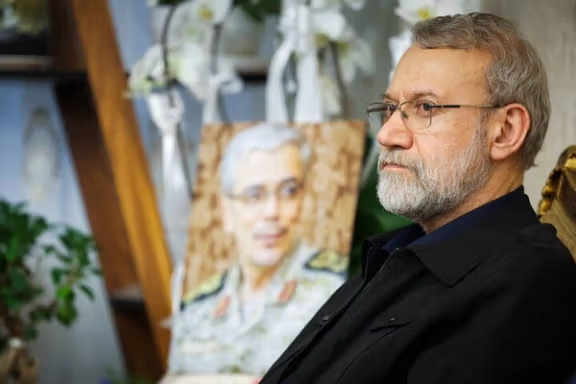
Iran’s newly appointed Supreme National Security Council secretary Ali Larijani will travel to Iraq and Lebanon this week in his first foreign trip since taking the post, with a bilateral security deal with Baghdad and high-level talks in Beirut on the agenda.

Larijani, who also serves as Supreme Leader Ali Khamenei’s personal representative to the council, said he would sign a “bilateral security agreement” with Iraq and meet “various currents” in the country.

“Iran’s approach with neighbors is to consider both the security of Iranians and the security of neighbors,” he told state broadcaster IRIB before departing for Baghdad.

In Iraq, Larijani’s trip comes days after Prime Minister Mohammed Shia al-Sudani reiterated there was “no reason” for weapons to be held outside state institutions, and said he had used a mix of political and military pressure to prevent Iran-aligned armed groups from joining last month’s 12-day conflict between Israel and Iran.

Baghdad says it has thwarted 29 planned attacks by such groups on US bases in the country.

Iraq's political landscape is divided into competing Shia, Sunni, and Kurdish blocs. Recent power shifts have seen Shia factions, such as the Sadrist Movement and the Iran-backed Shia Coordination Framework, gain prominence, though Kurdish and Sunni groups still hold significant roles. Iran has historically backed Shia militias, some of which are now part of Iraq's security apparatus through Popular Mobilization Forces.

Trip to Lebanon

Larijani’s three-day trip will also take him to Lebanon, where he said he would deliver unspecified messages to officials and discuss expanding trade ties.

“National unity in Lebanon must be preserved in all conditions. Lebanon’s independence is important to us and we will help to maintain it,” he said.

The visit comes amid renewed friction between Tehran and Beirut over the Lebanese government’s plan to disarm Iran-backed Hezbollah.

Lebanon’s foreign ministry last week condemned remarks by Khamenei aide Ali-Akbar Velayati rejecting the disarmament decision, calling them “flagrant and unacceptable interference” in domestic affairs.

The ministry said Lebanon’s future and political system were matters “decided solely by the Lebanese people” and warned Tehran to “mind its own business.”

Beirut’s cabinet earlier this month instructed the army to draft a plan by year-end to bring all weapons under state control, an implicit challenge to Hezbollah, which has vowed to resist disarmament.

Senior Iranian officials, including Velayati and military commander Iraj Masjedi, have publicly opposed the move, describing it as an American- and Israeli-driven policy that will fail.

Khamenei appointed Larijani to his new role on Thursday, two days after President Masoud Pezeshkian named him as SNSC secretary.

With the appointment, Larijani replaces Ali Akbar Ahmadian both as secretary of the Supreme National Security Council and as one of Khamenei’s two designated representatives to the body. Saeed Jalili, who served as SNSC secretary from 2007 to 2013, is the other representative currently serving in that capacity.
Most Viewed

US terminates green cards of 3 Iranians tied to Islamic Republic
1

US terminates green cards of 3 Iranians tied to Islamic Republic

2
PODCAST

Worst outcome is Islamic Republic’s survival, ex-CIA official says

3
ANALYSIS

Iran brings unusually broad team to US talks to blunt future blame

4
INSIGHT

Tehran sends tough message but keeps diplomacy door open

5

Zoroastrian religious figure arrested in Iran

Banner
Banner

Spotlight

  • Tehran sends tough message but keeps diplomacy door open
    INSIGHT

    Tehran sends tough message but keeps diplomacy door open

  • Worst outcome is Islamic Republic’s survival, ex-CIA official says
    PODCAST

    Worst outcome is Islamic Republic’s survival, ex-CIA official says

  • Why the Iran-US truce is more likely to buy time than peace
    ANALYSIS

    Why the Iran-US truce is more likely to buy time than peace

  • Engaged but uncommitted: China watches Iran and US fight and talk
    ANALYSIS

    Engaged but uncommitted: China watches Iran and US fight and talk

  • A truce for the world, a reckoning for Iran’s economy
    ANALYSIS

    A truce for the world, a reckoning for Iran’s economy

  • Why the world failed to bypass the Strait of Hormuz
    ANALYSIS

    Why the world failed to bypass the Strait of Hormuz

•
•
•

More Stories

Holocaust survivor dies from Iran attacks, raising Israel death toll to 32

Aug 10, 2025, 16:05 GMT+1

A 91-year-old Holocaust survivor who was seriously injured during Iran’s missile attacks on Israel in June died at her home in the central Israeli city of Rehovot on Saturday, raising death toll from Tehran's attacks to 32, Hebrew media reported.

Olga Weissberg collapsed in her home late Saturday and was pronounced dead at the scene by Magen David Adom medics.

She had been wounded on June 15 in an Iranian missile strike during the 12-day war, but was later discharged from hospital. Israeli media reports said her health had deteriorated in recent days.

Weissberg is the second Holocaust survivor whose death has been linked to the June attacks. Ivette Shmilovitz, 95, was killed in a missile strike on Petah Tikva, a city east of Tel Aviv, on June 17.

Iran and Israel fought a 12-day conflict in June that included US strikes on Iranian nuclear facilities at Isfahan, Natanz and Fordow, and Israeli strikes that destroyed critical infrastructure, killing several senior military and scientific figures as well as hundreds of civilians.

Iran responded with missile strikes that killed 31 civilians and one off-duty soldier, according to official figures published by the Israeli government.

The Islamic Republic says 1,062 people were also killed by Israel during the 12-day conflict, including 786 military personnel and 276 civilians.

Embassy closures in Tehran trap thousands of Iranian passports

Aug 10, 2025, 13:54 GMT+1

The closure of several foreign embassies in Tehran during and after the 12-day war with Israel has left between 3,000 and 4,000 Iranian passports stuck in diplomatic missions, stranding visa applicants, Iranian officials said on Sunday.

Omid Mohammad-Alikhan, a member of Iran’s Association of Travel Agencies, told state news agency IRNA that with some embassies halting tourist visa issuance, between 40,000 and 50,000 people remain in limbo.

The Swiss embassy has suspended tourist visas, France has limited operations, the South African mission is closed, Brazil’s embassy has yet to reopen, and Japan plans to resume work in the coming days, he said.

The disruption has hit hardest those needing to travel on fixed dates, such as students who must arrive for the start of the academic year and athletes travelling to competitions or training camps.

Hormatollah Rafiei, head of Iran’s Association of Air and Tourism Agencies, said more than 250 international flights were cancelled during the conflict, preventing over 30,000 people from travelling abroad and leaving airlines and accommodation providers owing passengers over 600 billion tomans (about $6.5 million).

Rafiei criticized a government directive instructing travel agencies to refund customers directly, saying airlines, hotels and booking platforms must first reimburse the agencies.

“Until these companies return the money, we cannot refund the passengers,” he said, adding that despite airlines’ claims of repaying 80% of the funds, agencies had not received the money.

Incoming tourism hit

Iran's tourism sector has also been hit by a sharp drop in foreign arrivals. Deputy Tourism Minister Anoushirvan Mohseni-Bandpey said 330,000 foreign tourists visited Iran in July, down 53% from a year earlier, blaming the war and what he called “Iranophobia” campaigns.

He said visa issuance for most European countries has stopped, but travel between Iran and Asian nations, Turkey, Russia and China continues. Recovering pre-war levels would require time and confidence-building, he added.

Air traffic remains far below pre-war levels despite the reopening of major airports 10 days after the ceasefire between Israel and Iran.

Routes to Europe and East Asia, including Austria, Germany, China and Thailand, remain suspended, while flights to regional hubs such as Turkey and the United Arab Emirates have also been sharply reduced.

Israel-Iran cyber hostilities continue beyond ceasefire – FT

Aug 10, 2025, 12:23 GMT+1

Cyber operations between Israel and Iran have intensified since June’s brief war despite a ceasefire, the Financial Times reported, citing Israeli officials and cybersecurity experts.

“It heated up after the start of the war, and it’s still going on,” one Israeli official told the FT.

Since the June 24 ceasefire, Iranian-aligned groups have attempted to exploit a recently identified Microsoft server software vulnerability to attack Israeli companies, according to chief executive of Israeli cyber threat intelligence company ClearSky, Boaz Dolev.

While the missiles stopped following the ceasefire that ended the 12-day war which saw massive destruction both sides, Iran's cyber war has continued at full pace, as reported by Iran International last month.

“Although there is a ceasefire in the physical world, in the cyber arena, [the attacks] did not stop,” Dolev added.

Spear-phishing messages purporting to be from diplomats and the prime minister’s office have also surged, cyber security company Check Point told the FT.

During the June conflict, Israel-linked hackers carried out some of the most disruptive strikes of the campaign. Gonjeshke Darande, a group widely regarded as aligned with Israel, claimed responsibility for destroying $90mn from Iran’s Nobitex cryptocurrency exchange and crippling services at Bank Sepah and Bank Pasargad by disabling their main and backup data centers.

While Iran’s capabilities were not to be underestimated, none of the wartime attacks on Israel had dramatic impact, Moty Cristal, a crisis negotiator and lieutenant colonel in the Israeli military reserves, told the FT.

Dolev said Iranian-linked groups had retaliated with hack-and-leak operations against about 50 Israeli companies, alongside attempts to plant malware aimed at destroying computer systems.

While they appeared unable to penetrate the defenses of Israel’s military or largest firms, he said, the attackers targeted smaller, more vulnerable businesses in their supply chains.

These included logistics and fuel providers as well as human resources firms, with hackers later releasing the CVs of thousands of Israelis with defense and security backgrounds.

Iran may not enter new talks with US, senior lawmaker says

Aug 10, 2025, 11:51 GMT+1

The head of Iran’s parliamentary National Security and Foreign Policy Committee said on Sunday that no time or place has been set for new talks with the US as an ongoing review looks set to conclude that negotiations with the US are unjustified.

Ebrahim Aziz said that Tehran is not afraid of dialogue but accused Washington of repeatedly breaking its commitments.

“Some interpret negotiation as retreat, but this view is incorrect. Iran has consistently engaged with strength and adherence to principles, while the other side has repeatedly violated its obligations,” Azizi said at a press conference.

He added that Iran remains open to talks only if the other party respects the fundamental rules of negotiation.

“No specific date or venue has been set for new talks, and it is possible that the outcome of our assessments will be that negotiating with an uncommitted side is not permissible,” he said.

Azizi reaffirmed Iran’s right to uranium enrichment, saying that while Iran would not negotiate the principle of enrichment, discussions could occur regarding the level and percentage of enrichment.

He also emphasized that lifting sanctions is a critical national interest, but Tehran demands lasting guarantees given past experiences with broken deals.

The 2015 nuclear deal (JCPOA) offered Iran sanctions relief in exchange for limits on its nuclear program. The US withdrawal under former President Donald Trump in 2018 triggered a gradual unraveling of the deal, with Iran scaling back its commitments and European parties failing to deliver promised economic benefits.

Regarding Iran’s cooperation with the International Atomic Energy Agency (IAEA), Azizi said Tehran suspended cooperation due to the agency’s misleading reports that “paved the way for military attacks.”

He accused IAEA chief Rafael Grossi of politicizing the agency and said that future cooperation would be restructured according to new parliamentary laws.

Iran’s state-run English-language newspaper Tehran Times reported on Friday that Tehran and Washington may start Norway-mediated indirect talks in August, covering Iran’s nuclear program and compensation demands over the June war with Israel and the US.

The US has called Iran’s compensation demand “ridiculous,” urging Tehran to stop funding militias and its nuclear program.

Iran and the US held five rounds of talks earlier this year; a sixth was suspended after Israeli airstrikes on Iranian sites triggered a 12-day conflict with casualties on both sides.

IRGC warns of severe consequences over US-controlled Zangezur corridor

Aug 10, 2025, 11:19 GMT+1

The political deputy of Iran’s Revolutionary Guard criticized the recent US-brokered Armenia-Azerbaijan agreement on the Zangezur corridor, warning the deal risks destabilizing the strategically vital South Caucasus region.

Yadollah Javani condemned Armenian Prime Minister Nikol Pashinyan and Azerbaijani President Ilham Aliyev for “falling for the gambler Trump’s trap” by involving the US, Britain, and NATO in the region, ignoring the interests of key neighbors.

In a statement titled “Aliyev and Pashinyan on Zelensky’s Road to Misery,” Javani compared their actions to Ukrainian President Volodymyr Zelensky’s decision to invite NATO into Russia’s traditional security zone, which precipitated Russia’s invasion.

“The strategic error by Zelensky has so far imposed heavy and irreversible costs on Ukraine’s sovereignty and territorial integrity,” Javani wrote, “and now Aliyev and Pashinyan risk similar consequences by leasing the Zangezur corridor exclusively to the United States for 99 years, provoking Iran, Russia, China, and India.”

The corridor, designed to link Azerbaijan to its Nakhchivan exclave through southern Armenia, was renamed the “Trump Route for International Peace and Prosperity” (TRIPP) following the deal signed at the White House on Friday.

Although it remains under Armenian jurisdiction, the land will be leased to a private American company responsible for construction and logistics.

Iran, which shares a border near the corridor, has expressed fierce opposition.

Ali Akbar Velayati, senior adviser to Supreme Leader Ayatollah Ali Khamenei, told state media that Tehran would block the corridor’s establishment even without Russia’s help.

He accused Washington of attempting to reshape the South Caucasus and said, “This passage will not become a gateway for Trump’s mercenaries; it will become their graveyard.”

Ali Bagheri Kani, the secretary of Iran's Strategic Council on Foreign Relations, told state broadcaster IRIB on Saturday “the Islamic Republic will not easily overlook the issue of Zangezur.”