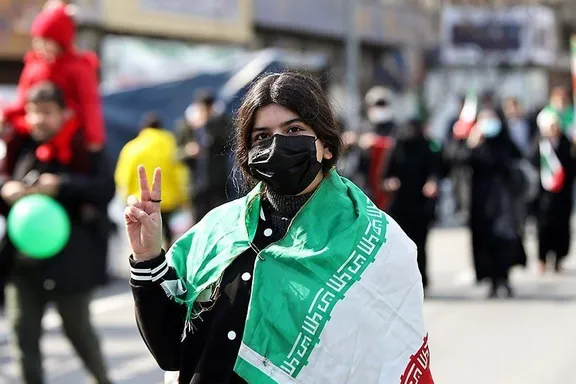
A young girl attending the rally to commemorate the anniversary of Iran's 1979 Revolution,
A young woman in a loosely draped hijab, strands of hair framing her face, flashes a peace sign while holding a photo of a slain Revolutionary Guard commander.
The improbable image fills the front page of hardline daily Vatan-e Emrooz, presented as part of the Islamic Republic’s “new generation of resistance.”
But analysts told Iran International it is less a reflection of reality than a carefully crafted narrative aimed at shoring up support for Tehran after its 12-day war with Israel — the worst direct military confrontation in their fraught history.
The war left hundreds of civilians dead, damaged infrastructure and deepened economic strain. In its aftermath, the Iranian establishment has worked to project resilience and unity, even among citizens who defy its strict social codes.
The Vatan-e Emrooz cover accompanied a story built around a Foreign Policy article by an Iranian-American academic which argued that some young Iranians are rallying behind Tehran’s anti-West, anti-Israel stance in the war’s aftermath.
Following the bruising conflict, Tehran embraced nationalist symbols it long suppressed, with mythological tales and ancient monarchs adorning public billboards.
For author Arash Azizi, whose book What Iranians Want: Woman, Life, Freedom examines political and social change, this type of imagery is part of a familiar playbook.
Referring to a domestic militia and Iran's Islamic Revolutionary Guard Corps, he described Vatan-e Emrooz as “a hardliner outlet, traditionally close to the Basij, which is a section of the IRGC … known for a very sensational sort of tabloid-style headlines.”
The paper, he added, has long featured stylish young who appear supportive of the establishment to imply that “even sections of the population that flout the hijab rules … nevertheless supports its foreign and military policies.”
Holly Dagres, a senior fellow at the Washington Institute for Near East Policy, studies Iran’s younger generations and regularly tracks Gen Z and Gen Alpha trends.
She said that while this visual contrast between appearance and ideology is not new—women without hijab have backed hardliners, and chador-wearing women have voted reformist—the cover is nonetheless a strategic push.
“It’s for the regime to make a point, especially at a time when it has historically high anti‑regime sentiment, that ... we have the support of these individuals too that don’t usually fit the stereotypical box of what a good Islamic citizen in our view is," Dagres told Iran International.
No gesture by chance
Visual communication expert Siavash Rokni, who holds a PhD in communication and researcher in popular music at McGill University, sees deliberate messaging in the picture’s design: the woman’s ear “out of her scarf,” the bright blue clothes “evoking kind of happiness and rejuvenation and the future,” and her phone with a peace sign “as kind of the representation of Gen Z.”
Rokni also points to the way she holds her phone — not in a natural texting or scrolling posture, but almost like a prop, gripped sideways with fingers loosely wrapped around it. The position, he suggests, looks staged.
It’s an example of what Rokni calls the Islamic Republic’s turn to “soft war”—countering Western “soft power” via curated cultural imagery. The same effect is visible, he added, in rap lyrics and music videos where some artists are either funded or influenced by the IRGC to echo establishment talking points, while others openly align themselves with them.
Gen Z beyond reach?
Activist Tara Dachek, part of Iran’s Gen Z and now living abroad, sees the image as a sign of weakness, not strength. “The Islamic Republic is drowning — these are its last desperate gasps,” she told Iran International. Such visuals, she says, reflect “fear, repetition and desperation” rather than genuine engagement.
Having left Iran six years ago, Dachek believes the cover only affirms that her “generation is on the right path — the regime has already lost us.”
"Even back then, I didn’t trust state media. I never followed their news because I knew it wasn’t truth — it was survival wrapped in a lie," said Dachek.
Among younger Iranians, the dissatisfaction runs deep.
Surveys show that nearly 75% of Iranians—including many Gen Z individuals—opposed mandatory hijab, with 84% favoring a secular state over the Islamic Republic, according to GAMAAN — a Netherlands-based research organization that conducts large-scale online surveys of Iranians.
Gen Z, who wasn't yet born at the time of the 1979 revolution, frequently expresses opposition to both political Islam and compulsory dress codes while embracing global cultural values.
Despite Tehran’s efforts to project unity, young Iranians may not be as passive or easily swayed as officialdom believes. Shaped by years of protest and repression, they remain among the most vocal critics of the Islamic Republic.
A billboard in Tehran's central Enghelab (Revolution) square, featuring supreme leader Ali Khamenei and his post-war patriotic messaging
Ali Larijani’s reappointment as secretary of Iran’s Supreme National Security Council (SNSC) may appear to mark a return to moderation, but it is better understood as a tactical facelift.
Behind the tailored suits and diplomatic polish lies the same system preparing for confrontation, not compromise.
The SNSC, one of the Islamic Republic’s most powerful institutions, is ultimately controlled by Supreme Leader Ali Khamenei. All senior appointments fall under his direct authority.
Larijani, who previously served as SNSC secretary from 2005 to 2007 and was parliament speaker for over a decade, is one of the regime’s most enduring insiders. A longtime adviser to Khamenei, he has often served as a bridge between rival factions.
With his neatly trimmed beard, sharp gaze, and preference for suits over uniforms, Larijani offers a stark contrast to his predecessor, Rear Admiral Ali Akbar Ahmadian of the IRGC Navy, who often appeared in fatigues and had a distinctly harder edge.
But the change is stylistic, not strategic. Tehran’s broader posture remains intact.
Image over substance
The reshuffle comes as Iran faces mounting pressure over its nuclear program and prepares for the possibility of renewed military conflict with Israel or the United States.
Even journalists aligned with the reformist camp have voiced skepticism over Larijani’s return, calling it “too little, too late.” That skepticism is echoed by Nour News, affiliated with former SNSC chief Ali Shamkhani, who issued a thinly veiled warning on Wednesday:
“National security bodies complement the decision-making process, not replace it. If management and structural changes at a national security body are paired with unrealistic expectations, it will lead to the institution losing its operational credibility.”
Contained rivalries
Larijani and Shamkhani represent rival power centers within the Islamic Republic, each vying for influence over national security and foreign policy.
They may trade blows in public—or, in Iranian political parlance, compete for a bigger “share of the revolution’s spoils.” But when faced with internal unrest or foreign threats, such rivalries are quickly subordinated to regime survival.
Three veterans of Iran's security establishment Ali Larijani (left), Ali Shamkhani (right), Mohsen Rezaei (front) at an event to mark the death of President Ebrahim Raisi, Tehran, Iran, May 31, 2025
Their behavior is captured by a Persian proverb: “We might tear each other limb from limb, but we are brothers. Therefore, we will always bury the bones.”
The Islamic Republic’s first supreme leader Ruhollah Khomeini put it more bluntly: “Preserving the regime is everyone’s highest religious duty—even more important than the life of the (Promised Savior).”
Echoing the Supreme Defense Council of the 1980s, the new body is tasked with streamlining security decision-making in wartime.
It will be chaired by the president—or an SNSC member appointed by him—and will include the heads of Iran’s three branches of power, the intelligence minister, the chief of the General Staff, commanders of the IRGC and Artesh, two Supreme Leader representatives, and the head of the Khatam al-Anbia Central Headquarters.
The formation of the new body is a sign that Tehran sees confrontation as imminent.
Larijani’s return should be viewed in that context: not the return of a moderate to power, but the placement of a loyal, presentable veteran into a structure recalibrating for crisis.
As another Persian proverb puts it: “When the adversary rains arrows down on you, take shelter. Rush from one column to another, and buy yourself time—until chance provides you with an opening to fight or flee.”
File photo of an electronic board showing stock prices at Tehran Stock Exchange in Tehran
Iran’s Revolutionary Guards intervened this spring to block a leading tech firm’s stock market debut, The Washington Post on Wednesday, in a sign of the sprawling military organization's grip over the ailing economy.
The company, Divar, is one of the most prominent firms to emerge from Iran’s start-up sector in the past decade. Its CEO took the rare step of publishing online a letter indicating the Revolutionary Guards' disapproval of its listing under his leadership.
Offering online classified ads similar to Craigslist, Divar enables Iranians to buy and sell secondhand goods and find and rent homes.
It has about 38 million active users, or nearly half the country’s population, according to a 2023 report from a Swedish investment firm with indirect shares in the company.
But its efforts to go public on the Tehran Stock Exchange were halted after the Guards objected to the presence of Divar’s founder and CEO, Hessam Mir Armandehi.
Late last month, Armandehi published a copy of the internal order on LinkedIn. “It is hereby brought to your attention that the Intelligence Organization of the Guards … has declared Mr. Hessam Mir Armandehi’s lack of qualification, and consequently, the company’s acceptance is contingent upon his absence,” the June 10 letter read. According to the document, the order had been issued on April 27.
Divar is reportedly highly profitable, according to four people familiar with the company who spoke to the Washington Post on condition of anonymity. A consortium of foreign investors, including Europeans, holds 15 percent of the shares of its parent company, according to its website. The consortium and the Swedish firm declined to comment.
The post was seen as a rare act of defiance in what The Washington Post called a secretive, authoritarian system.
Dozens of Iranian executives shared Armandehi’s post and wrote messages of support. “I wish we had a good and responsible government that appreciated great and capable entrepreneurs and start-ups,” one wrote. Another added, “Exactly for this reason it is impossible to grow in Iran!!”
Divar has previously clashed with security institutions. The company has refused to turn over private user data and resisted pressure to sell shares to entities linked to the state.
One person familiar with the company said Divar was also pressured to sell to a firm partly owned by a conglomerate close to Supreme Leader Ali Khamenei, who holds ultimate authority over the Guards.
In one past case, Armandehi’s cousin and fellow executive Ashkan Armandehi was briefly detained after refusing to hand over user data.
He later told Iranian media the company would not comply with blanket requests. “Providing information about ads and users without a court order is illegal,” he said.
Iran’s Revolutionary Guards are widely known to hold major shares in oil, telecom, and construction. But the Divar case has exposed the Guards’ expanding informal control over digital companies they do not legally own, the article said.
“If a founder doesn’t have the right to stay in their own company, no investor will confidently invest in the digital economy,” Iran’s Deputy ICT Minister Ehsan Chitsaz wrote on X. “The stock market is a tool for corporate governance and transparency, not a tool for the arbitrary elimination of individuals or managerial coercion.”
The pressure Armandehi described has further deepened the private sector’s challenges by eroding fair competition and undermining Iran’s efforts to attract foreign capital, experts told The Washington Post.
“This leads to lower investment, of course, and it leads to capital flight not only from investors in Divar but also in many other digital companies, many other companies that are private,” said Mahdi Ghodsi, an economist at the Vienna Institute for International Economic Studies. “If they continue these kinds of policies, they are helping the collapse of the Islamic Republic.”
Despite the threats, Armandehi said he is staying. “Even now with all these pressures, I’ve neither lost hope nor have any plans for emigrating or leaving Divar,” he wrote.
A session of the Iranian parliament on August 3, 2025
Two senior Iranian lawmakers have welcomed the creation of a new Defense Council under the Supreme National Security Council (SNSC), calling it a timely move to streamline military decision-making in what they described as wartime conditions.
“The formation of this council was necessary given the current wartime situation and possible conditions in the future,” said Alaeddin Boroujerdi, a veteran parliamentarian and member of the National Security and Foreign Policy Committee.
“Due to the wartime conditions we are in, the establishment of this council and the concentration of military and defense decisions can create coordination and coherence in decision-making and execution in critical situations.”
Boroujerdi said the council’s focus on defense matters would complement the broader remit of the SNSC.
“Since the Supreme National Security Council deals with numerous security, national and foreign policy issues, there was a need for military and defense developments to be followed in a concentrated manner in one council,” he said, adding that its inclusion of senior armed forces commanders could “greatly strengthen our decision-making and policy-making in wartime.”
Esmaeil Kowsari, another member of the committee and a former Revolutionary Guards commander, said the council’s establishment met a necessity that emergedduring the recent war and would speed up the chain of command.
“In wartime it is necessary for decisions to be taken quickly, so there must be a headquarters or council where decisions are made with greater speed and decisiveness,” he said. “This council can play an important role in the country’s defense policies.”
Kowsari, recalling the 1980–88 Iran-Iraq war, said that rapid, centralized decision-making had been essential then and would be so again.
“We have never initiated a war and have always defended our country firmly and decisively, but we must be fully prepared,” he said. “The decisions and actions of this council must be designed in such a way as to have the ability to surprise the enemy and, with timely strikes, suppress threats.”
The SNSC approved the Defense Council’s formation on Aug. 3 under Article 176 of the constitution.
Chaired by the president, the council will include the heads of the judiciary and parliament, senior military commanders, and key ministers. Officials say its mandate is to serve as a standing wartime command center, enabling swift, centralized responses to military crises.
On Tuesday, Iran's Supreme Leader Ali Khamenei appointed conservative politician Ali Larijani to lead to lead the country’s top security body, the SNSC.
Iran's president Masoud Pezeshkian alongside Army chief Abdolrahim Mousavi (right) and ground forces commander Kioumars Heydari, Tehran, Iran, April 18, 2025
Iran has established a new Defense Council under the Supreme National Security Council (SNSC), aiming to centralize military decision-making and prepare for crises ranging from war to potential leadership transition.
According to the SNSC Secretariat’s August 3 announcement, the council’s core responsibility is to enable swift, centralized defense decisions in wartime or national emergencies.
While it functions under Article 176 of Iran’s constitution alongside other SNSC sub-bodies—analysts say its timing and composition signal deeper institutional concerns.
Why now?
The move comes amid heightened tensions with Israel and the United States, and growing doubts over Iran’s ability to respond quickly in moments of crisis.
Abdulrasool Divsalar of the United Nations Institute for Disarmament Research said on X that Iran’s delayed response to Israel’s June attacks exposed “a crisis in the strategic military decision-making structure.”
Without secure digital infrastructure, he said, assembling the full SNSC during wartime could be dangerously slow and vulnerable to decapitation strikes.
The new council, by concentrating authority in a smaller group of key officials, is designed to reduce those risks.
MP Mohammad-Esmaeil Kowsari told Jamaran the Defense Council avoids the SNSC’s sluggish consensus model, replacing it with a “smaller, more focused group—allowing for faster and more effective decision-making.”
Lawmaker Mohammad Seraj added that in wartime, “any decision made by the Defense Council is equivalent to one made by the SNSC.”
Function and composition
The council will be chaired by the President and include the heads of the Judiciary and Parliament, two SNSC representatives appointed by the Supreme Leader, the Intelligence Minister, and the Chief of the General Staff.
A key difference from the SNSC is the Defense Council’s permanent inclusion of the top commanders of the Army, the IRGC, and the Khatam-al-Anbia Central Headquarters, which oversees joint military operations.
Though officially a sub-body, some observers see the council as more than a bureaucratic fix.
Writing in Ham Mihan, journalist Ahmad Zeidabadi called it “a move to re-centralize fragmented political authority amid a time of crisis,” alluding to doubts over what might happen if Supreme Leader Ali Khamenei becomes incapacitated.
In that case, the President—who chairs both the SNSC and Defense Council—would be the highest-ranking official in the country.
Institutional context
While the SNSC has long held final authority over Iran’s national security matters, its broad membership—spanning political, military, and economic leaders—makes it unwieldy in urgent situations.
Several lesser-known sub-councils already function under its umbrella, including the Passive Defense Council for critical infrastructure, the Intelligence Coordination Council made up of agency chiefs, and the National Security Council chaired by the Interior Minister.
The Defense Council is distinct in its mandate and composition: focused exclusively on defense, it aims to function as a standing wartime command center. Like the SNSC, its decisions require final approval from the Supreme Leader.
Ali Larijani next to Iran's supreme leader Ali Khamenei
Veteran powerbroker Ali Larijani has been reappointed as Secretary of Iran’s Supreme National Security Council (SCNS), returning to a role from which he resigned two decades ago after clashes with ultra-hardline President Mahmoud Ahmadinejad.
His comeback underscores not only his enduring relevance in Iran’s power circles but also a career defined by strategic shifts, navigating factions and consistent loyalty to the country’s ultimate authority Supreme Leader Ali Khamenei.
For much of his career, Larijani was known as a staunch conservative.
He vocally opposed reformist President Mohammad Khatami and the broader reform movement, using his position as head of the state broadcaster IRIB to discredit Iranian intellectuals.
The program Hoviat ("Identity") targeted cultural figures like poet Ali Akbar Saeedi Sirjani, some of whom were later victims of the Intelligence Ministry’s multiple targeted murders.
‘Problem solver’
Yet by 2015, Larijani emerged as a key supporter of the Iran nuclear deal, helping secure its approval in parliament in under 20 minutes despite conservative opposition. The move aligned him with then-president Hassan Rouhani and marked a dramatic pivot from his earlier hardline stance.
Khamenei publicly praised Larijani at the time as a "problem-solver," though his growing closeness to Rouhani reportedly raised eyebrows in the Supreme Leader’s inner circle.
Larijani was blocked twice from running for president in 2021 and 2024
Throughout these shifts, Larijani remained attuned to the political winds.
His alliances with Presidents Akbar Hashemi Rafsanjani and Khatami cooled as soon as Khamenei distanced himself from them—underscoring a deeper, more consistent alignment with the Supreme Leader over any political faction.
Return to the fold
Despite being sidelined in recent presidential elections—disqualified by the Guardian Council in both 2021 and 2024 allegedly over his daughter studying abroad—Larijani has evidently regained the trust of Iran's theocrat.
Following President Ebrahim Raisi’s death last yer, he was handed two sensitive tasks: overseeing the Iran-China strategic accord and acting as an intermediary with Russia after Israeli strikes on Iranian soil.
While many establishment figures kept a low profile during the crisis, Larijani reemerged as a visible supporter of the Islamic Republic and its top leadership.
An operator without a party
Though courted by moderate conservatives to form a party during Rouhani’s presidency, Larijani resisted. One reason may be his limited popular base.
In parliament, he represented Qom, where a few thousand votes suffice to win a seat—far fewer than the million-plus votes typically needed in Tehran.
Larijani’s political instincts appear rooted more in elite maneuvering than popular mobilization, consistent with his background in a deeply clerical family tied to the seminaries of Qom and Najaf.
The Larijani legacy
Ali Larijani is part of one of Iran’s most influential political dynasties. His father, Hashem, was a respected cleric who steered clear of politics, but his sons embraced the Islamic Republic’s institutions.
Ali's four brothers have held senior roles across Iran’s judicial, legislative and security branches. Ali, the only full-time politician in the family, carved out a career that included 12 years as Speaker of Parliament, top roles in the media and culture ministries and ongoing membership in the Expediency Council.
Educated at the Qom Seminary and Tehran University—where he earned a PhD in Western philosophy—Larijani blends ideological training with technocratic credentials.
He is married to the daughter of Ayatollah Morteza Motahari, a key architect of the Islamic Republic, further cementing his position within Iran’s ruling elite.
A Loyal chameleon
While Larijani now often echoes hardline rhetoric against the United States, he has occasionally voiced cautious support for dialogue.
Deeply skeptical of Europe but pragmatic when necessary, he remains one of the few establishment figures with the credentials and adaptability to help steer Iran toward diplomatic de-escalation, should that path ever open.
Few Iranian politicians have changed stripes as fluidly as Larijani. Yet through all the turns—from hardliner to moderate broker, from sidelined veteran to high-level envoy—his loyalty to Khamenei has never wavered.
In a system where ideological purity is often less important than proximity to the Supreme Leader, Larijani has mastered the art of staying close to the only power that truly matters.