• العربية
  • فارسی
Brand
  • Iran Insight
  • Politics
  • Economy
  • Analysis
  • Special Report
  • Opinion
  • Podcast
  • Iran Insight
  • Politics
  • Economy
  • Analysis
  • Special Report
  • Opinion
  • Podcast
  • Theme
  • Language
    • العربية
    • فارسی
  • Iran Insight
  • Politics
  • Economy
  • Analysis
  • Special Report
  • Opinion
  • Podcast
All rights reserved for Volant Media UK Limited
volant media logo

Rights groups warn of imminent execution of three Iranian Arab men

Jul 12, 2025, 18:25 GMT+1Updated: 07:51 GMT+0

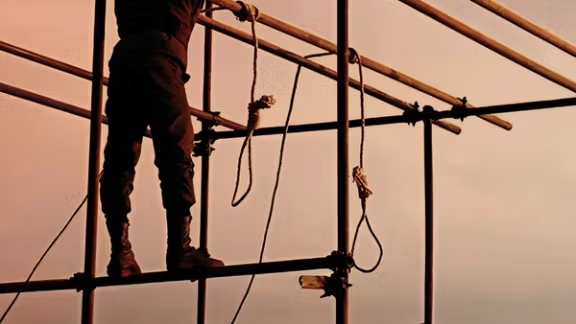
Fifteen human rights organizations issued a joint statement Saturday calling for international action to halt the looming executions of three Arab political prisoners from Ahvaz who were transferred to solitary confinement earlier this month.

Ali Majdam, Moein Khanfari, and Mohammadreza Moghadam were sentenced to death on charges of “armed rebellion,” and, according to reports from Ahvaz, were moved to solitary cells on June 26.

The signatories warned the men now face an imminent risk of execution.

“These individuals are at grave risk, despite credible reports of coerced confessions, prolonged solitary confinement, and grossly unfair trials,” the statement read.

Rights advocates said the renewed isolation, set against the backdrop of heightened internal repression following the 12-day war between Iran and Israel, signals a retaliatory acceleration in executions.

The statement condemned the sharp rise in executions in recent months, calling it a “tool of repression” in the hands of Iran’s security apparatus.

“We warn against retaliatory measures following the recent conflict and demand an immediate halt to these inhumane practices.”

'Not a tool of justice, but control'

The groups reminded Iran's global standing as one of the top executioners, often after trials lacking transparency, access to independent legal counsel, or protection from torture.

“The death penalty in Iran is not a tool of justice, but a mechanism for fear and control,” the statement said.

The coalition demanded that governments and rights institutions act swiftly to pressure the Islamic Republic to suspend the executions and abolish all death sentences against political, civil, and social activists.

Among the 15 signatories to the statement are Iran Human Rights Organization, Kurdistan Human Rights Association-Geneva, the Ahwazi Center for Human Rights, and Haalvsh.

Most Viewed

Ideology may be fading in Iran, but not in Kashmir's ‘Mini Iran'
1
INSIGHT

Ideology may be fading in Iran, but not in Kashmir's ‘Mini Iran'

2
INSIGHT

Hardliners push Hormuz ‘red line’ as US blockade tests Iran’s leverage

3
VOICES FROM IRAN

Hope and anger in Iran as fragile ceasefire persists

4

Iran International says it won’t be silenced after London arson attack

5

US sanctions oil network tied to Iranian tycoon Shamkhani

Banner
Banner

Spotlight

  • Hardliners push Hormuz ‘red line’ as US blockade tests Iran’s leverage
    INSIGHT

    Hardliners push Hormuz ‘red line’ as US blockade tests Iran’s leverage

  • Ideology may be fading in Iran, but not in Kashmir's ‘Mini Iran'
    INSIGHT

    Ideology may be fading in Iran, but not in Kashmir's ‘Mini Iran'

  • War damage amounts to $3,000 per Iranian, with blockade set to add to losses
    INSIGHT

    War damage amounts to $3,000 per Iranian, with blockade set to add to losses

  • Why the $100 billion Hormuz toll revenue is a myth
    ANALYSIS

    Why the $100 billion Hormuz toll revenue is a myth

  • US blockade targets Iran oil boom amid regional disruption
    ANALYSIS

    US blockade targets Iran oil boom amid regional disruption

  • Iran's digital economy battered by prolonged blackout
    INSIGHT

    Iran's digital economy battered by prolonged blackout

•
•
•

More Stories

Iran detains 21 Christian converts amid postwar crackdown, rights group says

Jul 12, 2025, 15:45 GMT+1

Iran has arrested at least 21 Christian converts in recent weeks, with some facing charges under a new law targeting alleged collaboration with hostile states, a rights group said.

The arrests, carried out by the Ministry of Intelligence, took place in Tehran, Rasht, Urmia, Kermanshah, Varamin, and Kerman, including one just before the recent war with Israel, according to the advocacy group Article 18.

While full details of the cases remain unclear, some involve the alleged possession of Bibles. Others may fall under a law that allows harsher punishments—including the death penalty—for individuals accused of cooperating with countries such as the United States or Israel.

Some detainees “have been threatened with charges under a newly proposed law seeking to enforce harsher punishments for those alleged to have collaborated with hostile states such as the United States or Israel,” the group said.

The bill, titled the “Intensification of Punishment for Espionage and Cooperation with the Zionist Regime and Hostile States Against National Security and Interests,” was approved by Iran’s parliament late June but faced scrutiny from the Guardian Council, which is tasked with ensuring that legislation complies with Islamic law and the Constitution.

Hadi Tahan-Nazif, spokesman for the Guardian Council, acknowledged on Friday that parts of the bill remain legally problematic.

“Since criminal laws require precision, there were ambiguities and flaws that needed to be resolved,” he said.

Earlier this month, 57 Iranian academics, jurists, and lawyers issued a public letter condemning the legislation.

Pattern of religious persecution

The new wave of arrests comes amid broader crackdowns that have targeted activists, dissidents, and members of religious minorities—including Jews, Baha’is, and Christian converts. Though Christianity is officially recognized under Iran’s constitution, the state continues to treat conversion from Islam as a threat to national security.

The continued targeting of Christian converts stands in direct violation of Article 18 of both the Universal Declaration of Human Rights and the International Covenant on Civil and Political Rights, both of which guarantee freedom of religion, including the right to change one’s belief and to practice it openly or in private.

Putin urges Iran to accept 'zero enrichment' nuclear deal with US - Axios

Jul 12, 2025, 12:18 GMT+1

Russian President Vladimir Putin has urged Iranian officials to accept a nuclear agreement that would ban uranium enrichment, a key US demand in any future talks, Axios reported Saturday citing multiple sources.

Putin conveyed his position to both President Donald Trump and Iranian leaders in recent weeks, encouraging Tehran to move toward a deal that would help restart negotiations with Washington.

“Putin would support zero enrichment,” one European official told Axios. “He encouraged the Iranians to work toward that… The Iranians said they won’t consider it.”

Shortly after publication, Iran’s Tasnim News, affiliated with the Revolutionary Guards, rejected the Axios report, citing an informed source.

Moscow has long defended Iran’s right to enrich uranium in public, but behind closed doors, Russian officials have taken a tougher stance following the 12-day war between Iran and Israel, according to European and Israeli officials familiar with the talks cited by Axios.

Despite Iran’s military support for Russia in Ukraine, including drones and missiles, Tehran was frustrated with Moscow’s limited support during the war with Israel, Axios reported.

Russian officials have since told Iran that they would be willing to remove its stockpile of highly enriched uranium and supply low-level fuel for civilian use if a deal is reached.

Araghchi says Iran open to nuclear talks, but enrichment non-negotiable

Tehran has insisted it will not accept any agreement that eliminates its ability to enrich uranium.

Iran is open to future talks over its nuclear program but will not accept any deal that excludes uranium enrichment, Foreign Minister Abbas Araghchi said Saturday during a meeting with foreign envoys in Tehran.

“We have always been ready to negotiate over our nuclear program and will continue to be,” Araghchi said. “But it is natural that we must ensure any future talks are not turned into war by the US or others.”

“No agreement will be accepted without enrichment,” he added. “If talks happen, the subject will only be the nuclear issue.”

Araghchi ruled out any discussion of Iran’s military capabilities. “Iran’s military and defense power will not be part of any negotiation,” he said.

He said Iran’s nuclear facilities were damaged in recent strikes by the US and Israel, but the bigger blow was to the global non-proliferation regime. “The reality is our facilities were hit, but what was hit harder was the Non-Proliferation Treaty itself.”

He added that cooperation with the IAEA would continue but now be managed through Iran’s Supreme National Security Council and reviewed on a case-by-case basis.

Axios also reported that plans to hold US-Iran nuclear talks in Oslo have been dropped after both sides cooled on the idea. They are now seeking an alternative venue, according to the sources cited by the report.

Enrichment ban remains key dispute

Meanwhile, Israeli officials continue to warn against any Iranian enrichment. Former Israeli Defense Minister Yoav Gallant said this week that Supreme Leader Ali Khamenei must abandon nuclear ambitions or face further military action.

“The strikes in June exposed your system and dismantled your capabilities,” Gallant wrote in a public letter.

Israeli Prime Minister Benjamin Netanyahu also dismissed future diplomacy unless Iran ends all enrichment and missile development.
Iran files 50 cases over alleged ties to Israel, judiciary says

Jul 12, 2025, 10:35 GMT+1

Iran’s judiciary has filed 50 cases in Tehran against individuals accused of collaborating with Israel, judiciary spokesman Asghar Jahangir said Saturday, pledging swift prosecution and no leniency.

“Close cooperation and coordination between law enforcement and the judiciary led to the formation of around 50 cases in Tehran within less than two weeks,” Jahangir said at a press conference, adding that the charges involve “rumor-mongering” and spreading public anxiety.

Jahangir said the judiciary is determined to prosecute those accused of acting “for the enemy” and would not allow the cases to be delayed. “We will show no leniency,” he said. “We will not allow these cases to be dragged out.”

According to Jahangir, 32 online accounts were flagged; most edited their content after receiving warnings and avoided further legal action, but ten individuals were formally charged. Some remain in custody, while others were released on bail.

Jahangir said several people had also been arrested on espionage charges, but added that court rulings had not yet been issued.

“Some have been informed of their charges as spies, but until a court ruling is issued, no one can be legally labeled a spy,” he said.

He declined to specify how many were charged with spying for Israel. “Every one of these traitors holds valuable information that must be extracted thoroughly before any sentencing,” he said. “This process is essential for identifying others involved.”

Aftermath of Evin prison strike

Responding to questions about the Israeli airstrike on Evin prison, Jahangir confirmed that five inmates convicted of financial crimes were killed and others injured. He said all prisoners were relocated to other facilities within hours and denied reports that some detainees had gone missing or failed to contact families.

Jahangir admitted a small number of inmates had escaped. “A few took advantage of the situation and fled, but the number is not significant. They will be recaptured and returned,” he said.

No sign of Iranian efforts to access enriched uranium stocks at Isfahan - ISIS

Jul 12, 2025, 08:38 GMT+1

Recent satellite imagery shows Iran has not begun recovery or excavation work at key nuclear tunnel entrances at the Isfahan complex, where enriched uranium is believed to be stored, analysts from the Institute for Science and International Security (ISIS) said Friday.

Images taken on July 9 show that all three tunnel entrances at the Isfahan Nuclear Complex remain blocked by earthen backfill and bomb damage, according to David Albright, the institute’s president, and other researchers.

“To access these stocks, the Iranians would have to dig through and clear about 20 meters of rubble or backfill,” the team wrote. “The July 9 image shows no earth moving equipment or other heavy machinery present at any tunnel entrance.”

The tunnels are suspected of housing parts of Iran’s remaining enriched uranium stockpile, but analysts said that any effort to access them would be highly visible to overhead surveillance and could trigger further US or Israeli strikes.

A combination picture shows satellite views of tunnel entrances to the Isfahan Nuclear Technology Research Center before and after being hit by U.S. airstrikes amid the Iran-Israel conflict, in Isfahan, Iran, June 20, 2025 (above), and June 22, 2025. Maxar Technologies/Handout via REUTERS
100%
A combination picture shows satellite views of tunnel entrances to the Isfahan Nuclear Technology Research Center before and after being hit by US airstrikes amid the Iran-Israel conflict, in Isfahan, Iran, June 20, 2025 (above), and June 22, 2025. Maxar Technologies/Handout via REUTERS

In addition, satellite imagery of the main Isfahan complex — which includes the destroyed uranium conversion and metal production facilities — shows no activity. According to the institute, Iran would likely need to conduct drone or HAZMAT surveys before removing rubble or beginning any rebuilding.

“This is a lengthy and complicated process,” the group said. “Iran may also be holding off on any such activities as they are easily spotted via overhead imagery.”

Israel says Iran did not move 60% enriched uranium before strikes

A senior Israeli official told Reuters this week that Iran did not relocate its 60% enriched uranium stockpile before last month’s US airstrikes on its nuclear facilities at Fordow, Natanz, and Isfahan. The material — estimated at around 400 kilograms — “was not removed and has not been moved since,” the official said.

The official added that while Iran may still be able to reach the stockpile at Isfahan, removing it would be difficult due to the extent of the bomb damage. “The Iranians might still be able to gain access to Isfahan but it would be hard to remove any of the material there,” the official said, according to Reuters.

Before the strikes, the International Atomic Energy Agency (IAEA) had assessed that most of Iran’s 60% enriched uranium was stored at the Isfahan complex. Since the attacks, IAEA inspectors have left the country following a new Iranian law that bars cooperation with the UN watchdog.

Tehran has accused the agency of leaking sensitive information to Israel and the United States and has said future coordination will be managed by its Supreme National Security Council. The IAEA has not been able to verify the location or status of the uranium stockpile since the strikes.

Iranian CEO arrested in LA for allegedly sending electronics to Iran

Jul 12, 2025, 06:54 GMT+1

An Iranian national and US lawful permanent resident has been arrested on charges of illegally exporting electronics from the United States to Iran, violating US sanctions, the Justice Department said Friday.

Prosecutors said Ostovari is the founder and CEO of a Tehran-based engineering company that supplied signaling and communications systems to the Iranian government, including on projects for the Islamic Republic of Iran Railways.

From at least May 2018 to July 2025, Ostovari and his co-conspirators “obtained and shipped sophisticated computer processors, railway signaling equipment, and other electronics and electronic components to Company A in Iran,” according to the indictment unsealed Friday. “Many of these items were controlled under federal regulations, and their export to Iran without a license was prohibited.”

He is charged with one count of conspiracy to violate the International Emergency Economic Powers Act (IEEPA) and three counts of violating the IEEPA. Prosecutors say Ostovari acted in knowing violation of the Iranian Transactions and Sanctions Regulations (ITSR), which, alongside the IEEPA, prohibit the export, sale, or supply — directly or indirectly — of certain US-origin goods to Iran without authorization from the US Treasury Department’s Office of Foreign Assets Control (OFAC).

The Justice Department said Ostovari used two front companies in the United Arab Emirates — MH-SYS FZCO and Match Systech FZE — to carry out the scheme. He and others “intentionally concealed from electronics suppliers in the United States and elsewhere that the goods were destined for Iran,” falsely listing the UAE companies as end users.

Prosecutors allege that after becoming a lawful US permanent resident in May 2020, Ostovari continued the exports. “Ostovari knew of the US sanctions against Iran,” the indictment states, “mentioning them in emails to co-conspirators and directing one co-conspirator to provide false information to a federal export control officer.”

Neither Ostovari nor his companies applied for or received a license from OFAC to export the equipment, according to the Justice Department.

If convicted, Ostovari faces up to 20 years in prison for each count. Homeland Security Investigations and the Commerce Department’s Bureau of Industry and Security are investigating the case.