• العربية
  • فارسی
Brand
  • Iran Insight
  • Politics
  • Economy
  • Analysis
  • Special Report
  • Opinion
  • Podcast
  • Iran Insight
  • Politics
  • Economy
  • Analysis
  • Special Report
  • Opinion
  • Podcast
  • Theme
  • Language
    • العربية
    • فارسی
  • Iran Insight
  • Politics
  • Economy
  • Analysis
  • Special Report
  • Opinion
  • Podcast
All rights reserved for Volant Media UK Limited
volant media logo
PODCAST

Sapped Tehran could resort to assassinations, ex-White House official says

Negar Mojtahedi
Negar Mojtahedi

Iran International

Jul 11, 2025, 22:44 GMT+1Updated: 07:52 GMT+0
A view shows the aftermath of an Israeli strike on a building in Tehran, Iran, on June 26, 2025

The Islamic Republic may have suffered a punishing blow in the recent 12-day war but has not backed down and may resort to assassinations, former White House official Michael Doran told Eye for Iran.

Iran's establishment is disoriented, humiliated and prone to fight back by asymmetric means now that its conventional military and regional allies have been so thoroughly degraded, said Doran, a senior fellow at the Hudson Institute thinktank.

“They're like a boxer that's been punched in the nose, fallen down on his knee on the mat, but he's getting up … they'll start assassinating people,” Doran said.

In an interview with Eye for Iran, Doran said that while Iranian officials publicly declared victory after US and Israeli strikes on its nuclear facilities, behind closed doors the Islamic Republic is in crisis.

Its most powerful military sites were struck. Its deterrence was shattered. And now, it is left with few options but through covert attacks and regional destabilization.

Supreme Leader Ali Khamenei, he added, still does not understand the full extent of Tehran's losses. “Nobody wants to be the bearer of bad news... everybody lies to their superior,” Doran said.

Doran said Tehran will turn to tactics it has long relied on including assassinations and reliance on proxy groups across the region.

Rights groups have for decades accused Tehran of killing dissidents abroad and four members of Iran-backed Hezbollah in Lebanon were indicted by an international tribunal for their alleged role in killed a former prime minister, Rafic Hariri.

“They're going to look for those lines of fissure and see where they can cause trouble,” he said. “Assassination, intimidation ... that's the program always.”

After the 12-day war, Iran is again trying to fracture emerging regional cooperation, Doran said, adding that Tehran may target figures in Lebanon, Syria or elsewhere to advance its battered interests. Doran served as Senior Director for Near East and North African Affairs at the National Security Council and later as Deputy Assistant Secretary of Defense under President George W. Bush, where he helped shape US strategy on Iran and the broader Middle East.

“If the Lebanese start moving toward normalization with Israel, they'll assassinate somebody,” he said. “They’ll assassinate al-Sharaa in Damascus,” Doran added, referring to Syria's de facto leader, an opponent of Iran.

Despite recent rhetoric about diplomacy, Doran believes US President Donald Trump remains committed to preventing a nuclear-armed Iran. “He knows that the guys across the way from him are nasty people, nasty thugs,” he said.

As Tehran regroups, Doran said the United States must maintain its pressure.

“Don't remove the sanctions,” he warned. “Iran is weak ... but they still know those techniques. And I expect them to use them.”

You can watch the full episode of Eye for Iran on YouTube or listen on any major podcast platform like Spotify, Apple, Amazon Music and Castbox.

Most Viewed

Hardliners push Hormuz ‘red line’ as US blockade tests Iran’s leverage
1
INSIGHT

Hardliners push Hormuz ‘red line’ as US blockade tests Iran’s leverage

2

Iran International says it won’t be silenced after London arson attack

3
VOICES FROM IRAN

Hope and anger in Iran as fragile ceasefire persists

4

US sanctions oil network tied to Iranian tycoon Shamkhani

5

Iran halts petrochemical exports to supply domestic market

Banner
Banner

Spotlight

  • Hardliners push Hormuz ‘red line’ as US blockade tests Iran’s leverage
    INSIGHT

    Hardliners push Hormuz ‘red line’ as US blockade tests Iran’s leverage

  • Ideology may be fading in Iran, but not in Kashmir's ‘Mini Iran'
    INSIGHT

    Ideology may be fading in Iran, but not in Kashmir's ‘Mini Iran'

  • War damage amounts to $3,000 per Iranian, with blockade set to add to losses
    INSIGHT

    War damage amounts to $3,000 per Iranian, with blockade set to add to losses

  • Why the $100 billion Hormuz toll revenue is a myth
    ANALYSIS

    Why the $100 billion Hormuz toll revenue is a myth

  • US blockade targets Iran oil boom amid regional disruption
    ANALYSIS

    US blockade targets Iran oil boom amid regional disruption

  • Iran's digital economy battered by prolonged blackout
    INSIGHT

    Iran's digital economy battered by prolonged blackout

•
•
•

More Stories

Iran says Merz’s praise of Israeli campaign makes Berlin complicit

Jul 11, 2025, 22:30 GMT+1

Iran's foreign ministry on Friday condemned German Chancellor Friedrich Merz’s blessing of Israel’s military strikes on Iranian nuclear sites, saying his remarks make Germany complicit in the attacks.

“The Chancellor persists in his support for the Israeli regime’s lawless behavior and atrocity crimes, even at the cost of violating the fundamental principles of the UN Charter and international law,” Iranian Foreign Ministry spokesman Esmaeil Baqaei said Friday on X.

Chancellor Friedrich Merz, speaking during a parliamentary session on Wednesday, defended Israel’s attacks Iran, calling them legitimate self-defense.

“I have no doubt about the legitimacy and legality under international law of what Israel has done,” Merz said.

“Saying it was a preemptive strike against a potentially imminent nuclear attack from Iran is only one of several possible assumptions. One could also conclude that Israel has been attacked almost daily for years and has the right to defend itself militarily.”

During the conflict, Merz said Israel was doing the West's "dirty work" for it by degrading their shared enemy.

“Endorsing an injustice is no less than complicity in it,” Baqaei added.

Meanwhile, Israeli Prime Minister Benjamin Netanyahu said in an interview on Thursday that Israel had rolled back Iran's nuclear program—but implied that the confrontation with the Islamic Republic is not yet over.

Netanyahu cited Merz in the interview as one of the only heads of state to publicly back Israel's campaign.

Iran and Israel are currently observing a ceasefire following the recent 12-day war.

'Let's cut off the gas': official line on Tehran blast sparks jokes

Jul 11, 2025, 22:00 GMT+1

An explosion at a residential tower in western Tehran this week lit up Iranian social media with jokes faster than it triggered panic, with the official gas leak explanation convincing few, if any.

Authorities cited “owner negligence,” but eyewitnesses disputed the claim. Satire followed in characteristic volume and speed, instinctively almost—to cope with pervasive post-war unease that sees Israeli shadows everywhere after 12-days of strikes and assassinations.

“Call the Tehran gas company right now and someone picks up saying ‘Shalom, how can I help you?’” quipped one X user named Mehran.

“We thought the army would be the first to break ranks,” activist Ebrahim Allahbakhshi posted on X. “Turns out it was the gas company.”

“The gas company has joined the people,” concurred an anonymous but influential activist going by the name Hamidreza.

Default is disbelief

Years of contradictory official accounts, botched cover-ups and evasive press conferences have hollowed out public trust. Disbelief is automatic. Then comes humor—and the occasional ‘gotcha’ fact-checking.

The affected tower was largely unoccupied and yet to be connected to the gas grid, witnesses from the area told Iran International.

Many others pointed out that there were no signs of fire associated with gas explosions in the available pictures of the building.

Even a typically sober voice like BBC analyst Hossein Bastani couldn’t resist invoking precedent.

“One of the strange constants of Israel’s operations in Iran is the Islamic Republic’s effort to deny Israeli responsibility,” he wrote on his Telegram channel.

“The 2011 Bidganeh explosion that killed Hassan Tehrani Moghaddam, father of Iran’s missile program, was first described as an ‘accident’—until it was revealed to be Mossad’s work.”

No hard evidence has emerged to date of Mossad’s hand in that explosion, but British publications Time and The Guardian have reported Israeli links citing unnamed officials outside and inside Iran.

Israel is the punchline

This perceived Israeli link is reflected in almost every reaction.

“The Islamic Republic has lost control of the gas company too—just like it lost the skies over Iran,” joked Amin Pouria, a prominent influencer with over 400,000 followers on X, alluding to Israel’s aerial dominance during the 12-day war.

Some users even posted AI-generated images depicting Israeli prime minister Benjamin Netanyahu in the uniform of Iran’s national gas company.

Blogger Siamak Mosalmani invoked the targeted assassination of Iran’s top military brass by Israel—and their mass funeral after the ceasefire.

“With the mayor of Tehran in attendance, the Martyrs of Gas section (will be) opened at (Tehran’s main cemetery) Behesht Zahra.”

It struck a chord because it mirrored the state’s reflex: blame the tool, ignore the problem.

Digital strategist Adel Talebi summed up the sentiment with a full-on mock policy proposal.

“You say WhatsApp is a spy tool, you’re shutting down the internet,” he posted on X. “But now gas has gotten unruly too, blowing up on its own, without coordination. Maybe it’s time to cut off gas entirely?”

Witchcraft and war: claims of Israeli sorcery draw scorn

Jul 11, 2025, 17:57 GMT+1
•
Maryam Sinaiee

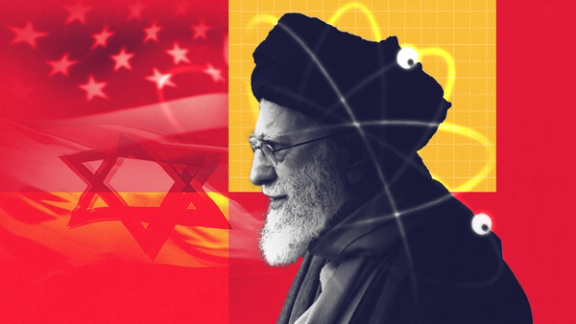
A senior Tehran official has alleged Israel deployed the occult and supernatural spirits in its war with Iran, prompting widespread mockery and a renewed debate over the role of jinn in Iranian political discourse.

“A strange phenomenon,” declared Abdollah Ganji, former chief of the Islamic Revolutionary Guard Corps (IRGC)-affiliated daily Javan, to his 150,000 followers on X on July 9.

“After the recent war, several pieces of paper were found on the streets of Tehran containing talismans with Jewish symbols," he added. "A few years ago, the Supreme Leader said that hostile countries and Western and Hebrew intelligence services use occult sciences and jinn beings for espionage."

In March 2020, supreme leader Ali Khamenei alleged in a televised address that “enemies from among both jinn and human beings” were arrayed against Iran.

The quote was later removed from some official transcripts.

What Are Jinn?

Ganji—now an advisor to the mayor of Tehran—was echoing a broader pattern of supernatural claims pervading Iran’s official political narrative.

In Islamic tradition, jinn are supernatural beings made from fire, distinct from humans, who are created from soil.

Mentioned frequently in the Quran and rooted in pre-Islamic mythology, jinn are believed by some to have the ability to shapeshift, influence human thoughts, and act as agents of harm or espionage.

References to them remain common in Iranian political and religious rhetoric, particularly when discussing Israel and Western powers. Clerics on Iranian television and radio have repeatedly discussed Israel’s alleged use of jinn.

“Given the Zionists’ history of controlling jinn, many of their missions are carried out through them,” said Hojatoleslam Mehdi Karami in an October 2024 program.

In March 2023, state TV aired remarks by Quranic scholar Hojjat ol-Eslam Valiyollah Naghipourfar, who claimed Iran’s intelligence services had thwarted Israeli infiltration efforts conducted via jinn.

Scapegoating failure?

While many clerics view jinn as real and spiritually potent, others—particularly among Iran’s modernist theologians—interpret them metaphorically.

Ganji’s comment on X renewed the debate, with moderate voices pushing back.

“Talking about Jewish talismans and the role of jinn and fairies in Israel’s aggression against Iran is an attempt to downplay the role of infiltrators and to overlook the enemy’s tactics,” former government spokesman Abdollah Ramezanzadeh said on X.

Desert totems

Ganji’s post—and the ensuing debate—wasn’t missed in Israel.

“Consuming drugs and conversing with jinn are not desirable traits in someone leading a country,” an X account purporting to represent Israel's intelligence agency, the Mossad, posted in Persian.

To make the debate even more intriguing, Ganji’s post coincided with the circulation of a satellite image showing geometric patterns—including Stars of David and triangles—etched into a desert near a missile base in central Iran.

The origin of the shapes remains unclear, but some social media users linked them to occult or symbolic efforts aimed at Iran’s military.

Iranian authorities have since removed the markings but Israeli diplomat Waleed Gadban reposted an image of the desert patterns with a mocking caption: “We are closer to you than your jugular vein.”

Iranian missile attack struck inside US airbase in Qatar, Pentagon confirms

Jul 11, 2025, 17:35 GMT+1
•
Fardad Farahzad

A June 23 Iranian missile attack caused damage deep inside a US airbase in Qatar, the Pentagon said on Friday, confirming an Iran International report citing satellite imagery which indicated a cutting-edge communications hub within the facility was destroyed.

"One Iranian ballistic missile impacted Al Udeid Air Base June 23 while the remainder of the missiles were intercepted by U.S. and Qatari air defense systems," Department of Defense Spokesman Sean Parnell told Iran International in response to an emailed request for comment.

"The impact did minimal damage to equipment and structures on the base. There were no injuries. Al Udeid Air Base remains fully operational and capable of conducting its mission, alongside our Qatari partners, to provide security and stability in the region," Parnell added.

The imagery obtained by Iran International provided the most concrete indication yet of physical harm to the Al Udeid Air Base, the biggest US military facility in the Middle East and the forward headquarters of US Central Command (CENTCOM).

An open-source satellite image of the US airbase at Al Udeid Qatar before a 12-day Mideast war last month shows the geodesic radome housing the Air Force modernization enterprise terminal (MET).
100%
An open-source satellite image of the US airbase at Al Udeid Qatar before a 12-day Mideast war last month shows the geodesic radome housing the Air Force modernization enterprise terminal (MET).
A satellite image taken on June 24 by US firm Satellogic obtained by Iran International appears to the same radome reduced to a blackened smear.
100%
A satellite image taken on June 24 by US firm Satellogic obtained by Iran International appears to the same radome reduced to a blackened smear.
A zoomed in version of the satellite image obtained by Iran International of the US airbase at Al Udeid, Qatar.
100%
A zoomed in version of the satellite image obtained by Iran International of the US airbase at Al Udeid, Qatar.

Iran attacked Al Udeid in retaliation for US strikes on three Iranian nuclear sites the previous day, a surprise operation which capped off a 12-day war between Iran and Israel which US President Donald Trump said "obliterated" Iran's nuclear program.

"US forces, alongside our Qatari partners, successfully defended against an Iranian ballistic missile attack targeting Qatar’s Al-Udeid Air Base near Doha, Qatar," CENTCOM said the day of the attack.

President Trump at the time dismissed the Iranian response as "very weak" in a post on Truth Social.

"13 (missiles) were knocked down, and 1 was ‘set free,’ because it was headed in a nonthreatening direction,” Trump added. “I am pleased to report that NO Americans were harmed, and hardly any damage was done."

The United States did not retaliate following the attack and Trump swiftly promulgated a ceasefire which remains in place.

Open-source satellite imagery of the sprawling base encompassing runways, roads dozens of structures shows one distinctive site toward the center of the facility: a white geodesic dome.

A June 24 satellite picture from geospatial analytics company Satellogic obtained by Iran International appeared to show the area reduced to a blackened smear.

No apparent damage appears visible elsewhere.

The site is likely a radome, or weatherproof enclosure, housing a roughly satellite dish-shaped modernization enterprise terminal (MET) whose installation at Al Udeid was described in a 2016 press release on the US Air Force's official website.

Costing $15 million, the MET "provides secure communication capabilities including voice, video and data services, linking service members in the U.S. Central Command area of responsibility with military leaders around the world," the Air Force wrote.

The MET in Qatar was the first outside the United States and features anti-jamming technology, it added.

A US officers briefs colleagues about the new Modernized Enterprise Terminal (MET) at Al Udeid Air Base, Qatar, Jan. 21, 2016 in this US Air Force file photo.
100%
A US officers briefs colleagues about the new Modernized Enterprise Terminal (MET) at Al Udeid Air Base, Qatar, Jan. 21, 2016 in this US Air Force file photo.
The Modernized Enterprise Terminal (MET) sits inside a radome at Al Udeid Air Base, Qatar, Jan. 21, 2016, in this US Air Force file photo.
100%
The Modernized Enterprise Terminal (MET) sits inside a radome at Al Udeid Air Base, Qatar, Jan. 21, 2016, in this US Air Force file photo.

"Two US Army Patriot systems and several more operated by Qatar were responsible for defending the base," Farzin Nadimi, a defense and security analyst at the Washington Institute, told Iran International. "From the moment the Iranian missiles were detected, they had just about two minutes to respond."

An Iranian drone, he added, could have formed an as-yet undisclosed part of the attack, Nadimi said. "It may have slipped through while the Patriot batteries were busy intercepting incoming missiles."

Netanyahu says Israel not yet finished with Iran

Jul 11, 2025, 17:10 GMT+1

Prime Minister Benjamin Netanyahu said in an interview that Israel had rolled back Iran's nuclear program but implied the Jewish state had not yet finished its confrontation with the Islamic Republic.

"They want to develop the means of mass death, atomic bombs and the means to
deliver them to every theater near you. That's what they're trying to do. And we stopped it. We rolled back this grave means to our survival," Netanyahu told Newsmax on Thursday.

"We haven't finished the job, but I can tell you that America started something. We'll finish it," Netanyahu said, alleging Tehran ultimately sought intercontinental ballistic missiles enabling it to strike the United States and even President Donald Trump's Florida manse Mar-a-Lago.

Israel worsted Iran in a shock military campaign lasting 12 days which was capped off with an American attack on Iranian nuclear facilities. A fragile ceasefire now persists.

Trump said the attack "obliterated" Tehran's nuclear program, in a conclusion Netanyahu's remarks may have been addressing. The US President has suggested Tehran was vanquished and has not appeared eager for hostilities to resume.

The Israeli premier said once again that Israeli blows had paved the way for regime change within Iran, adding that it could be achieved with minimal military commitment from outside.

"We hit them right on the nose, in the groin ... it creates a possibility inside Iran, because the people who belong tyrannized now say they have hope," he said.

"If there'll be a regime change, it won't come from 1000s and 1000s of Israeli soldiers and Americans with boots on the ground ... No, it will come from the people inside Iran themselves, and I see the cracks."