• العربية
  • فارسی
Brand
  • Iran Insight
  • Politics
  • Economy
  • Analysis
  • Special Report
  • Opinion
  • Podcast
  • Iran Insight
  • Politics
  • Economy
  • Analysis
  • Special Report
  • Opinion
  • Podcast
  • Theme
  • Language
    • العربية
    • فارسی
  • Iran Insight
  • Politics
  • Economy
  • Analysis
  • Special Report
  • Opinion
  • Podcast
All rights reserved for Volant Media UK Limited
volant media logo

Iran warns of firm response ahead of IAEA board resolution push

Jun 10, 2025, 07:46 GMT+1
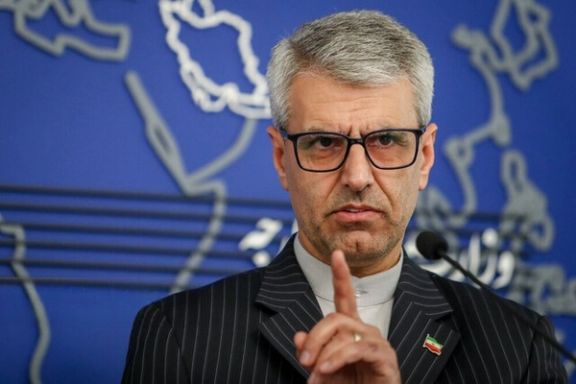
Foreign ministry spokesperson Esmaeil Baghaei.

Iran said it will respond firmly to any politically motivated or unlawful action against its nuclear program, as Western powers push for a non-compliance resolution at the UN nuclear watchdog’s Board of Governors meeting in Vienna.

The draft resolution, backed by the United States, France, Germany, and the United Kingdom, follows a confidential report by International Atomic Energy Agency (IAEA) Director General Rafael Grossi, circulated to member states late last month. The report raised concerns over undeclared nuclear activity at multiple Iranian sites and Iran’s continued accumulation of highly enriched uranium.

Foreign ministry spokesperson Esmail Baghaei rejected both the IAEA report and the resolution as politically driven. “Any extralegal action against Iran’s national interests will be met with a strong and proportionate response,” he said in a radio interview aired by Iranian state media on Tuesday.

Baghaei said the report lacked new technical evidence and repeated allegations already resolved under the 2015 nuclear deal. He accused Western governments of attempting to revive closed cases and impose pressure on Iran through the agency’s mechanisms.

“There is no evidence in the report of non-compliance or deviation from peaceful activities,” he added.

He emphasized that peaceful uranium enrichment is Iran’s legal right under the Non-Proliferation Treaty (NPT), and warned that any further escalation would be met with reciprocal steps. He did not specify what measures Iran might take.

Earlier in the week, the spokesperson of Iran's atomic agency, Behrouz Kamalvandi, said that the last resolution by the agency led Tehran to increase its 60-percent uranium production sevenfold, launch 20 cascades of centrifuges, and install new generations of centrifuges.

IAEA chief Grossi said on Monday that while the resolution process is separate from indirect nuclear talks between Tehran and Washington, the two tracks clearly influence one another. “There is no formal link, but there is mutual influence,” he said.

Iran has yet to formally respond to the latest US proposal on the nuclear file. President Donald Trump said on Monday he expected a new round of talks on Thursday, but Iranian officials said that timeline is unlikely. Baghaei later said discussions are being planned for Sunday in Muscat.

Most Viewed

Ghalibaf defends Iran-US talks amid hardline backlash
1
INSIGHT

Ghalibaf defends Iran-US talks amid hardline backlash

2
INSIGHT

100 days after carnage: Iran economy reels from war, inflation, unemployment

3
INSIGHT

A nation in limbo: 100 days after the massacre, has the world moved on?

4
ANALYSIS

From instability to influence: Pakistan’s pivotal role in US-Iran diplomacy

5
ANALYSIS

100 days on: why Iran’s January protests spread across social classes

Banner
Banner

Spotlight

  • War-hit homeowners feel abandoned as Iran’s reconstruction aid fades

    War-hit homeowners feel abandoned as Iran’s reconstruction aid fades

  • 100 days on: the anatomy of Iran’s January crackdown
    INSIGHT

    100 days on: the anatomy of Iran’s January crackdown

  • Ghalibaf defends Iran-US talks amid hardline backlash
    INSIGHT

    Ghalibaf defends Iran-US talks amid hardline backlash

  • 100 days on: why Iran’s January protests spread across social classes
    ANALYSIS

    100 days on: why Iran’s January protests spread across social classes

  • From instability to influence: Pakistan’s pivotal role in US-Iran diplomacy
    ANALYSIS

    From instability to influence: Pakistan’s pivotal role in US-Iran diplomacy

  • A nation in limbo: 100 days after the massacre, has the world moved on?
    INSIGHT

    A nation in limbo: 100 days after the massacre, has the world moved on?

•
•
•

More Stories

Trump says Iran involved in Gaza hostage talks

Jun 10, 2025, 07:17 GMT+1

US President Donald Trump said on Monday that Iran is involved in negotiations aimed at securing a ceasefire and the release of hostages between Israel and Hamas in Gaza.

“Gaza right now is in the midst of a massive negotiation between us and Hamas and Israel, and Iran actually is involved,” Trump told reporters at the White House. “We want to get the hostages back.”

Trump gave no further details.

The US has proposed a 60-day ceasefire in Gaza. Israel has accepted the plan, while Hamas has not agreed. The proposal includes the release of 28 Israeli hostages, both living and dead, in exchange for 1,236 Palestinian prisoners and the remains of 180 Palestinians.

Separately, Trump said talks with Iran on its nuclear program were continuing but differences remained. He said Iran wanted to continue enriching uranium, which the US opposes.

“They seek enrichment. We can’t have enrichment,” Trump said.

Earlier on Monday, Iran’s foreign ministry said it would soon present a counter-proposal to a recent US offer, which it has called unacceptable.

Trump told reporters he expected the next round of discussions to take place on Thursday. However, Spokesperson Esmail Baghaei later said the next round of indirect negotiations was being planned for Sunday in Muscat.

UN nuclear chief says Israeli strike may push Iran toward the bomb

Jun 9, 2025, 21:44 GMT+1

An Israeli strike on Iranian nuclear sites may push Tehran toward pursuing a bomb, International Atomic Energy Agency (IAEA) chief Rafael Grossi told Israeli news channel i24News.

Such an attack "might have an amalgamating effect which would make a determination on the part of Iran to go to a nuclear weapon or to abandon the treaty on non-proliferation. I’m telling you this because they have told me,” Grossi said.

The IAEA chief emphasized the difficulty any military operation would have of destroying Iran's nuclear capabilities.

“Certainly this program runs wide and deep. And when I say deep, I know what I’m saying. So many of these facilities are extremely well protected. This would require a very, very devastating force to affect it.”

The United States and Iran are locked in high-stakes negotiations over Tehran's nuclear program, and US President Donald Trump has mooted an attack if they fail.

Israel struck multiple targets inside Iran in October and has repeatedly vowed to deny Iran a nuclear weapon, which it views as an existential threat.

Tehran denies seeking nuclear weapons but its arch-nemesis Israel and Western countries doubt its intentions.

Grossi said Iran needed to the let the nuclear watchdog do its job by allowing more inspection and explaining past behavior.

"I am in a constant dialog, especially with the foreign minister (Abbas) Araghchi," Grossi said. "(They say) they have nothing happened. If this is the case, then they should allow us to do our job and to get as much access as we can."

Western powers may push for a resolution finding Tehran non-compliant with its nuclear non-proliferation obligations at the upcoming quarterly meeting of the IAEA Board of Governors this week.

Iran has warned of an unspecified strong response to any such move and has accused the IAEA of being swayed by its Western adversaries.

The United States accused Iran of seeking a nuclear weapon as part of the shadowy Amad Project scrapped in 2004, an effort Washington says was overseen by Iran’s Organization of Defensive Innovation and Research.

"There are areas of real concern and we need to get to the bottom of a number of things," Grossi said, without referring to any specific issues.

"Over the past few years ... we discovered traces of enriched uranium in places that were not supposed to be having any nuclear activity. So my question here - this is not an accusation - It's just a very logical question: if we found these traces there, what was going on?"

The IAEA would likely play a central role in verifying and overseeing any nuclear agreement between Iran and the United States, as it did with an international deal US President Donald Trump scrapped in 2018.

Hawks in Israel and the United States have said Iran's lack of full disclosure on past activities calls into question its commitment to any future deal.

"For years ... we have been getting some answers, and these answers have not been satisfactory," Grossi added. "Please do not believe that we are naive."

Iran warns of retaliation against Israeli nuclear sites if attacked

Jun 9, 2025, 18:25 GMT+1

Iran’s Supreme National Security Council issued a warning on Monday that any Israeli attack on Iranian nuclear facilities will be met with a direct response targeting Israel’s concealed nuclear infrastructure.

Iran’s state broadcaster IRIB reported on Saturday that Iranian intelligence services had obtained a large cache of sensitive material from Israel, including documents related to the Jewish state's nuclear and strategic facilities.

The intelligence operation yielded a “significant intelligence achievement,” the Supreme National Security Council's said in a statement, adding that a detailed database of Israeli targets is now at the disposal of Iran’s armed forces.

“In the event of aggression, the (Israeli) regime’s hidden nuclear facilities will be targeted,” the statement said.

The council emphasized that this intelligence gain was part of “a smart, quiet strategy” by the Islamic Republic in response to what it described as hostile media and political pressure.

It further praised what it described as "the tireless and unassuming efforts of the armed forces aimed at building operational capabilities tailored to the weaknesses and strengths of the Zionist occupying regime (Israel) and its supporters."

Iran's intelligence and operational readiness, the statement added, now allows Iran’s forces to immediately retaliate not only against nuclear threats but also against any act of sabotage targeting Iran’s economic or military infrastructure.

Iran’s intelligence minister said on Sunday the documents will soon be made public. However, Israeli security experts have cast doubt on Tehran’s claims of obtaining sensitive Israeli intelligence as exaggerated or psychological warfare.

Asher Ben-Artzi, a former head of Israel’s Interpol, told Iran International, “I know that the relevant information is well-guarded in Israel and it does not seem to me that hackers can access it."

He warned that the intelligence may not be as significant as claimed. “Iran wants to tell the world that their intelligence personnel are professionals, but they probably think that their use of disinformation will increase their achievements,” he said.

In 2018, Israel said it had stolen Iran's nuclear documents including 55,000 pages and 55,000 digital files from a warehouse in Tehran's Shourabad area through an intelligence operation.

Gas tank explosion at Iran's Natanz steel complex kills one, injures seven

Jun 9, 2025, 17:21 GMT+1

An Afghan worker was killed and seven others injured following the explosion of a gas tank at the Sharif Khaledabad Steel Complex in Natanz, a city in central Iran which houses the country's main uranium enrichment facility.

Local emergency officials confirmed the incident occurred on Sunday, resulting in the immediate death of one worker who was a national of Afghanistan.

The seven others who were wounded in the blast were promptly transferred to a nearby medical facility for treatment. No further details were released regarding the extent of their injuries.

The acting head of the Natanz Emergency Services said the precise cause of the explosion remains under investigation. Authorities are continuing their inquiry into the circumstances surrounding the incident.

Natanz is primarily known as the site of Iran's main uranium enrichment facility. The facility, officially known as the Shahid Ahmadi Roshan Nuclear Facility, is a key component of Iran's nuclear program.

Cautious Democrats seek Iran talks success but question backroom approach

Jun 9, 2025, 16:50 GMT+1
•
Marzia Hussaini

Democratic lawmakers on the sidelines of the Trump administration's high-stakes nuclear talks with Iran largely hope for their success but lament being cut out of a process playing out behind closed doors.

While hawkish Republicans and a lone Democratic Senator John Fetterman have vocally questioned Iran's nuclear intentions as Trump has pushed for harsher terms, mainstream members of the caucus have mostly kept mum.

Trump in 2018 exited an international deal inked under Democratic President Barack Obama, much to the party's consternation, but its leadership has signaled cautious backing for a new stronger deal.

House Minority Leader Hakeem Jeffries last week blessed the diplomatic effort but questioned why Congress was not being briefed.

"With respect, we don't have a great deal of visibility into what President Trump is trying to accomplish in terms of the current negotiations with Iran," the New York representative said.

"Iran should never be allowed to become nuclear capable, and ... (a deal) should be longer and stronger than what had previously existed, and should be done in a manner that is verifiable and resilient."

Jeffries told Iran International "that a future agreement must be stronger than its predecessor—enforceable in a lasting way, with real consequences for violations.”

The crux of the dispute in talks appears to center around enrichment. While Obama's deal allowed limited uranium enrichment on Iranian soil, a toughened line by Trump's negotiators demands a total halt - a scenario Tehran has repeatedly rejected.

Senator Chris Murphy, a Connecticut Democrat who sits on the Senate Foreign Relations Committee, was more critical of the administration's handling of the key foreign policy issue.

"As far as I know the administration has provided zero briefing to this committee on the negotiations, so they seem to be happening totally in secret," Murphy told Iran International.

"I think that's pretty dangerous for the American people to be kept in the dark about these negotiations, especially really sensitive negotiations that involve a potential nuclear war," he added.

Democrat maverick

Republicans, by contrast, who appear to have no more formal briefing than their counterparts across the aisle have consistently expressed in news interviews and social media posts a reticence to trust Iran in a new agreement.

Perhaps the harshest line on Iran has been taken not by Republican but by Democratic Senator John Fetterman of Pennsylvania, a strident advocate of Israel who suggested on X last week that Washington should bomb its way out of the Iran impasse.

His remarks hinted that Iran's highly enriched uranium stockpile should be hit with a US bunker-buster bomb.

While bellicose Republican rhetoric toward Iran is familiar territory, a sitting Democrat openly advocating for preemptive military action is almost unprecedented in the post-Iraq invasion era.

According to an aide close to Fetterman who spoke to Iran International on condition of anonymity, he views Iran’s nuclear program as a “ticking time bomb.”

Fetterman, the aide added, believes any delay in confronting Iran militarily could leave both the United States and Israel with fewer and riskier options in the future.

An Israeli preemptive strike would be a “once-in-a-generation opportunity” to, in his words, “obliterate” the Islamic Republic’s nuclear ambitions.

The emergence of Fetterman’s hawkish line has intensified long-standing tensions within Democratic ranks over the use of military power and America’s strategic posture in the Middle East.

For Democrats, Fetterman’s rhetoric adds a new layer of complexity as the party seeks to re-establish a distinct foreign policy identity in opposition.

While they seek to articulate a position that contrasts meaningfully with the Trump administration, avoiding internal fragmentation or policy incoherence will be key.