• العربية
  • فارسی
Brand
  • Iran Insight
  • Politics
  • Economy
  • Analysis
  • Special Report
  • Opinion
  • Podcast
  • Iran Insight
  • Politics
  • Economy
  • Analysis
  • Special Report
  • Opinion
  • Podcast
  • Theme
  • Language
    • العربية
    • فارسی
  • Iran Insight
  • Politics
  • Economy
  • Analysis
  • Special Report
  • Opinion
  • Podcast
All rights reserved for Volant Media UK Limited
volant media logo

Iran truckers face arrests and pressure as nationwide strike enters sixth day

May 27, 2025, 23:15 GMT+1Updated: 08:09 GMT+0

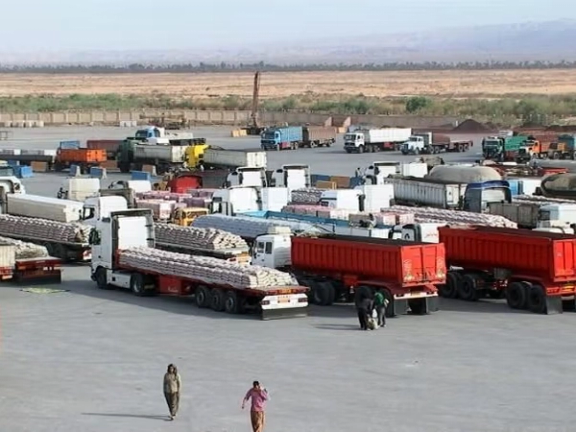
Iran's security forces have escalated efforts to suppress the nationwide truck drivers' strike through arrests, summonses, and intimidation, particularly in the southern city of Sirjan, as the strike stretches into its sixth day.

Sources told Iran International that intelligence and security agencies have begun directly contacting and summoning truck drivers in Sirjan, Kerman province, with several reportedly detained in an attempt to break the strike.

On Tuesday, the Islamic Revolutionary Guard Corps (IRGC) in Kerman province said in a statement that it had dismantled what it called an “organized anti-security network” operating across several provinces.

The statement did not specify the network’s alleged activities or any link to the truckers' strike.

Iran's Truckers and Heavy Vehicle Drivers Union released a statement marking the sixth day of the strike, confirming that 11 drivers and truck owners had been detained in Kermanshah, western Iran.

The union called for their immediate and unconditional release, saying, “Repression, arrest, and threats are not a response to legitimate demands — they are a sign of desperation in the face of our growing call for justice.”

In response to the arrests, hundreds of drivers in Kermanshah staged a protest in front of the provincial governor’s office, denouncing what they described as unjust treatment and expressing solidarity with their detained colleagues.

Launched on May 22 in the southern port city of Bandar Abbas, the coordinated protest has since spread widely across the country, with truckers pledging to hold out for a full week or longer if their demands remain unmet.

Drivers are demanding better working conditions, higher freight rates, and relief from high insurance costs and fuel restrictions.

Most Viewed

Iran International says it won’t be silenced after London arson attack
1

Iran International says it won’t be silenced after London arson attack

2
VOICES FROM IRAN

Hope and anger in Iran as fragile ceasefire persists

3
INSIGHT

How Tehran bends its own red lines to boost state rallies

4

Iran halts petrochemical exports to supply domestic market

5

US arrests Iranian national over alleged Basij-linked visa fraud

Banner
Banner

Spotlight

  • Too early to tell who is winning Iran war, experts say
    PODCAST

    Too early to tell who is winning Iran war, experts say

  • How Tehran bends its own red lines to boost state rallies
    INSIGHT

    How Tehran bends its own red lines to boost state rallies

  • Iran blackout cripples freelancer, small business incomes
    VOICES FROM IRAN

    Iran blackout cripples freelancer, small business incomes

  • Ideology may be fading in Iran, but not in Kashmir's ‘Mini Iran'
    INSIGHT

    Ideology may be fading in Iran, but not in Kashmir's ‘Mini Iran'

  • US blockade enters murky phase as tankers spoof signals and buyers hesitate
    ANALYSIS

    US blockade enters murky phase as tankers spoof signals and buyers hesitate

  • Why the $100 billion Hormuz toll revenue is a myth
    ANALYSIS

    Why the $100 billion Hormuz toll revenue is a myth

•
•
•

More Stories

Inflation-stricken Iranians voice anger over soaring costs

May 27, 2025, 21:25 GMT+1

Iranians have expressed anguish and exhaustion and detailed their daily struggle to afford basic goods amid soaring inflation in messages submitted to Iran International.

A stream of voice messages and videos sent in from across the country to Iran International's submissions line points to a population grappling with collapsing purchasing power and authorities they see as out of touch with their plight.

The average monthly salary in Iran is around 150 to 200 million rials—equivalent to approximately $200-$250. But for residents in Tehran, especially those with families, this amount barely covers essentials.

One video showed a family’s lunch—just potatoes, yogurt and bread—accompanied by a bitter message voiced by the person filming: “May God curse you."

“Two packed small cakes and two juices cost 1,000,000 rials ($1.2),” said one person by audio message. “How long must we live like this?”

From grocery items to medical care, costs have surged dramatically. A 10 kg bag of Pakistani rice now sells for 9,800,000 rials ($11.80), while apples and pears fetch up to 7,000,000 rials/kg ($8.43)

Others described medical burdens. A pensioner, aged 70, said his income was just 38,000,000 rials (around $45.8) a month. “Half of that goes to medication,” he said. In another message, a military veteran said he had to pay out of pocket for cold medicine. “At my age, this is shameful,” he added.

Multiple complaints targeted the government's National Housing Plan. One registrant said she borrowed 1,500,000,000 rials (around $1,800) for a housing deposit but never received the promised loan. “Why aren’t you giving people their loans, President Pezeshkian?” she asked.

Others addressed Iran’s leadership more broadly. “You say you’ll destroy America,” one voice said, “but people are paying 16,500,000 rials ($20) just to buy soy and beans.”

Another pointed to baby formula: two subsidized cans plus a painkiller cost over 3,400,000 rials ($4.10), with unsubsidized prices higher. “So what’s the point of subsidies?”

Several messages referenced US President Donald Trump’s recent remarks during his Middle East tour, calling Iranian leaders “thieves.” One man said, “If you’re not thieves, why are people bent over in garbage bins?”

The sharp rise in prices for basic goods such as the cheapest type of bread called lavash—up from 65,00 rials to 13,250 in under a year (~$0.008 to $0.016)—has left many Iranians how their static incomes can ever catch up to soaring costs. “Who gets a raise that often?” one asked.

The voices together point to a society under strain with many seeing no financial future in the status quo.

Iranian prisoner accused of spying for Israel faces imminent execution

May 27, 2025, 20:00 GMT+1

Political prisoner Pedram Madani is facing imminent execution in Iran after being resentenced to death for alleged espionage for Israel, drawing sharp rebukes from rights groups and public figures.

Nobel Peace Prize laureate Nargess Mohammadi described the case as “a blatant act of injustice,” citing what she called coerced confessions, denial of legal representation and a biased judicial process.

“Pedram was denied a lawyer of his choosing. His confession was extracted under pressure and torture in solitary confinement,” Mohammadi wrote on Instagram.

“They hang innocent youths by the neck while knowing full well the confessions were false and the prisoner, even under their own laws, does not deserve the death penalty.”

Madani, who is around 40 years old, was arrested in 2019 on charge of spying for Israel and sentenced to death by a Revolutionary Court on charges of “corruption on earth.”

According to Norway-based Iran Human Rights (IHR), Iran’s Supreme Court overturned the death sentence three times, but each time the case was reassigned to other courts which reinstated the verdict.

Madani was moved Sunday from Tehran’s Evin Prison to Ghezelhesar Prison, and his family was summoned for a final visit—moves widely interpreted as indicators of imminent execution.

“Death sentences in Iran, especially on charges such as espionage, are issued and carried out without any due process. These executions are extrajudicial killings that the international community should not remain indifferent to,” said Mahmood Amiry-Moghaddam, director of IHR.

Madani’s case has triggered renewed calls for action from civil society and former detainees.

The official support account for Olivier Grondeau, a French national recently freed from Iranian detention, posted, “Three times, his death sentence was overturned by the Supreme Court. Yet, he is scheduled to be executed tomorrow. We demand the immediate cancellation of his execution.”

From Evin Prison, civil activist Mehdi Mahmoudian said Madani was previously misled with false promises of clemency from intelligence agencies.

Mahmoudian described Madani as the third inmate in a month to be removed from Evin’s Ward 4 for execution, warning of a “terrifying pattern of accelerated capital sentences.”

Iran late last month executed Mohsen Langarneshin, a 32-year-old network security engineer accused of helping Israel carry out assassinations and bomb attacks. However, a prominent activist, human rights groups and a leaked call from the condemned prisoner indicated the charges were false.

At least 113 executions have been recorded in the first 25 days of 2025, IHR said, underscoring what it calls a deepening execution crisis.

“As long as executions go on,” the Grondeau support group wrote, “every day in Iran will be a day of mourning.”

Could Kurdish gas deals with US spell trouble for Iran?

May 27, 2025, 19:05 GMT+1
•
Negar Mojtahedi

Two major energy agreements signed between US companies and the Kurdistan Regional Government (KRG) have sparked swift backlash from Baghdad and could undercut Iran’s long-standing economic and political grip on Iraq.

During a high-profile visit to Washington in May, KRG Prime Minister Masrour Barzani announced the deals with HKN Energy and WesternZagros, targeting development of the Miran and Topkhana-Kurdamir gas fields in the western part of the region near the Syrian border. Together, the projects are valued at $110 billion over their lifetime.

The US-KRG energy deals have sent a powerful message—both to Baghdad and to Tehran. If realized, they could shift Iraq’s energy independence and diminish Iran’s regional clout.

US Energy Secretary Chris Wright praised the deals at the Al-Monitor Global Institute in Washington on May 22, calling them “very aligned with President Trump’s agenda.”

He added, “We need Iraq and others off Iranian dependence.”

Secretary of State Marco Rubio met with Prime Minister Barzani in Washington on May 23. According to the State Department, the Secretary praised the energy agreements and reaffirmed US support for a strong and resilient Kurdistan Region within a sovereign and prosperous federal Iraq.

But analysts believe without a breakthrough in Baghdad-Erbil relations and tangible infrastructure investment, the deals remain aspirational—more of a political statement than a pipeline to regional transformation.

Iran’s gas grip at risk

Iran currently supplies around 25% of Iraq’s electricity needs through natural gas exports. Should the Kurdish projects proceed, that influence could be seriously eroded.

According to Iman Nasseri, Managing Director for the Middle East at FGE, Iran has little to gain financially from its gas exports to Iraq, and growing domestic shortages are shifting Tehran’s calculus.

He told Iran International, “They’re (Iraq) receiving gas for free because they have the excuse of not being able to pay due to US sanctions....Iran would welcome any scenario that could get Iraqis off the contract that they have signed with the Iranians [...] because they are short in natural gas at the moment."

Nasseri said that while the gas fields targeted by the US-KRG deals—estimated to hold 13 trillion cubic feet collectively—are indeed substantial, the main obstacles to their development have always been political and economic, not technical.

Strategic implications for Iran

Meanwhile, Baghdad swiftly denounced the agreements. Iraq’s Oil Ministry declared them “null and void." A senior Iraqi official told Reuters the central government had not been informed in advance.

KRG’s Ministry of Natural Resources defended the move, citing existing legal frameworks and long-standing contracts validated by Iraqi courts.

Energy analyst Dalga Khatinoglu told Iran International that the gas reserves in Iraqi Kurdistan—estimated at over 211.9 trillion cubic feet —are large enough to position the region as a major exporter to Turkey and Europe.

While Iran holds five times more gas, he warned, Tehran risks losing its most critical energy customers if the Kurdish fields come online.

“Iran earns $5 billion a year from gas exports to Iraq and Turkey,” Khatinoglu said, underscoring the threat to both revenue and regional influence. If Kurdish gas starts reaching Turkey and Europe, Iran not only loses market share—it loses geopolitical leverage.

US policy or political signal?

Ambassador John Craig, a former senior US diplomat, told Iran International the announcement may signal more of a “test” than a decisive turning point.

“The KRG is testing the water—to see how the Iranians react to it and how the US reacts to it,” he said, emphasizing that Iran “no longer has the punch” it once did following Israeli strikes that “took out all their munitions factories” and weakened Tehran’s regional leverage.

Craig is a former US ambassador to Oman under President Clinton and later served as director for the Middle East at the National Security Council under President George W. Bush.

He said that while the Kurdish leadership may see an opening to act more independently, the projects are far from being realized. “This is not going to happen in the next 10 months, no. It’s long term,” he said. “Exploration, production, development—it could take three to five years.”

Nasseri also described the deals as more symbolic than real, likening them to ‘wishful thinking’ without the conditions needed for execution. He emphasized that Kurdistan currently lacks a viable off-taker, adding, "you can’t develop gas without finding a place and an off-taker that can consume that gas.”
Iran open to compromise in 'so many ways' for a nuclear deal - CNN

May 27, 2025, 08:30 GMT+1

Iran is open to compromise in nuclear talks with the United States, but uranium enrichment remains non-negotiable, CNN reported citing an interview with foreign ministry spokesperson Esmail Baghaei on Monday.

“If the intention is to make sure that Iran’s nuclear program would not be weaponized, I think that’s something that we could simply do,” Baghaei said.

“If the (US) intention is to deprive Iranians of their right to peaceful nuclear energy, I think that would be very problematic to the extent that I think it would really challenge the whole process,” he added.

Asked how a compromise could be reached, he replied, “So many ways,” without elaborating.

Following Tehran and Washington's fifth round of nuclear talks, US President Donald Trump on Sunday said that “real progress” had been made in recent talks with Iran and suggested there could be “some good news” in the coming days.

However, in spite of the contentiousness of the issue, Baghaei suggested there is room for maneuver.

“The fact that so far we have continued our talks means that we understand there is a certain level of understanding that Iran cannot under any circumstances give up its right to peaceful nuclear energy,” he said.

Last week, Iran's Supreme Leader, Ali Khamenei, ruled out the option of ceasing enrichment.

"Saying things like 'we won’t allow Iran to enrich uranium' is way out of line. No one is waiting for anyone’s permission. The Islamic Republic has its own policy, its own approach, and it will continue to pursue it," he said, going as far as to say he felt it would be the issue to break the talks.

"Indirect negotiations took place (under Raisi) as well—just like now—but without results,” Khamenei said during a memorial ceremony for the late president and others killed in a helicopter crash last May.

“We do not think it would yield results now either. We do not know what will happen.”

Iranian cleric arrested in Saudi Arabia after critical video

May 27, 2025, 07:31 GMT+1

A senior Iranian cleric affiliated with the office of Supreme Leader Ali Khamenei was arrested in Saudi Arabia during the annual Hajj pilgrimage after publishing a video critical of the kingdom’s religious and cultural policies, Iranian state media reported on Monday.

Gholamreza Ghasemian, a conservative religious scholar and a former head of Iran’s parliamentary library and documentation center, was detained in the city of Medina while performing Hajj rituals, the reports said.

On Tuesday, Iran’s judiciary spokesman said the arrest of Gholamreza Ghasemian in Saudi Arabia was “unjustified and unlawful,” adding that the Foreign Ministry would follow up on the case.

Saudi authorities have not commented publicly on the matter.

In a video posted before his arrest, Ghasemian criticized Saudi Arabia, accusing it of transforming the Islamic holy cities of Mecca and Medina into destinations for entertainment and commercialization.

He also described conditions for pilgrims as highly restrictive, alleging that Saudi authorities prevent worshippers from engaging deeply with Islamic teachings during Hajj.

Cleric linked to 2016 Saudi embassy attack

Ghasemian has been linked by an Iranian documentary filmmaker to the 2016 attack on Saudi diplomatic missions in Iran, which triggered a major rupture in relations between Tehran and Riyadh.

According to the filmmaker, Javad Mogouei, Ghasemian gave a fiery speech at a religious gathering shortly before some attendees went on to storm the Saudi embassy in Tehran.

The assault on the embassy and the consulate in Mashhad came after Saudi Arabia’s execution of prominent Shia cleric Nimr al-Nimr. The incident led Riyadh to sever diplomatic ties, accusing Iran of failing to protect foreign missions. Iranian security forces were widely criticized for allowing demonstrators to set fire to the embassy and destroy diplomatic property.

Saudi and Iran continue to rebuild relations

The arrest comes at a time of cautious rapprochement between Tehran and Riyadh, who resumed diplomatic relations in 2023 after a seven-year break.

In April, Saudi Defense Minister Prince Khalid bin Salman made a rare visit to Tehran, marking only the second such trip since Iran’s 1979 revolution.

Ties have also improved in practical terms. Earlier this month, a direct flight by Saudi carrier Flynas landed in Iran for the first time in nearly a decade, marking the start of Hajj operations under a bilateral agreement that will see around 37,000 Iranian pilgrims flown to Saudi Arabia by July 1. Flynas and Iran Air are jointly operating the routes.