• العربية
  • فارسی
Brand
  • Iran Insight
  • Politics
  • Economy
  • Analysis
  • Special Report
  • Opinion
  • Podcast
  • Iran Insight
  • Politics
  • Economy
  • Analysis
  • Special Report
  • Opinion
  • Podcast
  • Theme
  • Language
    • العربية
    • فارسی
  • Iran Insight
  • Politics
  • Economy
  • Analysis
  • Special Report
  • Opinion
  • Podcast
All rights reserved for Volant Media UK Limited
volant media logo

Iran’s army chief says forces ‘fully prepared’ for more attacks on Israel
May 26, 2025, 10:46 GMT+1
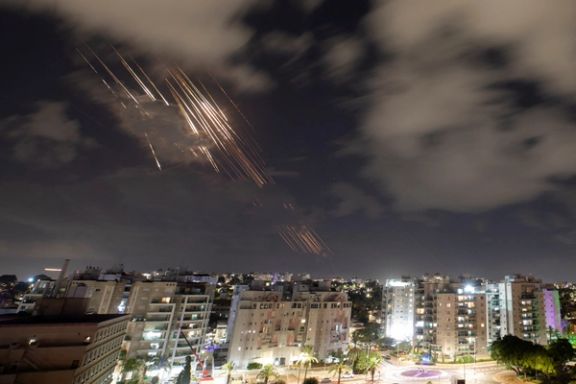
Israel's Iron Dome anti-missile system intercepts rockets after Iran fired a salvo of ballistic missiles, as seen from Ashkelon, Israel, October 1.

Iran’s top army commander warned on Monday that the military is fully prepared for more direct attacks on Israel as the two sides continue to exchange war-talk.

“If they [Israel] are in a rush to receive another True Promise operation [aerial assault], we are fully ready to deliver an appropriate strike — and collect on what they already owe us,” Major General Abdolrahim Mousavi, Commander-in-Chief of Iran’s Army, said during a military ceremony using the code name of Iran’s direct attacks on Israel.

Mousavi’s comments come amid a multi-front conflict between Israel and Iranian-aligned forces, including Hezbollah in Lebanon, groups in Syria and Iraq and the Houthis in Yemen, in the wake of the war in Gaza sparked by Iran-aligned Hamas's October 7 attacks on Israel.

Israeli and US officials have said that recent operations have weakened Iran’s regional capabilities, particularly following an Israeli airstrike on Iranian targets including air defense systems in late October, and a spate of attacks on infrastructure and leadership of Iran's strongest ally, Hezbollah, last year.

Responding to what he described as “rhetoric” from Israeli leaders, Mousavi dismissed the threats as bluster, saying the Israeli leadership “lacks the capacity to harm the greatness of Iran.”

He added that Tehran’s response, should conflict escalate, would bring “extraordinary challenges” for Israel and its allies.

The remarks echo recent comments from senior Islamic Revolutionary Guard Corps (IRGC) commander Ali Fadavi, who said in February that Iran would launch a third direct strike on Israel “in due course” — an operation dubbed True Promise 3.

Iran's first direct attack on Israel, Operation True Promise 1 on April 13 involved over 300 missiles and drones targeting military installations with minimal damage, retaliating for the killing of two Iranian generals in Damascus.

Operation True Promise 2 on October 1 followed with around 200 missiles targeting Israeli military facilities after the assassination of Iran-aligned militant leaders, including former Hezbollah leader Hassan Nasrallah and Hamas political chief Ismail Haniyeh.

Fadavi said that Iran had withstood external threats for over four decades, describing the United States and Israel as “the Great Satan and its partners.”

The phrase, a hallmark of the Islamic Republic’s revolutionary rhetoric, underscores Iran’s framing of its confrontation with the West as both geopolitical and ideological.

Despite the combative tone from Tehran, US and Israeli officials maintain that their policies of deterrence and sanctions are limiting Iran’s influence and delaying its nuclear ambitions.

US President Donald Trump, who has expressed his optimism over the ongoing indirect nuclear negotiations, which he says are preferred over threats of 'bombing' Iran, also reinstated the “maximum pressure” campaign aimed at curbing Iran’s nuclear program and regional activities.

"You cannot threaten Iran on one hand and claim to support dialogue on the other," Foreign Ministry spokesperson Esmaeil Baghaei said on several occasions since the negotiations began.

Most Viewed

Ghalibaf defends Iran-US talks amid hardline backlash
1
INSIGHT

Ghalibaf defends Iran-US talks amid hardline backlash

2
ANALYSIS

From instability to influence: Pakistan’s pivotal role in US-Iran diplomacy

3
ANALYSIS

100 days on: why Iran’s January protests spread across social classes

4

War-hit homeowners feel abandoned as Iran’s reconstruction aid fades

5
INSIGHT

100 days on: the anatomy of Iran’s January crackdown

Banner
Banner

Spotlight

  • The politics of pink: how Iran uses cuteness to rebrand violence
    ANALYSIS

    The politics of pink: how Iran uses cuteness to rebrand violence

  • Bread shortages, soaring prices strain households in Iran, residents say
    VOICES FROM IRAN

    Bread shortages, soaring prices strain households in Iran, residents say

  • War-hit homeowners feel abandoned as Iran’s reconstruction aid fades

    War-hit homeowners feel abandoned as Iran’s reconstruction aid fades

  • 100 days on: the anatomy of Iran’s January crackdown
    INSIGHT

    100 days on: the anatomy of Iran’s January crackdown

  • Ghalibaf defends Iran-US talks amid hardline backlash
    INSIGHT

    Ghalibaf defends Iran-US talks amid hardline backlash

  • From instability to influence: Pakistan’s pivotal role in US-Iran diplomacy
    ANALYSIS

    From instability to influence: Pakistan’s pivotal role in US-Iran diplomacy

•
•
•

More Stories

UK carrier strike group enters Red Sea amid Indo-Pacific deployment

May 25, 2025, 11:42 GMT+1

The United Kingdom’s Carrier Strike Group (CSG), led by HMS Prince of Wales, has entered the Red Sea as part of Operation Highmast, the country’s most extensive naval deployment in recent years, according to the UK Defense Journal.

The task group, which transited the Suez Canal early Saturday morning, includes warships from several NATO allies: Canada’s HMCS Ville de Québec, Norway’s HNoMS Roald Amundsen and logistics vessel Maud, and Spain’s ESPS Méndez Núñez. HMS Richmond is expected to join the group shortly.

The eight-month operation aims to strengthen defense ties and project the UK’s presence across the Indo-Pacific. Activities will include joint exercises, regional port visits, and security patrols in coordination with the United States, Australia, and Japan, according to the UK Ministry of Defense (MoD).

"This deployment demonstrates our commitment to upholding regional stability and ensuring maritime freedom," the MoD said in a statement.

The carrier group integrates UK F-35B stealth jets, Merlin helicopters, unmanned systems, and allied platforms in a range of training and operational missions, including anti-submarine warfare and integrated air defense.

Royal Air Force (RAF) assets provided overwatch during the transit. Two Poseidon MRA1 maritime patrol aircraft were observed operating over the Sinai Peninsula Saturday morning.

In preparation for the transit, the RAF also reinforced its forward base at Akrotiri, Cyprus, deploying four Voyager aerial refueling aircraft from RAF Brize Norton earlier in May.

The deployment comes at a time of heightened tension in the Red Sea region. Despite a recent ceasefire agreement between the United States and Yemen's Houthi rebels, the UK is not a signatory.

The move follows the departure of the US aircraft carrier USS Harry S. Truman from the Red Sea, leaving the area temporarily without a US carrier presence. While the USS Carl Vinson remains in the wider region, British officials acknowledge the vulnerability of the UK-led group as it operates near conflict zones.

Last month, the UK participated in a joint airstrike with US forces against a Houthi military facility in Yemen, targeting infrastructure used to manufacture drones implicated in attacks on commercial shipping.

The Houthis accuse the British of aiding Israel in the war in Gaza, supplying weapons, spare parts and intelligence.

There has been no formal announcement of the manoeuvre from the British military.

Iran International has put a request for comment to the Royal Navy.

Revolutionary Guard chief says Iran is ‘in full-scale war’

May 25, 2025, 09:36 GMT+1

Iran is engaged in a “full-scale war” on political, economic, and military fronts, but the country remains calm and stable internally, the commander of Iran’s Islamic Revolutionary Guard Corps (IRGC) said on Sunday.

Major General Hossein Salami, speaking at a ceremony honoring veterans of the Iran-Iraq war in West Azarbaijan province, said that although Iran faces what he described as a “powerful global coalition” of enemies, it continues to function normally at home.

“We are in a full war, but nothing appears warlike. The arenas of battle are active, but the country is at peace,” Salami said in remarks broadcast by state media.

“You see the enemy’s deployment, hear their rhetoric, and feel their political pressure. But the mystery lies in how this nation stands firm and dignified under such heavy pressure.

“All parts of the system are operating normally, while we are in a full-scale war. There is no anxiety among the people—this is exceptional and unprecedented,” he said.

Also on Sunday, commander of Iran’s Army Ground Forces said Iran’s army is fully prepared to respond to any threat “at any level and scale.”

“Our hands are truly on the trigger, and our eyes are wide open,” said Brigadier General Kioumars Heidari, according to state-affiliated ISNA news agency. “We are monitoring threats carefully and are ready to act on the command of the Supreme Leader.”

The comments come after a CNN report last week quoted US intelligence officials who said Israel was preparing to strike Iran's nuclear facilities if ongoing indirect US-Iran nuclear talks collapse.

Before the talks began, US President Donald Trump had already warned Iran that if a new deal was not reached within a set time, the US would bomb Iran.

Speaking to reporters, Heidari said the armed forces — including the regular army and particularly its ground forces — are positioned to retaliate swiftly and decisively against any hostile action.

“If any threat is carried out, rest assured that its origin will be wiped out in a fraction of a moment,” he said. “The people should have confidence that we will confront any threat, from any source, at any scale.”

Last week, Iran’s top military commander announced a major increase in the country’s air defense capabilities, including a fivefold rise in detection and tracking systems.

Last October, Israel carried out a major strike on Iranian targets, destroying large sections of the country’s air defense infrastructure. The attack followed two massive airstrikes from Tehran on Israel. Reports in Fox News and the Wall Street Journal said all of Iran’s S-300s were taken out of action.

“The country’s air defense readiness—especially in detection, identification, and elimination of aerial threats—has advanced significantly compared to last year,” Major General Mohammad Bagheri, the chief of staff of Iran’s armed forces, told the IRGC's Tasnim News Agency.

Iran says army helicopter missile systems upgraded

May 24, 2025, 15:27 GMT+1

Iran’s army aviation commander said on Saturday that the range and accuracy of the military’s helicopter-launched missiles have significantly improved, with all components now locally produced.

Brigadier General Ghasem Khamoushi, commander of the Islamic Republic’s Army Aviation (Havanirooz), said Iran has developed precision-guided and long-range missiles domestically and expanded the operational capabilities of its helicopters to include night missions using indigenously developed night-vision systems.

“Missile range has increased more than sevenfold, and targeting systems have become significantly more precise,” he told reporters during a ceremony marking the anniversary of the 1982 liberation of Khorramshahr during the Iran-Iraq war.

The city, taken by Iraqi forces early in the war, was retaken by Iran during Operation Beitol-Moqaddas in what is considered a turning point in the war.

Khamoushi added that key helicopter parts, previously affected by sanctions, are now produced in Iran using domestic expertise and knowledge-based companies. The advances, he said, will be formally unveiled in the coming weeks.

Khamoushi also said that Iranian helicopters, once limited to daytime operations, are now equipped to conduct missions in complete darkness, thanks to technological upgrades and locally developed equipment.

Trump's message to Iran on Arab tour was to ditch ideology, confrontation

May 23, 2025, 22:15 GMT+1
•
Negar Mojtahedi

President Donald Trump’s tour of Arab capitals this month aimed to draw a contrast between their pro-Western, prosperity-driven policies and Tehran's Islamic ideology and opposition, former Palestinian peace negotiator Ghaith al-Omari said.

As Arab states astride the Persian Gulf prosper, Iran remains mired in grievance, repression and decline, according to former Palestinian peace negotiator Ghaith al-Omari on Eye for Iran.

“The Persian Gulf is non-ideological. Their leaders say, ‘My job is how to make life better for my people.’ This is completely incompatible with the ideological mindset—including in Iran,” al-Omari said.

As Saudi Arabia and the UAE surge ahead—reimagining their economies and societies—Iran clings to a narrative rooted in the past.

“What is the narrative coming from the Iranian regime? It’s a narrative of grievance... rooted in the past, in both past grievances and past glory... not a view of prosperity.”

Al-Omari said the Middle East is undergoing a seismic shift, with Persian Gulf countries becoming the “center of gravity” in the region—and Trump recognizing and seizing that opportunity.

Decades of neglect

During his speech at the US-Saudi Investment Forum in Riyadh on May 13, 2025, President Trump drew a sharp contrast between the trajectories of Saudi Arabia and Iran. The president anccused Iran’s leadership for mismanaging the country and funding terrorism, while praising the transformation of its neighbors.

“Iran's decades of neglect and mismanagement have left the country plagued by rolling blackouts lasting for hours a day. All the time, you hear about it. While your skill has turned dry deserts into fertile farmland, Iran's leaders have managed to turn green farmland into dry deserts, as their corrupt water mafia—it's called the water mafia—causes droughts and empty riverbeds,” said Trump.

His remarks resonated with many Iranians, long critical of Tehran's failures. The speech reinforced a new US posture in the region—one that rewards progress and punishes destabilization.

Trump’s Persian Gulf tour also produced sweeping economic and defense agreements.

A $142 billion arms deal was signed, the largest defense cooperation agreement in US-Saudi history. It includes cutting-edge warfighting technology and signals a shift in US strategic posture.

Saudi Arabia committed to investing $600 billion in the United States across energy, defense, mining, and other sectors.

Taken together, these moves represent a strategic pivot: away from traditional diplomacy, and toward a model focused on mutual economic and security interests.

And one in which Iran—after its unprecedented direct missile attack on Israel last year—is increasingly isolated and weakened.

Even Syria adapts—leaving Tehran more isolated

Even Syria—long seen as a spoiler in regional affairs—is signaling a shift.

"Syria has been a spoiler in the region since the 1970s," said al-Omari. "Now Syria is not a spoiler."

Trump's outreach to Damascus, despite its authoritarian legacy, underscores the extent to which even old adversaries are repositioning themselves in a changing Middle East. As others pivot toward stability and integration, Tehran's confrontational stance risks leaving it behind.

Qatar

Qatar was also a focal point of Trump’s tour.

Qatar Airways agreed to purchase up to 210 planes from Boeing. Trump described it as “the largest order of jets in the history of Boeing.”

He also accepted a Boeing 747-8 aircraft from the Qatari government, valued at roughly $400 million. Trump said it would be “stupid” to turn it down, framing it as a donation to the US Department of Defense, not for personal use. The move sparked backlash, even among Trump’s own supporters.

Al-Omari criticized Qatar’s influence strategy, noting its financial clout and controversial alliances.

“Qatar is a very problematic actor. Qatar has been the supporter of Hamas, the supporter of Muslim Brotherhood, the supporter of disruption throughout the region.”

He added that while Persian Gulf countries all have relations with Iran, “Qatar has partnership with Iran in many ways. That’s different.”

Trump made headlines when, during a state dinner in Doha, he said: “Iran should say a big thank you to the Emir, because he's fighting for them.”

He also reportedly asked the Qatari government to push Iran toward a nuclear deal.

“The Qataris like these problematic relations to be behind the scenes, to be hush-hush," said al-Omari on Eye for Iran, "Trump being Trump, he doesn't like to play this subtle behind the scenes game. He says it as it is."

A new era of American diplomacy

Al-Omari said Trump’s approach marks a sharp departure from previous presidents like Barack Obama.

“Trump sees the region through a transactional lens. Obama focused on moral lectures. Trump prefers investment and deals—but keeps military options on the table, especially when it comes to Iran.”

The administration wants Iran to integrate into this future-oriented regional order—but warns of consequences if it doesn’t.

“There’s an opportunity for Iran if it wants to take it,” said al-Omari. “The region is changing—but not at any price.”

You can watch the full episode of Eye for Iran featuring Ghaith al-Omari on YouTube or listen on any major podcast platform like Spotify, Apple, Amazon Music or Castbox.

Slain Israeli embassy staffer had expressed solidarity with Iranian people

May 22, 2025, 13:41 GMT+1

Yaron Lischinsky, one of two Israeli embassy employees killed in a shooting outside the Capital Jewish Museum in Washington, had publicly expressed solidarity with the Iranian people and participated in events supporting democracy in Iran.

Lischinsky, who served as a Middle East affairs advisor at the Israeli embassy in Washington, was killed alongside his fiancée, Sarah Lynn Milgrim, by a lone gunman who opened fire on a group leaving a diplomatic event on Wednesday night.

A suspect, identified by police as 30-year-old Elias Rodriguez of Chicago, was taken into custody shortly afterward. Video footage shows him shouting "free free Palestine" after his arrest as police took him into custody.

The Israeli Foreign Ministry confirmed that both victims were locally employed staff members who had been active in cross-cultural dialogue and reconciliation efforts.

In previous posts on the social media platform X, Lischinsky had voiced support for the people of Iran, distinguishing them from the Islamic Republic. In a Nowruz message last year, he wrote: "The people of Iran are not our enemies. We wish them all the best and hope that one day peace will return."

Lischinsky had also participated in a conference organized by the National Union for Democracy in Iran (NUFDI), a US-based advocacy group, where he was seen in photos alongside Iranian opposition figures. One image shared from the event included a flag bearing the historic Lion and Sun emblem of Iran.

The shooting occurred just over a mile from the White House and has been described by Israeli and US officials as a targeted act of violence. Security around Israeli diplomatic facilities worldwide has since been heightened.

Lischinsky, originally from Bavaria, Germany, was remembered by colleagues and community members as a committed and empathetic figure who worked to build bridges in the Middle East.

Authorities continue to investigate the motive behind the attack, with the FBI investigating possible hate crime or terrorism motives though no formal terrorism charges have been announced.

FBI Deputy Director Dan Bongino wrote on X "Early indicators are that this is an act of targeted violence. Our FBI team is fully engaged and we will get you answers as soon as we can, without compromising additional leads."

Mayor Muriel Bowser told reporters, "We will not tolerate antisemitism ... the FBI's role, of course, as always when there is any possibility of a terrorist act, or acts motivated by hate or other bias, the FBI will be conducting those investigations."

The incident comes amid rising concerns about hate crimes linked to the Israel-Gaza conflict. Human rights groups have reported increased incidents of both antisemitic and anti-Arab violence in the United States since October 2023.