• العربية
  • فارسی
Brand
  • Iran Insight
  • Politics
  • Economy
  • Analysis
  • Special Report
  • Opinion
  • Podcast
  • Iran Insight
  • Politics
  • Economy
  • Analysis
  • Special Report
  • Opinion
  • Podcast
  • Theme
  • Language
    • العربية
    • فارسی
  • Iran Insight
  • Politics
  • Economy
  • Analysis
  • Special Report
  • Opinion
  • Podcast
All rights reserved for Volant Media UK Limited
volant media logo

Iran sees nuclear agreement with US as unlikely - CNN
May 23, 2025, 13:23 GMT+1Updated: 08:11 GMT+0
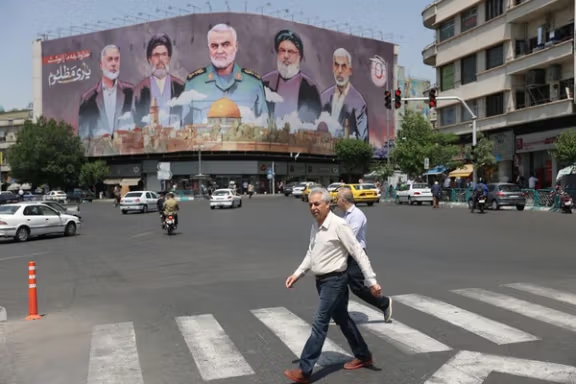
Pedestrians walk in front of a political baA street scene in Tehran

US-Iran talks appear unlikely to lead to an agreement if the United States continues to insist that Tehran dismantle its uranium enrichment program, CNN cited two Iranian sources as saying.

Iran's Supreme Leader Ali Khamenei this week dismissed US statements forbidding Iranian enrichment, and US secretary of state Marco Rubio gave his most detailed explanation yet about Washington's opposition to Iran's domestic capacity to do so.

Iran’s participation in the fifth round of talks in Rome on Friday is solely to gauge Washington’s latest stance rather than pursue a potential breakthrough, the sources cited by CNN added.

“The media statements and negotiating behavior of the United States has widely disappointed policy-making circles in Tehran,” CNN quoted the two Iranian sources as saying in a joint message.

“From the perspective of decision-makers in Tehran, when the US knows that accepting zero enrichment in Iran is impossible and yet insists on it, it is a sign that the US is fundamentally not seeking an agreement and is using the negotiations as a tool to intensify pressure.”

They added that while some Iranian officials initially hoped for a “win-win” compromise, a consensus has since formed that the Trump administration is pushing the talks toward deadlock.

Asked by a CNN reporter about the sources' comments before publication on Thursday, US state department spokesperson Tammy Bruce said the resumption of talks was the most important thing.

"It's gossip," she told reporters. "Some people don't have an interest in (talks' success), and that's where you get unnamed sources from.

"What is the story and what matters is that everyone is at the table in Rome."

With the current US position, the sources told CNN, the negotiations are becoming unproductive and may not continue much longer.

The sources said Tehran no longer takes seriously US efforts to distance itself from Israel’s position and believes the American proposals follow the agenda of Israeli Prime Minister Benjamin Netanyahu, who has demanded that Iran be barred from all uranium enrichment.


Most Viewed

Ghalibaf defends Iran-US talks amid hardline backlash
1
INSIGHT

Ghalibaf defends Iran-US talks amid hardline backlash

2
ANALYSIS

From instability to influence: Pakistan’s pivotal role in US-Iran diplomacy

3
ANALYSIS

100 days on: why Iran’s January protests spread across social classes

4

War-hit homeowners feel abandoned as Iran’s reconstruction aid fades

5
INSIGHT

100 days on: the anatomy of Iran’s January crackdown

Banner
Banner

Spotlight

  • The politics of pink: how Iran uses cuteness to rebrand violence
    ANALYSIS

    The politics of pink: how Iran uses cuteness to rebrand violence

  • Bread shortages, soaring prices strain households in Iran, residents say
    VOICES FROM IRAN

    Bread shortages, soaring prices strain households in Iran, residents say

  • War-hit homeowners feel abandoned as Iran’s reconstruction aid fades

    War-hit homeowners feel abandoned as Iran’s reconstruction aid fades

  • 100 days on: the anatomy of Iran’s January crackdown
    INSIGHT

    100 days on: the anatomy of Iran’s January crackdown

  • Ghalibaf defends Iran-US talks amid hardline backlash
    INSIGHT

    Ghalibaf defends Iran-US talks amid hardline backlash

  • From instability to influence: Pakistan’s pivotal role in US-Iran diplomacy
    ANALYSIS

    From instability to influence: Pakistan’s pivotal role in US-Iran diplomacy

•
•
•

More Stories

Tehran instructs delegation to walk away from talks if enrichment forbidden

May 23, 2025, 13:09 GMT+1

The Iranian negotiating team has been instructed not to proceed with any talks that include proposals to halt or reduce uranium enrichment to zero, Iran International has learned.

According to information obtained by Iran International, a formal directive was issued to the delegation ahead of the fifth round of indirect negotiations with the United States in Rome.

The order said any discussion of ending enrichment is off-limits, and negotiators are required to reject such proposals outright.

Foreign Minister Abbas Araghchi’s televised interview, aired the night before the talks began, was part of this coordinated approach.

The appearance, organized in consultation with the Supreme National Security Council and the sanctions negotiations committee, aimed to publicly reinforce Tehran’s red lines and manage expectations over a possible failure of the Rome talks.

The messaging also sought to frame the US as responsible should the talks collapse, by emphasizing Iran’s refusal to abandon what it views as its core nuclear rights.

Iran says unyielding US line on enrichment will scupper talks

May 22, 2025, 20:05 GMT+1

Iran's foreign minister said on Thursday that nuclear talks with the United States will fail if Washington insists on Iran halting its uranium enrichment, in one of Tehran's gloomiest assessments yet of the negotiations.

“The American side says enrichment must stop in Iran, and if that is their goal, there will be no agreement,” Abbas Araghchi said in an interview with state media.

“We will not give up our rights, and our nuclear program, including enrichment, must continue."

Iran insists its disputed nuclear program is peaceful and sees domestic enrichment as a right enshrined by international covenants.

Western countries and Mideast arch-nemesis Israel doubt Iran's intentions.

US state department spokesperson Tammy Bruce said on Thursday that Washington was optimistic about the talks which are due for a fifth round in Rome on Friday because Iranian diplomats were still talking despite the hard US line on enrichment.

"The fifth round of the nuclear talks would not be happening if we didn't think that there was potential for it," Bruce told reporters on Thursday.

"Clearly we believe that we are going to succeed," she added. "Most of our leaders have who have spoken on it (have said talks are) about no enrichment, and the Iranians are (still) at that table. So they also understand what our position is, and they continue to go."

Iran prepared to respond to any Israeli strike

Addressing reports that Israel may be preparing for a strike on Iranian nuclear facilities, Araghchi said he had written to UN Secretary-General António Guterres warning that Iran will defend its nuclear facilities if attacked.

"If the threats continue, we will be forced to implement special arrangements to protect our nuclear facilities and materials, and those who need to understand what these special arrangements are will certainly understand," he said.

CNN reported Tuesday that US intelligence indicates Israel is preparing for potential strikes on Iranian nuclear infrastructure, citing multiple American officials.

Araghchi also said that Israel is against US negotiations with Iran and in recent months they have tried their best to drag Washington into war with Tehran.

“Whether or not the US participates in an attack alongside Israel, we see it as a partner in aggression. We do not accept the idea that Israel could act without American coordination,” he said.

Newspapers in Iran challenge gag order, back talks with US

May 22, 2025, 15:31 GMT+1
•
Behrouz Turani

Several Tehran outlets defied a state-imposed ban on Wednesday by publishing commentary on ongoing nuclear talks with Washington, some striking an optimistic tone that diverged from the Supreme Leader’s skeptical message a day earlier.

In a speech on Tuesday, Ali Khamenei questioned the likelihood of a deal with the United States under President Donald Trump. Within hours, Iran’s Supreme National Security Council issued a directive prohibiting the country’s press from commenting on the negotiations.

Still, major reformist dailies Etemad and Sharq carried pieces backing the talks the next day—one commentator even letting his imagination sail into uncharted territory.

“Not only will Iran and the United States reach an agreement, but they will also pave the way for the reopening of the US embassy in Tehran and consulates in other Iranian cities,” former MP Esmail Gerami Moghaddam said in an interview with Etemad.

“Trump has never said Iran should stop enrichment—only that Iran cannot have nuclear weapons,” he asserted, arguing that Trump’s recent trade agreements with neighboring Arab nations prove he is not seeking escalation in the region.

Sharq’s editorial—titled Does Diplomacy Still Have a Chance?—was not as rosy, denouncing what it called Washington’s excessive demands.

“Iran does not want to participate in talks that collapse before they even begin,” it quoted an unnamed official as saying, arguing that the “zero enrichment” red line advanced by Trump and his team threatens Iran’s sovereignty.

Nevertheless, the editorial ended on a hopeful note that the talks would continue.

Sharq also quoted former nuclear negotiator Hossein Mousavian—now at Princeton University, where he faces a campaign by Iranian dissidents calling for his removal.

“These problems would not have arisen had there been more direct negotiations with the U.S.,” Mousavian told Sharq, accusing U.S. officials of posturing that, in his words, undermines trust.

This echoed Foreign Minister Abbas Araghchi, who on Tuesday accused officials in Washington of leaking sensitive information and called for confidentiality.

In another piece, Sharq highlighted Qatar’s mediation efforts alongside Oman’s as a potential breakthrough. The duo’s involvement, it argued, could help establish a peaceful framework and restore regional stability.

“Qatar, as an experienced mediator, can build upon Oman’s initiatives,” the editorial said, noting that recent statements from Doha about bridging the gap between Washington and Tehran had raised hopes among diplomats.

By offering to mediate between Iran and the U.S., it concluded, Qatar is sending a clear message to President Trump: that his allies in the region prefer diplomacy over confrontation.

Khamenei’s paper warns of ‘dead-end’ on eve of fifth round of talks

May 22, 2025, 13:03 GMT+1

Iran’s hardline Kayhan newspaper, closely aligned with Supreme Leader Ali Khamenei, warned on Thursday that indirect talks with the United States are heading toward a “pre-designed dead-end,” accusing Washington of seeking Iran’s total capitulation on nuclear enrichment.

An editorial warned that the diplomatic process to reach a new nuclear deal is heading toward a “pre-designed dead-end,” accusing Washington of seeking Iran’s total capitulation on nuclear enrichment.

The article came on the eve of the fifth round of negotiations mediated by Oman as Iranian officials expressed growing skepticism over the value of continuing the process.

“The Americans have brought the talks to a dead-end not due to misunderstandings or technical disagreements, but as a direct result of their excessive demands,” Kayhan wrote.

“Their goal is to empty Iran’s hands of nuclear capability and impose their will on a nation that has resisted domination for four decades.”

The remarks echoed comments made earlier this week by Khamenei himself, who publicly rebuked US demands that Iran halt all uranium enrichment and expressed pessimism about the outcome of the diplomatic process.

“We don’t think these talks will succeed, and we don’t know what will happen,” Khamenei said during a speech marking the anniversary of former President Ebrahim Raisi’s death.

Officials from across Iran’s political establishment – including the foreign minister, the parliament, and the first vice president – reiterated that uranium enrichment remains a red line.

Iran is the only non-nuclear weapon state enriching uranium to 60% U-235, a level that causes "serious concern," according to International Atomic Energy Agency (IAEA) Director General Rafael Mariano Grossi.

The IAEA has consistently maintained that there is no credible civilian use for uranium enriched to this level, which is a short technical step from weapons-grade 90% fissile material.

Iran's stockpile of 60% enriched uranium had increased to 275 kg, enough to theoretically make about half a dozen weapons if Iran further enriches the uranium.

Foreign Minister Abbas Araghchi told reporters on Wednesday: “Enrichment will continue in Iran, with or without an agreement. If the other side wants more transparency, we’re open to that, but they must lift sanctions in return.”

He added, “If they want to enter into areas of our peaceful nuclear activities and deprive us of what is our right under the NPT, there will be no room for agreement.”

Iran’s parliament also issued a statement declaring it would “never retreat from the nuclear rights of the Iranian people,” accusing the United States of acting as a “criminal regime” with no legitimacy to dictate terms.

Iran urges UN to act on Israeli threats against nuclear sites, says US shares blame

May 22, 2025, 12:44 GMT+1

Iranian Foreign Minister Abbas Araghchi has called on the United Nations to respond to Israeli threats against Iran’s nuclear facilities, warning that Tehran will take “special measures” to defend its infrastructure if necessary.

In a letter to UN Secretary-General António Guterres, the UN Security Council president, and International Atomic Energy Agency (IAEA) chief Rafael Grossi, Araghchi cited a recent CNN report that said US intelligence indicates Israel is preparing for possible attacks on Iranian nuclear infrastructure.

“Iran will take all necessary measures to protect and defend its citizens, interests, and facilities against any terrorist or sabotage actions,” Araghchi wrote. “As in the past, we strongly warn the Israeli regime against any adventurism, and Iran will respond decisively to any threats or violations.”

A CNN report this week cited US intelligence officials quoted as saying military movements had been observed suggesting a potential attack on Iran's nuclear facilities in addition to intercepted communications.

Araghchi added that Iran considers the United States responsible for any potential Israeli attack, understanding that any such operation would need the tacit approval of Washington. “In the event of any strike against Iran’s nuclear facilities, the US government will share responsibility,” he said.

Araghchi reiterated Iran's position, in which it maintains that its nuclear program is peaceful and fully under IAEA monitoring, and cited multiple UN and IAEA resolutions prohibiting attacks on civilian nuclear infrastructure.

He warned that, in light of ongoing threats, “the Islamic Republic of Iran will be compelled to adopt special protective measures for its nuclear facilities and materials,” with details to be shared with the IAEA in due course.

Araghchi flags US intel leak on Israeli threats 'alarming'

Following the letter, Araghchi reiterated his message in a post on X, calling it a “serious pre-action warning.”

“Threats from the rogue Israeli regime are nothing new,” he wrote. “But the recent leak citing US officials as divulging Israeli plans for an unlawful attack on Iran and its nuclear facilities is alarming and warrants immediate and serious condemnation from the UN Security Council and the IAEA.”

He added: “The nature, content, and extent of our actions will correspond and be proportionate to preventive measures taken by these international bodies.”

Separately, Iran’s Revolutionary Guards warned that Israel would face a “devastating and decisive response” if it attacked Iran. “They are trying to frighten us with war but are miscalculating, as they are unaware of the powerful popular and military support the Islamic Republic can muster in war conditions,” Guards spokesperson Alimohammad Naini said, according to state media.