• العربية
  • فارسی
Brand
  • Iran Insight
  • Politics
  • Economy
  • Analysis
  • Special Report
  • Opinion
  • Podcast
  • Iran Insight
  • Politics
  • Economy
  • Analysis
  • Special Report
  • Opinion
  • Podcast
  • Theme
  • Language
    • العربية
    • فارسی
  • Iran Insight
  • Politics
  • Economy
  • Analysis
  • Special Report
  • Opinion
  • Podcast
All rights reserved for Volant Media UK Limited
volant media logo
ANALYSIS

Trump's niceties on Iran talks may not last without clear results

Ali Afshari
Ali Afshari

Analyst of Iranian politics based in the US

May 13, 2025, 19:00 GMT+1Updated: 08:14 GMT+0
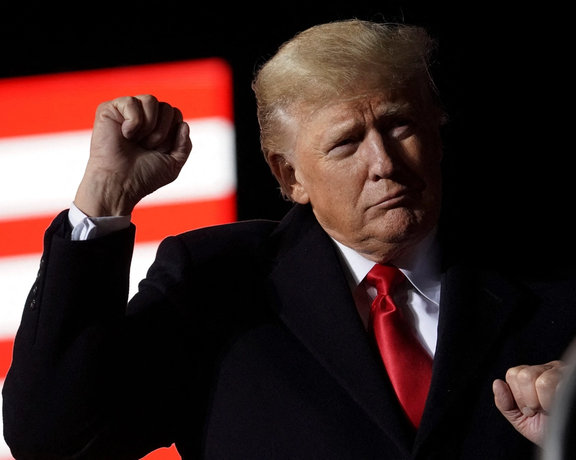
Donald Trump gestures as he speaks during a rally, in Conroe, Texas, US, January 29, 2022.

The fourth round of indirect negotiations between Tehran and Washington ended without a breakthrough but preserved a fragile diplomatic opening on the eve of President Donald Trump’s visit to Iran’s Arab neighbors.

Before traveling to Saudi Arabia on May 12, Trump reaffirmed his opposition to Iran acquiring nuclear weapons, while praising Iranian negotiators for being, in his words, very reasonable and very intelligent.

Despite pillorying Tehran at length in a speech in Saudi Arabia the next day, the comments suggested an openness to continued dialogue—even amid mounting pressure from within his own ranks.

Trump’s position reflects a carrot-and-stick strategy: applying sanctions while keeping the door open for a potential deal. Yet, internal divisions are growing.

Middle East envoy and chief negotiator Steven Witkoff told Breitbart last week that no level of uranium enrichment should take place in Iran—opposing the allowances made under the 2015 Joint Comprehensive Plan of Action (JCPOA).

Witkoff’s remarks echo those of hawkish Republicans who reject even limited enrichment under international monitoring. Witkoff once again aligned himself with that position, signaling that any new deal could be more restrictive than the 2015 deal.

In the same interview, however, Witkoff distanced himself from advocates of military action, accusing them of a “bias toward war.” He emphasized that Trump prioritizes diplomacy, arguing that critics underestimate the risks of armed confrontation.

The messaging—hardline on enrichment, moderate on military force—underscores the absence of a unified Republican policy.

Trump himself has sent conflicting signals. In an interview with Hugh Hewitt on 7 May, he reaffirmed his desire to end Iran’s uranium enrichment but also indicated a willingness to hear justification for maintaining some nuclear infrastructure.

Elusive positions

A week—and one more round of talks—later, we are none the wiser about the Trump administration’s red lines.

US vice president J.D. Vance has taken a more flexible position, suggesting a tightly monitored, limited centrifuge program could be acceptable. His stance diverges from that of US secretary of state Marco Rubio and Witkoff’s latest, betraying disagreement at the very top.

In Tehran, the message has been more consistent—in public at least. The right to enrich uranium is non-negotiable, foreign minister Abbas Araghchi posted on X on the eve of the fourth round of talks.

Enrichment, in reality, is what gives supreme leader Ali Khamenei the leverage he has always sought to face his western ‘enemies.’

Khamenei’s strategy, as far as can be surmised from his decisions in the last two decades, is to remain close to the nuclear threshold without crossing it, standing on the brink without falling into the abyss of war.

Despite this impasse, both sides agreed to extend the negotiations, signaling a desire to avoid blame for their collapse. Still, the fundamental disagreement over enrichment remains unresolved.

Witkoff has also called for the talks to address Iran’s regional conduct, particularly its support for armed groups like Hezbollah and the Houthis. He argues any deal should reduce the Islamic Republic’s hostile actions against the US and Israel.

These positions are yet to be formalized, but the rulers in Tehran appear to have used whatever influence they have with the Houthis to calm the Red Sea and ease pressure on Iran’s negotiators.

But the link between nuclear diplomacy and regional security remains tenuous.

Fraught issue

Historically, the US strategy on Iran’s nuclear program has fluctuated. The Bush administration failed to enforce a zero-enrichment model; the Obama administration accepted a 3.67% cap to delay Iran’s breakout capacity. Trump’s second-term ambitions appear to aim higher—but face the same practical limits.

UN nuclear chief Rafael Grossi asserted recently that completely eliminating Iran’s program may no longer be achievable.

Also significant is public opinion in the US. In a recent poll by the University of Maryland, more than two-thirds of respondents said they preferred a negotiated deal to curb Iran’s nuclear activities, with only 14% backing military action.

On this point at least, and for now, President Trump appears to be reflecting the popular will, letting diplomacy run its course while pursuing his maximum pressure campaign of sanctions, hoping to force Iranians to blink first.

Unclear to nearly all watching the talks—and perhaps even to those involved in it—is how far and how long he is willing to go without visible results.

Most Viewed

State media slam Araghchi's Hormuz tweet, say it let Trump claim victory
1

State media slam Araghchi's Hormuz tweet, say it let Trump claim victory

2

Iran International says it won’t be silenced after London arson attack

3
INSIGHT

How Tehran bends its own red lines to boost state rallies

4
OPINION

The Hormuz get out of jail card turned to a grave

5

Iran halts petrochemical exports to supply domestic market

Banner
Banner

Spotlight

  • Too early to tell who is winning Iran war, experts say
    PODCAST

    Too early to tell who is winning Iran war, experts say

  • How Tehran bends its own red lines to boost state rallies
    INSIGHT

    How Tehran bends its own red lines to boost state rallies

  • Iran blackout cripples freelancer, small business incomes
    VOICES FROM IRAN

    Iran blackout cripples freelancer, small business incomes

  • Ideology may be fading in Iran, but not in Kashmir's ‘Mini Iran'
    INSIGHT

    Ideology may be fading in Iran, but not in Kashmir's ‘Mini Iran'

  • US blockade enters murky phase as tankers spoof signals and buyers hesitate
    ANALYSIS

    US blockade enters murky phase as tankers spoof signals and buyers hesitate

  • Why the $100 billion Hormuz toll revenue is a myth
    ANALYSIS

    Why the $100 billion Hormuz toll revenue is a myth

•
•
•

More Stories

Trump castigates Iran in lengthy speech before Saudi leadership

May 13, 2025, 17:40 GMT+1

Speaking before Crown Prince Mohammed bin Salman and other top Saudi and US officials, President Donald Trump spent much of a lengthy speech on Tuesday criticizing Iran while urging a deal over its disputed nuclear program.

Tehran as obstacle to regional peace

"The only thing still standing between this region and its unbelievable potential was a small group of rogue actors and violent thugs seeking constantly to drag the Middle East backward and into havoc, mayhem and indeed, into war. Unfortunately, instead of confronting these destructive forces, the last US administration chose to enrich them and empower them and give them billions and billions of dollars.

"Our task is to unify against the few agents of chaos and terror that are left and that are holding hostage the dreams of millions and millions of great people.

"The biggest and most destructive of these forces is the regime in Iran, which has caused unthinkable suffering in Syria, Lebanon, Gaza, Iraq, Yemen and beyond. There could be no sharper contrast with the path you have pursued on the Arabian Peninsula than the disaster unfolding right across in the Gulf in Iran."

A Persian Gulf of contrasts

"While you have been constructing the world's tallest skyscrapers in Jeddah and Dubai, Tehran's 1979 landmarks are collapsing into rubble and they had it going for a little while under a much different system but those buildings are largely falling apart.

"Iran's decades of neglect and mismanagement have left the country plagued by rolling blackouts lasting for hours a day ... While your skill has turned dry deserts into fertile farmland, Iran's leaders have managed to turn green farmland into dry deserts as their corrupt water mafia ... causes droughts and empty river beds. They get rich."

Syria and Lebanon

"Countless lives were lost in the Iranian effort to maintain a crumbling regime in Syria. Look at what happened with Syria and Lebanon, their Hezbollah proxies have pillaged the hopes of a nation whose capital Beirut was once called the Paris of the Middle East.

"Can you imagine all of this misery and so much more was entirely avoidable?

"If only the Iranian regime had focused on building their nation up instead of tearing the region down.

"In Syria, which has seen so much misery and death, there is a new government that will hopefully succeed in stabilizing the country and keeping peace. That's what we want to see in Syria, they've had their share of travesty, war killing many years.

"I will be ordering the cessation of sanctions against Syria in order to give them a chance."

Enmity or peace with Iran

"In the case of Iran, I have never believed in having permanent enemies. I am different than a lot of people think. I don't like permanent enemies ... I want to make a deal with Iran.

"But if Iran's leadership rejects this olive branch and continues to attack their neighbors, then we will have no choice but to inflict massive maximum pressure drive Iranian oil exports to zero like I did before."

"(The US will) take all action required to stop the regime from ever having a nuclear weapon."

Iran’s president says Supreme Leader sets terms for US talks

May 13, 2025, 13:40 GMT+1

Iranian President Masoud Pezeshkian said any indirect negotiations with the United States will proceed in full coordination with Supreme Leader Ali Khamenei and reaffirmed that Iran will not retreat from its core principles.

“These negotiations will be fully aligned with the Supreme Leader’s guidance, which will light our path,” Pezeshkian said during a meeting with a group of lawmakers. “We have not and will not tie the people’s livelihood to the outcome of the talks.”

Pezeshkian said that while Iran seeks dialogue without escalating tensions, it would not compromise on what he called national values. “We will not retreat from our principles under any circumstances,” he added. “At the same time, we are not seeking tension.”

Earlier in the day, Iran’s deputy foreign minister said the country is open to accepting temporary restrictions on uranium enrichment, though no detailed agreement has been reached.

Majid Takht-Ravanchi, speaking after the fourth round of indirect talks with the United States in Oman, said negotiations have yet to address the specifics of enrichment levels.

The talks, described by both sides as difficult but constructive, mark the highest-level contact between Tehran and Washington since the US withdrew from the 2015 nuclear deal in 2018 under former Trump administration.

Iran has since accelerated its enrichment to 60% purity—well above the deal’s 3.67% cap but below weapons-grade, according to the UN nuclear watchdog.

While US officials have called for a full dismantlement of Iran’s enrichment capabilities, Tehran insists the right to enrich is non-negotiable.

Iran’s atomic energy chief, Mohammad Eslami,said on Tuesday that the nuclear program remains a pillar of national strength and is not subject to bargaining.

Western powers accuse Iran of seeking nuclear weapons—an allegation Tehran denies. Despite diplomatic engagement, the US continues to expand sanctions targeting Iran’s nuclear and energy sectors.

Trump’s Persian Gulf tour marks strategic shift from security to economy – Nour News

May 13, 2025, 11:23 GMT+1

US President Donald Trump’s tour of Saudi Arabia, the UAE, and Qatar reflects Washington’s recalibrated strategy in the Middle East, prioritizing economic diplomacy over security, according to an analysis by Nour News, a media outlet affiliated with Iran’s Supreme National Security Council.

The absence of Israel from Trump’s itinerary, despite the ongoing war in Gaza, is interpreted as a tactical move to avoid inflaming tensions while quietly pursuing economic deals and regional realignment, read thearticle.

The report suggests Trump aims to defuse regional anger over US support for Israel without publicly confronting America’s traditional ally.

According to Nour News, Trump’s primary goal is to secure large-scale investments from Persian Gulf nations—highlighting pledges of $600 billion from Saudi Arabia and $1.4 trillion over ten years from the UAE—as part of his economic diplomacy. Security and human rights, the outlet said, are lower on the agenda.

Despite Trump's push, the report points to skepticism in US media, including NPR, which described Trump’s ambitions—ending the Gaza war, curbing Iran’s nuclear program, and pushing Saudi Arabia to join the Abraham Accords—as “unlikely” given current regional dynamics.

The analysis also suggests Trump is seeking to rebuild America’s global image, using Persian Gulf partnerships to project stability and contain China’s growing influence in the region.

US Secretary of State Marco Rubio, President Donald Trump, Saudi Crown Prince Mohammed Bin Salman and Mohammed bin Abdulrahman bin Abdulaziz, Deputy Governor of Riyadh Region, meet in Riyadh, Saudi Arabia, May 13, 2025.
100%
US Secretary of State Marco Rubio, President Donald Trump, Saudi Crown Prince Mohammed Bin Salman and Mohammed bin Abdulrahman bin Abdulaziz, Deputy Governor of Riyadh Region, meet in Riyadh, Saudi Arabia, May 13, 2025.

Iran’s nuclear chief says atomic industry is non-negotiable

May 13, 2025, 10:37 GMT+1

Iran’s nuclear chief said that the country’s nuclear industry will not be subject to any form of negotiation or compromise, describing it as a pillar of national power.

“The nuclear industry is a point of wealth and strength for the Iranian nation and is not subject to bargaining or negotiation,” Mohammad Eslami said speaking at an event in Karaj, near Tehran, on Tuesday.

“We have paid a heavy price to achieve nuclear knowledge, and nuclear technology is the key to progress in all fields of science and engineering,” he added.

Eslami’s remarks come as Iran and the United States concluded a fourth round of indirect nuclear negotiations in Oman on Sunday.

US President Donald Trump has said that the goal of the negotiations is to achieve "full dismantlement" of Tehran's nuclear program.

Tensions have mounted in recent days following comments by US envoy Steven Witkoff, who told Breitbart News last week that Washington's red line remains “no enrichment,” effectively calling for the dismantling of Iran’s nuclear infrastructure in Natanz, Fordow, and Isfahan.

Earlier on Tuesday, a senior Iranian lawmaker said Tehran will not give up uranium enrichment under any potential agreement with the United States, stressing that enrichment levels of up to 20% — or at least 5% — will be maintained on Iranian soil.

Ahmad Bakhshayesh Ardestani, a member of the Iranian parliament’s National Security and Foreign Policy Committee, told local media that the outlook for ongoing negotiations with Washington is positive, but insisted Iran will not concede to US demands.

“America ultimately has to accept our conditions,” he said.

Iran’s Deputy Foreign Minister Majid Takht-Ravanchi on Tuesday said that no specific details have been agreed regarding possible limits on uranium enrichment, after the latest round of talks in Muscat.

Iran has accelerated its enrichment activities since 2019, exceeding limits set under the 2015 nuclear deal, which the US exited unilaterally in 2018.

The UN nuclear watchdog has confirmed Iran’s enrichment of uranium to levels approaching weapons-grade, a move Tehran says is reversible if sanctions are lifted and credible guarantees are provided.

Iranian Foreign Minister Abbas Araghchi on Sunday said that Iran may consider temporary limits on enrichment “in terms of scope, level, and quantity” as a confidence-building measure, but also emphasized that the principle of enrichment itself is non-negotiable.

Amid the standoff, some Iranian commentators are reviving a long-standing proposal to break the impasse by forming a regional nuclear consortium that would include Iran, Arab states and the United States.

In February, the UN nuclear watchdog found that Iran's stockpile of near-weapons-grade uranium had risen to levels that, in principle, could be further enriched to produce enough material for six nuclear bombs.

Iran's indirect approach to US talks is a weak point - Shargh daily

May 13, 2025, 08:45 GMT+1

Iran's insistence on indirect negotiations with the United States remains a weakness given the sensitive circumstances surrounding the nuclear talks, reformist Shargh daily wrote on Tuesday.

The newspaper acknowledged that an agreement could potentially be reached through text exchanges, but argued this approach is disproportionate to the high stakes of the discussions.

Given Iran's insistence on maintaining domestic enrichment, the newspaper expressed concern that the talks might not achieve progress under such conditions.







