• العربية
  • فارسی
Brand
  • Iran Insight
  • Politics
  • Economy
  • Analysis
  • Special Report
  • Opinion
  • Podcast
  • Iran Insight
  • Politics
  • Economy
  • Analysis
  • Special Report
  • Opinion
  • Podcast
  • Theme
  • Language
    • العربية
    • فارسی
  • Iran Insight
  • Politics
  • Economy
  • Analysis
  • Special Report
  • Opinion
  • Podcast
All rights reserved for Volant Media UK Limited
volant media logo
INSIGHT

Clinch quick US deal before it's too late, former officials say

Behrouz Turani
Behrouz Turani

Iran International

May 7, 2025, 19:07 GMT+1Updated: 08:16 GMT+0
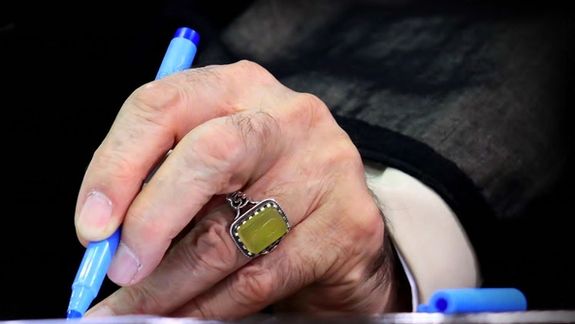
Iran's Ayatollah Ali Khamenei writes on a document, file photo.

With the hawks in Washington pushing for a tougher stance on Iran, and the talks appearing to lose some positive initial momentum after three rounds, a sense of urgency about a potential deal appears to be taking hold in Tehran.

Former officials and media pundits are urging a swift agreement with the United States, warning that delays could harden President Trump’s position or allow regional developments to close the door on diplomacy.

“Time is certainly working against us this time. Reaching an agreement today is better than doing so tomorrow,” former minister Abbas Akhundi said in an interview with moderate daily Etemad on Monday.

“Trump is an opportunity if you understand his logic and act at the right time,” Akhundi added. “He is not someone who will be willing to negotiate forever … so we must be able to conclude the negotiations in a short time.”

Such bold statements on a potential thaw with the US are tolerated, if not encouraged, because supreme leader Ali Khamenei has not only endorsed the negotiations but also hushed its hardline opponents with his customary cryptic messaging.

Any viable nuclear deal would require significant concessions on Iran’s part. Khamenei needs to make those palatable to the loyalists who back him in the face of growing popular discontent. The longer the process the harder his task will become.

Regional developments are also a factor. Ceasefires in the Middle East often last not as long as the wars they tend to end.

Akhundi touched on this too in his Monday interview: “Israel is certainly unhappy about the possibility of a deal and may try to obstruct an agreement through psychological warfare, targeted assassinations, and cyber-attacks,” he warned.

Former conservative MP Mahmood Abbaszadeh Meshkini echoed the urgency while calling for a more proactive strategy.

“Trump is not interested in starting a war with Iran,” Mashkini told Khabar Online, urging the decision-makers in Tehran to take the lead in shaping the agenda.

Like many conservatives who have jumped ship on talks, Meshkini backed the official line and even went as far to hint at the rift between the rulers and the ruled as a hindrance for Iran advancing its interests abroad.

Another conservative commentator Mohammad Mohajeri charted another territory previously unnavigable: concessions.

“Eventually, both sides might come to accept that some red lines are also open to negotiation,” he told the outlet Rouydad24 briefly—and somewhat daringly—before quickly qualifying his remarks, perhaps to guard against criticism for his plain speech.

“However, if the other side demands that enrichment in Iran be reduced to zero or that our peaceful nuclear activities be entirely shut down, that is certainly unacceptable,” he added.

Tehran’s official position has remained constant during negotiations with Washington: low levels of enrichment are non-negotiable. On the other side, however, the stance seems to have hardened as president Trump and others in his team talk about Iran’s nuclear program being dismantled altogether.

The apparent sense of urgency reflected in Iranian media this week may have a thing or two to do with this.

Most Viewed

Ghalibaf defends Iran-US talks amid hardline backlash
1
INSIGHT

Ghalibaf defends Iran-US talks amid hardline backlash

2
INSIGHT

A nation in limbo: 100 days after the massacre, has the world moved on?

3
ANALYSIS

From instability to influence: Pakistan’s pivotal role in US-Iran diplomacy

4
ANALYSIS

100 days on: why Iran’s January protests spread across social classes

5

War-hit homeowners feel abandoned as Iran’s reconstruction aid fades

Banner
Banner

Spotlight

  • War-hit homeowners feel abandoned as Iran’s reconstruction aid fades

    War-hit homeowners feel abandoned as Iran’s reconstruction aid fades

  • 100 days on: the anatomy of Iran’s January crackdown
    INSIGHT

    100 days on: the anatomy of Iran’s January crackdown

  • Ghalibaf defends Iran-US talks amid hardline backlash
    INSIGHT

    Ghalibaf defends Iran-US talks amid hardline backlash

  • 100 days on: why Iran’s January protests spread across social classes
    ANALYSIS

    100 days on: why Iran’s January protests spread across social classes

  • From instability to influence: Pakistan’s pivotal role in US-Iran diplomacy
    ANALYSIS

    From instability to influence: Pakistan’s pivotal role in US-Iran diplomacy

  • A nation in limbo: 100 days after the massacre, has the world moved on?
    INSIGHT

    A nation in limbo: 100 days after the massacre, has the world moved on?

•
•
•

More Stories

On 100th anniversary, Khamenei says Qom Seminary to shape modern Islam

May 7, 2025, 14:25 GMT+1

Iran's Supreme Leader on Wednesday marked the 100th anniversary of the reestablishment of the Qom seminary with a call for the religious institution to become a leading force in shaping Islam in the modern era.

In a written message to an international conference commemorating the centenary of the seminary’s revival, Ali Khamenei said the institution must not only maintain its core religious mission but also evolve to meet new social and intellectual demands.

“The most important mission of the seminary is ‘Balagh Mubin’ (clear and eloquent communication),” Khamenei said. “Among its most significant expressions is outlining the main and subsidiary lines of the new Islamic civilization, and explaining, promoting, and embedding it within society.”

Khamenei’s message reflects a broader push by Iran’s clerical leadership to position religious institutions not just as custodians of tradition but as active architects of what is termed modern Islamic civilization.

The Qom seminary, one of the most influential centers of Shiite scholarship, was revitalized in 1922 by Grand Ayatollah Abdol-Karim Haeri Yazdi and has since played a central role in Iran’s religious and political life — especially after the 1979 Islamic Revolution.

Khamenei emphasized the need for a seminary that is “innovative, dynamic, up-to-date, capable of addressing emerging issues, morally refined, driven by progress, rooted in revolutionary identity, and equipped to design governance systems.”

US-Houthi truce may remove major irritant to Iran nuclear talks

May 6, 2025, 19:30 GMT+1
•
Maryam Sinaiee

An apparent truce to a blazing Yemen front in Iran's regionwide confrontation with Israel and the United States could deal a fillip to flagging Iran-US talks that had been dogged by the uptick in fighting.

US President Donald Trump made the shock announcement in the White House on Tuesday that he was calling off a bombing campaign on Yemen's Houthis after the Iran-backed group "capitulated" by agreeing to halt attacks on shipping.

Oman said on Tuesday it was mediating a Houthi-US ceasefire deal, but adding to the fog of war, Mohammed al-Bukhaiti was quoted by Bloomberg as saying after Trump's announcement that it would continue its campaign until Israel halts attacks on Gaza.

Tehran and Washington have signaled continued commitment to nuclear negotiations but stepped-up combat between the Iran-backed Houthis in Yemen and Israel had cast a shadow over the diplomatic efforts.

The Houthis pierced Israel's air defenses to land a ballistic missile near Israel's main airport on Saturday and Israeli fighter jets attacked Yemen's main port on Monday and airport on Tuesday along with power plants and a factory.

"Our choice of when to respond, how to respond, and on what targets to respond - this is a consideration we make every time," Israeli Prime Minister Benjamin Netanyahu said on Tuesday.

"And this also concerns the patron of the Houthis - Iran, without whose approval and their long-term support, the Houthis cannot carry out their criminal missile attack."

The uptick in violence suggests the religious militia and perhaps its backers in Tehran are not deterred despite the painful blows Israel has meted out to Iran and its armed affiliates in over a year of regional fighting.

Before the Ben Gurion airport attack, US Defense Secretary Pete Hegseth also warned of unspecified payback for Tehran, citing its continued support for the Houthis despite an explicit warning from President Trump that they desist support or face attack.

Iran’s Supreme Leader Ali Khamenei has long rejected the notion that groups like the Houthis act at Iran’s direction. “The Islamic Republic does not have proxies. Yemen is fighting because of its faith,” he said in a December 2024 speech.

In a letter to the United Nations on Monday, Iran's UN ambassador Saeid Iravani rejected allegations of complicity in the Houthi attack on the airport, warning that “the United States and the Israeli regime will bear full and unequivocal responsibility for all consequences” arising from any aggression on the Islamic Republic.

The future of Iran-US indirect talks currently hangs in the balance after a fourth round is due to be held in Oman over the weekend after they were delayed by a week for unclear reasons.

Hardline Iranian media and officials, including the IRGC-linked Javan newspaper, praise the Houthis for their anti-Israeli and anti-American positions. “Ansarullah's missiles on Ben Gurion shook Israel’s psychological security,” Ali Shamkhani, a Khamenei advisor, wrote Tuesday on X.

“The attack from Sanaa was a strategic blow to the delusion of the Resistance’s collapse — a front that now holds the initiative, with an ever-growing presence from Lebanon and Gaza to Iraq and Sanaa,” he wrote.

Yet, the strike's timing has led some commentators to posit that that factions within Iran may be actively undermining diplomatic progress.

Iranian-Canadian analyst Shahir Shahidsaless raised the question directly: “Is the hardline faction of the Iranian government once again trying to sabotage and disrupt the talks?” he posted on X.

Even some conservatives have acknowledged that the timing of the strike could be damaging to the US talks. Military analyst Behzad Atabaki, writing on a Telegram channel, argued that Iran should have at least called for a pause in Houthi attacks during the negotiation period. “Maybe it’s too late, maybe not,” he said.

FM briefs Iran’s top clerical body on US talks

May 6, 2025, 14:21 GMT+1

Iran's Foreign Minister Abbas Araghchi on Tuesday briefed the Assembly of Experts for Leadership in the holy city of Qom on the latest developments in the country's foreign policy, including ongoing indirect negotiations with the United States.

Speaking to the Tasnim news agency on the sidelines of the Assembly's meeting, Araghchi said that members of the influential clerical body expressed their appreciation for the Foreign Ministry's effort.

He added that the ministry's approach continues "with dignity within the framework of national consensus."

Araghchi detailed the topics covered in his briefing, which included responses to questions and concerns from Assembly members regarding various foreign policy areas.

These included indirect talks with the US, the rationale behind the foreign ministry's approach, relations with regional organizations like the Shanghai Cooperation Organization and BRICS, US policies of pressure and threats, and future prospects, according to Tasnim.

Sectarian rhetoric, criticism of US talks on state media raise hackles

May 5, 2025, 21:08 GMT+1
•
Behrouz Turani

Iran’s state-run television is facing sharp criticism from senior clerics and political figures over inflammatory religious commentary and what they call biased coverage of negotiations with the United States.

“A fundamentalist group runs state TV behind the scenes,” moderate cleric and former MP Rasoul Montajabnia asserted last week, pointing to a recent broadcast that insulted Sunni Muslims. “(They) deliberately seek to sow discord among Muslims.”

On a daytime live show last week, a guest recited a derogatory poem about Abu Bakr, the first caliph of Islam. The network later issued an apology, removed the episode from all its platforms and opened an investigation.

The measures were deemed too little too late by several prominent clerics who accused the Islamic Republic of Iran Broadcasting (IRIB) of insulting religious sanctities.

Leading theologian Hossein Nouri Hamadani questioned the decisions made at IRIB. “There are many learned clerics at the seminary … It is unclear why the network invites those who make unfounded statements about Islam,” he said late last week.

At least two more prominent clerics, Hossein Ansarian and Hashem Hosseini Bushehri, weighed in on the subject, urging the broadcaster to change course.

This level of public criticism from within is rare—and significant—because the head of Iran’s state television is directly appointed by the Supreme Leader, and its political output is closely monitored by his office.

Even the IRGC-affiliated Tasnim News denounced certain broadcasts as “examples of bad taste,” leaving little choice for IRIB officials to issue rare public apologies—to viewers, authorities, and even neighboring countries.

“I do not deny there are oversights and mistakes,” IRIB chief Payman Jebelli told moderate conservative outlet Khabar Online, affirming his reverence for the clergy and their concerns.

Curiously, Khabar Online had carried an editorial alleging that “radical groups have infiltrated the national network,” and are driving the public away with their biased coverage of politics, especially the nuclear talks with the administration of US president Donald Trump.

Shortly after the second round of talks last month, state TV aired a live show in which an ultraconservative commentator warned of dire consequences including civil war if Tehran's engagement with the Trump administration continued.

“We have tried to deliver accurate news and stay aligned with the negotiators,” Jebelli told Khabar Online when asked about the show, adding IRIB backed the government in general even though some programs may contradict official policy.

Much of the criticism against the broadcaster has centered on Vahid Jalili—a senior IRIB official whose brother Saeed Jalili is the face and voice of Iran’s ultraconservatism and once led Tehran’s nuclear negotiations.

The brothers are seen by moderates as key to IRIB’s vision and direction.

The backlash against the state broadcaster, amplified by religious authorities and hardline outlets, suggests a growing divide not just between factions within the political elite, but potentially within the very institutions that project and preserve the state’s ideological authority.

“This should never have happened on a platform that’s under the leader’s supervision,” Montajabnia told Khabar Online, accusing the hardline faction of defying Ali Khamenei.

Asked if IRIB chief Jebelli could intervene to stop the broadcaster’s drive against the administration of president Masoud Pezeshkian, he said: “Only the supreme leader can resolve this.”

UK maneuvers for greater role in Iran talks amid security tensions

May 5, 2025, 15:58 GMT+1
•
Maryam Sinaiee

As Tehran and Washington cautiously inch forward their nuclear negotiations, the United Kingdom is positioning for a stronger hand in shaping any potential agreement amid Iranian-linked security threats and a standoff over detained Britons.

British Foreign Secretary David Lammy’s high-level meetings with Omani officials on April 27—just one day after Iran and the United States held indirect talks in Rome under Omani mediation—underscored the United Kingdom's efforts not to remain a bystander in one of the region’s most consequential diplomatic processes.

The UK was also set to meet Iranian officials along with France and Germany on May 2 just before the planned fourth round of US-Iran talks in Rome. However, that meeting was canceled following the postponement of the latest round of Tehran-Washington negotiations. No further plans have been announced yet.

The UK or any of the other signatories to the 2015 nuclear deal (JCPOA) has until October to activate the JCPOA’s so-called snapback mechanism which would reimpose all UN sanctions on Iran.

Lammy had already signaled alignment with Washington in late March, expressing a shared commitment to ensuring Iran "never develops or acquires a nuclear weapon." On April 15, he also discussed Iran’s nuclear program with Israeli Foreign Minister Gidon Saar during a meeting in London.

Iranian nationals, terror charges

Meanwhile, the diplomatic backdrop was further complicated by a counter-terrorism operation in the UK. On May 4, British police arrested seven Iranian nationals on terrorism-related charges in two separate operations.

Iran’s foreign ministry and state television have remained silent on the arrests. While some domestic outlets cautiously reported the news by citing international coverage, they refrained from offering analysis or commentary. In contrast, the hardline Quds daily responded swiftly and critically on Monday.

In a commentary titled “Security Dossier to Disguise Diplomatic Blackmail,” Quds accused the UK of exploiting the arrests for political leverage in the nuclear talks. “The latest move comes at a time when indirect nuclear talks between Tehran and Washington are taking place, and in this context, London's decision seems meaningful.”

Tehran-based analyst Sohrab Sadreddin quoted in the piece suggested that the arrests were intended as a signal to the US—especially Trump-aligned factions—that Iran remains a strategic threat to the West.

Sadreddin added that Britain, France and Germany are keen to be included in any future agreement between Washington and Tehran: "If an agreement is to be reached, Europe must also be included in it.”

Adding another layer of complexity and pointing to the recent arrest of two British nationals in Iran, the commentary also raised suspicions about a possible prisoner swap strategy.

In January, Iran detained a British couple in Kerman in southern Iran. The couple in their early 50s, Craig and Lindsay Foreman, were on an around the world motorbike tour through Iran. Iran's judiciary in February accused the Foremans of espionage.

The Foremans are not the only UK-linked detainees in Iran. Mehran Raouf, a 68-year-old British-Iranian labor activist, has been imprisoned since October 2020. He is currently serving a 10-year sentence on charges related to national security offenses.

Iran, which does not recognize dual nationality, has a long history of detaining dual citizens and foreigners on security-related charges, often using them as bargaining chips in its dealings with Western powers, including Britain.

In April 2022, British-Iranian nationals Nazanin Zaghari-Ratcliffe and Anoosheh Ashouri -- both accused of espionage -- were released following Omani mediation, after Britain settled a long-standing £400 million debt owed to Iran.