Undermining Khamenei’s strategy harms national interest, senior Iranian cleric warns
A top clerical official warned Saturday that casting doubt on decisions made in the name of national interest can weaken the Islamic Republic’s leadership and serve hostile agendas.
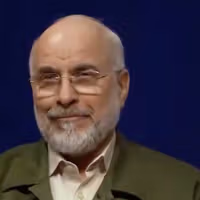
“Creating suspicion about expediency-based decisions weakens the leadership’s standing and is against the interests of the system,” said Ali Saeedi, head of the Ideological-Political Office of Iran's Supreme Leader Ali Khamenei.
He emphasized that throughout Islamic history, leaders—including the Prophet and Imams—made pragmatic choices to protect the broader mission of Islam.
Saeedi outlined a list of consequences for failing to grasp the logic behind such decisions, including weakening unity, spreading rumors, and empowering adversaries. He warned elites against misinterpreting the leadership’s judgments or politicizing sensitive decisions.
His remarks come amid an alignment among clerical and political figures who have recently pushed back against criticism of indirect Iran-US negotiations.
Former minister Mostafa Pourmohammadi said Saturday that dismissing the talks as desperate or imposed stems from poor historical understanding—adding that national survival must guide current strategy.
Iran’s escalating water crisis is not only draining its aquifers but also laying the groundwork for potentially devastating earthquakes, a leading geology expert warns.
Mehdi Zare says human responses to prolonged drought—particularly rampant groundwater extraction—are altering underground stresses and could trigger seismic activity in cities like Tehran, Isfahan, and Mashhad.
“Droughts can indirectly influence seismicity through human activities, particularly over-extraction of groundwater, which alters subsurface conditions,” Zare wrote on Rokna news Saturday.
These shifts may activate critically stressed faults, he added, especially in tectonically sensitive regions.
As aquifers are depleted, the earth’s crust begins to rebound, redistributing pressure and modifying fault dynamics. This process, compounded by reductions in pore pressure, brings fault lines closer to rupture.
In some areas of Tehran, groundwater levels are falling by up to two meters a year. Land subsidence has reached 31 centimeters annually in parts of southwest Tehran, according to government data released in March.
The 2017 Malard earthquake near Tehran, which measured magnitude 5.0, occurred near one such subsiding zone. Zare notes that similar patterns have been observed in California, India, and Spain, where changes in groundwater levels preceded swarms of small but revealing earthquakes.
Ali Beitollahi, head of earthquake engineering at Iran’s Ministry of Housing research center, warned of a destructive cycle. “Population grows, water becomes scarce, more dams and wells are built—and so we drill again,” he said.
He criticized the government’s approach, which focuses on securing more water rather than managing demand. “We are now hearing plans to drill deep wells in Tehran this summer,” Beitollahi said. “Our mismanagement is taking us to a dangerous place.”
Iran’s water reserves have fallen to critical levels, accelerating the risk of shortages and forcing officials to consider rationing months before peak summer demand.
Tehran's water supply is critically strained as key dams plummet to record lows, worsening a nationwide drought. Latian and Mamlou dams are at 12% capacity, Lar at 1%, and Karaj at 7%.
Nationwide rainfall is 82.9% of normal, and dam inflow is only 42%. Officials urge a 20% reduction in water use, as 19 provinces face water stress.
With 40 percent of Tehran’s aquifer already depleted and critical urban centers still expanding, experts say the time to act is rapidly closing. Without structural water governance reform and population redistribution, Iran risks turning drought into disaster—both above ground and below.
A former Iranian ambassador said Saturday the delay of the latest round of indirect Iran-US nuclear talks—originally planned for Rome—was requested by the American side amid an ongoing White House reshuffle.
“The delay was agreed upon by both sides, but the main reason lies with the US, likely due to the nomination of Mr. Witkoff to a new post,” said Ali Beman Eghbali Zarch, former envoy to Albania, referring to Steve Witkoff, appointed by Donald Trump as envoy for Middle East affairs.
Eghbali said both Iran and the US remain prepared to reach a deal, though pressure from Israel and other actors could complicate progress. “There is clear political will on both sides,” he said, “but success will depend on insulating the talks from external sabotage.”
He also warned that the toughest layer of US sanctions—those requiring congressional repeal—will take time to remove, even if an initial agreement is reached.
Dozens of relatives of those killed or missing in the Bandar Rajaei explosion staged a protest on Saturday, blocking access to the port and demanding faster identification of remains.
According to Fars News Agency, around 40 family members gathered at the entrance of the port holding photos of their loved ones. Protesters called for clarity on the fate of those still unaccounted for.
Out of 70 confirmed deaths from the April 26 blast, only 36 bodies have been identified so far.
Videos sent to Iran International earlier in the day showed demonstrators halting traffic on the main road to the dock in protest over the slow pace of forensic efforts.
The head of Hormozgan’s judiciary warned Saturday that public commentary on the Bandar Rajaei explosion could carry legal consequences if deemed misleading or politically motivated.
“Misinformation or statements made with secondary aims or unlawful intent may be considered criminal under Iranian law,” said Mojtaba Ghahremani, adding that the incident is under investigation by security and judicial bodies.
He also cautioned against generalizing the blast to the entire port, noting that the explosion occurred at a “small company” among 52 operating within the 2,400-hectare facility.
A senior Iranian lawmaker said Tehran is willing to accept some "quantitative limits" on its nuclear program—but only if the United States lifts all sanctions and restores normal economic conditions.
“Nuclear negotiations are a two-way street,” said Alaeddin Boroujerdi, a member of parliament’s National Security and Foreign Policy Commission. “If all sanctions are removed and our economy is allowed to function normally, we would accept certain quantitative nuclear restrictions.”
Boroujerdi added that Iran remains committed to the Non-Proliferation Treaty (NPT) and its nuclear doctrine is grounded in the Supreme Leader’s fatwa prohibiting nuclear weapons.
He warned that Israeli pressure on the US remains the main obstacle to progress. “If Washington caves to Tel Aviv, Iran will use all its capacity to defend national interests,” he said.