• العربية
  • فارسی
Brand
  • Iran Insight
  • Politics
  • Economy
  • Analysis
  • Special Report
  • Opinion
  • Podcast
  • Iran Insight
  • Politics
  • Economy
  • Analysis
  • Special Report
  • Opinion
  • Podcast
  • Theme
  • Language
    • العربية
    • فارسی
  • Iran Insight
  • Politics
  • Economy
  • Analysis
  • Special Report
  • Opinion
  • Podcast
All rights reserved for Volant Media UK Limited
volant media logo

Port shutdown halts over half of Iran's cargo as fire not yet contained

Apr 27, 2025, 11:48 GMT+1Updated: 08:19 GMT

More than half of Iran's port activity remains offline following a major explosion at the Shahid Rajaee port in Bandar Abbas, according to Iranian port authority data.

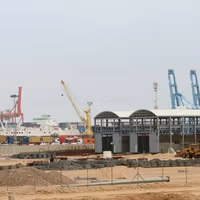
The explosion on Saturday which has devastated Rajaei Port, the country's largest container port near Bandar Abbas, has halted 57% of the country's nominal loading and unloading capacity.

Although Iranian customs officials announced that some customs and transit activities have resumed, full port operations are still suspended pending the complete extinguishment of the fire.

Cleanup efforts are underway, with Interior Minister Eskandar Momeni saying that about 80% of firefighting operations had been completed by Sunday afternoon.

At least 28 people have been killed and more than 1,000 injured.

The Ministry of Health has declared a state of emergency in Bandar Abbas, citing serious air pollution and the risk of chemical contamination. Authorities have also shut down all schools, universities, and government offices in the city as a precaution.

Rajaei Port processes about 85% of Iran’s container cargo and 52% of its oil product trade, according to the Iranian Ports and Maritime Organization.

Over the past Iranian year (March 2024 - March 2025), the port handled over 81 million tons of goods — over half of Iran’s total maritime cargo traffic — and $29 billion of Iran’s $130 billion foreign trade.

Smoke rises following an explosion at the Shahid Rajaee port in Bandar Abbas, Iran, April 26, 2025.
100%
Smoke rises following an explosion at the Shahid Rajaee port in Bandar Abbas, Iran, April 26, 2025.

In the container sector, Shahid Rajaee handles a dominant 77% of the country's nominal container capacity, equivalent to 6.65 million TEUs (twenty-foot equivalent units), out of 11 active container ports. The next largest, Bushehr, has a capacity of just 550,000 TEUs.

A rough estimation suggests that each day of disruption at the port potentially halts the movement of an estimated 221,000 tons of various goods, including 61,000 tons of containerized cargo and 75,000 tons of oil products.

The cause of the explosion remains under investigation. A source with ties to Iran’s Islamic Revolutionary Guard Corps told the New York Times that the blast was triggered by sodium perchlorate, a chemical used in solid rocket fuel.

Less than a month before the explosion, reports indicated the arrival of the Jairan, an Iranian cargo ship linked to the transport of missile components from China to Bandar Abbas.

The Jairan, owned by the US-sanctioned Islamic Republic of Iran Shipping Lines (IRISL), delivered a cargo of sodium perchlorate to the port in late March, following a similar delivery by the MV Golbon in February, according to The Maritime Executive.

The substance is processed in Iranian facilities such as Parchin and Khojir to produce ammonium perchlorate, which constitutes 70% of the fuel for Iran’s solid-fueled ballistic missiles, including the Kheybar-Shekan, Fattah, Fateh-110, and Zolfaghar missiles.

On Sunday, an Iranian defense ministry spokesperson said that there were no military-use shipments among the import or export cargo at the port, adding that foreign media had been spreading rumors regarding the incident.

Iran’s moderate Ham-Mihan newspaper suggested sabotage was a likely cause, noting the coincidence of the blast with the resumption of expert-level talks between Iran and the United States.

Comparisons have been drawn between the Rajaei Port explosion and the 2020 Beirut port disaster. Lebanese authorities said the explosion was triggered by a fire in a warehouse with a huge stockpile of ammonium nitrate fertiliser - commonly used for ammunition and explosives - which had been negligently stored for years.

Rajaei Port, ranked 59th among the world's major ports, is considered vital for Iran’s economy, with no immediate alternative to its vast cargo-handling capacity.

Iranian officials said a full assessment of the damage and a timeline for complete restoration would be announced after the fire is fully extinguished.


Most Viewed

US terminates green cards of 3 Iranians tied to Islamic Republic
1

US terminates green cards of 3 Iranians tied to Islamic Republic

2
PODCAST

Worst outcome is Islamic Republic’s survival, ex-CIA official says

3
ANALYSIS

Iran brings unusually broad team to US talks to blunt future blame

4
INSIGHT

Tehran sends tough message but keeps diplomacy door open

5

Zoroastrian religious figure arrested in Iran

Banner
Banner

Spotlight

  • Tehran sends tough message but keeps diplomacy door open
    INSIGHT

    Tehran sends tough message but keeps diplomacy door open

  • Worst outcome is Islamic Republic’s survival, ex-CIA official says
    PODCAST

    Worst outcome is Islamic Republic’s survival, ex-CIA official says

  • Why the Iran-US truce is more likely to buy time than peace
    ANALYSIS

    Why the Iran-US truce is more likely to buy time than peace

  • Engaged but uncommitted: China watches Iran and US fight and talk
    ANALYSIS

    Engaged but uncommitted: China watches Iran and US fight and talk

  • A truce for the world, a reckoning for Iran’s economy
    ANALYSIS

    A truce for the world, a reckoning for Iran’s economy

  • Why the world failed to bypass the Strait of Hormuz
    ANALYSIS

    Why the world failed to bypass the Strait of Hormuz

•
•
•

More Stories

Tehran newspapers split over causes of port explosion

Apr 27, 2025, 08:46 GMT+1

Tehran's morning newspapers on Sunday presented divergent accounts of the explosion at Rajaei port in southern Iran, exposing political fault lines over the incident’s cause.

While conservative outlets attributed the blast to safety failures, one reformist-aligned paper warned of sabotage linked to foreign adversaries.

Kayhan, Vatan-e-Emrooz, and Javan, outlets close to Iran’s security establishment, attributed the explosion to negligence in container safety. Javan accused “external enemies of spreading disinformation.”

In contrast, Ham-Mihan, a reformist-leaning daily, suggested the timing of the explosion — coinciding with Iran-US negotiations in Muscat — was unlikely to be accidental.

“It is improbable that the explosion’s concurrence with the start of technical talks between Iran and America is coincidental,” the editorial said.

The paper cited US President Donald Trump’s past comments on Israeli operations, saying Washington might tolerate Israeli non-military acts of sabotage. Ham-Mihan argued the port blast may have been subcontracted to proxies rather than being a direct Israeli operation.

The editorial read, “In a country of 85 million, at least ten thousand individuals have sensitive access; without patriotism, they could deal irreversible blows.”

Kayhan countered that linking the explosion to the Muscat negotiations was based on “unsupported narratives spread by fake news networks,” and urged authorities to clarify whether the explosion resulted from negligence or other factors.

The official cause of the explosion remains under investigation, as calls grow for a transparent and detailed accounting.

Iran, US open third round of nuclear talks in Oman

Apr 26, 2025, 12:27 GMT+1

Iran and the United States opened a third round of nuclear negotiations in Oman on Saturday.

Foreign Minister Abbas Araghchi is leading Iran’s delegation. The US State Department confirmed that Steve Witkoff, the special envoy for nuclear affairs, is heading the American team, alongside Michael Anton, who previously served as National Security Council spokesman during Trump's first term as leading the American technical delegation.

“We’re having very serious meetings, and there are only two options. And one option is not a good option. It’s not a good option at all,” President Donald Trump said Friday, according to Reuters. He added, “I think we’re doing very well with respect to Iran.”

The negotiations follow last weekend’s session in Rome. Iranian officials are said to be willing to return to the technical constraints of the 2015 nuclear deal, including reactivating International Atomic Energy Agency surveillance cameras at nuclear facilities.

Under the 2015 Joint Comprehensive Plan of Action (JCPOA), Iran was restricted to enriching uranium up to 3.67 percent with a stockpile limit of 300 kilograms.

Following Washington’s unilateral withdrawal from the accord in 2018, Iran expanded enrichment to 60 percent and accumulated more than 8,000 kilograms of uranium, while maintaining that its program remains civilian in nature.

An Iranian official participating in the negotiations told Reuters that "the only remaining point of disagreement in the general discussions and mutual understanding is the missile issue."

According to the official, Iran's position — that it would not exceed the obligations outlined in the 2015 deal and related resolution — means it would "only refrain from building missiles capable of carrying nuclear warheads as a gesture of goodwill."

Both negotiating teams arrived in Muscat on Friday. Araghchi and Omani Foreign Minister Badr Albusaidi later attended the Muscat International Book Fair, where Araghchi’s Arabic-language book The Power of Negotiation was unveiled.

Witkoff traveled to Oman after meetings with Russian President Vladimir Putin in Moscow.

Iranian state media reported the talks were initially scheduled for one day but may be extended depending on technical progress.

The outcome could shape whether Iran steps back toward nuclear restrictions or deepens a confrontation already straining regional security.

Iran’s minister attends Pope Francis’ funeral under heavy US security presence

Apr 26, 2025, 10:11 GMT+1

Iran’s Minister of Culture Abbas Salehi represented the Islamic Republic at the funeral of Pope Francis at St. Peter’s Square on Saturday, appearing alongside global dignitaries in a rare display of Tehran’s diplomatic outreach.

Salehi was accompanied by Mohammad Hossein Mokhtari, Iran’s ambassador to the Vatican, to pay respects to the late pontiff, who died Monday at the age of 88 after years of declining health.

Live broadcasts showed Salehi and Mokhtari standing near US President Donald Trump and former President Joe Biden during the ceremony. Footage also showed a heavy presence of Trump’s security personnel surrounding the Iranian representatives at St. Peter’s Square.

Separately, Ali Bahreini, Iran’s ambassador to the United Nations office in Geneva, signed a book of condolences at the Vatican’s permanent mission on Thursday, expressing Tehran’s sympathy, IRNA reported.

Pope Francis, remembered for championing interfaith dialogue, drew tributes from leaders across the world, reflecting the broad reach of his papacy.

Blast reported at Iran's Bandar Abbas port, cause unclear – local media

Apr 26, 2025, 10:00 GMT+1

A loud explosion was heard at the Shahid Rajaee port in Iran’s southern city of Bandar Abbas on Saturday, local media reported.

Local media quoted the residents as saying the blast shook the ground and was heard in nearby towns.

Hormozgan province’s crisis management chief, Mehrdad Hassanzadeh, said the blast was caused by "the explosion of several stored containers in the port yard" and that "injured individuals are currently being evacuated from the site."

According to Tasnim news agency, the explosion occurred at an administrative building inside the port.

However, Tasnim later reported that a fuel tank had exploded for unknown reasons, prompting the deployment of rapid response teams and the suspension of all port operations.

The National Iranian Oil Refining and Distribution Company (NIORDC) said in a statement that "the explosion had no connection with the refineries, fuel storage tanks, or oil pipelines related to this company in the area," and that "operations at facilities in Bandar Abbas are continuing without interruption." It added that firefighting and emergency teams from nearby oil companies were on standby to assist port authorities.

There are conflicting accounts about the cause of the explosion, and no official confirmation has been issued.

There were no immediate reports of casualties, but Tasnim said the blast caused extensive damage.

This is a developing story.

Sweden urges Iran to release death row scientist as he pleads from prison

Apr 25, 2025, 22:00 GMT+1

Sweden on Friday called on Iran to immediately release Ahmadreza Djalali, a Swedish-Iranian academic detained and sentenced to death nine years ago after he released an appeal from prison warning he was at his breaking point.

"Ahmadreza Djalali is being held under very harsh conditions, and his poor health is deteriorating further. This is deeply concerning," Sweden’s foreign minister Maria Malmer Stenergard said in a statement on Friday.

"The government demands that Iran immediately release Ahmadreza Djalali on humanitarian grounds so that he can be reunited with his family," she added.

The statement came as Djalali marked nine years since his arrest in Iran and issued a direct plea to Sweden’s prime minister and the European Parliament in a message from Tehran's Evin prison.

"I am at my breaking point. 3,288 days of suffering and being under risk of execution, showed the inefficacy of words and condemnation," Djalali said.

"If I die here, either due to execution or illness, the officials who were careless and neutral about my situation over all these years and left me behind when they were able to return me home are also responsible in my death," he added.

Djelali was convicted of "corruption on earth" for allegedly spying for Israel by an Iranian revolutionary court in 2017 but said authorities used torture to coax his confession, which was subsequently repeatedly broadcast on state media.

He also criticized the prisoner swaps between Iran and Belgium, and between Iran and Sweden, saying, "In both events, I was used as a bargaining chip but I was left behind without trade and discriminately during the swap of Assadi and Nouri with Belgian and Swedish prisoners in Iran."

As part of a prisoner exchange agreement last year in June, Sweden repatriated a former Iranian official convicted of war crimes, Hamid Nouri, in exchange for the release of two Swedish citizens, Johan Floderus, an EU representative, and Saeed Azizi, who had been detained in Iran on charges of spying for Israel.