In the days leading up to the second round of talks between Iranian and US delegations, confusion persisted over the venue and agenda of the meeting.
The two sides had initially agreed to meet in Rome. However, a disagreement reportedly arose between Iranian officials—who insisted on holding the meeting at the Omani Embassy in Rome—and the Italian government, which maintained that the talks should take place at the Italian Foreign Ministry. This prompted Tehran to make a last-minute announcement on the evening of April 14 that the meeting would instead be held in Oman.
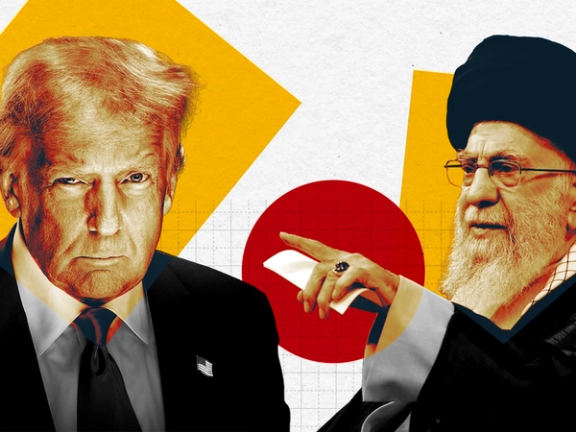
The US side has not publicly commented on the dispute over the location. However, President Donald Trump, who had previously expressed cautious optimism following the first round, criticized the week-long gap between meetings, suggesting that Iran was stalling. “They've got to go fast, because they're fairly close to having one, and they're not going to have one,” he said, referring to Iran’s nuclear capability.
Iranian officials had also requested that Omani Foreign Minister Sayyid Badr Albusaidi attend the Rome meeting, though they did not provide an explanation for the request.
While Iran’s state broadcaster—heavily influenced by the ultraconservative Paydari Party—has been reluctant to cover the first and second meetings with the Americans, the government broke its silence by releasing previously undisclosed information exclusively to the Tehran Times, an English-language daily. Notably, this disclosure bypassed the many Persian-language newspapers published in Tehran.
Supreme Leader Ali Khamenei also weighed in on the talks during a speech on Tuesday. Echoing Trump’s earlier tone, he expressed cautious optimism and said the Iranian negotiating team had performed well.
In a commentary, Eco Iran, a Telegram channel known for serious coverage of domestic politics and economics, wrote: “Despite their historic hostility, an agreement is still possible between Tehran and Washington.” The channel added that Trump had succeeded in pushing Tehran to move its red lines. “The meeting showed that neither Iran nor the United States wants another war in the region,” it added.
Eco Iran also noted growing anxiety among Iranians at home, with many watching the negotiations closely while fearing that Trump’s patience might wear thin. The channel added that Israel is monitoring the talks with concern—especially as Trump may offer Saudi Arabia access to nuclear technology and uranium enrichment during his upcoming visit to Riyadh.
Meanwhile, the pro-reform Telegram channel Jamaran, which is affiliated with former President Mohammad Khatami, posted that many Iranians—particularly those in the middle class—have long supported meaningful engagement with the United States. “Now that the talks have started, the Iranian people are closely watching the developments and discussing them widely,” the channel wrote.
Jamaran added that the public perception is shifting, with many now believing that the government has finally chosen negotiations as a path to address the country’s mounting challenges. It also emphasized that for more than two decades, polls have consistently shown that Iranians favor diplomacy with the West, while also demanding respect for national dignity and interests.
The centrist Telegram channel Emtedad published a commentary by journalist Davoud Heshmati, who welcomed former US Secretary of State John Kerry’s suggestion that any future agreement with Iran should be ratified by the US Senate. He argued that such a step would help reassure Iranians concerned about the possibility of a future US president walking away from the deal.
The comment reflects lingering distrust in Iran toward Trump, with many fearing that even if a new agreement is reached, it could once again be revoked by him—or a successor.
The United States faces a formidable adversary in talks with Islamic Republic, a former top US intelligence official told Iran International, and Tehran's aim could be to buy time for its nuclear program.
Norman Roule, a veteran of the Central Intelligence Agency for over 30 years who once oversaw its Iran desk, said Tehran's veteran negotiators could drag out the talks to their advantage while enriching uranium toward levels needed to build a bomb.
“Every day talks drag on, Iran moves closer to the threshold,” he said. “And if it calculates that it gains more from staying on the edge of weaponization than actually building a bomb, it will continue to play this game.”
Tehran has proven adept, Roule said, at “negotiating the negotiation”, or what he described as using drawn-out diplomacy to defuse military threats and reduce sanctions while continuing nuclear development.
As the United States prepares to resume nuclear talks with Iran this weekend, Iran’s leadership would appear to be on the backfoot amid uncertainty over its political succession, economic malaise, regional setbacks and rising international suspicion of its nuclear ambitions.
Iran has historically used negotiations as a pressure valve, Roule said, entering talks only when the threat of military confrontation peaks, with previous talks in 2003, 2012, and 2015 coinciding with an escalated US military presence or regional turmoil.
But this time is different, he argued.
Norman Roule pictured during an interview with Marzia Hussaini at Iran International's office in Washington DC
“This regime is weaker, more isolated, and increasingly unpopular. If Iran keeps using its nuclear program as a shield to avoid pressure on its oppression, terrorism, and hostage-taking, the international community must call its bluff.”
According to Roule, the Trump administration is entering the talks with a clear objective: a permanent end to Iran’s capacity to build a nuclear weapon, without repeating the perceived flaws of the 2015 Joint Comprehensive Plan of Action (JCPOA).
“The 2015 agreement placed temporary and reversible limits on Iran’s nuclear program but gave Tehran permanent sanctions relief,” Roule said. “The result was that Iran used that economic relief to finance terrorism and militias across the region.”
Now, Washington may seek to allow Iran a more limited civilian nuclear capability while barring any path to weaponization and denying access to funds that could revitalize Iran’s destabilizing regional network.
Historic Strain
The talks with Trump are proceeding as Tehran is at is weakest strategic moment since emerging from the punishing Iran-Iraq War in 1988, Roule argued.
Politically, the sudden death of President Ebrahim Raisi in a 2024 helicopter crash removed the only viable successor to Supreme Leader Ayatollah Khamenei who shared the veteran leader's ideological alignment and political credentials.
Presidential elections last year saw historically low turnout, signaling popular resignation, and the recent ouster of the Vice President and the Finance Minister pointed to factional infighting.
On the economic front, inflation and the proportion of Iranians living below the poverty line both stand at around 30% while blackouts routinely plunge residents and businesses into the dark.
“This is an economic catastrophe,” he said. “Iran's people are paying the price for decades of mismanagement and isolation.”
Militarily, an Oct. 26 Israeli attack likely knocked out much of Iran's air defenses, capping months of harsh Israeli blows on Tehran's allies Hamas and Hezbollah.
“The ring of fire Iran built around Israel is now broken,” Roule said. “The Quds Force remains, but it is bruised and scattered,” he added, referring to the elite paramilitary force that oversees Tehran's foreign operations.
Moment of reckoning
While Roule emphasized his support for a diplomatic solution, he acknowledged that Israel in particular is closely studying plans for a potential attack
“If Israel delivers a significant strike, it won’t eliminate Iran’s nuclear capability permanently,” he said, “but it could raise the costs so high that Tehran would hesitate to rebuild.”
Still, there was some possibility that Tehran could choose a fundamentally different posture toward the United States.
“This could be the moment the Supreme Leader chooses normalization over confrontation,” Roule said. “The Iranian people — brilliant, resilient — deserve a future that isn’t shaped by threats, militias and sanctions.”
Iran's Supreme Leader Ali Khamenei during a meeting with a group of senior officials on April 15, 2025
Iran's Supreme Leader has expressed a mix of cautious optimism and profound skepticism regarding the ongoing talks with the United States, dismissing the talks as only one of Foreign Ministry’s dozens of tasks.
During a meeting with a group of senior officials, Ali Khamenei emphasized the need to avoid tying the country's issues to the outcome of these negotiations.
"We are neither extremely optimistic nor extremely pessimistic about these talks," he said, adding however that “we are very pessimistic about the other side, but we are optimistic about our own capabilities."
Khamenei added, "Ultimately, it is a task and a move that has been decided upon, and the initial steps have been implemented well.”
"We must avoid linking the country's issues to these discussions, repeating the mistake of the JCPOA where national progress was made dependent on the negotiation's advancement. Such an approach creates a conditional environment, stalling everything until the talks' results are known," the Supreme Leader said in a reference to the 2015 agreement.
Khamenei's carefully balanced comments suggest a pragmatic approach to the dialogue, acknowledging the necessity of exploring diplomatic avenues while maintaining deep reservations about the intentions of the American side.
As Tehran and Washington gear up for the next nuclear talks on April 19, a sense of cautious optimism appears to be growing among Iranian officials and many public figures,apparently stemming from a perceived shift in Khamenei’s stance, evidenced by his greenlight of Muscat negotiations.
The influence of ultra-hardline opponents of US engagement, such as former nuclear negotiator Saeed Jalili and the Steadfastness Front (Paydari Party), appears to be diminishing amid internal divisions.
Resistance to negotiations among hardliners has softened because outright opposition risks being seen as defiance of Khamenei’s authority.
US President Donald Trump signs an executive order in January 2025
The Trump administration is considering a proposal to cut nearly 50 percent of the State Department's funding for the upcoming fiscal year, The New York Times reported.
The report cited an internal memo about a proposal to eliminate almost all funding for international organizations like the United Nations and NATO, ending the budget for supporting international peacekeeping operations and curtailing all of the department’s educational and cultural exchanges, like the Fulbright Program.
It said that it is uncertain whether the drastic cuts proposed in the memo would gain approval in the Republican-controlled Congress.
Among the proposed cuts, the report said, the memo outlines a pay and hiring freeze through fiscal 2026, with exceptions for any hires necessary to oversee foreign aid programs transferred from the US Agency for International Development (USAID), which is being disbanded.
The report added that the memo seeks to reduce foreign aid spending by more than 50 percent of the current budget levels for both the State Department and USAID.
The State Department will request a $28.4 billion budget for fiscal year 2026, $26 billion less than the allocation for fiscal year 2025, according to the memo.
The report said that the Trump administration also plans to claw back some funds for the current fiscal year, seeking to reclaim approximately $20 billion in unspent funds from fiscal year 2025 to return to the Treasury.
The report did not specify whether Iran-related programs were included in the cuts.
Over the years, USAID has been a donor to Iranians in the diaspora to strengthen freedom of speech and free flow of information.
A part of the US funds also covers the expenses of Virtual Private Network (VPN) services which ordinary Iranians used to circumvent the Islamic Republic’s censorship.
Official government figures show Washington is the world's biggest donor of international aid, spending $39 billion in the 2024 fiscal year, out of which $65 million was allocated to funding State Department-administered Near East Regional Democracy (NERD).
The body is the main foreign assistance channel through which the United States has supported civil society and human rights in Iran since 2009, according to the Congressional Research Service.
The report added that it was not immediately clear if Secretary of State Marco Rubio had endorsed the memo which NYT said was dated April 10.
The divide among Iran's ultraconservatives began at least a month before the latest round of Iran-US talks, but it has since escalated into an open rift, with most hardliners now backing away from their earlier opposition to negotiations.
Even before the talks resumed, Mahmood Nabavian, vice chairman of the Iranian parliament’s National Security Committee, had begun taking positions that diverged from the hardline Paydari Party’s stance on both domestic and foreign policy.
As recently as last week, hardliners in the Iranian parliament (Majles) and Friday Prayer imams continued to insist that Supreme Leader Ali Khamenei opposed any negotiations with the United States. They maintained that there was no possibility of Iran engaging in talks with anyone from the Trump administration.
That changed on Saturday, April 12, when Foreign Minister Abbas Araghchi met with Trump’s special envoy for the Middle East, Steve Witkoff, in Oman. By Monday, it became clear that the meeting had been more substantial than initially disclosed—despite Araghchi’s earlier statements, the two officials had held a face-to-face meeting lasting about 45 minutes.
Iranian hardliners had expected Khamenei to react—perhaps with public disapproval or at least a symbolic rebuke of his foreign minister. But instead, the Supreme Leader remained silent.
At the Majles, ultraconservative lawmaker Hamid Rasaei declared, in a less than happy tone, that the talks had taken place with Khamenei’s full endorsement. Hossein Shariatmadari, editor of the hardline daily Kayhan, echoed the sentiment, insisting the meeting would not have occurred without the Supreme Leader’s explicit approval.
This left the ultraconservatives with little ground to stand on regarding the negotiations. Still, pockets of resistance remained in the Majles. Outspoken hardliner Mehdi Kouchakzadeh shouted that the legislature had been kept in the dark about the talks. Speaker Mohammad Bagher Ghalibaf quickly cut him off, insisting that the Majles was fully informed. Other lawmakers looked on in silence, their expressions unreadable.
Some hardliners such as Nabavian supported the talks as something that was backed by Khamenei but lambasted Araghchi for meeting with Witkoff breaking his promise of not holding direct talks.
On Monday, the moderate conservative website Khabar Online and the reformist, pro-Pezeshkian daily Etemad published detailed reports on the ultraconservatives’ anger over the negotiations, highlighting what they described as a new rift within Iran’s hardline camp.
Khabar Online reported that the ultraconservatives have fractured into several factions. Some figures, it noted, were so enraged that their public remarks included direct insults toward the negotiators. Meanwhile, other conservatives such as Naghavi Hosseini, along with centrists like Mansoor Haghighatpour, criticized the hardliners opposing the talks, branding them "infiltrators who seek to polarize Iranian society."
Abbas Amirifar, a cleric close to former President Mahmoud Ahmadinejad, accused the ultraconservatives of dishonesty, saying they only pretend to be obedient to Supreme Leader Ali Khamenei. Former lawmaker Gholamali Imanabadi went further, calling them "traitors." From the reformist camp, cleric Mohsen Rohami claimed, "If there were a referendum on negotiating with America, 98 percent of Iranians would vote in favor of the talks."
Supreme Leader Ali Khamenei speaking on April 13, 2025, avoided any direct reference to talks with the US.
Khabar Online revealed that many prominent conservatives have repeatedly expressed their support for negotiations with the United States. Even Ali Khezrian, a staunch supporter of Paydari Party at the Majles has defended the negotiations saying that "America has been weakened under Tump and it is now time to negotiate with it."
Others like hardline cleric Mojtaba Zolnouri who had set fire to copies of the 2015 nuclear agreement at the Majles have also supported the talks. Zolnouri said: "We live under the shadow of the Supreme Leader. We will accept whatever he wants."
Curiously, one prominent ultraconservative figure—former nuclear negotiator Saeed Jalili—has remained conspicuously silent on the ongoing talks. He has not commented on the negotiations themselves, nor on the exchange of letters between Trump and Khamenei that preceded them.
Some Iranian media outlets speculate that Jalili may be mobilizing his "infantry"—a reference to the vigilante groups often active in Tehran and other cities—for a potential street campaign. Another theory circulating among reporters in Tehran is that Jalili is confident the current round of talks will ultimately fail. A third possibility is that he has been instructed by authorities to stay silent for now.
Nonetheless, Jalili still wields influence. His brother Vahid oversees state television, which has maintained its anti-US tone despite the launch of formal negotiations. Media analysts note that state TV continues to give airtime to commentators openly opposed to the talks and to US policy in the region.
A real shift in Khamenei’s stance on negotiations, some observers argue, would only be evident if state television—and Tehran’s hardline newspapers—begin to change their messaging.
Supreme Leader Ali Khamenei praying at the Sharine of Masoumeh in Qom on the day of Muscat talks
Many Iranian officials, political elites, and many public figures appear to be cautiously optimistic as Tehran and Washington prepare for the next round of nuclear talks, set to take place on April 19.
The optimism stems from what appears to be a shift in Supreme Leader Ali Khamenei’s position—evidenced by his authorization of earlier negotiations in Muscat—and US President Donald Trump’s insistence that Iran must either accept a deal or face serious consequences. Notably, Khamenei made no mention of the talks during his meeting with military commanders following the Oman round, echoing hissilence on other contentious issues such as the mandatory hijab in recent months.
“God willing, the negotiations will move forward in the right direction, public anxiety will ease, and the country can return to a state of calm so businesses can operate with more motivation and confidence,” said Mahmoud Alavi, special aide to President Masoud Pezeshkian and former intelligence minister, on Tuesday. Alavi added that a deal seems plausible because Trump, now positioning himself for the international stage, may prefer being remembered as a “peace hero” rather than a “war hero.”
The former head of Iran’s Atomic Energy Organization, Ali-Akbar Salehi, expressed similar optimism. He said both Tehran and Washington appear determined to reach a positive outcome and dismissed the likelihood of military conflict, adding that Trump has no interest in engaging the US in another war.
Azar Mansouri, head of the Reform Front, echoed this hopeful sentiment in a post on X, describing a “general feeling of optimism” within society. She emphasized that the talks were being coordinated by “all pillars of governance”—a veiled reference to Khamenei and his close circle—and described the process as constructive so far.
Abbas Golrou, a member of the parliament’s National Security Committee, also pointed to consensus within the political establishment. “The entire sovereign system has endorsed the talks,” he said, again alluding to Khamenei’s involvement. “This is the right thing to do.”
In interviews with the reformist daily Ham-Mihan, several former diplomats expressed cautious hope. “This may be the first time we can [realistically] hope for all sanctions—not just nuclear-related ones—to be lifted if the negotiations fully succeed,” said Qasem Mohebali, former Director General of the Foreign Ministry’s Middle East and North Africa Division.
Still, concerns remain. Mansouri warned of potential disruption from hardline factions with significant access to state media and public platforms such as Friday prayer pulpits.
The influence of ultra-hardline opponents of US engagement, including former nuclear negotiator Saeed Jalili and the Steadfastness Front (Paydari Party), appears to be waning amid internal divisions. Even among some hardliners, resistance to negotiations has softened, as outright opposition could now be interpreted as defiance of Khamenei’s authority.
Facing a deepening economic crisis, President Pezeshkian has publicly acknowledged that sanctions must be lifted for any meaningful recovery. As a result, many ordinary Iranians are also pinning their hopes on the success of the talks.
“People are hopeful, cautious, angry, and anxious all at once—but I think most of them are taking the possibility of a deal very seriously,” said Amir-Hossein, a Tehran-based businessman, in an interview with Iran International.
“You can see it in the market,” he added. “People are starting to sell the dollars they were holding onto, which shows they believe the rial might strengthen if sanctions are lifted," he said, adding that in his view Khamenei has realized that he has no option other than capitulating to save himself and the Islamic Republic from annihilation.
Indeed, the Iranian rial has appreciated in recent days, and the main index of the Tehran Stock Exchange has rebounded sharply—surpassing its all-time high from January after months of decline.