• العربية
  • فارسی
Brand
  • Iran Insight
  • Politics
  • Economy
  • Analysis
  • Special Report
  • Opinion
  • Podcast
  • Iran Insight
  • Politics
  • Economy
  • Analysis
  • Special Report
  • Opinion
  • Podcast
  • Theme
  • Language
    • العربية
    • فارسی
  • Iran Insight
  • Politics
  • Economy
  • Analysis
  • Special Report
  • Opinion
  • Podcast
All rights reserved for Volant Media UK Limited
volant media logo

Islamabad demands Iran find killers of eight Pakistani workers
Apr 14, 2025, 13:33 GMT+1Updated: 08:40 GMT+0
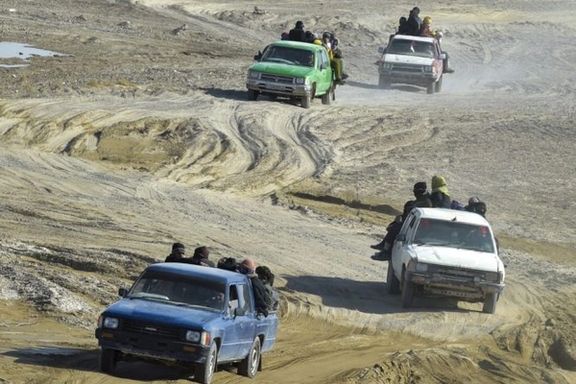
File photo from Iran-Pakistan border areas

Pakistan called on Iranian authorities to identify and detain those responsible for the killing of eight Pakistani nationals in southeastern Iran.

Armed assailants stormed an auto repair shop in Mehrestan County in Iran’s Sistan and Baluchestan province on Friday and killed the workers at close range.

"Pakistan strongly condemned the inhumane and cowardly killing of its nationals in Iran," Pakistan’s Foreign Office said in a statement on Monday.

"The leadership and people of Pakistan are deeply saddened and disturbed by this tragic incident. The Prime Minister has expressed heartfelt condolences for the bereaved families."

"We hope for Iranian side's full cooperation in investigating the matter and in timely repatriation of victims' remains," the statement added.

According to Halvash, an advocacy group for the Baluch people, the incident took place early Friday in the village of Hizabad-e Paein.

The victims—car mechanics and bodywork specialists from Pakistan’s Punjab province—were living and working at the repair shop when gunmen entered the premises, tied their hands and feet, and shot them.

Iranian security forces were deployed to the site following the killings, and the area was placed under heightened surveillance, according to Halvash.

Photos and ID cards of the eight Pakistani nationals killed in Iran
100%
Photos and ID cards of the eight Pakistani nationals killed in Iran

Iran has officially denounced the killings as an "act of terrorism." In a statement on Sunday, Foreign Ministry spokesman Esmail Baqaei said that the country’s security and judicial authorities are determined to identify and bring the perpetrators to justice.

Asr-e Iran website reported that a group calling itself the Balochistan Liberation Army claimed responsibility for the attack.

The armed group operates on both sides of the Iran-Pakistan border and has been involved in previous attacks on state and civilian targets.

The Iranian embassy in Islamabad also issued a statement condemning the act as “inhumane and cowardly.”

In January 2024, Iran and Pakistan exchanged rare cross-border strikes targeting militant groups. Iran launched missiles at what it said were Jaish al-Adl positions inside Pakistan, prompting a retaliatory Pakistani strike on Baloch separatist camps in Iranian territory.

Jaish al-Adl is an armed opposition groups to the Islamic republic.

The strikes marked the most serious escalation in years along the shared frontier.

100%

Most Viewed

Iran International says it won’t be silenced after London arson attack
1

Iran International says it won’t be silenced after London arson attack

2
VOICES FROM IRAN

Hope and anger in Iran as fragile ceasefire persists

3

Iran halts petrochemical exports to supply domestic market

4
INSIGHT

How Tehran bends its own red lines to boost state rallies

5

US arrests Iranian national over alleged Basij-linked visa fraud

Banner
Banner

Spotlight

  • Hardliners push Hormuz ‘red line’ as US blockade tests Iran’s leverage
    INSIGHT

    Hardliners push Hormuz ‘red line’ as US blockade tests Iran’s leverage

  • Ideology may be fading in Iran, but not in Kashmir's ‘Mini Iran'
    INSIGHT

    Ideology may be fading in Iran, but not in Kashmir's ‘Mini Iran'

  • War damage amounts to $3,000 per Iranian, with blockade set to add to losses
    INSIGHT

    War damage amounts to $3,000 per Iranian, with blockade set to add to losses

  • Why the $100 billion Hormuz toll revenue is a myth
    ANALYSIS

    Why the $100 billion Hormuz toll revenue is a myth

  • US blockade targets Iran oil boom amid regional disruption
    ANALYSIS

    US blockade targets Iran oil boom amid regional disruption

  • Iran's digital economy battered by prolonged blackout
    INSIGHT

    Iran's digital economy battered by prolonged blackout

•
•
•

More Stories

Tehran says direct talks with US don’t work for Iran

Apr 14, 2025, 09:08 GMT+1

Iran’s foreign ministry spokesperson said that US-Iran negotiations are indirect because direct talks would not be effective or beneficial for the Islamic Republic.

Esmail Baghaei said that indirect negotiations are not unusual and have occurred before, adding that they are currently taking place in other contexts as well.

“Direct negotiations, in a situation where one side insists on a coercive approach, uses threats, and resorts to force, are neither beneficial nor acceptable to a side like the Islamic Republic of Iran,” he said speaking to reporters on Monday. “Therefore, we will continue with the form and approach we have chosen.”

Baghaei also said that the next round of talks may take place in a location other than Oman, adding that the location is not as important as ensuring the framework of interaction between Iran and the US remains unchanged.

On Sunday, Axios reported that Rome will host second round of Iran-US negotiations next week.

Baghaei added that the Iran's main demand in the negotiations is the removal of sanctions, which the Islamic Republic is pursuing with determination.

Baghaei also confirmed that the Director General of the UN's nuclear watchdog Rafael Grossi will likely visit Tehran this week. Earlier the Wall Street Journal reported that Grossi will visit Tehran this week ahead of the next round of US-Iran talks on Saturday.

He also addressed Tehran's economic cooperation with Washington, saying: "The Islamic Republic has never placed any obstacles to economic cooperation with other parties, but the real problem lies with the US, which, through complex laws, has deprived its own citizens of any economic dealings with Iran."

Baghaei confirmed that Foreign Minister Abbas Araghchi will travel to Moscow later this week for a pre-planned visit.

"The trip was planned in advance, but there will be consultations regarding the talks with the US," Baghaei said.


Squeezed Iranians doubt whether Iran talks will bring relief

Apr 13, 2025, 15:06 GMT+1

Some Iranians are questioning whether US-Iran talks will alleviate persistent economic hardship and political repression.

The talks took place on Saturday and were led by Iran’s Foreign Minister Abbas Araghchi and Donald Trump’s Middle East envoy Steve Witkoff.

While both sides described the exchange as “positive and constructive,” Iranians interviewed anonymously by Iran International or in the form of messages to its submission service questioned the impact of the discussions on their lives.

“This negotiation won’t lower prices or fix the economy,” said one citizen in a video message showing a small grocery purchase costing over ten million rials (around $11).

“Even if billions are unfrozen, not a single rial will reach the people. It’s all in the name of the people, but for the benefit of the regime,” another added.

Iran's economy has been in crisis since 2018, when Trump exited the JCPOA nuclear deal and imposed heavy sanctions on Iran. Tens of millions subsist at poverty level, with workers making around $120 a month.

Some pointed to systemic mismanagement and repression as the root of Iran’s crises, not international sanctions. They criticized the West for engaging diplomatically with a government they believe is at its weakest.

“Why negotiate when the regime is vulnerable?” asked one voice message. “Why not support the Iranian people and end this nightmare?”

The move toward talks, despite Supreme Leader Ali Khamenei’s longstanding opposition to negotiations with what he has repeatedly called a untrustworthy United States, was seen by some as an act of desperation.

“Khamenei once said Qasem Soleimani’s shoes were worth more than Trump,” said a citizen to Iran International, referring to the IRGC commander killed in 2020 on Trump's orders. “Now he negotiates with the man he called Soleimani’s killer.”

As Trump continues to press for a new deal—recently warning that Iran must comply or face consequences—many Iranians say the clerical rulers have caved to external pressure for the sake of survival.

“They refused American vaccines during COVID, but now they’re ready to shake Trump’s hand to stay in power,” said another.

Several messages also highlighted a growing sense that the only path to change may be confrontation. “We’re even ready for war,” said one citizen. “If that’s what it takes to end this regime.”

Images circulating online captured public sentiment, including a Tehran banner reading: “With or without a deal, this executioner republic will fall by the will of the Iranian people.”

Khamenei urges military vigilance a day after US-Iran talks in Oman

Apr 13, 2025, 12:34 GMT+1

A day after talks between Iranian and American officials in Oman, Supreme Leader Ali Khamenei told military commanders that Iran’s armed forces must maintain maximum readiness to confront hostile pressure.

He addressed commanders in Tehran on Sunday, describing the military as the nation’s shield and saying Iran’s progress had left its enemies frustrated.

“What makes them hostile is not the name of the Islamic Republic, but the resolve of a Muslim and independent nation that refuses to rely on others for its dignity,” Khamenei said.

He called for ongoing upgrades in capacity—including weapons, logistics, and personnel welfare—alongside a parallel emphasis on ideological commitment.

Khamenei told military officers that foreign actors were actively working to undermine belief in the legitimacy of the armed forces’ mission.

“Armies that lack conviction, courage, and trust in their cause have collapsed, no matter how heavily equipped they were,” Khamenei added, accusing Western powers of hypocrisy for opposing Iran’s military development while holding massive arsenals of their own.

He acknowledged economic weaknesses but warned against allowing them to overshadow what he called advances in both physical preparedness and national morale.

Chief of Staff Major General Mohammad Bagheri also echoed the call for readiness, referring to Iran’s weapons production, joint exercises, and cooperation between military branches. He praised Iran’s role in supporting Gaza and Lebanon and said public backing remained strong.

“The armed forces are fully prepared, and the enemy will fail to achieve its goals,” Bagheri said.

The comments follow recent threats by US officials, including president Donald Trump over Iran’s nuclear activities and regional support for proxies.

After Trump’s threats of a military strike, Tehran agreed to indirect talks, despite a previous refusal by Khamenei.

Iran’s FM calls first round of US talks 'respectful and constructive'

Apr 13, 2025, 08:22 GMT+1

The initial indirect nuclear discussions between Iran and the United States in Muscat established a tone of equality between the two parties, according to Iranian Foreign Minister Abbas Araghchi.

“In my view, for a first session, it was a constructive meeting,” Araghchi said in remarks published by Iranian media after the talks.

“It was conducted in a calm and very respectful environment. No inappropriate language was used, and both parties demonstrated their intent to pursue these negotiations toward an agreement from an equal footing.”

The meeting, facilitated through shuttle diplomacy by Omani Foreign Minister Badr al-Busaidi, lasted about two and a half hours, he added.

Araghchi confirmed that Busaidi moved between the Iranian and American delegations four times to relay messages.

The Iranian official said that Tehran is not interested in drawn-out or symbolic dialogue. “We and the other side both believe in avoiding time-wasting negotiations. The US also indicated that it seeks a fair and timely agreement,” he added.

A second session is expected to be held next Saturday. Araghchi said while Oman will continue to host the process, the physical location may change.

The White House also described the exchange as a rare moment of diplomacy amid longstanding tensions.

US and Iranian officials held “very positive and constructive” talks in Muscat on Saturday, the White House said in a statement.

Special Presidential Envoy Steven Witkoff, accompanied by Ambassador Ana Escrogima, met Iranian Foreign Minister Abbas Araghchi in talks hosted by Oman’s foreign minister.

“Special Envoy Witkoff underscored to Dr. Araghchi that he had instructions from President Trump to resolve our two nations’ differences through dialogue and diplomacy, if that is possible. These issues are very complicated, and Special Envoy Witkoff’s direct communication today was a step forward in achieving a mutually beneficial outcome,” added the statement.

Internal rifts, profiteers threaten Iran-US talks

Apr 12, 2025, 13:05 GMT+1

Two senior Iranian political figures warned that internal disunity and vested domestic interests could undermine negotiations with the United States, as officials from both sides resume contacts in Oman.

The talks should be treated as a national decision rather than a partisan initiative, said the former Deputy Speaker of Iran’s Parliament Ali Motahari.

“These talks are a decision by the entire system and must not be portrayed as imposed by one faction,” said Motahari, a conservative politician known for outspoken views, in an interview with Rouydad24 on Saturday.

Motahari pointed to the 2015 nuclear agreement as an example of what could be achieved through engagement but also how easily it could unravel.

Former Iranian lawmaker Ali Motahari
100%
Former Iranian lawmaker Ali Motahari

“In the two years the JCPOA was implemented, we saw single-digit inflation and higher economic growth,” he said. “Let’s not allow partisan competition sabotage this round.”

The outcome of this round would signal whether “the negotiations are on a constructive track and whether the other side seeks a fair resolution or talks from a position of dominance,” he said.

From the Reformist camp, a former official also called for sidelining powerful domestic actors who benefit from Iran’s continued isolation.

Reformist figure Mohammad Hashemi
100%
Reformist figure Mohammad Hashemi

“To advance negotiations and end sanctions, the government must disarm the so-called sanctions profiteers,” said Mohammad Hashemi, the brother of former president Akbar Hashemi Rafsanjani, in an interview with Khabar Online website.

Hashemi warned that these groups, though few in number, wield significant influence and have actively worked to destabilize the new government.

“Their power lies in chaos. Without confronting them, real progress is impossible,” he added.

He also offered a cautious assessment of US President Donald Trump.

“Trump has no credible track record. He tore up the nuclear deal and ordered the killing of IRGC commander Qasem Soleimani,” Hashemi said.

“But he’s also a businessman, not a warmonger. He prefers deals over war.”