• العربية
  • فارسی
Brand
  • Iran Insight
  • Politics
  • Economy
  • Analysis
  • Special Report
  • Opinion
  • Podcast
  • Iran Insight
  • Politics
  • Economy
  • Analysis
  • Special Report
  • Opinion
  • Podcast
  • Theme
  • Language
    • العربية
    • فارسی
  • Iran Insight
  • Politics
  • Economy
  • Analysis
  • Special Report
  • Opinion
  • Podcast
All rights reserved for Volant Media UK Limited
volant media logo

Israeli FM says diplomacy still an option to prevent Iran developing nuclear weapons

Apr 3, 2025, 09:50 GMT+1Updated: 15:22 GMT+1
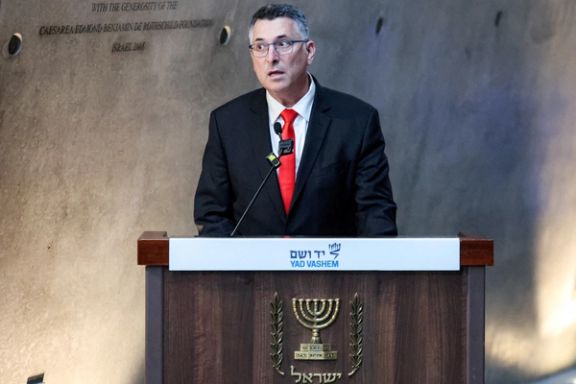
Israel's Foreign Minister Gideon Saar speaks during the visit of the US Secretary of State, Marco Rubio, to the Yad Vashem Holocaust Memorial museum in Jerusalem February 16, 2025.

Israel's foreign minister said the country is not ruling out a diplomatic path to prevent Iran obtaining a nuclear weapon, adding that there were signs that there could be indirect talks between Tehran and the United States.

"We don't hold discussions with the Iranians, as you know, but they made it clear they are ready to an indirect negotiations with the US, and I will not be surprised if such negotiations will start," Israeli Foreign Minister Gideon Saar said on Thursday following a meeting with his French counterpart in Paris.

“What's important is the objective, and the objective is not to have Iran with nuclear weapon. I think it's international consensus, and we don't exclude the diplomatic path,” he added.

Iran denies seeking nuclear weapons, though hardliners are calling for the country's Supreme Leader Ali Khamenei to drop the religious ban on nuclear weapons, an argument that has gained pace in the wake of threats from US President Donald Trump.

Trump recently threatened to bomb Iran if a deal is not reached within a two month deadline, prompting a sharp response from Khamenei, who warned of a "heavy blow in return" if Iran were attacked. The exact start date of Trump's deadline to Iran remains unclear.

According to two US officials cited by Axios, the White House is seriously considering the Iranian proposal for indirect nuclear talks, even as the US military significantly increases its presence in the Middle East.

"Iran is a dangerous state with an extremist regime that works intensively against regional stability, exporting the Islamist revolution and spreading terrorism in the region," Saar said after the meeting with Jean-Noël Barrot.

Since October 7 when Iran-backed Hamas invaded Israel, killing 12,000 mostly civilians and taking more than 250 others hostage, Iran's allies have launched attacks on Israel from Syria, Iraq, Lebanon and Yemen.

"The most extremist regime in the world shouldn't possess the most dangerous weapon in the world," he added.

Along with the US, France was pivotal in securing the ceasefire between Israel and Iran's largest proxy, Hezbollah in Lebanon. Following the Lebanese militia's assault on Israel in allegiance with Hamas in Gaza, the archenemies came the closest to war since 2006 before the ceasefire which came into effect in November.

"We shouldn't allow Hezbollah to recover and rearm, and we will not let it happen," said Saar, as the fragile ceasefire continues amid allegations from both sides of breaches.

"Inside Lebanon, there is cooperation between Iran, Hezbollah, and Hamas, and we will not allow terror activities from there against Israel and our civilians. We will not allow to come back to the reality of October 6th on any of Israel's borders."

On Tuesday, the Israeli military said it assassinated a Revolutionary Guards member coordinating Hamas and Hezbollah operations in Lebanon.

Hassan Ali Mahmoud Badir, a member of Hezbollah's Unit 3900 and the Revolutionary Guards Quds Force, was killed in the Dahiyeh area of Beirut, a stronghold of the Iran-backed Hezbollah militia.

"Badir recently operated in cooperation with the Hamas terrorist organization, directed Hamas terrorists, and assisted them in planning and advancing a significant and imminent terror attack against Israeli civilians," a statement released on Tuesday said.

"Given the immediacy of the threat, Badir was struck immediately in order to eliminate the threat posed by a terror attack intended to harm Israeli civilians."

Most Viewed

Ghalibaf defends Iran-US talks amid hardline backlash
1
INSIGHT

Ghalibaf defends Iran-US talks amid hardline backlash

2
ANALYSIS

From instability to influence: Pakistan’s pivotal role in US-Iran diplomacy

3
ANALYSIS

100 days on: why Iran’s January protests spread across social classes

4

War-hit homeowners feel abandoned as Iran’s reconstruction aid fades

5
INSIGHT

100 days on: the anatomy of Iran’s January crackdown

Banner
Banner

Spotlight

  • The politics of pink: how Iran uses cuteness to rebrand violence
    ANALYSIS

    The politics of pink: how Iran uses cuteness to rebrand violence

  • Bread shortages, soaring prices strain households in Iran, residents say
    VOICES FROM IRAN

    Bread shortages, soaring prices strain households in Iran, residents say

  • War-hit homeowners feel abandoned as Iran’s reconstruction aid fades

    War-hit homeowners feel abandoned as Iran’s reconstruction aid fades

  • 100 days on: the anatomy of Iran’s January crackdown
    INSIGHT

    100 days on: the anatomy of Iran’s January crackdown

  • Ghalibaf defends Iran-US talks amid hardline backlash
    INSIGHT

    Ghalibaf defends Iran-US talks amid hardline backlash

  • From instability to influence: Pakistan’s pivotal role in US-Iran diplomacy
    ANALYSIS

    From instability to influence: Pakistan’s pivotal role in US-Iran diplomacy

•
•
•

More Stories

Iran faces internal debate over building nuclear weapons

Apr 3, 2025, 07:32 GMT+1
•
Maryam Sinaiee

Remarks by a senior adviser to Iran’s Supreme Leader warning of Iran being pushed to produce nuclear weapons by US threats have sparked intense debate in Iran.

In a televised interview on Monday, Ali Larijani suggested that if Iran were attacked and public demand for nuclear weapons emerged, even the Supreme Leader’s religious decree (fatwa) against weapons of mass destruction could be reconsidered. Nonetheless, he insisted that Iran is not pursuing nuclear arms and remains committed to cooperating with the International Atomic Energy Agency (IAEA).

Khamenei’s ruling was presented by Iranian officials at the International Conference on Nuclear Disarmament in April 2010. But such religious decrees could be altered or overturned given the ‘requirement of time and place’ as many historical instances prove.

Many hardliners and ultra-hardliners in Tehran—typically staunch critics of the moderate conservative Larijani—have embraced his remarks on social media.

“Had any other political figure raised the possibility of the Islamic Republic moving toward nuclear weapons, they would have been accused of warmongering or bluffing. Dr. Larijani’s decision to bring it up was a wise move and a timely act of sacrifice,” wrote Vahid Yaminpour, a prominent ultra-hardliner and former state television executive, on X.

“The Iranian nation wants nuclear weapons,” declared Seyed Komail, an ultra-hardliner social media activist with 27,000 followers, in response to Larijani’s remarks.

Abdollah Ganji, former editor of the IRGC-linked Javan newspaper, dismissed concerns over potential US or Israeli strikes, arguing that Iran’s nuclear facilities are too deeply fortified to be destroyed. He warned that an attack could lead to Iran's withdrawal from the Non-Proliferation Treaty (NPT) and retaliation against US military bases and Israel.

However, Larijani’s remarks stand in contrast to official government positions. Soon after his interview, Iran’s Foreign Minister Abbas Araghchi reaffirmed on X that Iran “under no circumstances” would seek, develop, or acquire nuclear weapons, emphasizing that diplomacy remains the best course of action.

Nour News, an online outlet believed to be affiliated with Iran’s Supreme National Security Council (SNSC), also weighed in, questioning whether the US is prepared to face the consequences of further escalation.

Larijani’s statements have drawn strong criticism as well. Detractors argue that such rhetoric provides the US and Israel with an excuse to justify pre-emptive military action. “The Leader’s fatwa prohibiting nuclear weapons is absolute and without exceptions,” posted cleric Saeed Ebrahimi on X, adding that raising the prospect of nuclear bombs would only give Iran's enemies justification for aggression.

Mohammad Rahbari, a prominent political commentator in Tehran, suggested that Larijani’s remarks signaled Iran may be alarmingly close to nuclear capability—precisely the kind of pretext Israel has been seeking for a preemptive strike. Senior reformist journalist Mohammad Sahafi also warned that such nuclear posturing could alienate potential allies who might otherwise support Iran in the face of Western pressure.

“Larijani's comment was unprofessional and came from a position of weakness; it had no merit. It also gave the other side an excuse to have strong reasons for pre-emptive action and to shape a global consensus. In short, if we are concerned about our homeland, we should not take such a reckless stance,” Hemmat Imani, an international relations researcher in Iran, wrote.

Others speculate that Larijani’s remarks are part of ongoing indirect negotiations with Washington. “Ali Larijani’s ‘warning’ should be seen as a calculated move in high-level negotiations,” suggested Iranian environmental journalist Sina Jahani.

Describing Larijani’s remarks as “a form of nuclear blackmail the Islamic Republic has used as a tool of threat for years,” Arvand Amir-Khosravi, a Norway-based academic and monarchist, wrote on X that the threat was “nothing more than a propaganda ploy to gain leverage in potential negotiations,” adding that pursuing nuclear weapons would invite military retaliation rather than enhance Iran’s security.

The United States Office of the Director of National Intelligence reported in November 2024 that, as of September 26, Iran was not actively building a nuclear weapon. However, last month, Rafael Grossi, director general of the International Atomic Energy Agency (IAEA), described Iran’s nuclear program as extremely ambitious and wide-ranging. He warned that the country's uranium enrichment had reached near weapons-grade levels and was alarmingly close to the threshold for acquiring nuclear weapons.
'Great': US envoy answers Iran's top diplomat in cryptic, deleted post

Apr 2, 2025, 21:46 GMT+1

US President Donald Trump's special envoy Steve Witkoff reacted "great" on Wednesday to a spirited statement by Iran's foreign minister on X before swiftly deleting the post.

It was not immediately clear if the expunged monosyllable, which marks the first public interaction between Tehran and the Trump administration, was meant in earnest, irony or error.

Witkoff's office did not immediately respond to an Iran International request for comment.

Tensions between Tehran and Washington have ramped up in recent days after Trump mooted bombing the country.

Foreign Minister Abbas Araghchi had written four paragraphs lamenting Washington's exit from a nuclear deal and recent talk of attacking Iran.

"10 years after signing the JCPOA—and 7 years after the US unilaterally walked away from it—there is not ONE SHRED OF PROOF that Iran has violated this commitment," Araghchi wrote, referring to a 2015 agreement from which the United States withdrew in Trump's first term.

"Diplomatic engagement worked in the past and can still work. BUT, it should be clear to all that there is—by definition—no such thing as a 'military option' let alone a 'military solution'," he added.

Witkoff, who has spearheaded talks for Trump in Israel-Hamas and Ukraine-Russia conflicts as part of the populist President's bid to wind down foreign reports, replied simply: "Great".

Within minutes, the reply was deleted from Witkoff's account.

The post came weeks after after a leaked chat among senior administration officials including Witkoff about plans for an imminent attack on the Iran-aligned Houthi group in Yemen sparked consternation in Washington among Trump's opponents.

Critics said the inclusion of a prominent journalist in the group and the discussion of sensitive military plans on a commercial chat app, Signal, endangered national security and revealed too much about official thinking and intelligence sources.

Trump on Sunday warned that Iran could face bombing and secondary tariffs if a nuclear deal was not reached with Washington. The remarks prompted a sharp riposte from Iranian Supreme Leader Ali Khamenei, who warned of a "heavy blow in return" if Iran were attacked.

Trump had previously reached out to Khamenei in the form of a personal letter in an attempt to explore a new nuclear agreement and prevent military escalation, Witkoff said late last month.

"We don't need to solve everything militarily," Witkoff told Fox News.

"Our signal to Iran is let's sit down and see if we can, through dialogue, through diplomacy, get to the right place. If we can, we are prepared to do that. And if we can't, the alternative is not a great alternative."

Russia says US threats on Iran nuclear sites 'illegal and unacceptable'

Apr 2, 2025, 18:24 GMT+1

Moscow has rejected as illegal US threats against Iran's nuclear infrastructure, the Russian foreign ministry said on Wednesday, as tensions between Washington and Tehran have ramped up in recent weeks.

The remarks follow a discussion between the deputy foreign ministers of Russia and Iran Sergei Ryabkov and Iranian deputy foreign minister Majid Takht Ravanchi on Wednesday in which the two sides accused Western countries of "artificially and unreasonably" inflaming tensions over Tehran's nuclear program.

Using military force against Iran and threatening to strike its nuclear infrastructure would be "illegal and unacceptable," the Russian foreign ministry said according to Reuters, as they would cause "large-scale and irreversible radiological and humanitarian consequences" for the Middle East and the world.

US president Donald Trump has repeatedly expressed his preference for a nuclear deal with Iran but warned that a failure to reach one within a timeframe he has set could lead to military action.

The exact start date of Trump's reported two-month deadline to Iran remains unclear.

Tehran has rejected direct negotiations with the Trump administration and has suggested indirect talks via Oman.

A day earlier, Ryabkov warned against a US strike on Iran and expressed optimism that the stand-off could be resolved diplomatically.

"There is still time, and the 'train has not left the station' yet. We must intensify efforts to reach a reasonable agreement," Ryabkov said in an interview with Russian journal International Affairs.

"Russia is ready to offer its services to Washington, Tehran and all parties interested in resolving this issue," he added.

Kremlin spokesman Dmitry Peskov also said last month that Russian President Vladimir Putin had agreed to mediate nuclear talks between Washington and Tehran.

Trump weighing indirect Iran talks amid military buildup - Axios

Apr 2, 2025, 10:46 GMT+1

The White House is seriously considering an Iranian proposal for indirect nuclear talks, even as the US military significantly increases its presence in the Middle East, according to two US officials who spoke to Axios.

The deliberations come as Trump has repeatedly expressed his preference for a nuclear deal with Iran but warned that a failure to reach one within a timeframe he has set could lead to military action. The exact start date of Trump's reported two-month deadline to Iran remains unclear.

The consideration of indirect talks follows Iran's formal response to a letter sent by Trump to Supreme Leader Ali Khamenei in March. Iran rejected direct US talks as well as negotiating over its missile program and its support for armed regional groups, which the US has insisted must be part of any discussions.

While Trump had proposed direct negotiations, Iran has reportedly agreed only to indirect discussions mediated by Oman, which has previously played a mediating role between the two nations.

The US officials cited by Axios added that the Trump administration believes direct talks would be more effective but is not dismissing the Iranian proposal or Oman's potential role as mediator.

"After the exchange of letters, we are now exploring next steps in order to begin conversations and trust building with the Iranians," one of the US officials told Axios, emphasizing that no final decision has been made and internal discussions are ongoing.

More than one year of indirect talks with the Biden administration failed to produce an agreement. Those who believe Tehran might be playing for time see its demand for Omani mediation as a tactic to drag out negotiations until the end of the Trump administration.

Sources indicate an internal debate within the White House, with some officials believing a negotiated agreement is still possible, while others view further talks as futile and advocate for military strikes against Iran's nuclear facilities.

In a parallel move, the Pentagon is undertaking a substantial buildup of forces in the Middle East. The deployment would provide Trump with readily available military capabilities should he decide diplomatic efforts have failed.

The diplomatic maneuvering occurs against a backdrop of escalating rhetoric between Washington and Tehran.

Trump recently threatened to bomb Iran if a deal is not reached, prompting a sharp response from Khamenei, who warned of a "heavy blow in return" if Iran were attacked.

Iran has also lodged a formal protest via the Swiss embassy, which represents US interests in Iran, vowing a "decisive and immediate" response to any threat.

Tensions are further fueled by Iran's increased uranium enrichment, bringing it closer to becoming a nuclear threshold state, although Tehran maintains it does not seek nuclear weapons.

The Pentagon confirmed on Tuesday the deployment of additional troops and air assets to the region, with two aircraft carriers, the Truman and Vinson, remaining in the area.

Last week, B-2 stealth bombers were sent to the Diego Garcia military base in the Indian Ocean, a move a US official indicated was linked to Trump's deadline.

"Should Iran or its proxies threaten American personnel and interests in the region, the US will take decisive action to defend our people," Pentagon spokesperson Sean Parnell said in a statement.

Republican lawmakers push for harsher stance on Iran

Apr 1, 2025, 22:15 GMT+1
•
Arash Aalaei

Republican lawmakers on Tuesday urged a tougher line on Washington's Mideast adversary Tehran and outlined plans for new legislation targeting the Islamic Republic as tensions have soared in recent days.

US President Donald Trump said on Sunday that Iran would face bombing if it did not agree to a new nuclear deal, prompting a senior advisor to Iran's Supreme Leader Ali Khamenei to moot the pursuit of a bomb in the event of an attack.

The Republican Study Committee (RSC) in a press conference advocated a series of new acts it said would increase pressure on Tehran in line with Trump's policy of stepping up sanctions in a bid to force the Islamic Republic to the negotiating table.

It named ten proposed pieces of legislation including the Free Iraq from Iran Act, Stop Corrupt Iranian Oligarchs and Entities Act and the No Sanctions Relief for Terrorists Act.

"This package is the strongest Iran sanctions and security package delivered to date.
The Iranian people are not the target," Congressman August Pfluger of Texas told reporters.

"It's the leadership that wants to gain a nuclear weapon and wants to continue that pariah state of sowing chaos and terrorism throughout the world," he added. "If I were them, I would make the choice of announcing loud and clear that they will not attain a nuclear weapon."

The US director of national intelligence Tulsi Gabbard said last week that Washington assessed Iran is not building nuclear weapons but that a taboo in Iran on discussing nuclear weapons in public was eroding.

The RSC is a conservative caucus for house Republicans founded in 1973.

"Right now, Tehran has a very clear offering, and that's to enter into negotiations in good faith with President Trump, who has laid out not only a roadmap for the Persian Farsi people to be successful, but for Iran to have a future," Representative Zach Nunn of Iowa said.

"It simply means stop funding terrorism, stop avoiding the sanctions regime, come to the table, de-escalate and end a nuclear regime that only ends in death for potentially hundreds of thousands of people in the Middle East."

Trump told NBC News on Sunday that if a deal was not reached, "there will be bombing — and it will be bombing the likes of which they have never seen before." Khamenei vowed retaliation to any attack.

An attack, a veteran nuclear negotiator and advisor to the Supreme Leader said on Monday, would push Iran toward acquiring nuclear weapons to ensure its defense,

Tehran denies seeking nuclear weapons and Khamenei has issued a religious injunction against them, but the United Nations nuclear watchdog says Iran has enriched more uranium than any state lacking a bomb.

"Not only are they pursuing a nuclear weapon to vaporize Israel and ultimately the United States, they're developing ICBMs, which can only be for one purpose, and that is to deliver a nuclear attack against the American people," Representative Joe Wilson of South Carolina said.

"And there must be verification, not the charades we've had with the previous administrations."

Trump withdrew from a 2015 international nuclear agreement with Iran in his first term after bashing it as too lenient. Khamenei said talks were pointless if a new deal could easily be broken.

The US military has deployed long range bombers at a strategic Indian Ocean airbase, a spokesperson told Iran International last week, a move which presaged major bombing campaigns against Afghanistan in 2001 and Iraq in 2003.