• العربية
  • فارسی
Brand
  • Iran Insight
  • Politics
  • Economy
  • Analysis
  • Special Report
  • Opinion
  • Podcast
  • Iran Insight
  • Politics
  • Economy
  • Analysis
  • Special Report
  • Opinion
  • Podcast
  • Theme
  • Language
    • العربية
    • فارسی
  • Iran Insight
  • Politics
  • Economy
  • Analysis
  • Special Report
  • Opinion
  • Podcast
All rights reserved for Volant Media UK Limited
volant media logo

Baghdad says Iran briefed Iraq on Trump’s letter to Khamenei

Mar 25, 2025, 07:39 GMT+0Updated: 09:23 GMT+0
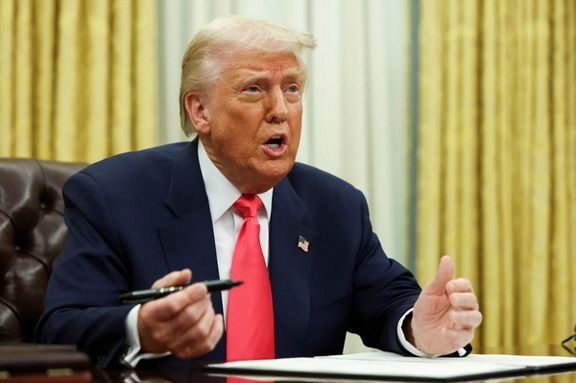
US President Donald Trump speaks in the Oval Office, on the day he signs executive orders, at the White House in Washington, DC, March 6, 2025.

Iran's foreign minister revealed the contents of a letter from US President Trump to Supreme Leader Ali Khamenei during a call with his Iraqi counterpart, according to Iraq's foreign ministry.

Foreign Minister Abbas Araghchi “informed Mr. Fuad Hussein of the contents of a letter from US President Donald Trump addressed to the Iranian leadership, represented by the Supreme Leader Seyyed Ali Khamenei,” Iraq's foreign ministry said in a statement.

“He confirmed that the Iranian government will respond to the letter.”

Last week, an Emirati official brought a letter from Trump proposing nuclear talks with Tehran, which Supreme Leader Ali Khamenei rejected, saying such a proposal was deception from Washington amid crippling sanctions on Iran.

According to Iraq's foreign ministry, Hussein appreciated being briefed on the contents of President Trump’s letter and said he hoped that the exchange of messages would help open channels for dialogue between the two sides.

Iran's Foreign Minister Abbas Araghchi (left) and his Iraqi counterpart Fuad Hussein at Iraq’s Foreign Ministry’s headquarters in Baghdad, October 13, 2024
100%
Iran's Foreign Minister Abbas Araghchi (left) and his Iraqi counterpart Fuad Hussein at Iraq’s Foreign Ministry’s headquarters in Baghdad, October 13, 2024

The two diplomats also discussed bilateral ties and agreed to continue communication, particularly during the sensitive phase ahead, the ministry added.

According to Axios, Trump’s letter to Khamenei included a two-month deadline for reaching a new nuclear agreement and warned of consequences if Iran expanded its nuclear program.

Iran's foreign ministry also released a readout of the call but made no mention of Trump’s letter. Instead, it focused on the escalation in Gaza and Lebanon following what it called brutal attacks by Israel, and the US military offensive in Yemen.

In part of the readout, the Iranian foreign ministry said Araghchi addressed US sanctions on Iran’s oil industry, saying the American claims and accusations aimed at pressuring Tehran were baseless.

The readout did not make any mention of Iraqi Oil Minister Hayan Abdel-Ghani who on Monday said Iranian oil tankers stopped by US forces in the Persian Gulf were using forged Iraqi documents, as Washington ramps up sanctions on Iran's oil exports as part of US President Donald Trump renewed "maximum pressure" campaign.


Most Viewed

Ghalibaf defends Iran-US talks amid hardline backlash
1
INSIGHT

Ghalibaf defends Iran-US talks amid hardline backlash

2
INSIGHT

Iran diplomacy wobbles as factions compete to avoid looking soft on US

3
VOICES FROM IRAN

Bread shortages, soaring prices strain households in Iran, residents say

4
ANALYSIS

The politics of pink: how Iran uses cuteness to rebrand violence

5

Scam messages seek crypto for ships’ safe passage through Hormuz, firm warns

Banner
Banner

Spotlight

  • Diplomacy tolls at Hormuz as conflict returns to its doorstep
    OPINION

    Diplomacy tolls at Hormuz as conflict returns to its doorstep

  • Opposition to US talks grows in Tehran as ceasefire deadline nears
    INSIGHT

    Opposition to US talks grows in Tehran as ceasefire deadline nears

  • Tehran moderates see ‘no deal–no war’ limbo as worst outcome
    INSIGHT

    Tehran moderates see ‘no deal–no war’ limbo as worst outcome

  • The future has been switched off here
    TEHRAN INSIDER

    The future has been switched off here

  • Lights out, then gunfire: Witnesses recount Mashhad protest crackdown
    VOICES FROM IRAN

    Lights out, then gunfire: Witnesses recount Mashhad protest crackdown

  • Is Iran entering its Gorbachev moment?
    INSIGHT

    Is Iran entering its Gorbachev moment?

•
•
•

More Stories

Iran's top medical body warns of skilled staff exodus

Mar 24, 2025, 21:09 GMT+0

Iran’s health system faces an uphill battle filling vacancies, the country's medical regulatory body warned on Monday, citing shortages of doctors and nurses as the most pressing challenge in the year ahead.

“The three main challenges in the new year will be staffing, financing, and supplies,” the spokesman for the Iranian Medical Council Reza Laripous said, according to state-affiliated news agency ILNA .

Healthcare cannot function without trained workforce, Laripour warned, no matter how many new hospitals are built or expensive equipment brought in.

“Personnel—especially physicians and nurses—are the core users of medical resources and thebackbone of effective care,” he said.

The Iranian government strictly regulates medical fees and annually announces chargeable rates for private general practitioners, specialists, and dentists.

In early April, for instance, doctor's fees for general practitioners and specialists were set at 1.26 million rials ($20) and 1.89 million rials ($30), respectively, for the next twelve months. The medical community argues that these tariffs for medical services do not align with inflation and has strongly objected to them.

Since August, nurses in dozens of cities across Iran have been staging ongoing protests againstharsh working conditions and the government’s failure to pay wages consistently.

Laripour cited unfair tariffs, heavy workloads, and unequal resource distribution as key drivers behind dissatisfaction, leading many to leave their profession.

These pressures, he added, could push skilled staff to leave Iran or shift away from clinical work altogether.

He called for urgent government intervention, including better funding and attention to both thenumber and variety of healthcare professionals.

Without meaningful action, he said, rising inflation and poor economic planning will make it “irrational to expect effective care under current tariff structures,” leaving both providers and patients to bear the costs.

Iranian medical have repeatedly warned in the past few years about the inevitable deterioration of the healthcare system and its possible collapse if the same trends continue.

Government officials have never offered concrete figures on the number of doctors, midwives, and nurses who have left the country for better jobs in neighboring countries including the United Arab Emirates and Oman, as well as elsewhere in the world.

Iran says no one will dare attack despite US military buildup in region

Mar 24, 2025, 08:39 GMT+0

Iran's Foreign Minister Abbas Araghchi said that no nation would dare attack Iran due to its high state of military preparedness.

Speaking at a Red Crescent New Year's headquarters meeting on Monday, Araghchi said, "Our enemies are well aware of the consequences of any aggression against our territory,” emphasizing the readiness of Iran's armed forces and emergency services.

He added that this readiness acts as a deterrent, ensuring no one has the power or courage to violate Iran's borders.

"Our adversaries are fully aware of the high level of capability and readiness possessed by our armed forces, emergency services, and government. This preparedness provides us with immunity and strength, effectively deterring any potential aggression against our territory."

Elsewhere in his remarks, he affirmed that Iran rejects direct negotiations with the US, but is open to indirect talks through intermediaries.

'The Islamic Republic of Iran, under maximum pressure and the threats it faces, will definitely notenter into direct negotiations with the United States. This is our clear policy and it will continue until there is a change in the other side's approach towards the Iranian people.”

Araghchi asserted, “The current outlook is that, with the accusations being made and the unreasonable demands that are repeated daily, we will not enter into any direct negotiations with the American side.”

He added,“However, the path for indirect negotiations is open, and there are various channels through which it can be done.”

Araghchi's comments come as the United States significantly increases its naval presence in the Middle East, a move directly linked to escalating tensions with the Iran-backed Houthi rebels in Yemen.

US Defense Secretary Pete Hegseth has ordered two aircraft carrier strike groups to the region next month, a rare deployment intended to bolster US strikes against the Houthis, whose primary benefactor is Iran.

This buildup follows persistent Houthi attacks on commercial and military vessels in the Red Sea, which the group frames as a response to the Israeli war in Gaza.

The extended deployment of the USS Harry S. Truman and the expedited arrival of the USS Carl Vinson will provide US commanders with increased capacity for patrols and strikes.

The US has maintained a consistent naval presence in the Middle East, with carrier strike groups rotating through the region. This current deployment, however, marks a notable increase in firepower, potentially signaling a stronger deterrent message to Iran amidst regional tensions.

The comments also follow two aerial attacks by Israel last year which saw a major weakening of Iran's air defenses, which Iran has played down as the two countries play out their tit-for-tat attacks.

Iran tankers used fake Iraqi documents to dodge US sanctions, Baghdad says

Mar 24, 2025, 08:31 GMT+0

Iranian oil tankers stopped by US forces in the Persian Gulf were using forged Iraqi documents, according to Iraqi Oil Minister Hayan Abdel-Ghani.

"We received some verbal inquiries about oil tankers being detained in the Persian Gulf by US naval forces carrying Iraqi shipping manifests," Abdel-Ghani said on state television late on Sunday.

"It turned out that these tankers were Iranian ... and were using forged Iraqi documents. We explained this to the relevant authorities with complete transparency and they also confirmed this."

Later on Monday, Iran's oil ministry denied the reports about Iranian oil tankers being seized by the United States.

This comes as Washington has been ramping up sanctions on Iran's oil exports, as part of US President Donald Trump renewed "maximum pressure" campaign, aimed at cutting Iran’s oil exports to zero in a bid to force Tehran into talks over its nuclear program.

In December, Reuters reported that a fuel smuggling network using forged documents has generated at least $1 billion annually for Iran and its proxies in Iraq.

The network sells crude exclusively to companies that own refineries and does not supply trading firms, Abdel-Ghani said, adding that several traders were behind the scheme.

Ban on Iran Air hampers medicine imports, state carrier says

Mar 24, 2025, 08:10 GMT+0

Iran Air, the country's flag carrier, has reported significant losses and a severe impact on drug imports following the European Union and UK's flight ban, with the airline's CEO calling for international legal action to restore services.

Hossain Khanlari, CEO of Iran Air (Homa), told ILNA news agency that the suspension of European flights has not only harmed the airline's revenue but also severely affected the supply of essential medicines to Iran amid an already dire health crisis.

EU sanctions have stopped all direct Iran Air flights to Europe. The flight bans impact passenger travel and trade, as Iran Air was the sole Iranian carrier serving Europe.

"Iran Air was a major carrier of pharmaceuticals from Europe, with two-thirds of the 12-ton cargo on each flight being medicine, primarily from Germany," Khanlari said.

The flight ban has disrupted this critical supply chain, creating hardships for patients in Iran. "We are pursuing legal avenues through international bodies to resume these flights, especially to address the current drug shortage," Khanlari stated.

Iran's healthcare system is under severe strain, grappling with critical medicine shortages and rapidly escalating costs with a huge flood of professionals fleeing the country for better opportunities abroad.

Government debt to pharmacies has crippled supply chains, while the plunging value of the Iranian rial has inflated the price of both imported and domestically produced drugs. A black market for essential medications has emerged, and some pharmaceutical companies have ceased production due to financial unviability.

The government's attempts to control drug prices and subsidize costs are failing to counteract the economic pressures, and rising healthcare expenses are driving more families into poverty.

In addition to the drug supply issue, Khanlari highlighted the ban's impact on Iranian citizens living in Europe, students, and academics who relied on Iran Air for travel.

"Many Iranians visited their families in Europe using our flights, and Iranians residing in Europe traveled back home with Iran Air. These individuals are now facing increased travel costs," he said.

To mitigate the financial losses from the European flight cancellations, Iran Air has increased its regional flights and added routes to East and South Asia. "While these new routes are profitable, they cannot fully compensate for the revenue lost from European flights," Khanlari explained.

Despite the new routes, Iran Air remains committed to resuming its European services. "We are eager to restart our European flights to serve our citizens," Khanlari said. "However, in the absence of European routes, we must focus on expanding our operations in Asia."

The European sanctions against Iran’s civil aviation industry announced in September are particularly significant, as Iran Air used to operate an average of 24 weekly flights each way to at least nine European cities, including Paris, London, Frankfurt, and Rome, according to information obtained by Aviacionline via Cirium.

In August, the United States sanctioned Iran Air after accusing Tehran of supplying Russia with short-range ballistic missiles. The US Treasury accused Iran Air of having transported goods "on behalf of Iran’s Islamic Revolutionary Guard Corps (IRGC) and Ministry of Defense and Armed Forces Logistics (MODAFL)."

Iran has been deeply involved in Russia’s war effort in Ukraine since mid-2022, providing drones, spare parts and training.
Israel arrests citizen over Iranian spy plot targeting nuclear, military facilities

Mar 23, 2025, 16:29 GMT+0

As cases of Israelis being hired by Iranian operatives continue to soar, Israel Police says it has arrested a 65-year-old accused of carrying out surveillance and photography missions for Iran at infrastructure and security sites in Israel.

Named as Eduard Yusupov, the statement from Israeli Police said: “Based on the findings of the investigation, it can be said that Yusupov was operated by Iranian intelligence elements.”

He is said to have agreed to carry out the missions starting last October, for a fee of tens of thousands of dollars paid in crypto currency after being approached by a person who identified himself as an Azerbaijani citizen living in Dubai.

“[Yusupov] had carried out numerous missions for him, including surveillance and photography missions related to infrastructure and security sites in Israel, including IDF bases, the Haifa Port, the Haifa refineries, and the Nuclear Research Center,” the statement added.

It shows a recurring pattern in the actions of Iranian intelligence, using agents of Azeri origin who recruit via social media networks, targeting in this case and others, Israeli citizens of Caucasian origin.

Israeli intelligence analyst Ronen Solomon, said it shows the breadth of languages Iranian operatives are working with to target weaker elements of Israeli society who often come from lower economic brackets or less integrated groups.

He wrote on X: “Both in Israel and when traveling abroad, don't think that Iranian intelligence only speaks Persian. They may sit next to you in a hotel or casino and chat in your language as well.”

Last month, 73-year-old Israeli, Moti Maman, received a 12-year sentence for spying for Iran and plotting to assassinate Israeli leaders including the country’s PM and defense chief, in what the prosecution called a “deterrence” punishment as the number of Iran-backed plots foiled shot up by 400% alongside Israel’s war against Hamas in Gaza and conflict with Iran’s allies in the region.

“During the year, 13 serious espionage affairs by Israelis were exposed and thwarted for the Iranian intelligence agencies, and serious indictments were filed against 27 Israelis,” a statement said.