• العربية
  • فارسی
Brand
  • Iran Insight
  • Politics
  • Economy
  • Analysis
  • Special Report
  • Opinion
  • Podcast
  • Iran Insight
  • Politics
  • Economy
  • Analysis
  • Special Report
  • Opinion
  • Podcast
  • Theme
  • Language
    • العربية
    • فارسی
  • Iran Insight
  • Politics
  • Economy
  • Analysis
  • Special Report
  • Opinion
  • Podcast
All rights reserved for Volant Media UK Limited
volant media logo

Iran warns of severe response to a US attack as Arabs urge restraint

Mar 22, 2025, 18:00 GMT+0
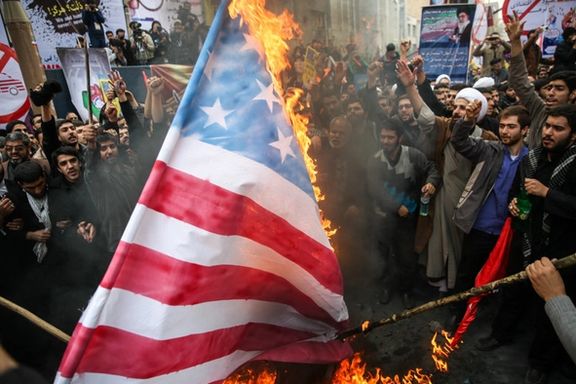
Pro-government protesters torch a US flag in Iran

Iran showcased its underground missile bases near the Persian Gulf on Saturday, warning of a harsh response to any US attack, as Washington boosted its naval presence in the region despite Arab calls for restraint.

Alireza Tangsiri, the commander of the Islamic Revolutionary Guard Corps (IRGC) Navy, warned on Saturday that "if the enemy commits a foolish act," they will witness how Iranian forces will send them to the depths of hell.

On the sidelines of a visit to Iran's naval forces and underground missile bases in the Persian Gulf region, Tangsiri said the IRGC's combat and offensive units in the Strait of Hormuz never take their eyes off the enemy and maintain the highest level of spiritual and combat readiness.

"If a battle breaks out, rest assured the enemy will be struck from a place they never anticipated."

The US has been carrying out airstrikes against the Houthis in Yemen—Iran’s regional allies—since last week. Washington has also warned Tehran to halt its military support for the group, which has been targeting commercial shipping in the Red Sea since November 2023.

In a rare move on Thursday, US Defense Secretary Pete Hegseth ordered two aircraft carriers, USS Harry Truman and USS Carl Vinson, to be present in the Middle East next month as tensions rise between Tehran and Washington.

Hegseth ordered the USS Carl Vinson, which has been operating in the Pacific, to start steaming toward the Middle East, and also extended the presence of USS Harry Truman for at least an additional month.

USS Harry Truman has been conducting operations in the Red Sea against Tehran-backed Houthis and was scheduled to begin heading home to Virginia at the end of March.

Regional calls for restraint

On Saturday, Egyptian Foreign Minister Badr Abdelatty in a phone call with his Iranian counterpart "stressed the need for self-restraint during this critical stage that the region is going through, and not to take steps or make moves that would contribute to fueling the crisis situation in the region," according to Cairo's foreign ministry.

He emphasized the importance of restoring calm and preventing the region from falling into a cycle of violence and escalation. Abdelatty also highlighted the need to protect freedom of navigation in the Red Sea, noting the significant losses to Egypt’s economy due to declining Suez Canal revenues and ongoing regional instability.

Saudi Foreign Minister Faisal bin Farhan also emphasized the necessity of coordination and close interaction among regional countries to prevent the escalation of the crisis, according to Tehran's readout of his call with Iran's top diplomat Abbas Araghchi.

On Friday, the Emirati foreign minister called the current situation deeply concerning and emphasized the need for continued consultations among regional countries to prevent further escalation.

Iran's supreme leader Ali Khamenei on Friday shrugged off warnings of a potential military confrontation with the United States if a nuclear deal was not reached, asserting that any aggression against Tehran will be met with a 'harsh slap'.

The remarks came after US President Donald Trump sent Khamenei a direct letter earlier this month offering negotiations under a limited timeframe. According to Axios, the message included a two-month window to reach a new nuclear agreement, paired with a warning of consequences should Iran further expand its nuclear program.

Most Viewed

Ghalibaf defends Iran-US talks amid hardline backlash
1
INSIGHT

Ghalibaf defends Iran-US talks amid hardline backlash

2
INSIGHT

A nation in limbo: 100 days after the massacre, has the world moved on?

3
ANALYSIS

From instability to influence: Pakistan’s pivotal role in US-Iran diplomacy

4
ANALYSIS

100 days on: why Iran’s January protests spread across social classes

5

War-hit homeowners feel abandoned as Iran’s reconstruction aid fades

Banner
Banner

Spotlight

  • War-hit homeowners feel abandoned as Iran’s reconstruction aid fades

    War-hit homeowners feel abandoned as Iran’s reconstruction aid fades

  • 100 days on: the anatomy of Iran’s January crackdown
    INSIGHT

    100 days on: the anatomy of Iran’s January crackdown

  • Ghalibaf defends Iran-US talks amid hardline backlash
    INSIGHT

    Ghalibaf defends Iran-US talks amid hardline backlash

  • 100 days on: why Iran’s January protests spread across social classes
    ANALYSIS

    100 days on: why Iran’s January protests spread across social classes

  • From instability to influence: Pakistan’s pivotal role in US-Iran diplomacy
    ANALYSIS

    From instability to influence: Pakistan’s pivotal role in US-Iran diplomacy

  • A nation in limbo: 100 days after the massacre, has the world moved on?
    INSIGHT

    A nation in limbo: 100 days after the massacre, has the world moved on?

•
•
•

More Stories

Iranian cleric urges ‘Death to America’ chants until US comes to its senses

Mar 22, 2025, 12:32 GMT+0

A senior Iranian cleric has called for the continued use of the “Death to America” slogan, saying it should be chanted “as long as the United States has not come to its senses.”

Ahmad Khatami, a member of Iran’s Assembly of Experts and Tehran’s interim Friday prayer leader, made the remarks on Saturday during a speech in Tabriz, asserting that US hostility stems from opposition to Islam itself.

“America does not oppose this or that person,” Khatami said. “Based on verses from the Quran, their problem is with Allah.”

US President Donald Trump has sent a message to Supreme Leader Ali Khamenei, demanding a new nuclear agreement within two months or face consequences if Iran expanded its program. Trump has said several times that the Islamic Republic should never obtain nuclear weapons.

The letter was described as firm in tone and was reportedly shared in advance with close US allies, including Israel, Saudi Arabia, and the United Arab Emirates.

Tehran has acknowledged receiving the letter but has not commented publicly on its contents.

Trump’s Middle East envoy, Steve Witkoff, said on Friday that Iran used indirect channels to respond after the US president sent the letter.

“I’m not at liberty to talk about the specifics,” Witkoff said in an interview released on The Tucker Carlson Show. “But clearly through a, you know, back channels, through multiple countries and multiple conduits, they've reached back out.”

Khatami also warned that Washington’s broader goal was to “destroy the religion that has come alive in the region,” but insisted, “they will never achieve this dream.”

Khatami concluded by linking his call to Iran’s revolutionary ethos, saying Iranians “have never grown tired of resisting arrogance," referring to the United States.

Supreme Leader Ali Khamenei on Friday dismissed pressure for direct talks and emphasized Iran’s focus on deterrence. “Anyone who commits villainy against the Iranian people will be struck with a harsh slap,” he said.

US says Iran will face consequences after dissident plot verdict

Mar 22, 2025, 10:31 GMT+0

A US jury’s conviction of two men for attempting to assassinate Iranian journalist Masih Alinejad in New York on orders from Iran’s Islamic Revolutionary Guard Corps (IRGC) has prompted reactions from senior US officials.

“Iran's front groups and proxies trying to operate in the US will be investigated, disrupted, and prosecuted,” Secretary of State Marco Rubio said Friday in a post on X, following the jury's decision.

He added that the ruling showed “Iran's attempts at lethal plotting against Americans like @AlinejadMasih will be met with swift justice & accountability.”

The men convicted—Rafat Amirov, from Iran, and Polad Omarov, a Georgian citizen—were found guilty on five charges including conspiracy to commit murder-for-hire and attempted murder in aid of racketeering. Prosecutors said the plot was directed by senior IRGC officials and executed through an Eastern European crime syndicate.

Masih Alinejad, the target of the operation, responded online shortly after the ruling. “Thank you @SecRubio, for supporting me and standing up to the Islamic Republic’s acts of terror on US soil,” she wrote.

“For years, the regime in Iran has targeted Americans and spread terror,” she wrote. “Yet the previous administration failed to hold them accountable. Instead of enforcing sanctions, they handed over billions of dollars.” She said the Iranian leadership views dissent as a threat and called for tougher action. “The Islamic Republic only understands one thing: pressure. It’s time to use strength and resolve to make them pay for their actions.”

According to the Justice Department, Amirov obtained targeting details from the IRGC and passed them to Omarov, who then worked with Khalid Mehdiyev, an operative based in Yonkers, New York. Mehdiyev conducted surveillance outside Alinejad’s home and sent videos to Omarov indicating readiness to carry out the assassination.

Mehdiyev was arrested in July 2022 after police pulled him over and found an AK-47-style rifle, ammunition, and a ski mask in his car. Authorities said Omarov later threatened Mehdiyev’s family, warning they would be killed if she did not locate him.

“This verdict underscores the Department’s commitment to finding and holding accountable those who threaten our citizens and our freedoms,” said Sue J. Bai, who leads the Justice Department’s National Security Division.

The FBI’s Counterintelligence Division and its Iran Threat Task Force led the investigation with support from the NYPD and Czech authorities. The Justice Department said Alinejad has previously been the target of IRGC-backed plots to kidnap or kill her for her activism, which includes highlighting Iran’s human rights record and advocating against compulsory hijab laws.

Trump envoy says Iran reached out through back channels

Mar 22, 2025, 08:29 GMT+0

Donald Trump’s Middle East envoy, Steve Witkoff, said Iran used indirect channels to respond after the US president sent a letter to Supreme Leader Ali Khamenei earlier this month.

“I’m not at liberty to talk about the specifics,” Witkoff said in an interview released Friday on The Tucker Carlson Show. “But clearly through a, you know, back channels, through multiple countries and multiple conduits, they've reached back out.”

According to Axios, Trump’s letter to Ali Khamenei, delivered via a senior Emirati diplomat, included a two-month deadline for reaching a new nuclear agreement and warned of consequences if Iran expanded its nuclear program. The letter was described by sources as “tough” in tone.

However, Witkoff presented the message differently during his interview. “It roughly said, I'm a president of peace. That's what I want. There's no reason for us to do this militarily,” he said. “We should talk. We should clear up the misconceptions. We should create a verification program so that nobody worries about weaponization of your nuclear material.”

He also said Trump believes the issue “has a real possibility of being solved diplomatically” and “acknowledged that he's open to an opportunity to clean it all up with Iran.”

Iranian Foreign Minister Abbas Araghchi recently affirmed that indirect talks through countries like Oman are “not a strange method,” and on Friday he held a phone call with his Emirati counterpart. No details were released about the conversation.

Witkoff added that Trump wants to build trust with Iran and would prefer to avoid war. “He’s a president who doesn’t want to go to war,” he said. “He’ll use military action to stop a war.”

Carlson, a longtime ally of Trump, warned earlier in the week that a military strike on Iran “would certainly result” in a broader conflict and “thousands of American deaths.” Iranian media highlighted both his remarks and Witkoff’s interview, portraying them as possible signs of a shifting tone in Washington.

Still, Iran’s official stance remains defiant. Khamenei has rejected direct talks under pressure and, in a speech on Friday, focused instead on deterrence. “Anyone who commits villainy against the Iranian people will be struck with a harsh slap,” he said.

At the US State Department, spokesperson Tammy Bruce said Friday that Washington remains committed to preventing Iran from acquiring nuclear weapons and continues to rely on pressure. “Iran’s behavior, as we know, across the globe threatens US national interests,” she said, adding that the administration’s campaign of sanctions and diplomatic isolation has been very effective.

Iran's moment of truth: will 2025 be the year of war or a nuclear deal?

Mar 22, 2025, 04:57 GMT+0
•
Negar Mojtahedi

Iran is nearing a fork in the road, marked by what may be the most consequential decision yet to be made by the country’s supreme leader Ali Khamenei: war or a deal with the US administration of Donald Trump.

That’s according to Mark Dubowitz, the CEO of the Foundation for Defense of Democracies (FDD) and a well-known voice on Iran policy in Washington D.C. He's a staunch critic of the Islamic Republic who has been sanctioned by Tehran in 2019.

"I think the Supreme Leader faces probably the most fateful decision of his 35 years as supreme leader," Dubowitz told Eye for Iran, "Is he (Ali Khamanei) going to do a peaceful nuclear deal or is he going to have the United States and Israel take down his program and potentially take down his regime."

The preservation of the Islamic Republic is at stake, and this year could either result in the downfall of more than 40 years of Islamic rule over Iran or it may actually help keep it in power, described Dubowitz on the podcast.

"I think 2025 is going to be an interesting year, " said Dubowitz, "It could go the other way."

"It could be a nuclear deal that actually ends up being a bad deal for the United States, for Israel and for the region. There's a risk that President Trump does a bad deal, calls it the greatest deal ever negotiated."

Military action, what could it look like?

President Donald Trump has publicly said that he prefers diplomacy over war with Iran, and during the election campaign he vowed "to end wars."

As part of a diplomatic push, Trump sent a letter to Khamenei offering to negotiate on the nuclear issue, giving Iran a two-month deadline to reach a deal or face severe consequences, according to Axios.

That is one way the United States is preparing for all scenarios, laying the groundwork for anything from talking to military action.

"The Trump administration fully understands that 2025 is a critical year and President Trump will not let the Iranian regime get nuclear weapons," said Dubowitz.

What remains unknown is how Iran will respond especially given how weak the country is domestically with growing dissent, a free falling currency and the loss of regional influence with the degradation of its allies in Lebanon and Syria.

"There's a lot of rhetoric, overblown rhetoric," said Dubowitz, "Their capabilities don't match their threats.

The Israeli's have made it clear they are eager to engage in military strikes against Iran's nuclear facilities. Dubowitz believes the Unted States would support such action to a certain degree, whether in a joint military action or by supporting Israel in its efforts.

It also remains to be seen just how much influence Israel can have on the United States and if the Americans can flip Russia against Iran through a ceasefire in Ukraine favouring Moscow's interests.

High level Israeli delegates will be meeting with US officials in the White House next week to discuss Iran. That is part of Trump's calculus on creating leverage against the Islamic Republic, said Dubowitz.

But a potential war would not look like American-led coalitions in Afghanistan and Iraq, he added, but could include precise targets against Islamic Revolutionary Guard Corps (IRGC) ports and bases - including spy ships supporting the Houthis.

"We're going to create deterrence by punishment, " Dubowitz told Eye for Iran.

President Trump has made his position clear: “Iran must stop the sending of these Supplies IMMEDIATELY,” he wrote on X. Trump told Iran the country would be held responsible for any attacks by the Yemenis militant group.

US-led strikes have targeted the militant group’s training sites, command centers and weapons facilities since last week. The Houthis claimed attacks targeting American warships in the Red Sea area, as well as a missile launch against Israel.

Iran has tried to distance itself from the Houthis to evade responsibility.

Although Iranian leaders like IRGC Chief Commander Hossein Salami have issued dire warnings of "tough, decisive, and devastating" retaliation, Dubowitz believes Tehran's capabilities fall short of its threats. However, the regime retains the ability to sow chaos globally through agents and sleeper cells.

A missed opportunity for Iranians

The central focus of Trump's Iran policy is to cut off all pathways to Iran getting a nuclear bomb.

While Dubowitz praised the current administration's Iran policy thus far, he said Washington has failed to provide maximum support to the Iranian people.

The mere existence of the clerical establishment means a deal, no matter how many safeguards are in place, would not work in the long term, according to Dubowitz.

The best way to prevent a nuclear bomb in Iran and to prevent aggression in the Middle East and West is for the overthrow of the Islamic Republic, said Dubowitz.

The best way to achieve that, in his view, is to support the people of Iran.

"I do believe this regime is going down, but we need to actually be serious about this and we need a policy of supporting the Iranian people to help bring it down."

He emphasized the need for practical support mechanisms, including establishing labor strike funds, bypassing internet shutdowns, and launching cyber operations to blind the government's security apparatus during uprisings.

"Shame on us if we're not ready to support the Iranian people the next time they're on the streets," said Dubowtiz.

The decisions made in 2025 will not only define Iran’s future but will also reshape the geopolitical landscape of the Middle East and beyond.

Whether Iran embraces diplomacy or conflict, the reverberations will be felt across the globe. The stakes can hardly be higher.

You can watch the full episode of Eye for Iran with the FDD's Mark Dubowitz on YouTube or listen on any podcast platform like Spotify, Castbox, Apple or Amazon.
A tough economic year risks turning into disaster for Iran

Mar 21, 2025, 15:08 GMT+0
•
Dalga Khatinoglu

Iran began its new fiscal year on March 21 amid deepening economic and energy crises, with even officials of the Islamic Republic acknowledging that conditions are likely to worsen in the year ahead.

Meanwhile, the return of Donald Trump to the White House and the revival of the US administration’s maximum pressure policy have further tightened the noose on Iran’s economy.

While the Central Bank reported a year-on-year inflation rate of 45% last month, local media suggest that actual price increases are far higher. In reality, the cost of food, medicine, and other essential goods has nearly doubled.

Moreover, the fiscal year is ended with the US dollar surging to nearly 1 million Iranian rials, marking a 65% increase since the beginning of the past fiscal year. The depreciation of the rial has accelerated sharply in recent days.

At the same time, Central Bank data reveals that Iran’s foreign reserves have been rapidly depleting, plunging to just one-fourth of their level in March 2024 and a mere tenth of their March 2023 levels.

Iran’s foreign trade situation:

The latest figures from the Central Bank show that Iran's foreign exchange revenue crisis persisted in the first half of the current fiscal year, which began on March 20, 2024. No data has yet been released for the second half of the year.

During this period, Iran recorded a positive overall trade balance of $11.5 billion, including oil, goods, and services. However, the country also experienced capital flight totaling $12.5 billion.

As a result, the net balance of foreign currency inflows and outflows—including gold bullion—turned negative.

Iran-export-import-oil-non-service annual
100%

Given the sharp decline in Iran’s oil exports to China since September, the situation is expected to worsen—particularly as oil, petroleum products, and natural gas account for more than half of the country’s total exports.

Over the first 11 months, Iran has imported approximately 93 tons of gold bullion worth $7.3 billion in exchange for its oil and goods exports—three times the amount imported in the previous year. More than 55% of this gold was purchased from Turkey.

Iran-gold-imports
100%

Indeed, around 13% of Iran’s total oil and non-oil exports have been bartered for gold instead of foreign currency. This highlights the government’s inability to collect payments for exported goods and oil and transfer foreign currency into the country, due to US banking sanctions. As a result, Iran is facing a severe shortage of foreign exchange reserves.

Government debt crisis

Recent data from the Central Bank shows that the Iranian government’s debt to the banking system has surged by 41% during the current fiscal year. To cover its widening budget deficit, the government has relied heavily on borrowing from domestic banks, tapping into the National Development Fund, and issuing bonds.

According to the International Monetary Fund (IMF), Iran’s total government debt now exceeds $120 billion—roughly one-third of the country’s economy. In contrast, Iran’s total external debt, including both governmental and non-governmental liabilities, stands at less than $10 billion—just 2% of GDP—underscoring the country’s extreme financial isolation and the reluctance of international institutions to fund Iranian projects.

Two decades ago, before the imposition of heavy sanctions, Iran’s external debt was more than 12% of GDP, largely driven by foreign investment in oil and gas projects. Today, the government’s increasing dependence on domestic borrowing has sharply boosted liquidity, further fueling inflation. Over the past year alone, liquidity in Iran has risen by 28%.

Iran-liquidity-inflation
100%

The economic crisis has pushed more Iranians into poverty. Official reports suggest that one-third of the population lives in extreme poverty. However, based on the World Bank’s global poverty standards, around 80% of Iranian households earn less than $600 per month and fall below the poverty line.

Energy and Water Crisis

For the first time, Iran has experienced electricity and gas shortages across all seasons. During peak summer demand in 2024, electricity shortages reached 20%, while winter gas shortfalls surged to 25%. Officials warn that energy shortages could worsen by at least 5% in the next fiscal year.

Industrial reports show that since summer 2024, energy disruptions have forced 30–40% of Iran’s industrial capacity to shut down. At the same time, the country has been grappling with growing gasoline and diesel shortages since 2023. Without new refinery projects, these fuel deficits are expected to escalate rapidly.

Meanwhile, Iran’s water crisis has reached a critical stage. Tehran’s main reservoirs are reportedly at just 7% capacity, and officials warn of severe water shortages by summer 2025.