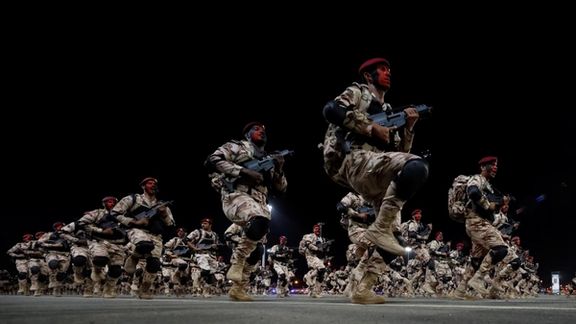
Members of Saudi security forces take part in a military parade in preparation for the annual Haj pilgrimage in the holy city of Mecca, Saudi Arabia August 4, 2019.
As conflict between Tehran and Washington escalates and war lowers over the horizon, "de-risking" has become a mantra in Arab capitals astride the Persian Gulf.
Tensions between Iran and the United States have risen sharply since Donald Trump re-entered the Oval Office on 20 January, presenting multiple risks of escalation.
A key deadline in October 2025 looms over whether European countries will trigger the snapback mechanism to re-impose United Nations sanctions removed as part of the Iran nuclear deal in 2015.
Indications, not least by President Trump himself, that he would like to negotiate a new agreement to address Iran’s rapidly-advancing nuclear program, have been offset by his administration’s restoration of its ‘maximum pressure’ policy on Iran.
Trump’s transactional nature and unconventional style of decision-making means nothing can be ruled out in a high-stakes confrontation without a clearly-defined plan.
Caught in the middle are Iran's Arab neighbours, where large-scale projects aimed at future-proofing economic development and growing non-oil sectors would be jeopardized by any conflict involving Iran.
‘De-risking’ has become a mantra in Arab capitals and particularly in Riyadh as the landmark year of 2030 draws closer and as the ‘giga-projects’ associated with Vision 2030 move into construction and delivery phases.
Qatar this month called for a diplomatic solution to the US-Iran standoff over Tehran's nuclear program and argued against military action.
The desire to reduce exposure to regional volatility has been evident in the process of rapprochement with Iran since 2020, with Saudi Arabia, the UAE, and Kuwait restoring full diplomatic ties with Tehran in 2022 and 2023 and maintaining regular dialogue on key issues of interest.
This was evident in regional responses to the war in Gaza after 7 October 2023 as the conflict did not regionalize, in part because there was little appetite in any capital on either side of the Persian Gulf for any escalation.
Excluded once, not twice
Back in 2015, officials in some Arab capitals and also in Israel expressed frustration that they were not included in the negotiations between Iran and the P5+1 that culminated in the signing of the Joint Comprehensive Plan of Action (JCPOA), from which Trump’s first administration withdrew in 2018.
In 2020, Saudi leaders called on the incoming Biden administration to consult with them as it sought to revive the Iran deal and explore an expanded ‘follow-on’ agreement, which ultimately did not happen.
As the indirect talks between US and Iranian officials broke down in 2022, the role of Iran's neighbouring Arab countries became more central to keeping open channels of communication between the parties.
The multilateral talks that led to the nuclear deal with Iran in 2015 excluded Middle Eastern powers
Oman and Qatar, along with Kuwait, have long played roles in diplomacy and mediation in regional affairs, as they generally maintained pragmatic working relationships with Iran which, in the Qatari case, included one of the world’s largest reservoirs of natural gas which straddled their maritime boundary.
Officials in Oman placed a premium on balancing relationships with regional partners and being able to utilize their ability to engage with adversaries to address flashpoints and minimize their threat to regional security.
Prior to their passing in 2020, both Sultan Qaboos of Oman and Emir Sabah of Kuwait had well-earned reputations as diplomatists par excellence borne out of decades of involvement in regional affairs.
An example of their efforts to reduce tensions was seen in early 2017 when Emir Sabah sent a letter to Iran’s then-president, Hasan Rouhani, to establish a basis for dialogue after tensions had soared in 2016. Rouhani responded by visiting Kuwait and Oman and Emir Sabah then traveled to Muscat to meet with Sultan Qaboos to follow up, but the subsequent rift over Qatar put paid to those efforts.
In 2025, Kuwait is focused on domestic issues and relatively absent from the regional scene, but there is space for Saudi Arabia to play more of an active role than it has in the past and to build upon the progress in the Kingdom’s relations with Iran since ties were re-established two years ago.
Since 2023, the Saudi leadership has been active in regional diplomatic initiatives concerning Syria, Gaza, and Sudan, and has burnished its credentials as an intermediary with convening power across the Arab and Islamic worlds.
In its ongoing facilitation of meetings of Ukrainian, Russian, and U.S. officials, the Kingdom has shown that it has the ability to navigate between adversaries and leverage its growing non-alignment in world affairs.
Securing a seat at the table in the Russia-U.S. talks may be a prelude to inserting Saudi Arabia into the middle of any negotiations between the U.S. and Iran, thereby minimizing the risks of exclusion from the talks, as in 2015, but Iranian officials may still view the Saudis as too close to the U.S. and not impartial.
The regional mediators of longer standing, Qatar and Oman, are likely to continue to offer their services in relaying messages between the Unites States and Iran and ensuring that opportunities for dialogue remain open, joined by the United Arab Emirates which delivered a letter from Trump to Iranian leaders on 12 March.
Trump redux
Trump’s mercurial approach to policy appears even more unpredictable second time around and has led to whipsaw decisions on tariffs that have added to market uncertainty and left analysts scrambling.
A similar pattern may well overshadow the next phase of the delicate dance between the U.S. and Iran, especially if Trump and Iranian leaders engage in verbal sparring matches of ever-increasing volume.
If this happens, officials in the Gulf States may focus on practical measures to limit the possibility of escalation, whether by accident or design, and identify the parameters of realistic dialogue going forward.
Taken together, their efforts are illustrative of the prevailing opinion in the region in favor of resolving the standoff between Tehran and Washington, and the depth of Emirati (and Saudi) political and economic relationships in DC may resonate with the Trump White House and its Congressional allies.
While tensions in other parts of the Middle East have soared in the wake of the Gaza war and the degradation of Iran’s ‘axis of resistance,’ the rulers in Riyadh, Muscat or Abu Dhabi are more closely aligned than they were in Trump’s first term, and may thus be better placed to play a proactive and productive role in de-escalatory regional dynamics.
Anxiety and disinformation are swirling in Iran as the latest threat of a military attack by US president Donald Trump has many fearing war.
Trump warned on Monday that he would hold Iran and its leadership responsible if its Houthi allies retaliated for dozens of US air strikes on the Tehran-backed group.
Official media zealously swatted away apparently baseless reports circulating on social media on Monday evening that the US military had sunk Iran’s reconnaissance ship Zagros in the Red Sea.
Saberin News, a Telegram channel with nearly a million followers reportedly linked to the Revolutionary Guards, denied on Tuesday the presence of any Iranian navy ships in the Red Sea, Bab al-Mandab Strait and the Indian Ocean.
“The reason for the spike in foreign exchange rates is the US attack on Houthis and the expectation that Iran will be the next target,” Morteza, a businessman in Tehran, told Iran International on Tuesday.
“Interestingly, people are not afraid of war although they think it is inevitable this time. They believe it will only be the government who will bear the brunt of an attack, should it materialize, and that they will come to no harm themselves,” he added.
According to Iranian-Canadian political analyst Shahir Shahidsaless, Trump may be laying the groundwork for military action against Iran if negotiations fail, either due to Iran’s refusal to engage, a lack of flexibility in talks, or if IAEA chief Rafael Grossi’s June report confirms that Tehran is rapidly advancing its nuclear program.
In a post on X on Tuesday, Shahidsaless suggested that the US operation against the Houthis could be a prelude to an attack on the Islamic Republic.
Meanwhile, Nour News, a media outlet close to Iran's Supreme National Security Council suggested on Tuesday that Tehran could withdraw from the Nuclear Non-Proliferation Treaty (NPT) if Trump acts on what it called his "delusion" that Iran seeks nuclear weapons.
A pro-government Iranian Middle East analyst and university lecturer, Mostafa Najafi, claimed in a post on X Monday that the United States has sent a backchannel message to Iran demanding the removal of its military and intelligence ships from the Red Sea and set a deadline.
According to Najafi, Iran has also warned “through its UN mission and at the military level against any American adventurism against its positions, interests, and assets.”
At the UN Security Council Monday evening, Iran's ambassador Amir-Saeid Iravani called Trump’s statements reckless and provocative and warned that any act of aggression against Iran could have severe consequences for international peace and security.
"Iran strongly and categorically rejects any accusation on the violation of relevant Security Council resolutions on arms embargoes in Yemen or involvement in any destabilizing activities in the region," Iravani said on Monday.
Iran and the Houthis have denied close military coordination, but weapons experts have linked the Yemeni fighters' advanced arsenal of anti-ship and ballistic missiles to Iranian technology. Iran has long presented the Houthis as an important part of its so-called "Axis of Resistance" against Israel and the United States.
A day after US President Donald Trump warned Iran of retaliation if its Houthi allies in Yemen launched an attack, the rial sank to a historic low against major currencies.
The currency was trading at one million per US dollar in Tehran on Tuesday as gold prices also rose. This represents a 14,000-fold devaluation of the rial, which had remained stable at 70 per dollar for over a decade before the 1979 Islamic Revolution.
Food inflation, which has averaged 100% in recent months, is expected to reach critical levels in the coming months unless Tehran initiates negotiations with the Trump administration.
The rial, which was valued at around 40,000 per dollar in early 2018, began to plummet after Trump withdrew from the JCPOA nuclear deal in May of that year and imposed tough economic sanctions, pushing inflation above 40%.
Despite long negotiations with the Biden administration in 2021-2022, Tehran did not reach an agreement with the US over reviving the JCPOA and its economic situation continued to deteriorate.
In February, President Trump called for new negotiations, stressing that Iran must not acquire nuclear weapons and vowing to tighten sanctions. So far, Supreme Leader Ali Khamenei has rejected talks, while Iranian officials maintain that Tehran will not negotiate under pressure.
Three days ago, Trump ordered air strikes against the Yemeni Houthis who have attacked international shipping in the Red Sea region and lobbed missiles at Israel. This was seen as a clear warning to Tehran. On Monday, Trump warned Tehran that it will be punished if its allies the Houthis retaliate against a US air assault over the weekend, escalating his rhetoric against Tehran.
"Every shot fired by the Houthis will be looked upon, from this point forward, as being a shot fired from the weapons and leadership of IRAN, and IRAN will be held responsible, and suffer the consequences, and those consequences will be dire!" Trump wrote on his Truth Social platform.
As tens of millions of Iranians earn the equivalent of less than $150 a month and inflation is rising, some media outlets and commentators in Tehran have warned of potential unrest.
Protesters take part in a demonstration in solidarity with Palestinians in the Gaza strip, in Sanaa, Yemen March 17, 2025.
Yemen's Houthi foreign minister said the group will not halt its Red Sea attacks on shipping, despite Iran's reported calls for de-escalation.
Jamal Amer told Reuters late on Monday that the Houthis would continue their actions despite US military strikes and requests from allies, including Iran.
"There will be no talk of any dialing down of operations before ending the aid blockade in Gaza. Iran is not interfering in our decision but what is happening is that it mediates sometimes but it cannot dictate things," Amer said.
This comes as two senior Iranian officials told Reuters on condition of anonymity that Tehran had delivered a verbal message to the Houthi envoy in Tehran on Friday, urging them to de-escalate. Amer said, however, that he had not been informed of any message Iran delivered to the Houthi envoy in Tehran.
Iran's Foreign Minister asked Oman, a known mediator with the Houthis, to convey a similar message during a visit to Muscat earlier this week, according to Reuters.
Iran has not made any public comment about recent outreach to the Houthis over their renewed action. Tehran says the group takes decisions independently, a statement echoed by the Houthis themselves.
"(The US) is threatening Iran and hitting Yemen. Now all scenarios are possible. We will do what they will do to us. If they are hitting us from (US aircraft carrier USS Harry S) Truman, we will retaliate by hitting Truman," the Houthi foreign minister said.
Amer acknowledged messages from other powers to de-escalate, but declared, "Now we see that Yemen is at war with the US and that means that we have a right to defend ourselves with all possible means, so escalation is likely."
US President Donald Trump warned Iran on Monday that it will be punished if its Yemeni allies the Houthis retaliate against a US air assault over the weekend, escalating his rhetoric against Tehran.
"Every shot fired by the Houthis will be looked upon, from this point forward, as being a shot fired from the weapons and leadership of IRAN, and IRAN will be held responsible, and suffer the consequences, and those consequences will be dire!" Trump wrote on his Truth Social platform.
Trump on Saturday ordered large-scale military strikes against dozens of targets in Yemen controlled by Tehran-backed Houthi armed group, saying the attacks aimed at ensuring freedom of navigation through shipping lanes the militants have targeted.
Earlier this week, IRGC Commander Hossein Salami denied US accusations of Iranian control over the Houthis' actions.
"We have always declared, and we declare today, that the Yemenis are an independent and free nation in their own land and have an independent national policy," Salami said.
"Ansarullah, as the representative of the Yemenis, makes its own strategic decisions, and the Islamic Republic of Iran has no role in setting the national or operational policies of any movement in the resistance front, including Ansarullah in Yemen," he added.
One of Iran’s most hardline media commentators warns that negotiating with the United States will increase the likelihood of an attack on Iran, arguing that accepting Washington’s terms would leave the country more vulnerable.
US-educated hardliner Foad Izadi, often cited by Iranian media as an expert on US politics, told the conservative Nameh News website that Washington has refrained from attacking Iran because it views such a move as too costly.
"Those who do not want their country to be attacked by the United States should not repeat Trump's statements," Izadi said. He also claimed that Washington is pressuring Iran’s neighbors to cut economic ties, including efforts to push Iraq to halt electricity and natural gas imports from Iran.
Izadi made the remarks before President Donald Trump issued a warning to Tehran on March 17, warning that it will bear responsibility for any attack by Yemeni Houthis, who are supported by the Islamic Republic.
Hardliners within Iran's ruling circles staunchly defend Supreme Leader Ali Khamenei's refusal to negotiate with the United States, despite clear warnings by the Trump administration.
Izadi argued that "the United States wants to limit Iran's access to conventional weapons. Therefore, negotiating with Washington is likely to increase the possibility of a US attack on a weak Iran."
Meanwhile, a prominent politician close to former President Hassan Rouhani, who supports
A prominent politician close to former President Hassan Rouhani, who supports negotiations, offers a different perspective, stating, "The United States is genuinely seeking a solution to its dispute with Iran over Tehran's nuclear program."
In an interview with the moderate conservative website Khabar Online, Mahmoud Vaezi, a senior aide to Rouhani and deputy leader of the Moderation and Development Party, said Washington is genuinely pursuing détente with Iran and hopes to resolve the ongoing nuclear dispute.
"Lifting US sanctions through negotiations with Washington will bring about an economic breakthrough in Iran," Vaezi asserted. Referring to plans for the Iranian New Year, which begins on March 20, he stressed that Iran must make difficult decisions to address its deepening economic crisis, which has severely impacted people's livelihoods.
He further emphasized the need for swift action to ease tensions with the United States and other countries, calling it a necessary step in the broader reforms required to stabilize living conditions in Iran.
The politician also urged Iranian officials to work toward removing barriers to international trade, reducing government intervention in economic affairs, and strengthening the private sector. He emphasized the need to foster a fair competitive environment to encourage greater private sector participation in the economy.
Like many other politicians in the Reformist camp, including Rouhani, Vaezi emphasized that Khamenei has not completely ruled out negotiations with the United States. He also tried to highlight contradictions in Trump's statements and actions.
In another development, Iranian academic and international law expert Mehdi Zakerian suggested in an interview with the reformist Shargh daily that Foreign Minister Abbas Araghchi should take a more proactive role in breaking Iran’s diplomatic deadlock. He argued that the current foreign policy crisis does not justify inaction. "The art of a diplomat is to offer solutions to crises. Stepping into an ideal situation and signing a pre-written agreement would be easy for anyone."
Expressing regret, Zakerian said, "Iran has missed many opportunities to actively resolve its own disputes with other countries and to contribute to regional conflict resolution." As examples, he pointed out, "Iran could have made more constructive decisions during last year’s wars in Gaza and Lebanon."
Rafat Amirov and Polad Omarev sit during their trial's jury selection, in which the two are charged with murder-for-hire and money laundering in a thwarted Tehran-backed assassination attempt of an Iranian American journalist and activist at a courtroom in New York, U.S., March 10, 2025 in this courtroom sketch. REUTERS/Jane Rosenberg/File Photo
The testimony of an FBI agent Monday in Manhattan Federal court reveals Iran’s ties with the mobsters who they allegedly hired to kill dissident Iranian American journalist Masih Alinejad.
Supervising special agent Justin Tuerack, who oversees the Iran squad at the bureau, took to the stand Monday, detailing the investigation into digital communications of the suspects.
Tuerack said he analyzed the meta data and IP addresses belonging to the cloud, Whats App, Apple IDs and Google Accounts of defendants Rafat Amirov, Polad Omarov and Islamic Revolutionary Guard Corps (IRGC) Ruhollah Bazghandi and members of his Iran-based network - Haj Taher, Hossein Sedighi and Seyed Mohammad Forouzan.
Federal prosecutors said Bazghandi orchestrated the alleged 2022 plot to kill the journalist in Brooklyn. Bazghandi, the brigadier general in the IRGC was previously chief of the Revolutionary Guard's counterintelligence department.
Orders from Iran to assassinate Alinejad
Khaled Mehdiyev, who pleaded guilty to attempting to assassinate Alinejad, testified that he received direct orders from fellow mobsters Amirov and Omarov. These men were acting on instructions from a network led by Bazghandi, according to prosecutors.
Mehdiyev, the would-be assassin, admitted in court that he had been stalking Alinejad outside her Brooklyn home in 2022 with one objective: “Shoot the journalist, kill the journalist.”
The prosecution claims that the Iranian government paid Amirov and Omarov $500,000 to orchestrate the assassination in retaliation for Alinejad’s human rights activism.
The plot was thwarted on July 28, 2022 when police arrested Mehdiyev of Yonkers, New York, as he passed a stop sign driving away from Alinejad’s house.
Digital evidence
Now web searches, text messages, calls and images stored on the cloud of the suspects is revealing the web of connections between the mobsters and Iran.
FBI-submitted evidence included WhatsApp messages from accounts allegedly belonging to Omarov and Amirov. These texts documented their communications with Mehdiyev, Bazghandi, and the IRGC network regarding the assassination attempt.
On July 23, 2022, Omarov sent a chilling message to Amirov: "we blocked it from both sides, it will be a show once she/he steps out of the house," according to FBI metadata evidence submitted in court.
Amirov's IP address showed him as being located in Iran's Western province of Azerbaijan, according to Tuerack at the time. “God willing we will have good news." he wrote back to Omarov.
A few days later on July 27, 2022 Omarov texted Amirov that Mehdiyev's hit on Alinejad would be his birthday gift, which is July 30 according to Omarov's passport.
"I told him to make this a birthday present for me," Omarov text message read said the FBI.
The conversation between the two would-be assassins reflects Mehdiyev's arrest. arrested.
“The fat one did not get in touch” Amirov texted Omarov in early August, apparently referring to Mahdiyev. "Damn him. I don’t want him to cause trouble,” Omarov texted back.
Rafat the Thief
After Mehdiyev’s arrest in July 2022, google searches from the IRGC network show the men searching “Rafat the Thief”, testified Tuerack.
Notably, this search occurred before any public knowledge of Amirov’s alleged involvement in the plot, a detail federal prosecutors emphasized.
Google map searches of Alinejad home, the pharmacy she used, photos and google searches of her husband Kambiz Foroohar were also made from the accounts affiliated with the IRGC network.
On September 5, 2022, a member of Bazghandi team, Sadighi, sent fellow member Haj Taher a message allegedly addressed to yet another alleged member of their network named Forouzan: "this is addressed to you, your boss and the mafia."
There were youtube searches "who wants to kidnap Masih Alinejad" coming from their work, said the FBI.
Forouzan,, according to Tuerack had three entries to describe a phone number allegedly belonging to Amirov: brotherhood, Rome and Rome/Rafat.
From Sept 14, 2022 - to Nov 27, 2022 - Forouzan allegedly contacted Amirov over text 362 times and made 226 calls to each other.
The Bazghandi Network continued to collect information on Alinejad until at least May 2023. The FBI thwarted two plots prior to the attempt to kill Alinejad, one in 2020 and the other in 2021, also by Iranian state agents trying to kidnap the journalist and take her to Iran.