• العربية
  • فارسی
Brand
  • Iran Insight
  • Politics
  • Economy
  • Analysis
  • Special Report
  • Opinion
  • Podcast
  • Iran Insight
  • Politics
  • Economy
  • Analysis
  • Special Report
  • Opinion
  • Podcast
  • Theme
  • Language
    • العربية
    • فارسی
  • Iran Insight
  • Politics
  • Economy
  • Analysis
  • Special Report
  • Opinion
  • Podcast
All rights reserved for Volant Media UK Limited
volant media logo

Iran's president should 'harakiri' over inflation crisis, analyst says

Mar 15, 2025, 07:43 GMT+0Updated: 12:25 GMT+0
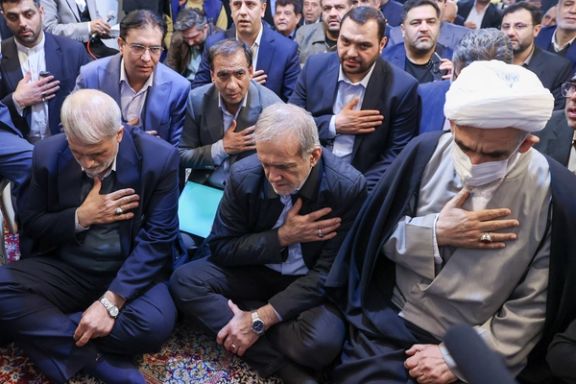
Iranian President Masoud Pezeshkian during a religious ceremony in Tehran March 2025()

President Masoud Pezeshkian should commit harakiri, a form of Japanese ritual suicide, rather than seek scapegoats for the country's soaring inflation, suggested a prominent Iranian commentator.

The comments by Abbas Abdi, published in Etemad newspaper, were prompted by President Pezeshkian's recent speech at a meeting on inflation, where he asked, "Whose collar should I grab for the rising prices?" Abdi responded, "there is no need to grab anyone's collar, but rather to commit hara-kiri."

The analyst's use of 'hara-kiri' was a pointed metaphor, not a literal call for the president to resign or kill himself. It was a play on words, rhyming in Persian with Pezeshkian's recent question about who should be held accountable.

Abdi’s intention was to highlight that the government's overall monetary policies, spanning multiple administrations and not just those of the current administration, are the primary drivers of inflation.

"The price of any commodity is primarily due to the value and purchasing power of money," Abdi wrote. "We always ask why goods are sold expensively. This question is mostly wrong. We should ask why the value of money is decreasing."

Abdi likened the government's actions to debasing currency, similar to diluting gold with copper. "Who does this? The government. So, for high prices, there is no need to grab anyone's collar, but rather to commit hara-kiri," he asserted.

He attributed the devaluation of currency to the government's excessive spending, inefficiency, and support for unproductive entities.

"The government does not spend according to its income and has a deficit," Abdi explained. "Its income is less than necessary because its efficiency is low. It has taken on useless responsibilities. It gives a lot of resources to people who do not serve the people at all, rather their presence is harmful."

Abdi criticized the government's reliance on price controls and regulatory bodies, arguing that they are ineffective and prone to corruption. "In fact, governments turn to pricing to compensate for their wrong policies and create large regulatory bodies that are both corrupt and impose a heavy burden on the nation," Abdi wrote.

He urged the president to examine the central bank's data on liquidity and production to understand the government's role in inflation. "The president could get the statistics of liquidity and production from the central bank to find out why the money supply and liquidity, which is in the hands of the government, has increased by about 35 percent last year, but production has increased by a maximum of 4 percent," he suggested.

Most Viewed

Ghalibaf defends Iran-US talks amid hardline backlash
1
INSIGHT

Ghalibaf defends Iran-US talks amid hardline backlash

2
VOICES FROM IRAN

Bread shortages, soaring prices strain households in Iran, residents say

3
ANALYSIS

From instability to influence: Pakistan’s pivotal role in US-Iran diplomacy

4
ANALYSIS

100 days on: why Iran’s January protests spread across social classes

5

War-hit homeowners feel abandoned as Iran’s reconstruction aid fades

Banner
Banner

Spotlight

  • Is Iran entering its Gorbachev moment?
    INSIGHT

    Is Iran entering its Gorbachev moment?

  • Iran crackdown reaches cemeteries as graves of slain protesters defaced
    EXCLUSIVE

    Iran crackdown reaches cemeteries as graves of slain protesters defaced

  • Iran diplomacy wobbles as factions compete to avoid looking soft on US
    INSIGHT

    Iran diplomacy wobbles as factions compete to avoid looking soft on US

  • The politics of pink: how Iran uses cuteness to rebrand violence
    ANALYSIS

    The politics of pink: how Iran uses cuteness to rebrand violence

  • Bread shortages, soaring prices strain households in Iran, residents say
    VOICES FROM IRAN

    Bread shortages, soaring prices strain households in Iran, residents say

  • Ghalibaf defends Iran-US talks amid hardline backlash
    INSIGHT

    Ghalibaf defends Iran-US talks amid hardline backlash

•
•
•

More Stories

Trump administration eyes US visa ban for Iranians

Mar 15, 2025, 07:11 GMT+0

The Trump administration is considering sweeping travel restrictions that could fully suspend visa issuance for citizens of ten countries, including Iran, according to an internal memo seen by Reuters.

Iran is among the countries facing the strictest new US travel restrictions, alongside Afghanistan, Syria, Cuba, and North Korea, Reuters reported on Friday. If implemented, the policy would fully suspend visa issuance for Iranians, effectively cutting off legal entry into the United States and further tightening Trump’s already restrictive immigration policies.

This move comes as Iranian migrants deported by the US struggle in dire conditions in Panama. Dozens of Iranians were among nearly 100 migrants transferred to a detention camp deep in the Panamanian jungle in February under an agreement between the US and Panama.

Deported migrants, including children, were initially held in a locked hotel before being moved to the Darién province—an area notorious for its harsh environment and prevalence of diseases like dengue. One Iranian migrant, Artemis Ghasemzadeh, described the facility as resembling a “zoo” with “fenced cages” and inadequate food.

The Panamanian government, under pressure from the US, insists the site is a temporary migrant center. However, reports indicate that some detainees, fearing persecution if repatriated, remain in limbo. Iranian Christians, in particular, face potential death sentences under Iranian law for converting from Islam.

Facing mounting criticism, Panama recently announced that it will issue temporary 90-day permits to some migrants, including those deported from the US. This measure applies to individuals unable or unwilling to return to their home countries due to security concerns. However, for many, these permits offer little clarity on their long-term future.

The new travel ban proposal echoes Trump’s first-term immigration crackdown, which included a travel ban primarily targeting Muslim-majority nations. That policy went through multiple legal battles before being upheld by the US Supreme Court in 2018.

Mother of gunman hired to kill Masih Alinejad identifies co-conspirator to order hit

Mar 14, 2025, 20:27 GMT+0
•
Negar Mojtahedi

The mother of Khalid Mehdiyev, the gunman who tried to kill Iranian-American journalist Masih Alinejad, delivered emotional testimony in court Friday identifying her son's alleged co-conspirator Polad Omarov as the man who ordered the hit job.

Appearing visibly shaken in court, Ms. Mehdiyeva recounted a video phone call Omarov made to her and her husband sometime in 2022.

“My husband was praying. We had a caller, and I covered my head. We exchanged hellos," said Ms. Mehdiyeva, "He said, ‘My name is Polad. Where is your son? I sent him to do a job for me."

He allegedly told Ms. Mehdiyeva that her son had failed at the task he ordered him to do. Mehdiyev's attempt to murder Alinejad was unsuccessful. Because of the botched murder attempt, Omarov told Ms. Mehdiyeva her son put all of them in trouble.

Once Alinejad spotted Khalid, who was lurking around her home in Brooklyn, peering into her window and wandering around her, she reported him to the FBI. He had been stalking Alinejad's every move, even sleeping in his vehicle outside her home for at least two days.

Threats from the Russian Underworld

Just hours after Omarov's call, at 3 a.m., an unfamiliar American number appeared on Ms. Mehdiyeva's phone. It was Khalid. Unbeknownst to her and Omarov, Khalid was in jail.

Ms. Mehdiyeva's voice trembled as she looked her son's alleged co-conspirator in the eye.

“He (Omarov) is the one who devastated our lives,” said Ms. Mehdiyeva, speaking in Azeri through an interpreter.

The threats did not stop after that call.

Ms. Mehdiyeva testified that members of the Russian mafia group that her son belonged to —Vor Zakone, also known as "Thieves-in-Law"— continued to harass her.

Fearing for their safety, the family fled Baku for the countryside.

Eventually, with assistance from the FBI, they were brought to the United States.

Cross Examination

During cross-examination, the defense sought to challenge Ms. Mehdiyeva’s credibility.

They questioned whether she had sought a U.S. green card prior to her arrival. She denied it, insisting she was only in the country due to threats in Azerbaijan.

“Do you remember telling your son on a recorded jail call that you would travel to Macedonia to enter the U.S.?” the defense asked.

“I don’t remember that,” she replied.

The defense further revealed that the U.S. government had provided financial support to the Mehdiyev family, including securing employment for her husband and eldest son.

Ms. Mehdiyeva had also worked as a nanny before quitting to attend the trial, leaving her in debt to her employer for $4,000 in prepaid wages. In total, the government provided the family with $31,120 in support.

Who are Vor Zakone?

The Russian criminal underworld developed in the gulags or the prisons of the Soviet Union and globalized in the post- Soviet world. The Vor Zakone evolved into a transnational organization with operations in 15 former Soviet republics and the countries of the former Eastern bloc.

Dr. Louise Isobel Shelley, an academic who specializes in terrorism, corruption, and transnational crime testified on behalf of the state as expert in court Friday. Shelley often consults with governments around the world about the Russian mafia.

Shelley said members of the Russian mafia carry out assassinations on behalf of state actors and are also involved in kidnappings, extortion, and money laundering.

Her testimony significant to the state which alleges the Iranian government-sponsored the murder-for-hire plot.

The plot to assassinate Alinejad was allegedly orchestrated as part of Iran’s campaign to silence one of its most vocal critics, according to Assistant U.S. Attorney Jacob Gutwillig.

As the trial continues, the chilling testimonies shed light on the dangerous intersection of organized crime and states, a web reportedly stretching from Tehran to Baku to the streets of New York City.
Dissident Iranian rapper Toomaj Salehi's detention was illegal, UN body says

Mar 14, 2025, 19:28 GMT+0

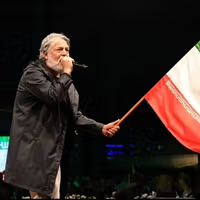
The UN rights body has ruled the detention of a top Iranian rapper and activist arbitrary and contrary to international law in a response to a petition submitted by rights groups and international lawyers on his behalf.

Iranian authorities subjected Toomaj Salehi, who was imprisoned for more than 753 days, to judicial harassment for his music and activism, the Working Group on Arbitrary Detention wrote in an opinion issued on Thursday.

The group concluded that his prosecution stemmed from his political opinions and artistic expression, particularly his support for the nationwide Woman Life Freedom protests sparked by the death in custody of Mahsa Jina Amini in September 2022.

Salehi was sentenced to death for his songs in support of the protests after being charged with “corruption on earth” but the verdict was later overturned, and he was released on December 1, 2024.

“This is not just about Toomaj but it is about a nation’s struggle against fear. This opinion by the UNWGAD is an important step towards that goal,” said Salehi’s cousin, Arezou Eghbali Babadi in a press release on Friday.

Caoilfhionn Gallagher KC, international counsel for Salehi’s family, emphasized the significance of the ruling, saying that it underscored the need to protect him from further arbitrary detention.

Claudia Bennett of the Human Rights Foundation said the case illustrated Iran’s intolerance of criticism and warned that the international community would hold it accountable for human rights abuses.

Turkey arrests five suspects over alleged espionage for Iran

Mar 14, 2025, 18:30 GMT+0

Turkish security forces arrested five people accused of spying for Iranian intelligence in a coordinated operation across Istanbul, Antalya, and Mersin, the Istanbul Chief Public Prosecutor’s Office said on Friday.

The suspects, three Turkish citizens and two foreign nationals, had allegedly been involved in "military and political espionage," Turkey’s state-run Anadolu Agency reported citing the prosecutor.

The operation was carried out as part of an investigation by the prosecutor’s office and Turkey’s National Intelligence Organization (MIT).

The report added that the individuals had contacted members of Iran’s Revolutionary Guards (IRGC) intelligence, obtained information about military bases and important regions in Turkey and critical points abroad, and transferred it to Iranian intelligence.

Relations between Ankara and Tehran have grown frostier after Iran's oldest Arab ally the Assad dynasty was swept from Syria by rebels close to Turkey last year.

Turkish Foreign Minister Hakan Fidan this month hit out at Iran's reliance on regional militias as dangerous and called for a policy shift, stoking Iran's ire.

He also suggested that "if you are attempting to destabilize a third country, other nations may reciprocate by supporting groups within your own borders."

Arrest warrants for the suspects were issued, and they were apprehended in operations carried out in Istanbul, Antalya, and Mersin provinces, the agency reported.

​In recent years, Turkey has experienced several incidents involving alleged espionage activities linked to Iran.

Last month, Israeli authorities sentenced a businessman to serve a 12 years in prison for spying for Iran and plotting to assassinate the country's leaders including the country’s PM and defense chief.

The man who was based in Turkey, but hailed from northern Israel, had entered Iran and met with agents who had instructed him to carry out operations in Israel.

In September 2022, Istanbul police arrested four Iranian citizens on suspicion of espionage, forgery of official documents, and human trafficking. The suspects were found in possession of numerous stolen passports, identification documents and espionage equipment.

In June 2022, Turkish authorities, in collaboration with Israeli intelligence agency Mossad, foiled an alleged Iranian plot to kidnap and assassinate Israeli tourists in Istanbul. The operation led to the detention of several Iranian and Turkish operatives Ankara accused of being linked to the IRGC.

‘Super-revolutionaries’ challenge Khamenei over hijab

Mar 14, 2025, 14:04 GMT+0
•
Maryam Sinaiee

Conservatives farther to the right even of Iran's Supreme Leader Ali Khamenei have become more assertive in their demands to implement a new restrictive hijab law which has been stalled for months.

During a speech on Saturday, Khamenei appeared to avoid responding to an ultra-hardline lawmaker who interrupted the session to ask Iran's ultimate authority on religion and policy why the hijab law had not come into force.

The situation turned awkward when Mohammad-Taghi Naghdali attempted to move closer after Khamenei said that he could not hear him and the veteran theocrat's security guards swiftly led him away to the back of the audience.

Enforcing the morality legislation - which imposes harsh penalties including heavy fines and prison sentences on women who violate strict hijab rules and on businesses that fail to comply - could be highly provocative in the current climate and risk sparking anti-government protests.

In an unprecedented move, lawmaker Mahmoud Nabavian, a member of the ultra-hardline Paydari Party, attempted to distance himself from those he labeled radicals following recent protests outside the Parliament by hardliner vigilantes.

Nabavian accused these radicals of deepening societal divisions and provoking those who oppose mandatory hijab.

“Calling for nationwide protests over [the imposition of hijab] aligns with the enemy’s plans to incite unrest in the country,” he wrote. More significantly, he suggested that these radicals are using social media to directly draw Khamenei into the issue.

Khamenei has conspicuously avoided addressing the hijab issue in his speeches in recent months, including during his December 17 address to an all-female audience.

However, in April 2023, he had taken a firm stance, declaring that disregarding hijab was “religiously and politically haram (forbidden).” In the same speech, he accused foreign intelligence agencies of encouraging Iranian women to defy the mandatory hijab.

A woman in Karaj, near Tehran, arguing with a hijab enforcer in 2024
100%
A woman in Karaj, near Tehran, arguing with a hijab enforcer in 2024

Currently, most expressions of frustration from vigilante groups toward Khamenei are veiled and circulated on domestic social media platforms such as Eitaa, a popular forum among ultra-hardliners and their associates.

Earlier this week, a small group of female vigilantes staged a rally in the religious city of Qom outside the office of Ayatollah Abdollah Javadi-Amoli, a prominent grand ayatollah recently praised by Khamenei for his scholarly contributions to seminaries.

The rally’s speaker criticized grand ayatollahs for their silence regarding the delayed enforcement of the hijab law. Such direct criticism of senior clerics, particularly those aligned with state ideology, is rare and highly frowned upon.

A widely circulated social media post anonymously criticizing Khamenei for the Supreme National Security Council’s (SNSC) decision in September to shelve the controversial new hijab law has sparked controversy.

Some of Khamenei’s own loyalists have shared the post, interpreting it as an act of disrespect toward the Supreme Leader.

Although the SNSC is chaired by the president, its decisions require Khamenei’s endorsement to be implemented.

Vigilante groups, often referred to as “super-revolutionaries” by rival hardliners, maintain strong ties with the ultra-hardline Paydari (Steadfastness) Party.

This faction played a key role in drafting the controversial hijab law and supports former nuclear negotiator Saeed Jalili, their preferred candidate in the June snap elections.

Despite their professed allegiance to Khamenei, ultra-hardliners strongly back Mohammad-Mehdi Mirbagheri, a mid-ranking cleric known for his extreme religious and political views, particularly on the hijab issue. 

Small groups of vigilantes have staged protests after Friday prayers several times in recent months. A dozen women held a sit-in outside the Parliament, erecting makeshift shelters to demand the hijab law’s implementation.

Their protests intensified this week as hundreds were bused in from other cities to join the demonstrations outside Parliament. Unlike other political protests, security forces did not attempt to disperse the roughly 1,500 protesters gathered on Tuesday.

The growing assertiveness of vigilante groups has raised concerns even among conservatives.

Criticizing the “super-revolutionary Paydari associates” for their rigid stance on the hijab law, the conservative Tabnak news website warned on Wednesday that they “are striving to create new challenges for the administration and, perhaps, from an analytical and in-depth perspective, exert pressure on the governance.” In Iranian political discourse, the term “governance” is often used to indirectly refer to Khamenei and the policies he dictates to top officials.