A retailer in Tehran's Grand Bazaar holds up clothes to attract attention, March 2025
Less than a week before the start of the new Iranian year, the government has yet to set new wages, which are adjusted annually for tens of millions of public and private sector workers.
The challenge is that last year’s high inflation would require tripling the current minimum monthly wage, which has fallen to the equivalent of $120. However, Iran’s deep economic crisis makes it nearly impossible for government-controlled enterprises to absorb such a sharp increase in labor costs. According to official estimates, a family of three needs at least $400 per month to cover basic necessities.
Even mid-level government employees, such as ministry press secretaries, earn only about $160 a month, a well-informed source in Tehran told Iran International. While this amount has greater purchasing power in Iran than in the US or Europe, it still represents a poverty-level income.
A meeting between government, business, and labor representatives is scheduled for March 11, but sources told local media that no decision is expected. With Nowruz beginning on March 20 and food prices soaring, many Iranians are struggling to afford holiday shopping.
An economic analyst in Tehran told Iran International that retail markets are stagnant as people cannot afford New Year shopping. Basic food prices have risen 30 to 100 percent since early January, driven by the Iranian currency losing half its value against the US dollar in recent months. This depreciation directly impacts the cost of food imports as well as machinery, fertilizers, and other agricultural necessities.
Meanwhile, the Trump administration is tightening economic sanctions, threatening to further reduce Iran’s oil exports—the backbone of its centrally controlled economy. Washington is demanding that Tehran abandon its nuclear program, but Supreme Leader Ali Khamenei has so far rejected negotiations on President Donald Trump’s terms.
By comparison, minimum wages in neighboring Iraq are twice as high as in Iran, while in Turkey, the minimum wage is nearly seven times greater, reaching $8,000 per year. With the current exchange rate, the average salary in Iran does not exceed $1,500 annually.
This growing financial hardship has sparked concerns of social unrest, similar to the mass protests of 2019 and 2022. Warnings about the risk of an uprising are appearing on social media and even in state-controlled media, as poverty spreads to the lower middle class.
Before the 1979 revolution, Iran’s urban middle class enjoyed rising living standards, with increasing access to homeownership, cars, and foreign travel. Today, economic pressures are reversing those gains, fueling discontent across the country.
Iran's supreme leader Ali Khamenei leading prayers, president Masoud Pezeshkian behind him, Tehran, March 8, 2025
While Iran denies receiving a letter from President Donald Trump demanding nuclear talks, statements by Supreme Leader Ali Khamenei, the foreign ministry and Iran's UN ambassador Saeed Iravani appear to be responses to it.
The officials' statements suggest that the letter or message contained a mix of carrots and sticks. They also indicate that Iran may be open to Trump’s proposals, provided the talks remain strictly focused on the nuclear issue, as Iravani stated.
Iravani further suggested that Iran can take part in talks with America only to convince Washington that its nuclear program is peaceful.
At another level, media, commentators, and politicians seem perplexed by Trump’s approach. As political analyst Ali Bigdeli told the pro-reform daily Arman Melli, “Trump’s statements about Iran have confused everyone.” He added that “Trump disregards diplomatic protocols and seeks to stage a show of power.”
“He wants to overwhelm the other side, leaving them uncertain about how to respond,” Bigdeli said. Given this, he suggested that Iran might be better off using European mediators rather than engaging with Trump directly.
At the same time, in a commentary in the reformist daily Shargh, Iran's former ambassador to Riyadh Mohammad Hosseini has predicted that "the possibility of a military attack by the United States and Israel on Iran is serious and highly likely in the near future."
Hosseini outlined 10 reasons and indicators suggesting that an attack on Iran is imminent. These include the shared Israeli and US assessment of a shifting balance of power in the region, Iran’s declining ability to respond to threats, and officials in both countries recognizing the weakening ties between the Iranian people and their government.
Hosseini added that Israel and the United States recognize Iran has accelerated uranium enrichment to weaponization levels. He also noted that both countries are aware of Iran’s loss of strategic depth in the region and the likelihood that Russia could use Iran as a bargaining chip in negotiations over Ukraine.
Ali Hossein Ghazizadeh, London-based Iran International analyst, said that Trump understands Iranians will not agree to negotiations under pressure, yet he insists on talks solely to demonstrate that Iran is unwilling to engage.
Meanwhile, former diplomat Fereydoun Majlesi told local media that IAEA Chief Rafael Grossi is concerned about the possible weaponization of Tehran's nuclear program. Another concern for the West is nuclear proliferation in the region as a result of regional countries' rivalry with Iran.
He noted that the United Arab Emirates has already built a nuclear power plant, and Turkey and Saudi Arabia may also be encouraged to develop their own nuclear programs. Majlesi added that Grossi recognizes Iran's ability to effectively circumvent US economic sanctions, making it less likely to abandon enrichment. He quoted Grossi as saying that Iran’s nuclear program has gained new momentum since the US withdrew from the 2015 nuclear deal.
Former chairman of the Iranian parliament's foreign relations committee, Heshmatollah Falahatpisheh, told the conservative Nameh News website that Trump's threats against Iran are mere "bluffs" and that now is not the right time for Iran to negotiate with him.
State TV commentator Hassan Hanizadeh also dismissed Trump's "war or negotiation" rhetoric as "empty threats," arguing that Trump has no real intention of negotiating with Iran.
Meanwhile, Iran's former chief diplomat in London, Jalal Sadatian, told Nameh News that while Trump might soften his stance on Iran’s nuclear program, he is unlikely to change his broader approach to dealing with Iran.
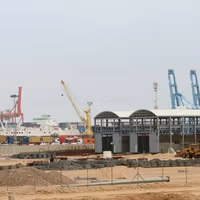
With foreign companies absent, Iran has signed a contract with domestic firms to implement pressure-boosting measures at South Pars, the world's largest gas field, which supplies 70% of the country's gas.
Despite possessing the world’s second-largest natural gas reserves, Iran faces domestic shortages due to insufficient investment in South Pars and holds only a small share of the global export market.
Iran’s Petropars, along with the Khatam al-Anbiya Construction Headquarters of the Islamic Revolutionary Guard Corps (IRGC), MAPNA Group, and Oil Industries Commissioning and Operation, signed a $17 billion contract this week to implement pressure-boosting measures in South Pars. Notably, these same Iranian entities signed a similar agreement a year ago, but for undisclosed reasons, a new contract was signed again.
This shared field with Qatar, which holds 14 trillion cubic meters of gas reserves on the Iranian side, has entered the second half of its lifespan and has been experiencing pressure and production decline since 2024. Without the installation of pressure-boosting facilities, its output is expected to drop by 10 billion cubic meters annually, unable to meet even domestic needs.
Previously, France’s Total, China’s CNPC, and Iran’s Petropars had signed a $5 billion contract to develop Phase 11 of South Pars and install a pressure-boosting facility. However, after the US withdrew from the JCPOA nuclear deal in 2018, both Total and CNPC abandoned the project. Half of the contract’s budget was allocated for drilling wells and constructing offshore pipelines to produce 50 million cubic meters of gas per day (mcm/d) at phase 11, while the other half was designated for building a 20,000-ton platform—15 times larger than existing platforms in South Pars—equipped with two massive 60-megawatt compressors and other facilities.
To maintain current production levels, South Pars requires 15 massive platforms and 30 large compressors, valued at approximately $37 billion.
Following Total's exit, which, along with a handful of Western firms, possessed the technical capability to construct such equipment, CNPC also withdrew, leaving Petropars solely responsible for the development. Consequently, Phase 11 of South Pars currently produces far below the targeted 50 million cubic meters, as the Iranian company has failed even to drill the necessary wells.
In the past decade, Petropars also developed Phase 12 of South Pars, aiming for 85 mcm/d production capacity. However, a confidential document from the National Iranian Gas Company (NIGC), seen by Iran International, reveals that current production from this phase stands at half that amount. On the other hand, Petropars relocated one of Phase 12’s platforms to Phase 11 instead of construction of new platforms for Phase 11.
Aside from Petropars, which has demonstrated poor performance in Phases 11 and 12, the Khatam al-Anbiya has signed dozens of oil and gas contracts with the Iranian government over the past years, none of which have been successfully implemented.
MAPNA, Iran’s largest thermal power plant contractor, is responsible for manufacturing compressors under the $17 billion pressure-boosting contract. However, in recent years, due to its inability to build compressors for high efficient combined-cycle plants, many of the power plants it constructed could not be converted into combined-cycle type, leading to severe electricity shortages in Iran.
It remains unclear how a company that has failed to produce power plant’s turbine compressors intends to manufacture huge compressors for South Pars' pressure-boosting project.
Despite holding the world’s second-largest gas reserves after Russia, Iran faces a massive gas shortage, which will worsen as South Pars' pressure continues to decline.
A document from Iran’s Oil Ministry, reviewed by Iran International, indicates that even if the $17 billion contract with domestic companies is implemented, it will only slow down the production decline in the Iranian section of South Pars—but the decline will continue nonetheless.
The Challenge of pressure decline in South Pars
An Iranian-born offshore platform designer working with Western companies—who has been involved in projects in the Qatari section of South Pars since last year— told Iran International that pressure-boosting for such a massive field is extremely complex, and it is unlikely that Iranian companies have the capability to execute such a project.
Due to the sensitivity of the issue, he requested anonymity but explained that gas production from this field has so far relied on the reservoir’s natural pressure of 120 atmospheres. Iran has merely drilled wells and laid pipelines to directly transport gas and condensates to onshore refineries: "But now, massive platforms—15 times larger than the standard platforms currently operating in South Pars—must be constructed. These platforms must be equipped with gas-liquid separation facilities so that gas can be transported using massive compressors, while condensates are separately pumped to onshore refineries using high-power pumps. Additionally, power plants must be installed on these platforms to provide the necessary electricity for the compressors and pumps”.
He said that only a handful of Western companies possess this technology, such as France’s Total and Germany’s Siemens, both of which have implemented pressure-boosting in the Qatari section of South Pars.
Details of Iran’s $17 billion contract with the four domestic companies indicate that instead of constructing 20,000-ton platforms, Iran plans to build smaller 4,000–5,000-ton platforms but in greater numbers. Additionally, the compressors planned for these platforms will have a capacity of 30 megawatts—only half the size of the massive compressors required.
However, Iran has no prior experience even in building even 4,000–5,000-ton platforms, and officials have stated that they are still working on developing the necessary infrastructure for such construction.
Iran’s electricity supply is expected to fall drastically short in 2025-2026, with the country unable to generate even a third of the additional power needed to meet demand, a senior industry official has warned.
The projected shortfall has fueled concerns over worsening blackouts and mounting pressure on the government to address the crisis.
Ali Nikbakht, chairman of Iran’s power plant association, estimated a 25,000-megawatt electricity deficit next year, which begins on March 21—roughly one-third of the country’s total consumption.
“We need to expand capacity by 6,000 megawatts annually, but next year we won’t even reach a third of that,” he said, adding that this year’s 20,000-megawatt shortage will persist. Several power plants, he noted, may be unable to operate during the summer due to financial constraints.
His remarks stand in contrast to Energy Minister Abbas Aliabadi, who insisted last month that Iran remains a major player in the global power industry.
“The Islamic Republic has secured a leading position in electricity production and equipment exports,” he said, adding that government planning would prevent major disruptions next summer.
However, power shortages have already led to unplanned, widespread shutdowns in recent months in the likes of schools and government buildings in massive swathes of the country.
Government spokesperson Fatemeh Mohajerani said last month, “Shutting down offices isn’t a solution, but a necessity. We had to choose between keeping offices open or preventing people from freezing.”
In parliament, lawmakers have voiced frustration over the outages. Jalil Mir-Mohammadi, an MP from Taft, said, “Continuous blackouts are damaging household appliances, while cuts to irrigation wells are devastating farmers.”
Rahmatollah Norouzi, another lawmaker, urged the energy minister to address the crisis in parliament.
The issue has drawn international attention. On February 19, US President Donald Trump reshared a post by journalist Ashley Rindsberg on Truth Social, citing a New York Times report on Iran’s blackouts. “This is how regimes fall,” the post read.
Iranian authorities have seized over 240,000 cryptocurrency mining devices in the past three years, the state electricity company Tavanir said on Sunday, as the country grapples with power shortages and network instability.
Mostafa Rajabi Mashhadi, Tavanir's CEO, told state media that the confiscated mining rigs consumed an estimated 800 megawatts of electricity.
He compared this to the 1,000-megawatt capacity of the Bushehr nuclear power plant, highlighting the significant strain the mining operations place on the national grid.
"Unfortunately, illegal use of the electricity network still occurs in the country," Mashhadi said, calling for increased cooperation with the Economic Security Police to identify and confiscate remaining illegal miners.
Under Iranian law, possession of unregistered cryptocurrency mining equipment can result in confiscation of the devices and fines of up to three times their value.
Tavanir's deputy for transmission and foreign trade estimated that approximately 700,000 illegal mining rigs are still operating in Iran, consuming around 2,000 megawatts of electricity.
The crackdown comes as Iran faces increasing pressure on its electricity grid, exacerbated by factors such as rising temperatures and increased industrial activity. It has led to mass closures of government offices, banks, and schools across most of Iran.
Earlier in the day, Iran's Power Plants Trade Association Chairman Ali Nikbakht predicted a 25,000-megawatt electricity deficit for next year, representing one-third of national consumption.
Level of water behind Karaj Dam, one of the main suppliers of Tehran's water.
Iran’s water reserves have fallen to critical levels, accelerating the risk of shortages and forcing officials to consider rationing months before peak summer demand.
The capital Tehran’s water supply is particularly strained, with reservoirs at their lowest levels in years.
“The situation at key dams is concerning,” said Mohammad Javanbakht, deputy energy minister and head of Iran’s water resources management company.
“With a 47 percent drop in rainfall in Tehran province, the Lar, Latian, Mamloo, and Karaj dams, which supply much of the city’s drinking water, have seen significant declines," he added.
In recent weeks, images and videos of receding water levels at Tehran’s reservoirs have circulated widely, fueling public concern over worsening shortages.
In a report on the state of stored water behind dams, the Ham-Mihan newspaper wrote on Sunday: "The situation of the country's dams is so critical that water shortages and rationing will occur earlier than summer, and the state of Tehran's water resources has reached a crisis level unprecedented in recent years."
On Friday, Tehran’s water and wastewater company, Abfa, announced that water consumption had spiked 20 percent, reaching a record 48,000 liters per second. Officials attributed the surge to Iranian New Year preparations.
According to Abfa, rainfall since the start of the current water year has been the lowest in 57 years. “Without additional rainfall, current reserves should meet demand for at least the next three months,” it said.
The energy crisis, marked by widespread electricity shortages and gas deficits, has also disrupted industries across the country. Ageing infrastructure, international sanctions, and poor management have compounded the problem, leading to the shutdown of approximately 80 power plants and closure of businesses.
During the winter, Iran faces a daily shortfall of at least 260 million cubic meters of gas, further straining the electricity supply.
Iran has vast oil and gas reserves, much of which it cannot tap due to US-led sanctions which stall investment and technology improvement.