• العربية
  • فارسی
Brand
  • Iran Insight
  • Politics
  • Economy
  • Analysis
  • Special Report
  • Opinion
  • Podcast
  • Iran Insight
  • Politics
  • Economy
  • Analysis
  • Special Report
  • Opinion
  • Podcast
  • Theme
  • Language
    • العربية
    • فارسی
  • Iran Insight
  • Politics
  • Economy
  • Analysis
  • Special Report
  • Opinion
  • Podcast
All rights reserved for Volant Media UK Limited
volant media logo

Iran defends its human rights record at UN
Feb 24, 2025, 15:11 GMT+0
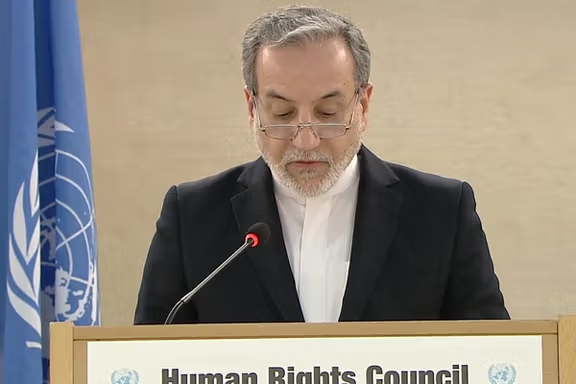
Iran's FM Abbas Araghchi speaking at UN Human Rights Council in Geneva on February 24,2025.

Iran defended its human rights record and condemned Western sanctions at a United Nations Human Rights Council meeting in Geneva.

“For decades, the Iranian people have faced grave challenges, including unjust economic sanctions and terrorism, which have had many devastating impacts on their social and economic rights,” Foreign Minister Abbas Araghchi said in a speech on Monday.

Araghchi, however, did not acknowledge that sanctions against Iran include those for human rights violations, which have targeted both individuals and entities across government sectors from the IRGC to the prison services. Other sanctions have been for Iran's support of Russia's war on Ukraine and its ongoing nuclear program.

The number of people executed in Iran rose from 834 to 901 in 2024, including 31 women, the UN Human Rights Office said in January. The figures have reached record highs since 2022.

While Araghchi said Tehran is committed to improving human rights and cited achievements in education, healthcare, and women's rights, Iran has restricted women's freedoms, including the violent enforcement of hijab laws.

Iran has frequently used violence to suppress demonstrations, including the 2022 protests following the death of Mahsa Amini in morality police custody. Iranian forces killed hundreds of protesters, and arrested thousands more.

Iran's top diplomat also warned against the “politicized use of human rights” as a tool for pressure saying, “Human rights may not be used as a leverage of political and economic pressure or interference in the internal affairs of countries.”

The Islamic Republic has been accused of detaining foreign nationals and dual nationals on vague charges as a means of gaining leverage in diplomatic negotiations—a practice rights groups describe as 'hostage diplomacy'.


Most Viewed

Ideology may be fading in Iran, but not in Kashmir's ‘Mini Iran'
1
INSIGHT

Ideology may be fading in Iran, but not in Kashmir's ‘Mini Iran'

2
INSIGHT

Hardliners push Hormuz ‘red line’ as US blockade tests Iran’s leverage

3
VOICES FROM IRAN

Hope and anger in Iran as fragile ceasefire persists

4

Iran International says it won’t be silenced after London arson attack

5

US sanctions oil network tied to Iranian tycoon Shamkhani

Banner
Banner

Spotlight

  • Hardliners push Hormuz ‘red line’ as US blockade tests Iran’s leverage
    INSIGHT

    Hardliners push Hormuz ‘red line’ as US blockade tests Iran’s leverage

  • Ideology may be fading in Iran, but not in Kashmir's ‘Mini Iran'
    INSIGHT

    Ideology may be fading in Iran, but not in Kashmir's ‘Mini Iran'

  • War damage amounts to $3,000 per Iranian, with blockade set to add to losses
    INSIGHT

    War damage amounts to $3,000 per Iranian, with blockade set to add to losses

  • Why the $100 billion Hormuz toll revenue is a myth
    ANALYSIS

    Why the $100 billion Hormuz toll revenue is a myth

  • US blockade targets Iran oil boom amid regional disruption
    ANALYSIS

    US blockade targets Iran oil boom amid regional disruption

  • Iran's digital economy battered by prolonged blackout
    INSIGHT

    Iran's digital economy battered by prolonged blackout

•
•
•

More Stories

81% of Iranian internet users bypass censorship with VPNs - Parliament

Feb 24, 2025, 13:19 GMT+0

A recent survey by the Iranian Parliament Research Center indicates that the vast majority of Iranians (81%) rely on VPNs to bypass internet censorship.

The survey, based on telephone interviews with 1,100 participants in December 2024, indicates that 49.4% of VPN users rely on free services, while 30.3% opt for paid alternatives. Only 18.9% of respondents reported not using a VPN.

The survey also shed light on public sentiment regarding potential changes to internet restrictions under President Masoud Pezeshkian.

A significant 24.8% of participants expressed "no hope at all" for the lifting of filtering and social restrictions. An additional26.7% indicated"low" hope. In contrast, 20.5% expressed "high" hope, and 11.2% "very high" hope. 16.8% either did not answer or responded"don't know."

Lifting internet filtering was one of Pezeshkian’s main campaign promises in the presidential election in 2024.

He had said, "I would put my neck on the line to solve the filtering issue."

Energy shortages force Iran to cut workweek to two, three days

Feb 24, 2025, 12:09 GMT+0

Government offices, banks, and schools across most of Iran remained closed on Monday as a worsening energy crisis forced authorities to shut down public services in at least 22 of Iran's 31 provinces.

The closures, driven by severe gas shortages and electricity cuts, have left Iranians accustomed to working weeks of just two or three days.

With snow, rain, and plunging temperatures further straining the country’s already fragile energy infrastructure, provincial officials announced the shutdowns late Sunday, impacting regions including Tehran, Mazandaran, Gilan, Golestan, Isfahan, Markazi, Kerman, Hamedan, etc.

In Tehran, schools, courts, and government offices suspended operations entirely, with authorities mandating that all heating systems be turned off to conserve fuel.

“This isn’t about bad weather,” said Nima, a wholesaler of car spare parts in the capital. “The government announces these closures to cover up its energy failures. They know if they don’t shut things down, people will protest over the lack of heating and electricity,” he told Iran International.

A large number of Iranians said on social media that in some provinces, schools were declared closed without arrangements for online classes. However, many said that virtual education is unreliable anyway, as power outages also disrupt internet access.

The country’s aging telecommunications infrastructure lacks backup battery systems, further limiting connectivity.

The frequent shutdowns have hit businesses hard, particularly as Iran nears Nowruz, the Persian New Year, when many retailers rely on a seasonal surge in consumer spending. Hamid, 38, who runs a clothing boutique in Tehran’s Gisha neighborhood, said sales have plummeted.

“We wait 11 months for this last stretch before Nowruz to make a profit, but every week, we lose two or three working days,” he told Iran International. “This morning, I sold just two pairs of pants and a shirt, which were already discounted. Meanwhile, my bounced checks are piling up.”

Iran’s work week has long been out of sync with the global economy, with weekends falling on Thursday and Friday instead of Saturday and Sunday. Nima said the latest wave of shutdowns has made the situation even worse.

“Iranian businesses already struggle because we only overlap with the international market for three days a week,” he said. “Now, with these extra closures, we’re essentially shut down half the month. How can there be an economy in a country that’s closed for business?”

Compounding the crisis, the Iranian rial continues to weaken against the US dollar amid economic pressures from US sanctions. The falling currency has further eroded purchasing power, leaving many consumers unable to afford even discounted goods.

Public sector closures have become a frequent occurrence in Iran, with schools and offices repeatedly shut in recent months due to pollution, dust storms, cold weather, and fuel shortages.

While officials cite weather conditions for the latest round of shutdowns, weather tracking services have not predicted subzero temperatures or heavy snowfall for many of the affected provinces.

For business owners like Hamid and Nima, the pattern is clear. “It’s not about the cold,” Nima said. “It’s about the country running on empty.”

Economist warns of hyperinflation as Iran’s economy deteriorates

Feb 24, 2025, 11:41 GMT+0

An Iranian economist has warned that hyperinflation could take hold unless effective negotiations with the United States lead to the lifting of sanctions.

“Without easing sanctions through productive negotiations, reducing inflation seems unlikely,” Ghodratollah Emamverdi told Etemad newspaper on Monday. He cautioned that if monthly inflation reaches 50%, Iran could face hyperinflation. Currently, monthly inflation is at four percent, while annual inflation is estimated to be over 40%.

On Sunday, the only government agency reporting inflation figures announced an annual rate of 35%. However, labor groups and analysts contend that the government downplays negative economic news, suggesting the real inflation rate is much higher.

Emamverdi noted that although Iran’s inflation rate has not yet reached the critical 50% threshold, continued sanctions and internal political tensions could push the economy into hyperinflation.

Majid-Reza Hariri, former head of Iran’s chamber of commerce, criticized the presidential administration’s inability to address the current crisis, saying the government is effectively paralyzed.

“We either have a government or we don’t, and I personally believe we are facing a state of no government. If the government cannot solve economic problems, no one is forced to be president or minister,” Hariri said. He added that everyone in the current administration was aware of the situation by mid-2024 but still chose to run for office or accept ministerial positions.

President Masoud Pezeshkian has argued that Iran’s complex and deep-seated economic problems are too vast for his administration to resolve, implicitly pointing to the impact of sanctions. Following Supreme Leader Ali Khamenei’s ban on negotiations with the United States in early February, Pezeshkian expressed his support for the decision, aligning himself with Iran’s ultimate political authority. As the new Iranian year approaches on March 20, the government faces the challenge of setting pay raises for millions of workers, including those in government and quasi-public enterprises. Workers are demanding wage increases of up to 70% to keep pace with soaring inflation.

The Iranian rial has lost more than 50% of its value in the past six months, driving expectations of even higher inflation. Currently, the minimum wage stands at about $120 per month, while semi-official estimates indicate that at least $400 per month is needed to support a family of three.

The government is considering a wage increase of less than 50%, which would still leave workers struggling to afford basic necessities. However, even a smaller pay hike could further fuel inflation.

Iran’s foreign minister meets UN secretary-general in Geneva

Feb 24, 2025, 11:35 GMT+0

Iran’s Foreign Minister Abbas Araghchi met with UN Secretary-General António Guterres on the sidelines of the Conference on Disarmament in Geneva on Monday, Iran’s official news agency IRNA reported.

The Conference on Disarmament (CD), established in 1979, is a UN-affiliated multilateral forum for arms control and disarmament negotiations.

It focuses on nuclear disarmament, preventing an arms race in space, and curbing weapons proliferation. Held annually in Geneva, it includes 65 member states.

According to IRNA's report, Araghchi and Guterres discussed global security challenges and the need for international cooperation to promote stability.

Iran summons Polish envoy after FM’s criticism of Iran’s ties with Russia

Feb 24, 2025, 10:49 GMT+0

Iran’s foreign ministry on Monday said it has summoned Poland’s chargé d'affaires in Tehran following comments made by Polish Foreign Minister Radek Sikorski, who last week criticized Iran and Russia's military cooperation.

"In response to the biased and baseless remarks made by the Polish foreign minister against our country, Marcin Wilczek, Poland’s chief envoy in Tehran, was summoned by Mahmoud Heidari, the assistant foreign minister," the statement read.

While the ministry did not elaborate on the specifics of the comments they rebuffed, semi-official IMNA news agency reported that the summons followed Sikorski’s role in facilitating the transfer of an Iranian-made drone from Ukraine to the US for display at the Conservative Political Action Conference (CPAC).

Speaking about his involvement, Sikorski told The Wall Street Journal last week, “There is an axis of aggression between Iran and Russia. The Islamic Republic is sending death and destruction into all directions, and we need to jointly, directly, face the threat and remove it.”

On taking credit for the trophy drone, Sikorski said, “We have to remember that the first credit needs to go to the Ukrainians, who shot the thing down.”

According to WSJ, Sikorski helped to facilitate the drone’s procurement for the US-based nonprofit organization, United Against Nuclear Iran (UANI).





