• العربية
  • فارسی
Brand
  • Iran Insight
  • Politics
  • Economy
  • Analysis
  • Special Report
  • Opinion
  • Podcast
  • Iran Insight
  • Politics
  • Economy
  • Analysis
  • Special Report
  • Opinion
  • Podcast
  • Theme
  • Language
    • العربية
    • فارسی
  • Iran Insight
  • Politics
  • Economy
  • Analysis
  • Special Report
  • Opinion
  • Podcast
All rights reserved for Volant Media UK Limited
volant media logo

Iran president hails dialogue after backing Khamenei's rejection of US talks

Feb 11, 2025, 17:13 GMT+0Updated: 20:18 GMT+0
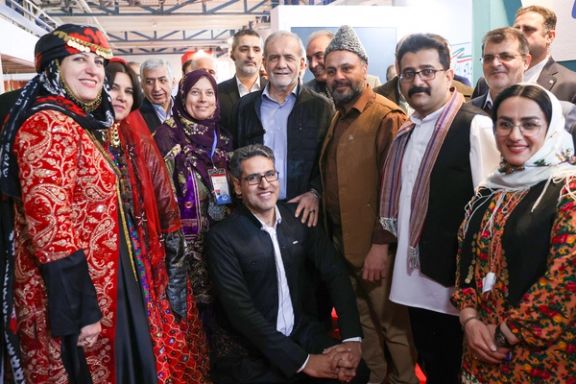
Iranian President Masoud Pezeshkian during a visit to a tourism expo in Tehran, February 11, 2025

Iran seeks peace and dialogue with the world, President Masoud Pezeshkian said Tuesday in guarded remarks which contrast with his endorsement the previous day of Ali Khamenei's opposition to talks with US President Donald Trump.

"Global peace and security can only be realized through connection, friendship, and sincerity—not through aggression, murder, massacres, expulsion, or discrimination. We must create a foundation for human interaction," said Pezeshkian, a relative moderate.

The remarks at a tourism exposition in Tehran referenced the devastation of Gaza in a 15-month incursion by Israel, which is backed by Iran's arch-foe the United States.

"We are not the ones seeking war. We are brothers with our neighbors, and we approach the world with dialogue and peace. It is those who wield power, stockpile weapons of mass destruction, and fuel wars and bloodshed—not us.”

His comments came one day after he threw his weight behind Khamenei's opposition to dialogue with the United States, saying the Supreme Leader "has the final say" on negotiations.

Pezeshkian's speech followed a wave of critical statements from Iranian officials against the idea of US talks after Trump mooted a deal over Iran's disputed nuclear program but reimposed harsh sanctions from his first term.

Earlier this month, Supreme Leader Ali Khamenei made ambivalent comments about the prospect of negotiations, which initially pleased Pezeshkian’s supporters.

But after some hardliners doubled down on their opposition, Khamenei expressly rejected the idea, saying talks "would not be wise, intelligent or honorable".

His criticism of talks set the stage for a renewed political battle within Iran, pitting hardliners against Pezeshkian’s government and its reform-minded allies who see dialogue with the US as the key to lift sanctions which have marred Iran's economy.

The tough stance of the Supreme Leader, the ultimate decision-maker on matters of state, was echoed by hardline media outlets linked to the clerical-military establishment who saw in the president's reticence an endorsement of Khamenei.

Hossein Shariatmadari, the firebrand editor of Kayhan newspaper, praised a similarly non-committal speech by Pezeshkian at a rally earlier this week commemorating Iran's Islamic Revolution.

"One of the outstanding features of this year's rallies was the intelligent and defiant speech by Dr. Masoud Pezeshkian, our esteemed President."

An editorial in Javan praised the address, highlighting not only his nearly 20 references to Khamenei’s leadership and his words as the final authority but also his clarification that “the US is not truly seeking negotiations in the first place, making the debate over whether to negotiate with Trump irrelevant.”

But Jomhouri-e Eslami, a conservative Iranian newspaper, ran an editorial criticizing the silencing of those who opposed Khamenei’s stance on negotiations.

According to the Constitution, the paper argued, individuals have the right to express opinions freely even if they disagree with the Supreme Leader.

"The people's right to express their opinions does not contradict the rights of the Leader, and it should not be assumed that just because the Leader holds a view on a particular issue, no one else has the right to express their own opinion on the matter," wrote Masih Mohajeri, the editor.

Opponents of talks, he continued, “allow themselves to deny the most fundamental Islamic and human rights of the people and label those who seek to express their opinions on various issues as traitors, ignorant, or agents of foreign powers.”

Most Viewed

Hardliners push Hormuz ‘red line’ as US blockade tests Iran’s leverage
1
INSIGHT

Hardliners push Hormuz ‘red line’ as US blockade tests Iran’s leverage

2

Iran International says it won’t be silenced after London arson attack

3
VOICES FROM IRAN

Hope and anger in Iran as fragile ceasefire persists

4

US sanctions oil network tied to Iranian tycoon Shamkhani

5

Iran halts petrochemical exports to supply domestic market

Banner
Banner

Spotlight

  • Hardliners push Hormuz ‘red line’ as US blockade tests Iran’s leverage
    INSIGHT

    Hardliners push Hormuz ‘red line’ as US blockade tests Iran’s leverage

  • Ideology may be fading in Iran, but not in Kashmir's ‘Mini Iran'
    INSIGHT

    Ideology may be fading in Iran, but not in Kashmir's ‘Mini Iran'

  • War damage amounts to $3,000 per Iranian, with blockade set to add to losses
    INSIGHT

    War damage amounts to $3,000 per Iranian, with blockade set to add to losses

  • Why the $100 billion Hormuz toll revenue is a myth
    ANALYSIS

    Why the $100 billion Hormuz toll revenue is a myth

  • US blockade targets Iran oil boom amid regional disruption
    ANALYSIS

    US blockade targets Iran oil boom amid regional disruption

  • Iran's digital economy battered by prolonged blackout
    INSIGHT

    Iran's digital economy battered by prolonged blackout

•
•
•

More Stories

Vigilante rallies fuel debate on Iran’s free assembly double standards

Feb 11, 2025, 10:55 GMT+0
•
Maryam Sinaiee

Recent rallies organized by vigilantes outside the Iranian Parliament and in the religious city of Mashhad have sparked criticism over the state's selective enforcement of freedom of assembly.

Held outside the Parliament on Sunday, the latest such rally featured chants against President Masoud Pezeshkian and members of his administration, particularly his strategic deputy, Javad Zarif, whom the vigilantes demanded be removed from office.

Known as the “People of the Party of God” (Ummat-e hezbollah), vigilante groups in Iran are closely aligned with ultra-hardliner factions such as the Paydari Party and the Basij militia of the Islamic Revolutionary Guards (IRGC). The Paydari Party has close ties to former nuclear negotiator Saeed Jalili, whom they supported in the snap presidential elections after the death of incumbent President Ebrahim Raisi in a helicopter crash on May 19.

Critics argue that authorities provide these groups privileges denied to other political organizations.

The moderate conservative Fararu news website criticized the rally, noting in a report on Monday that the freedom of assembly granted to these vigilantes is particularly striking.

“Freedom of speech [and assembly] is a blessed thing and an understandable [right] but only when it exists for all activists,” the piece on the site read.

Vigilantes protesting outside the Parliament on Sunday

Their protests also targeted Chief Justice Gholamhossein Mohseni-Ejei and Parliament Speaker Mohammad-Bagher Ghalibaf, accusing them of failing to enforce stricter hijab regulations and tighter internet filtering.

In their most recent rallies, these vigilantes, who have significantly dwindled in number in recent years, continued to demand a missile strike against Israel in response to its October attack on Iran's military facilities.

While the Iranian constitution guarantees the right to peaceful assembly under Article 27—requiring gatherings to be unarmed and in accordance with Islamic principles—political parties and groups are still prohibited from freely assembling in public spaces.

Female vigilantes protesting outside the Parliament for hijab enforcement on January 11

Assembly permits are often denied to most political groups, effectively suppressing their protests. In contrast, vigilante groups are allowed to hold rallies freely, without authorization, and often accuse rival political figures of treason or insufficient religious piety.

Unlike vigilantes, activists and citizens who attempt to hold rallies or protests are typically met with harsh dispersal or arrest by police and security forces for "illegal assembly."

In December, an Interior Ministry official warned ultra-hardliners and their affiliated vigilante groups of serious consequences if they continued to disrupt societal harmony with their protests against the President's new, more progressive policies.

On Sunday, the Ministry's Director General for Political Affairs reiterated the need for rally permits, but as in previous instances, no action has been taken against the vigilantes' illegal demonstrations in recent days.

Despite their shrinking numbers—Sunday’s rally reportedly attracted fewer than 100 participants—vigilante gatherings continue to garner significant media attention.

Speeches at the rally included one by Morteza Agha-Tehrani, a member of the Central Council of the Paydari (Steadfastness) Party and a member of Parliament's Cultural Committee.

Agha-Tehrani said that enforcing the hijab law shelved for the time being by the Supreme National Security Council (SNSC) to avoid unrest, would ultimately “bring security.”

Iranian parliament says US talks not forbidden but harmful

Feb 11, 2025, 09:25 GMT+0

The National Security and Foreign Policy Committee of Iran’s Parliament said that while negotiation remains a valid diplomatic tool, talks with the United States have consistently harmed Iranian interests.

“Negotiation with the US is not prohibited but has proven irrational and damaging,” the committee said, referencing past engagements with Washington.

It pointed to the 2015 nuclear deal, or JCPOA, as an example, listing extensive commitments Iran undertook—ranging from reducing enriched uranium stockpiles to converting nuclear facilities—while saying the US failed to deliver on sanctions relief.

Instead, sanctions increased, culminating in the Trump administration’s withdrawal from the deal in 2018, the statement added.

The commission said that engaging with the US has eroded trust, citing recent sanctions for Iran's support of regional militant groups, domestic human rights abuses and support for Russia's war on Ukraine.

They described the US as a “hostile and arrogant regime.” A member of the commission said, “Negotiating with such entities brings no rational benefits; it only deepens the damage.”

It echoes the messaging from the country's Supreme Leader Ali Khamenei, who, during a recent Friday address, said, “Negotiations with the United States have no impact on solving the country’s problems.”

His remarks come as divisions emerge among Iranian officials regarding potential talks on a new nuclear agreement. While some figures, like President Masoud Pezeshkian, have expressed openness to renewed discussions, Khamenei dismissed the idea, emphasizing self-reliance over external agreements.

Iran’s economy has suffered significant setbacks since the reinstatement of US sanctions in 2018. The national currency has devalued by 95%, inflation has remained at around 40% for five years, and over a third of the population now lives below the poverty line.

However, the committee stressed that these challenges should be addressed by fostering domestic production and strengthening ties with regional allies, rather than pursuing dialogue with an “untrustworthy adversary.”

Trump’s threats and economic pressure rattle Iranian officials

Feb 11, 2025, 08:10 GMT+0
•
Behrouz Turani

In Tehran, recent speeches and statements reveal Iranian officials are on edge over the intensifying war of words between US President Donald Trump and Supreme Leader Ali Khamenei.

As Iran’s financial and economic situation deteriorates following Trump’s decision to intensify sanctions, officials seem increasingly worried about potential unrest.

In less than a week, the rial has lost nearly 10 percent of its value.

Statements from Vice President Mohammad-Reza Aref and several military commanders reflect growing anxiety.

“Those with ill intentions might be sowing discord between the people and the government of Iran,” Aref warned, urging the government to start listening to the public.

As night fell on February 9, the eve of the 1979 Revolution’s anniversary, chants of “Death to the Islamic Republic” and “Death to Khamenei” echoed through Tehran and other cities, as people took advantage of the darkness and fireworks.

The slogans echoed the same demands Iranians voices during the nationwide 2022 anti-state protests, underscoring ongoing public dissent in the country.

On February 10, the Entekhab website published a lengthy statement from the Islamic Revolutionary Guard (IRGC), warning against "dangerous bi-polar situations" that could arise as some officials continue advocating for negotiations with the US to address the country’s economic crisis.

Meanwhile, the IRGC boasted that Iran has become a global power striving to establish an Islamic civilization. It warned state officials to be wary of “the cognitive war waged by enemies to undermine Iran’s international standing.” The statement also accused Trump of exaggerating his disputes with the Islamic Republic and making excessive demands to influence potential negotiations.

Calling the US "a terrorist regime," the IRGC warned that, following Khamenei's guidance, Iran would deliver a harsh response to any American miscalculation.

Recent tensions and exchanges between Tehran and Washington seem to have also shifted President Masoud Pezeshkian's rhetoric, aligning it more closely with Khamenei’s hardline stance.

Pezeshkian, who had previously advocated for dialogue with the United States, escalated his tone on Monday, saying, "Trump first threatens Iran's existence and then calls for talks with Tehran. Trump wants to deprive Iran of medicine, food, and water." Pezeshkian’s claims resembled statements by hardliner media accusing Trump of making outrageous demands.

On the same day, Parliament Speaker Mohammad Bagher Ghalibaf intensified what appeared to be a disinformation campaign against Trump by misrepresenting the contents of his recent executive memorandum on tougher sanctions. "Trump wants to disarm Iran," he said.

Several officials and politicians falsely claimed that Trump intends to hand over the three disputed Persian Gulf islands to the United Arab Emirates.

Former Iranian diplomat Kourosh Ahmadi, meanwhile, criticized the spread of misinformation about Trump’s executive memorandum.

“A wave of sheer lies is being spread about the contents of Trump’s executive memorandum. One such falsehood was promoted by Mr. Ghalibaf. Unfortunately, even some well-informed individuals have been misled into believing that Trump signed a document on disarming Iran,” Jamaran News quoted him as saying.

Trump says a 'very frightened and nervous' Iran longs for a deal with US

Feb 11, 2025, 00:48 GMT+0

Iran is terrified after losing almost all its air defenses and now would love to make a deal with the United States, Donald Trump said on Monday, adding that he would also prefer a deal with Tehran to an Israeli attack on their nuclear sites.

"Iran is very concerned. Iran is very frightened, to be honest with you, because their defense is pretty much gone," Trump told Fox News.

He was apparently referring to Israel's October attacks on Iran which, according to US officials, knocked out the country's last three Russian-provided S-300 air defense missile systems.

"Maybe they are trying to get new defense as we speak but their defense is largely gone... Iran is very nervous. I think they're scared. I think Iran would love to make a deal and I would love to make a deal with them without bombing them," Trump added.

Israeli officials have repeatedly raised the possibility of military action against Iran’s nuclear program, but Trump has insisted that he hopes a deal over Iran's nuclear program would make it so that the United States did not have to support an Israeli attack on Iran.

"Everybody thinks Israel with our help or our approval will go in and bomb the hell out of them," Trump said Monday, stressing that Israel would need the US support for such a strike.

"I would prefer that not happen. I'd much rather see a deal with Iran where we can do a deal, supervise, check it, inspect it."

Earlier he had said that any reports the United States and Israel would work together on a devastating military attack on Iran were overblown.

"I want Iran to be a great and successful Country, but one that cannot have a Nuclear Weapon. Reports that the United States, working in conjunction with Israel, is going to blow Iran into smithereens,” ARE GREATLY EXAGGERATED," Trump said on February 5.

'Iran is very militant'

Trump has long opposed foreign wars but has adopted a hard line on Iran, beefing up sanctions on its oil exports in his first term and pulling out of an international deal on Tehran's disputed nuclear program, known as the Joint Comprehensive Plan of Action (JCPOA).

"That was the dumbest" deal, Trump said. "And by the way, that would have expired by now. That was a road to a nuclear weapon. It was a short-term deal. You can't make a deal with just a few years on it."

Trump was referring to the so-called sunset clauses of the 2015 nuclear deal which, according to him, would enable Iran to pursue nuclear weapons in the future.

"They would have a legal right to have a nuclear weapon. You cannot allow Iran or just about anybody else by the way but especially Iran because they are very, very militant. You can't allow them to have a nuclear weapon," he told Fox News.

Trump said there are two ways to stop Tehran from developing a nuclear weapon: "With bombs or with a written piece of paper. And I'd much rather do a deal that's not going to hurt them. And I think they want it too."

Iran has denied seeking a nuclear weapon, but Israel has long contended that a bomb in the hands of its arch-enemy poses an existential threat.

Iran media purveys disinformation to justify Khamenei's rejection of US talks

Feb 10, 2025, 21:20 GMT+0

Several Iranian state media outlets are reporting false information that Donald Trump imposed outlandish preconditions for talks with Tehran, in what analysts call a coordinated campaign to justify Supreme Leader Ali Khamenei's rejection of talks with the US.

Iranian news site Khabar Fori cited a report it falsely attributed to The Wall Street Journal on Monday saying one of President Trump’s conditions for negotiating with Iran was the "transfer of three Iranian islands to the United Arab Emirates."

The control of the islands is a deeply felt issue for many Iranians across the political spectrum.

Hours later, other Iranian media outlets reported that the American newspaper had not published any such report.

At the same time, an article in Arman-e Melli newspaper and Nameh News listed seven alleged conditions, including "US oversight of all of Iran’s peaceful nuclear activities."

The report also said that, according to these conditions, all American and European prisoners "must be released unconditionally," and that Iran must "dismantle or place under full US supervision" all space technology and satellite research centers.

None of the alleged conditions appear in President Trump's official executive order on Iran, or in his public remarks on potential negotiations.

According to Iran International's in-house analysts, the disinformation campaign—emerging amid sharply rising prices and an unprecedented decline in the national currency rial—appears designed to shape public opinion, justify the Supreme Leader’s decision and mitigate public resentment toward him.

Trump ramps up pressure, Khamenei rejects talks

On February 5, Trump signed a presidential directive to resume his "maximum pressure" policy against the Islamic Republic, with the aim of preventing Tehran from acquiring nuclear weapons, countering its malign influence in the region by reducing its oil exports to zero.

Khamenei expressed opposition to negotiating with the US, saying such talks "have no impact on solving the country’s problems".

"Negotiating would not be wise, intelligent or honorable," added Khamenei, who is the ultimate decision-makers on all matters of state.

A day later, Trump expressed hope about reaching a deal with the Islamic Republic, saying that such a deal would forestall an Israeli attack on Iran.

Khamenei's categorical rejection of negotiations drew skepticism from some pro-government social media users and a few officials within the Islamic Republic.

Telegram channel Seda-ye Hashemi, which is said to be affiliated with associates of former President Akbar Hashemi Rafsanjani, published an editorial titled "Foreign Policy or Historical Stubbornness?", criticizing Khamenei’s reference to past nuclear negotiations.

"National interests should be defined based on realities, not historical and political prejudices," the author of the editorial wrote.

Parliament Speaker Mohammad Bagher Ghalibaf, however, addressed the matter, saying, "My expectation and demand from the president is that he and his colleagues in the government implement the Supreme Leader’s directive."

Tehran aligns with Supreme Leader on US talks

On Monday, during state-led celebrations marking the anniversary of the Islamic Revolution, several officials commented on Trump’s threats and the issue of negotiations.

In a speech, President Masoud Pezeshkian said, "Trump says, ‘Let’s negotiate,’ but signs every possible conspiracy against Iran and then claims he is ready for talks." Earlier, Pezeshkian said, "Our enemies think that if they besiege us, we will die of hunger," aligning with Khamenei’s stance against negotiations.

The country’s foreign minister, Abbas Araghchi, also referred to "America’s betrayal in the JCPOA," saying, "We do not trust negotiations and will never negotiate under pressure and coercion." A similar narrative came from Defense Minister Aziz Nasirzadeh, who said, "We will not negotiate under conditions of threats and sanctions."

On the other hand, Mahmoud Vaezi, former chief of staff to President Hassan Rouhani and deputy head of the Moderation and Development Party, suggested that Khamenei’s remarks do not rule out negotiations entirely but are specifically directed at the current circumstances under Trump.

Mostafa Pourmohammadi, secretary-general of the Combatant Clergy Association, echoed this view, saying that based on Khamenei’s position, negotiations should take place "at the right time, from a position of power and dignity."

Trump's remarks on Iran further inflamed currency and gold markets, driving dramatic price surges amid an already strained economy. In response, some officials stressed the need to "clarify" the Supreme Leader’s stance against negotiations with the US.

Gholam-Ali Haddad-Adel, head of the Coalition Council of Revolutionary Forces, said, "The Supreme Leader provides reasoning for his position, and those who support negotiations with Trump should also present their arguments." He acknowledged the "negative reactions of some on social media" to Khamenei’s remarks, attributing them to economic hardships and the pressure on vulnerable groups, but insisted that negotiations would not resolve these problems.

Despite some of Tehran's efforts to justify Khamenei’s decision and spread disinformation about Trump’s alleged preconditions for talks, many among the wider public continue to blame the Supreme Leader and state officials for Iran’s economic and social crises.

On the eve of the 46th anniversary of the 1979 Islamic Revolution, citizens in various Iranian cities chanted slogans against the Islamic Republic, including "Death to the Dictator" and "Death to Khamenei."