• العربية
  • فارسی
Brand
  • Iran Insight
  • Politics
  • Economy
  • Analysis
  • Special Report
  • Opinion
  • Podcast
  • Iran Insight
  • Politics
  • Economy
  • Analysis
  • Special Report
  • Opinion
  • Podcast
  • Theme
  • Language
    • العربية
    • فارسی
  • Iran Insight
  • Politics
  • Economy
  • Analysis
  • Special Report
  • Opinion
  • Podcast
All rights reserved for Volant Media UK Limited
volant media logo

Iran's exiled prince says he was banned from Munich security conference

Feb 6, 2025, 11:28 GMT+0Updated: 13:00 GMT+0
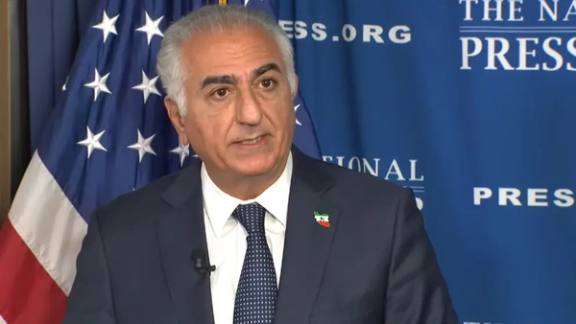
Iranian Exiled Crown Prince Reza Pahlavi, speaking on January 28 at a National Press Club Newsmakers event on the need for freedom, democracy and human rights for the Iranian people.

Iran’s exiled Prince Reza Pahlavi accused Germany of barring him from the upcoming Munich Security Conference, calling the decision an effort to silence the Iranian people and appease the Islamic Republic.

“I was pleased to be invited to take part in this year’s @MunSecConf. However, my participation in this conference has been blocked by @GermanyDiplo [German Foreign Office]," Pahlavi wrote in an X post.

A German foreign ministry spokesperson offered an implicit denial that government had any role in banning Prince Pahlavi's participation. The spokesperson told Iran International that 'The Munich Security Conference decides independently on its invitations," without offering any further details.

Prince Pahlavi also wrote, “This decision was not about silencing me. This was about silencing the Iranian people. It was about silencing all those who stand for freedom, justice, and dignity. And that we will not stand for."

The conference, which is scheduled to begin later this month, has previously welcomed speakers that have criticized the Iranian government. Last year, it also banned Iranian government officials from attending.

From his X post, Pahlavi has, however, suggested the German government has been influenced by Tehran in its decision.

“So while the German government caves to the Islamic Republic, I urge the German people to stand with Iranians fighting for human rights and democracy— not only for Iranians’ sake, but for their own,” he wrote.

Pahlavi, the heir of Iran’s last monarch, has been calling on Western nations to sever links with the Islamic Republic and provide support for Iran’s protest movement.

He vowed to travel to Munich despite the exclusion, saying that Iran’s liberation “will never be determined by foreign governments.”

Germany’s Foreign Office has not publicly commented on Pahlavi’s exclusion.

Most Viewed

Ideology may be fading in Iran, but not in Kashmir's ‘Mini Iran'
1
INSIGHT

Ideology may be fading in Iran, but not in Kashmir's ‘Mini Iran'

2
INSIGHT

Hardliners push Hormuz ‘red line’ as US blockade tests Iran’s leverage

3
VOICES FROM IRAN

Hope and anger in Iran as fragile ceasefire persists

4

Iran International says it won’t be silenced after London arson attack

5

US sanctions oil network tied to Iranian tycoon Shamkhani

Banner
Banner

Spotlight

  • Hardliners push Hormuz ‘red line’ as US blockade tests Iran’s leverage
    INSIGHT

    Hardliners push Hormuz ‘red line’ as US blockade tests Iran’s leverage

  • Ideology may be fading in Iran, but not in Kashmir's ‘Mini Iran'
    INSIGHT

    Ideology may be fading in Iran, but not in Kashmir's ‘Mini Iran'

  • War damage amounts to $3,000 per Iranian, with blockade set to add to losses
    INSIGHT

    War damage amounts to $3,000 per Iranian, with blockade set to add to losses

  • Why the $100 billion Hormuz toll revenue is a myth
    ANALYSIS

    Why the $100 billion Hormuz toll revenue is a myth

  • US blockade targets Iran oil boom amid regional disruption
    ANALYSIS

    US blockade targets Iran oil boom amid regional disruption

  • Iran's digital economy battered by prolonged blackout
    INSIGHT

    Iran's digital economy battered by prolonged blackout

•
•
•

More Stories

Iranians divided on possible US-Iran presidential meeting

Feb 6, 2025, 08:15 GMT+0
•
Maryam Sinaiee

Social media posts and readers’ comments on reports published by some media outlets reveal divergent views about the possibility of a meeting between the US and Iranian presidents.

President Donald Trump on Wednesday expressed hope for a nuclear agreement with Iran, stating his willingness to engage in talks with his Iranian counterpart. He added that he did not care who initiated the contact.

Some social media users noted that while Masoud Pezeshkian may be Iran’s president, unlike Trump, he is not the country’s highest authority. They emphasized that Pezeshkian would need approval from Supreme Leader Ali Khamenei for all significant decisions, including matters of foreign policy.

“Trump has absolute authority in the US for everything. Does Pezeshkian also have absolute authority?” one commenter questioned, pointing out that Pezeshkian lacks the power to fulfill even smaller promises, such as removing social media platform filters.

“Hold an urgent meeting with political, economic, cultural, and diplomatic experts, go to the Leader after summarizing [the situation], and invite Trump to Iran after his approval! Trump is ready for a deal,” Amin Asgari, a political economy researcher, told Pezeshkian in an X post.

Like many others, former Deputy to President Hassan Rouhani, Hamid Aboutalebi, advocated for diplomacy over hostility in a detailed post addressed to Pezeshkian. He urged Pezeshkian to call Trump and signal Iran’s readiness for talks, citing the need to reach a preliminary agreement to “prevent further tensions, mitigate risks, and avoid the potential activation of the snapback mechanism or escalation into conflict and war.”

Economic concerns

Many Iranians expressed economic concerns in response to media reports and social media discussions on the possibility of resuming maximum pressure sanctions.

Refusal to engage in talks with Trump, they argued, could lead to severe economic consequences as evidenced by the fast response of the foreign exchange market to the announcement and the depreciation of the rial.

“Forget about [the possibility of] negotiations. What will happen is maximum pressure and a halt in Iran's oil sales. This means more wretchedness and misery for us all,” lamented one user on X.

Another anonymous reader urged comprehensive talks, writing, “Think of the lifting of sanctions instead of squandering opportunities and spouting empty slogans.” This comment, posted on the conservative Tabnak news website under the headline “Trump’s Return to Maximum Pressure against Iran: Re-Taking an Unviable Path” received 125 upvotes and only nine downvotes.

Other comments on the same article echoed similar sentiments, predicting difficult times for Iran if hostilities with the US persist. However, not everyone agreed. One reader argued, “The Revolutionary Guards must give the Americans a new lesson,” though 297 users opposed the comment, while only 36 supported it.

Opposition to talks

Radical elements opposed to negotiations with the US reiterated in their posts that no Iranian official should meet with Trump. They cited his role in the assassination of Quds Force Commander Qasem Soleimani in January 2021. “We demand retribution for General Soleimani’s killers,” one user wrote on X.

Ehsan, an ultra-hardliner social media activist with over 3,700 followers, criticized reformist media outlets for selectively highlighting Trump’s remarks. “Trump’s threats to destroy Iran, impose maximum pressure, and prevent oil sales have been ignored by reformists, who instead focus on his willingness to meet Pezeshkian,” he wrote.

Interestingly, even some hardliner outlets, including Hamshahri, ran headlines such as “Trump: I’m Ready to Talk to Pezeshkian.”
Hunger strikes protesting executions spread to 35 Iranian prisons

Feb 5, 2025, 21:28 GMT+0

Prisoners in 35 facilities across Iran have joined hunger strikes as part of the No to Execution Tuesdays campaign, now in its 54th week protesting the country's use of capital punishment.

In a statement released by campaign members, they described the growing movement as a direct response to what they called an authoritarian system that relies on executions.

The statement, acquired by Iran International on Tuesday, said that over 30 individuals, including a woman, have been executed since January 20.

“Let us not forget that Supreme Leader Ali Khamenei previously acknowledged that judges should pay no attention to international human rights principles when issuing verdicts,” read the statement.

The authors also expressed appreciation for support online, in the media and through domestic and international gatherings by various groups on the anniversary of the campaign, expressing hope that enthusiasm continues for the cause

The initiative started on January 30, 2024, when female political prisoners in the women's section of Tehran’s Evin Prison initiated weekly hunger strikes to protest the rising number of executions and to express solidarity with inmates at Ghezel Hesar Prison in Karaj, who were taking similar actions.

Now well into its second year, the movement has continued to build momentum, gaining support from political prisoners nationwide.

Trump advisor says all options on the table for preventing a nuclear Iran

Feb 5, 2025, 18:39 GMT+0

All options are on the table for the United States to prevent Iran from acquiring a nuclear weapon, Trump's national security advisor Michael Waltz said in a Space conversation on X.

Waltz added that the US and Israel are on the same page when it comes to Iran not acquiring a nuclear weapon.

His comments came one day after Israeli Prime Minister Benjamin Netanyahu said in a joint press conference with Trump that the two leaders see eye to eye when it comes to the threat posed by their common enemy.

"We're both committed to rolling back Iran's aggression in the region and ensuring that Iran never develops a nuclear weapon," Netanyahu continued.

He made the remarks after Trump signed a directive restoring the so-called maximum pressure policy on Iran of his first term and warned of "catastrophic" consequences if Tehran does not make a deal on its nuclear program.

Trump said he hoped for an agreement denying Iran nuclear weapons "so that it doesn't end up in a very catastrophic situation," but sounded a dovish note by saying he was prepared to speak with his Iranian counterpart.

Iran says 'not difficult' to assure Trump it does not seek nuclear arms

Feb 5, 2025, 16:20 GMT+0

Demonstrating to US President Donald Trump that Iran does not seek nuclear weapons will not be difficult and is achievable, foreign minister Abbas Araghchi said on Wednesday, in an apparent olive branch to Tehran's main adversary.

"If the main issue is ensuring that Iran does not pursue nuclear weapons, this is achievable and not a difficult matter," Araghchi said.

Trump said on Tuesday he hoped for an agreement denying Iran nuclear weapons.

"They cannot have a nuclear weapon," he told reporters at a press conference held after signing a memorandum to restore his so-called maximum pressure policy against Iran.

"If ... they can convince us that they won't, and I hope they can," Trump continued, "It's actually very easy to do, I think they're going to have an unbelievable future."

The US President's directive on squeezing Tehran on Tuesday seeks to deny Iran nuclear weapons, limit its ballistic missile program and halt support for terrorism.

The head of Iran's Atomic Energy Organization, Mohammad Eslami, also weighed in on Trump's directive, saying Tehran has not and will never pursue nuclear weapons.

While Tehran has maintained its nuclear program is for peaceful purposes, it has accelerated its uranium enrichment to up to 60% — close to the 90% threshold that is considered weapons-grade, according to the UN nuclear watchdog.

The Iranian foreign minister's latest comments did not directly address Trump's sanctions directive but instead appeared to signal Tehran's openness to negotiations on the nuclear issue.

Trump on Wednesday expressed hope for a nuclear agreement, telling reporters that he would be willing to engage in talks with his Iranian counterpart.

Iran's First Vice President Mohammad Reza Aref said that although a meeting between "two human beings" is not impossible, engaging in talks with Trump is not currently on the Islamic Republic's agenda.

Fatemeh Mohajerani, the spokesperson for the presidential administration, also reacted to the US president's remarks regarding his readiness to negotiate with the Iranian president, saying, "Our country's foreign policy has always been based on a set of fixed principles."

"We follow three key principles: the dignity of the country and its people, wisdom in understanding underlying issues, and expediency. All national matters, particularly relations with other countries, are pursued based on these principles."

Trump’s National Security Presidential Memorandum (NSPM) did not mention any meetings or immediate negotiations.

'A failed experience'

In his Wednesday remarks, Araghchi dismissed Trump’s renewal the previous day of the so-called maximum pressure strategy of his first term aiming to reduce Iranian oil exports to zero.

"Maximum pressure is a failed experiment, and trying it again will only lead to another failure," Araghchi told Iranian media on Wednesday.

In Trump's first term in office, Iran's oil exports were reduced to near zero by re-imposing sanctions. Under former US President Joe Biden, however, Iran's oil exports increased starting in 2021 as Tehran found ways to circumvent those sanctions.

Iranian MP says he would not hesitate to kill Trump

Feb 5, 2025, 15:59 GMT+0

An Iranian lawmaker said he would kill Donald Trump after the US president threatened to obliterate Iran if it sought to assassinate him.

"For my part, I would say that whenever I get the opportunity, I will not hesitate for a moment to kill you, Donald Trump," said Mojtaba Zarei, a member of the Iranian Parliament's Foreign Policy Commission.

"And I am a political official speaking this diplomatically," he said in a post on Iranian social media platform Eitaa.

While signing a sanctions directive on Tuesday to increase pressure on Tehran, Trump was asked about the potential fallout for Iran if it made an attempt on his life.

US law enforcement last year accused Iran's Islamic Revolutionary Guard Corps, a powerful paramilitary organization, of organizing a plot to kill Trump in retaliation for his order to assassinate its foreign operations chief Qassem Soleimani in 2020.

"If they did that, they would be obliterated," Trump said.

"That would be the end. I've left instructions - if they do it, they get obliterated. There won't be anything left."

Iranian foreign ministry spokesperson Esmail Baghaei reacted to the remarks on Wednesday, saying, “Tehran reserves its right to pursue a legal process for achieving justice regarding the killing of national champions and senior officials to achieve results in domestic and international courts.”