• العربية
  • فارسی
Brand
  • Iran Insight
  • Politics
  • Economy
  • Analysis
  • Special Report
  • Opinion
  • Podcast
  • Iran Insight
  • Politics
  • Economy
  • Analysis
  • Special Report
  • Opinion
  • Podcast
  • Theme
  • Language
    • العربية
    • فارسی
  • Iran Insight
  • Politics
  • Economy
  • Analysis
  • Special Report
  • Opinion
  • Podcast
All rights reserved for Volant Media UK Limited
volant media logo

White House says Trump threat on Gaza hostages kept Iran in check

Jan 31, 2025, 19:50 GMT+0Updated: 08:31 GMT+0
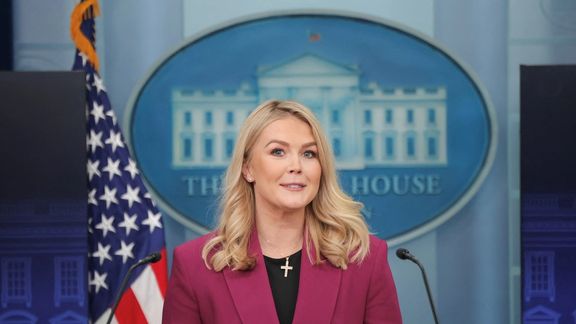
White House press secretary Karoline Leavitt

Iran has been deterred, and a Gaza ceasefire has held due to President Donald Trump's warning of dire consequences if Tehran-backed Hamas refused to release Israeli hostages, the White House said Friday.

Trump's new press secretary Karoline Leavitt was asked by a reporter whether her boss would pursue means short of military action to topple Iran's ruling system.

"I think the President has actually made his position on Iran very clear, and he made that clear when there were the negotiations about the ceasefire, which we know obviously is now in place, and the deadline on that ceasefire has continued," she replied.

Trump had said on Jan. 7 that "all hell will break out in the Middle East” if Hamas failed to ink a deal to release Israeli hostages the Palestinian group funded and armed by Iran abducted in an Oct. 7, 2023 attack.

"He said that Hamas and Iranian-backed terrorists would have hell to pay if that ceasefire didn't move forward, and then quickly thereafter it did," Leavitt added.

Trump has said that Iran cannot be allowed to possess nuclear weapons but has suggested his administration will not seek to overthrow the Islamic Republic.

Most Viewed

State media slam Araghchi's Hormuz tweet, say it let Trump claim victory
1

State media slam Araghchi's Hormuz tweet, say it let Trump claim victory

2
OPINION

The Hormuz get out of jail card turned to a grave

3

Iran International says it won’t be silenced after London arson attack

4
INSIGHT

How Tehran bends its own red lines to boost state rallies

5

Iran halts petrochemical exports to supply domestic market

Banner
Banner

Spotlight

  • Too early to tell who is winning Iran war, experts say
    PODCAST

    Too early to tell who is winning Iran war, experts say

  • How Tehran bends its own red lines to boost state rallies
    INSIGHT

    How Tehran bends its own red lines to boost state rallies

  • Iran blackout cripples freelancer, small business incomes
    VOICES FROM IRAN

    Iran blackout cripples freelancer, small business incomes

  • Ideology may be fading in Iran, but not in Kashmir's ‘Mini Iran'
    INSIGHT

    Ideology may be fading in Iran, but not in Kashmir's ‘Mini Iran'

  • US blockade enters murky phase as tankers spoof signals and buyers hesitate
    ANALYSIS

    US blockade enters murky phase as tankers spoof signals and buyers hesitate

  • Why the $100 billion Hormuz toll revenue is a myth
    ANALYSIS

    Why the $100 billion Hormuz toll revenue is a myth

•
•
•

More Stories

Friday sermons in Iran reflect hardline pushback against US talks

Jan 31, 2025, 15:03 GMT+0

State-appointed Iranian clerics have expressed their opposition to potential negotiations with the United States, criticizing the government's approach despite Supreme Leader Ali Khamenei potentially giving an implicit green light earlier this week.

Mohammad-Mehdi Hosseini Hamedani, the Friday prayer Imam of Karaj and the Supreme Leader’s representative in Alborz province accused supporters of negotiations of misleading the public.

"The enemy threatens Iran daily, yet some still talk about negotiations. The people know America cannot be reformed," he said during his sermon on Friday. He warned that those advocating for talks are placing Iranians in a false dilemma by pushing a narrative that all economic woes can be resolved through diplomacy.

Abdolnabi Mousavi-Fard, the Supreme Leader’s representative in Khuzestan, argued that Iran's strengthened regional position means talks are less necessary.

Any comprehensive talks with Washington, he insisted, would amount to surrendering to "illegitimate American demands."

"Before engaging in any new negotiations, the stance on America's demands must be clarified, as we know that the United States will not back down from its positions."

Abdolnabi Mousavi-Fard, the Supreme Leader’s representative in Khuzestan
100%
Abdolnabi Mousavi-Fard, the Supreme Leader’s representative in Khuzestan

This comes as Iran's Supreme Leader Ali Khamenei urged officials this week to know their enemy when negotiating and to strike deals accordingly, cryptic remarks that some commentators interpreted as a tacit endorsement of US talks.

The remarks from hardline clerics come as the government signals openness to diplomatic engagement with the United States over Iran’s nuclear program.

In an interview with Sky News, Foreign Minister Abbas Araghchi said that while Tehran is open to hearing out President Trump, any new deal will be far more challenging to achieve than in 2018 when the original nuclear agreement was signed.

"The situation is different and much more difficult than the previous time," Araghchi said. "Lots of things should be done by the other side to buy our confidence … We haven't heard anything but the 'nice' word, and this is obviously not enough."

This follows President Trump’s earlier remark that it would be "nice" if the nuclear crisis could be resolved without escalation or the need for Israel to launch military strikes against Iran.

While Tehran signals a cautious willingness for dialogue, opposition from conservative clerics underscores internal divisions within the Iranian leadership, with hardliners urging defiance while the government assesses its next move.

Tehran more ready than ever for US talks, commentators say

Jan 31, 2025, 12:16 GMT+0
•
Behrouz Turani

Infighting persisted among rival factions in Tehran over possible US talks after Ali Khamenei gave an implicit green light earlier this week, though with caveats reflecting his recurrent distrust of America.

At the same time, some of the key politicians who opposed the idea of negotiations with the United States have been realigning their stances and shifting their loyalties.

The conservative Jomhouri Eslami newspaper described the past week as marked by an intensifying war of words between supporters and opponents of negotiations aimed at addressing Iran's economic and foreign policy impasse.

The daily wrote: “Supporters of negotiations argue Iran cannot permanently cut ties with one of the world's major powers. They point to China and Russia, which have long-standing rivalries and conflicting interests with the US yet maintain relations. Likewise, they contend, Iran can engage with the United States and other nations—except those with illegitimate governments—without being vulnerable to coercion.”

"This group of politicians believes Iran must reconsider its foreign policy to better serve its own interests. On the other hand, opponents of negotiations, who are at the center of the recent infighting, argue that Iran should have no relations with the United States, as nothing justifies talks with Washington," the Jomhouri Eslami wrote, adding, "The opponents of negotiations with America insist that the United States is not trustworthy and that its officials do not honor their commitments."

The daily noted that this group organized rallies in Tehran over the past week to protest negotiations and their supporters. However, it added that statements from Iranian officials throughout the week suggest the country is more inclined than ever to pursue talks with the United States.

The daily added, "If this is the case, there is hope for a breakthrough in Iran's foreign relations that could lead to an improvement in Iranians' livelihood."

The commentary was part of the daily's weekly roundup in a tumultuous week of infighting and shifting alliances, including divisions within the conservative camp.

The conservative Nameh News website described an ongoing and unresolved rivalry between Majles Speaker Mohammad Bagher Ghalibaf and former Supreme National Security Council secretary Saeed Jalili.

The reformist, pro-government daily Etemad linked the disputes between the two politicians to their rivalry in past and recent presidential elections. In the June 2024 election, Ghalibaf withdrew his candidacy in favor of Masoud Pezeshkian, ultimately helping pave the way for Pezeshkian's victory in the runoff. According to Nameh News, the two politicians maintain opposing views about negotiations with the United States.

The website noted that, unlike Jalili, Ghalibaf does not oppose negotiations but believes Iranian negotiators should first align on their definitions and demands. However, it observed that Jalili and his supporters, particularly in the ultraconservative Paydari Party, oppose any form of talks between Iran and the United States.

"Jalili believes that Iran and the United States are fundamentally at odds, positioned as opposing forces by nature. He argues that escalating tensions between the two can serve as a means to restrain the other side," the website wrote.

As a result of the dispute, Ghalibaf—who has repeatedly shifted his loyalties over the past six months, moving between the Paydari camp and Pezeshkian's supporters—has once again aligned himself with the latter, Nameh News concluded.

Widening divisions are also emerging between pro-Pezeshkian reformists and the conservative faction. Ayatollah Mohsen Gharavian, a former ultraconservative who has joined the Reformists, insisted in an interview with Khabar Online that "the only way to end the sanctions is negotiating with global powers." He accused Jalili of mobilizing vigilantes in the streets against negotiations and argued that "he should distance himself from the radicals if he was not behind the rallies."

Meanwhile, Mohammad Karbasi, a hardline cleric in Qom, the center of the Shiite Seminary, accused reformist cleric Mohammad Ali Abtahi of "having a plan to instigate riots in the streets" after Abtahi recently stated in a post on X that "Iran's economy is affected by the impact of the sanctions" and that "negotiations can have a positive impact on Iran's economy if we have competent diplomats."
US leans on Beirut to curb Hezbollah sway in cabinet - Reuters

Jan 31, 2025, 11:54 GMT+0

Washington is exhorting senior Lebanese officials to prevent Hezbollah or its allies from selecting the country's next finance minister, Reuters reported citing sources familiar with the matter.

Hezbollah has traditionally played a key role in forming the government, working alongside its Shi'ite ally the Amal Movement which has controlled Lebanon’s finance ministry since 2014.

US officials are keen to limit their influence as Prime Minister-designate Nawaf Salam assembles a new cabinet, Reuters reported.

The US is exerting significant pressure on both Salam and Lebanese President Joseph Aoun to curb Hezbollah's power, Reuters cited a source close to the group as saying.

Lebanon could face difficulties securing foreign financial aid crucial for post-war reconstruction if Hezbollah or Amal were to select the next finance minister, Reuters reported citing other sources.

Washington’s intervention comes as Hezbollah’s position in the region has been shaken after over a year of combat with Israel.

Its key ally Syrian President Bashar al-Assad was toppled by Islamist militants, transforming the political landscape in Lebanon and the broader Middle East.

The damage from Israeli airstrikes last year was extensive, particularly in Shi'ite-majority areas where Hezbollah enjoys strong support.

While Hezbollah has urged international and regional powers to assist Lebanon’s rebuilding efforts, sources suggest that financial assistance is likely conditional on political changes—particularly the group’s diminished role in government.

Aoun’s presidency marks a shift from Iranian-backed dominance in Lebanon’s politics. Backed by factions seeking to reduce Hezbollah’s power, his election ended years of political paralysis and exposed the divide between Lebanon’s pro-Western and pro-Hezbollah blocs.

In his first parliamentary address, Aoun called for the Lebanese state to reclaim control over its military, signaling a challenge to Hezbollah. He said that his presidency would work towards ensuring the state had the exclusive right to bear arms—an implicit challenge to Hezbollah’s vast arsenal.

Iran’s embassy in Beirut congratulated Lebanon on Aoun’s election, expressing hope for stronger cooperation between the two nations. The statement did not address Hezbollah’s arms, reflecting the growing political tensions over the group’s future role in the country.

Israel says Iran is smuggling millions of US dollars in cash to Hezbollah – WSJ

Jan 31, 2025, 11:34 GMT+0

Israel has accused Iran of funneling tens of millions of dollars to Hezbollah through clandestine cash deliveries, lodging formal complaints with the US-led committee overseeing the cease-fire in Lebanon, The Wall Street Journal reported Friday.

Iranian envoys have been flying into Beirut from Tehran with suitcases stuffed with US dollars to finance Hezbollah’s operations. Additionally, Israel has reported that Turkish nationals have been used as couriers to transport funds from Istanbul to Beirut, according to WSJ.

The cease-fire committee, which includes representatives from Israel, Lebanon, the US, France, and the UN, has relayed these concerns to Lebanon’s government. The cease-fire terms require Lebanon to secure its borders to prevent arms smuggling but do not explicitly address cash transfers, WSJ reported, citing an unnamed US defense official.

These allegations come amid increased scrutiny of Iranian financial activities in Lebanon. In early January, tensions flared at Beirut Airport when an Iranian diplomat refused to have his bags searched, triggering a brief standoff. Lebanon’s Foreign Ministry later said that the funds in the diplomat’s possession were for embassy expenses and were allowed entry under the Vienna Convention on Diplomatic Relations.

However, reports suggest this was the third such incident since November, raising concerns about Lebanon’s commitment to curbing Iranian cash and arms transfers to Hezbollah.

Meanwhile, Hezbollah’s Deputy Secretary-General Naim Qassem revealed in December that $50 million had been distributed to over 233,000 displaced Lebanese households, openly acknowledging Iranian financial support for the group.

Reports of cash transfers to Iran’s proxy groups have surfaced in the past. In 2006, Mahmoud al-Zahar, a senior Hamas official, said on Al-Alam TV that during a visit to Tehran, he received several suitcases containing $22 million from Qassem Soleimani, the late commander of the IRGC’s Quds Force.

In 2019, China’s Xinhua News Agency reported that during an event preceding "Quds Day" in Gaza, Iran distributed $651,000 to Palestinian families in the territory.

Iran expands military drills as Israel moots striking nuclear sites

Jan 31, 2025, 09:58 GMT+0

A senior Iranian military commander said expanding military drills showcase the country's deterrence and defense capabilities as an Israeli official again broached a potential attack on Iran's nuclear program.

“These drills contribute to enhancing our combat readiness, demonstrating our national deterrence capabilities, and informing the public of our defensive strength,” said Admiral Habibollah Sayyari, chief of staff and deputy coordinator of the army.

“At the same time, they allow our adversaries to witness the extent of our deterrence and defense power.”

This military build-up comes as tensions with Israel and the US persist, with growing attention on Donald Trump’s stance on Iran.

Israeli officials have reiterated the possibility of military action against Iran’s nuclear program. On Thursday, Omer Dostri, spokesman for Prime Minister Benjamin Netanyahu, told The Jerusalem Post that while Israel prefers a diplomatic solution, it doubts Iran will comply.

“War is one way to achieve our objectives. If Iran halts its nuclear ambitions without an Israeli strike, fantastic,” he said. “But we do not expect that to happen.”

Dostri also said Israel hopes to work with Trump to restore his maximum pressure policy, which had imposed severe sanctions on Iran.

While Trump has suggested he may seek a diplomatic solution, Dostri made it clear that Israel is ready to act alone if needed. “We’ll give it a chance, but the clock is ticking. If necessary, we will act – with or without American approval.”

The latest drills in Iran included joint operations between the Islamic Revolutionary Guard Corps (IRGC) and the Iranian army, focusing on protecting key nuclear sites such as Natanz and Fordow.

The exercises, set to continue until mid-March, follow Iran’s unveiling of the Zagros, its first signals intelligence (SIGINT) vessel for electronic surveillance. Iran has also received 1,000 new drones to strengthen its defense capabilities.

Earlier this month, 110,000 paramilitary Basij forces took part in an IRGC drill to prepare for potential threats to Tehran.