• العربية
  • فارسی
Brand
  • Iran Insight
  • Politics
  • Economy
  • Analysis
  • Special Report
  • Opinion
  • Podcast
  • Iran Insight
  • Politics
  • Economy
  • Analysis
  • Special Report
  • Opinion
  • Podcast
  • Theme
  • Language
    • العربية
    • فارسی
  • Iran Insight
  • Politics
  • Economy
  • Analysis
  • Special Report
  • Opinion
  • Podcast
All rights reserved for Volant Media UK Limited
volant media logo

Iranian hardliners still oppose women at football matches

Maryam Sinaiee
Maryam Sinaiee

Iran International

Jan 31, 2025, 15:30 GMT+0Updated: 11:46 GMT+0
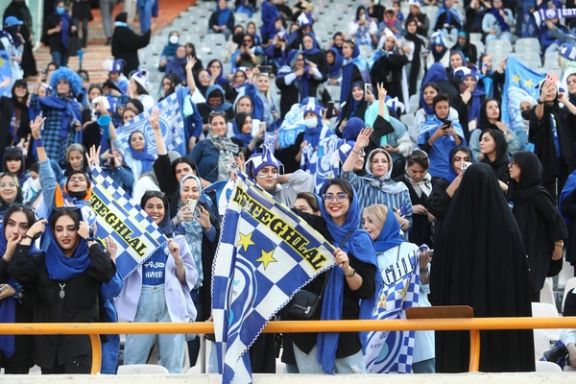
Female fans of Esteghlal FC allowed to watch a game in 2022

Female Iranian football fans are no longer officially banned from stadiums but religious fundamentalists still publicly rue the lifting of the four-decade-old restriction.

The ban enforced after the Islamic Revolution of 1979 was lifted in October 2019 under pressure from FIFA, the governing body for international football and its Asian counterpart the Asian Football Confederation (AFC).

FIFA had warned Iran’s football federation that it could face expulsion from global tournaments including the World Cup if women were not allowed to attend.

Female fan of Tractor FC at Tehran's Azadi Stadium
100%
Female fan of Tractor FC at Tehran's Azadi Stadium

Despite the policy change, opposition festers.

In March 2022 women who had bought tickets for a FIFA World Cup qualifier between Iran and Lebanon in the religious city of Mashhad were pepper sprayed when they tried to enter the stadium.

Women are still not permitted to attend all matches. Local authorities frequently cite what they call insufficient preparation, such as the lack of designated seating areas for women as a reason for their exclusion.

When women are allowed, the number of tickets available to them is often limited, and female enforcement officers in black chadors are present to ensure compliance with mandatory hijab laws.

Nevertheless, footage and photos posted on social media show defiance of the hijab is widespread.

Hijab enforcers and female fans at Tehran's Azadi Stadium
100%
Hijab enforcers and female fans at Tehran's Azadi Stadium

The hardline newspaper Kayhan, closely linked to the office of Iran’s Supreme Leader, criticized the decision to allow women into stadiums. On Thursday, the daily accused proponents of the change of “implanting the idea that women’s success and dignity lie in imitating men’s behavior and attire.”

Kayhan’s criticism followed the release of footage showing female fans at a match between Tractor FC and Persepolis FC on Wednesday in which both male and female fans were seen cheering and occasionally swearing.

Kayhan argued that women’s presence has not improved what it described as the “poisonous and unhealthy atmosphere” of stadiums. It said it has led to violations of what it called women’s dignity, a “fundamental principle in Iranian and Islamic culture," according to the hardline paper.

Official poster of Offside, a 2006 film about women trying to watch a football game disguised as men
100%
Official poster of Offside, a 2006 film about women trying to watch a football game disguised as men

Iranian authorities have long justified the ban on women’s attendance as a measure to protect them from exposure to profanities often chanted by male fans, even if women were seated in separate sections of the stadium.

Over the years, some women have taken significant risks to watch matches. Disguised as men, they attempted to enter stadiums but were often caught, arrested, abused or even sentenced to prison terms.

The ultra-hardline outlet Mashregh News also criticized FIFA President Gianni Infantino, suggesting he should have attended the Wednesday game week to understand the authorities’ stance against women’s presence in stadiums.

Infantino has consistently pressured Iran on this issue, particularly after the tragic case of Sahar Khodayari.

In September 2019, Khodayari, nicknamed the Blue Girl after her favorite team Esteghlal FC (nicknamed the Blue Team), set herself on fire after being sentenced to jail for attempting to enter Tehran’s Azadi Stadium disguised as a man.

This issue has also been reflected in art and media. Jafar Panahi’s 2006 film Offside depicted the story of young women disguising themselves as boys to watch a World Cup qualifying match at Azadi Stadium. The film won the Silver Bear at the Berlin International Film Festival but was never approved for screening in Iran.

Most Viewed

Iran negotiators ordered to return after internal rift over Islamabad talks
1
EXCLUSIVE

Iran negotiators ordered to return after internal rift over Islamabad talks

2
ANALYSIS

US blockade enters murky phase as tankers spoof signals and buyers hesitate

3
ANALYSIS

Why the $100 billion Hormuz toll revenue is a myth

4

US tightens financial squeeze on Iran, warns banks over oil money flows

5
ANALYSIS

US blockade targets Iran oil boom amid regional disruption

Banner
Banner

Spotlight

  • Hardliners push Hormuz ‘red line’ as US blockade tests Iran’s leverage
    INSIGHT

    Hardliners push Hormuz ‘red line’ as US blockade tests Iran’s leverage

  • Ideology may be fading in Iran, but not in Kashmir's ‘Mini Iran'
    INSIGHT

    Ideology may be fading in Iran, but not in Kashmir's ‘Mini Iran'

  • War damage amounts to $3,000 per Iranian, with blockade set to add to losses
    INSIGHT

    War damage amounts to $3,000 per Iranian, with blockade set to add to losses

  • Why the $100 billion Hormuz toll revenue is a myth
    ANALYSIS

    Why the $100 billion Hormuz toll revenue is a myth

  • US blockade targets Iran oil boom amid regional disruption
    ANALYSIS

    US blockade targets Iran oil boom amid regional disruption

  • Iran's digital economy battered by prolonged blackout
    INSIGHT

    Iran's digital economy battered by prolonged blackout

•
•
•

More Stories

Friday sermons in Iran reflect hardline pushback against US talks

Jan 31, 2025, 15:03 GMT+0

State-appointed Iranian clerics have expressed their opposition to potential negotiations with the United States, criticizing the government's approach despite Supreme Leader Ali Khamenei potentially giving an implicit green light earlier this week.

Mohammad-Mehdi Hosseini Hamedani, the Friday prayer Imam of Karaj and the Supreme Leader’s representative in Alborz province accused supporters of negotiations of misleading the public.

"The enemy threatens Iran daily, yet some still talk about negotiations. The people know America cannot be reformed," he said during his sermon on Friday. He warned that those advocating for talks are placing Iranians in a false dilemma by pushing a narrative that all economic woes can be resolved through diplomacy.

Abdolnabi Mousavi-Fard, the Supreme Leader’s representative in Khuzestan, argued that Iran's strengthened regional position means talks are less necessary.

Any comprehensive talks with Washington, he insisted, would amount to surrendering to "illegitimate American demands."

"Before engaging in any new negotiations, the stance on America's demands must be clarified, as we know that the United States will not back down from its positions."

Abdolnabi Mousavi-Fard, the Supreme Leader’s representative in Khuzestan
100%
Abdolnabi Mousavi-Fard, the Supreme Leader’s representative in Khuzestan

This comes as Iran's Supreme Leader Ali Khamenei urged officials this week to know their enemy when negotiating and to strike deals accordingly, cryptic remarks that some commentators interpreted as a tacit endorsement of US talks.

The remarks from hardline clerics come as the government signals openness to diplomatic engagement with the United States over Iran’s nuclear program.

In an interview with Sky News, Foreign Minister Abbas Araghchi said that while Tehran is open to hearing out President Trump, any new deal will be far more challenging to achieve than in 2018 when the original nuclear agreement was signed.

"The situation is different and much more difficult than the previous time," Araghchi said. "Lots of things should be done by the other side to buy our confidence … We haven't heard anything but the 'nice' word, and this is obviously not enough."

This follows President Trump’s earlier remark that it would be "nice" if the nuclear crisis could be resolved without escalation or the need for Israel to launch military strikes against Iran.

While Tehran signals a cautious willingness for dialogue, opposition from conservative clerics underscores internal divisions within the Iranian leadership, with hardliners urging defiance while the government assesses its next move.

Tehran more ready than ever for US talks, commentators say

Jan 31, 2025, 12:16 GMT+0
•
Behrouz Turani

Infighting persisted among rival factions in Tehran over possible US talks after Ali Khamenei gave an implicit green light earlier this week, though with caveats reflecting his recurrent distrust of America.

At the same time, some of the key politicians who opposed the idea of negotiations with the United States have been realigning their stances and shifting their loyalties.

The conservative Jomhouri Eslami newspaper described the past week as marked by an intensifying war of words between supporters and opponents of negotiations aimed at addressing Iran's economic and foreign policy impasse.

The daily wrote: “Supporters of negotiations argue Iran cannot permanently cut ties with one of the world's major powers. They point to China and Russia, which have long-standing rivalries and conflicting interests with the US yet maintain relations. Likewise, they contend, Iran can engage with the United States and other nations—except those with illegitimate governments—without being vulnerable to coercion.”

"This group of politicians believes Iran must reconsider its foreign policy to better serve its own interests. On the other hand, opponents of negotiations, who are at the center of the recent infighting, argue that Iran should have no relations with the United States, as nothing justifies talks with Washington," the Jomhouri Eslami wrote, adding, "The opponents of negotiations with America insist that the United States is not trustworthy and that its officials do not honor their commitments."

The daily noted that this group organized rallies in Tehran over the past week to protest negotiations and their supporters. However, it added that statements from Iranian officials throughout the week suggest the country is more inclined than ever to pursue talks with the United States.

The daily added, "If this is the case, there is hope for a breakthrough in Iran's foreign relations that could lead to an improvement in Iranians' livelihood."

The commentary was part of the daily's weekly roundup in a tumultuous week of infighting and shifting alliances, including divisions within the conservative camp.

The conservative Nameh News website described an ongoing and unresolved rivalry between Majles Speaker Mohammad Bagher Ghalibaf and former Supreme National Security Council secretary Saeed Jalili.

The reformist, pro-government daily Etemad linked the disputes between the two politicians to their rivalry in past and recent presidential elections. In the June 2024 election, Ghalibaf withdrew his candidacy in favor of Masoud Pezeshkian, ultimately helping pave the way for Pezeshkian's victory in the runoff. According to Nameh News, the two politicians maintain opposing views about negotiations with the United States.

The website noted that, unlike Jalili, Ghalibaf does not oppose negotiations but believes Iranian negotiators should first align on their definitions and demands. However, it observed that Jalili and his supporters, particularly in the ultraconservative Paydari Party, oppose any form of talks between Iran and the United States.

"Jalili believes that Iran and the United States are fundamentally at odds, positioned as opposing forces by nature. He argues that escalating tensions between the two can serve as a means to restrain the other side," the website wrote.

As a result of the dispute, Ghalibaf—who has repeatedly shifted his loyalties over the past six months, moving between the Paydari camp and Pezeshkian's supporters—has once again aligned himself with the latter, Nameh News concluded.

Widening divisions are also emerging between pro-Pezeshkian reformists and the conservative faction. Ayatollah Mohsen Gharavian, a former ultraconservative who has joined the Reformists, insisted in an interview with Khabar Online that "the only way to end the sanctions is negotiating with global powers." He accused Jalili of mobilizing vigilantes in the streets against negotiations and argued that "he should distance himself from the radicals if he was not behind the rallies."

Meanwhile, Mohammad Karbasi, a hardline cleric in Qom, the center of the Shiite Seminary, accused reformist cleric Mohammad Ali Abtahi of "having a plan to instigate riots in the streets" after Abtahi recently stated in a post on X that "Iran's economy is affected by the impact of the sanctions" and that "negotiations can have a positive impact on Iran's economy if we have competent diplomats."

A young Iranian's plight in Turkey underscores horrors of refugee life

Jan 31, 2025, 07:00 GMT+0
•
Negar Mojtahedi

35-year-old Iranian refugee Sina Rostami, who is detained in a Turkish deportation camp for not having proper documentation, is routinely awakened in the morning with the strike of a jailer's baton.

Sina is the portrait of the Iranian youth. Opposed to the theocratic establishment, he dreams of a better life in the West, but what he has experienced in his pursuit of freedom illustrates the grim reality of what many Iranian refugees face.

“The way they treat us here is like we’re not humans,” said Sina, speaking to Iran International.

Sina’s sleeping quarters that he shares with six people and the washrooms have no lights. Sina said he often has to wait 12 to 14 hours before he is permitted to recreation outdoors.

“I wasn’t even registered for food (rations) until recently and other Iranians would bring me food—which is not really edible anyway,” he said.

At the height of the Woman, Life, Freedom uprisings sparked by the death of young woman Mahsa Jina Amini in Iranian morality police custody in September 2022, Sina was one of tens of thousands of demonstrators arrested.

Sina described 18 days of interrogation, saying the night before his transfer to Tehran's notorious Evin prison that he was threatened with death unless he confessed. The next day he was blindfolded and threatened more.

"Prepare for your execution. Write your will if you have anything to say," Sina said his Iranian interrogators told him in prison.

However, he believes the threats of execution were part of their psychological torture. He was released from prison a few weeks later.

Sina felt life wasn't safe anymore after being released and decided two years later it was time to leave his homeland for new beginnings - but what awaited him was worse, he said.

Smugglers and victimizing refugees

After escaping Iran on a perilous journey in June 2024, Sina initially sought refuge in Turkey. He and a friend paid to make their way to Greece en route to the West when he was detained by Greek authorities.

Sina said he and his friend from Iran were searched by two armed men, wearing what he described as commando fatigues. They were then forced onto a pickup truck where they were dropped off at police headquarters.

After being questioned by Greek police, Sina said authorities bundled him and his friend onto another truck manned by a group of masked men. Sina said they were smugglers.

They were beaten with metal pipes, he said, and what happened next left Sina scarred for life. Sina said he was gang raped by the smugglers.

It happened at gunpoint, Sina said, adding that his hands were tied behind his back.

The smugglers took him and other refugees across the Evros River and back into Turkey to Istanbul.

Sina’s therapist, Azadeh Afsahi who was put in touch with him through other Iranian dissidents aware of his case, has been connecting with him since he was smuggled back into Turkey in June.

Sina was staying in insect-infested, illegal hostels until he was caught by Turkish authorities while trying to see a lawyer to legally leave the country.

“The trauma that he is enduring every day and now that he was put in camp in this deportation camp, all of those memories are coming back to him,” Afsahi told Iran International. “He is diagnosed with Post Traumatic Stress Disorder (PTSD) and severe depression. He has nightmares. He can't sleep."

Afsahi, who is of Iranian origin and lives in California, said Sina’s life is in danger either by suicide or death at the hands of Iranian authorities should he be repatriated. She communicates with Sina by telephone.

“He has suicidal thoughts. He is very depressed," said Afsahi who made the assessment of Sina as a clinical therapist.

"I have his permission to talk about this. Usually, I don't talk about what's happening in therapeutic sessions because it's against confidentiality. But the reason I'm talking right now is because his life is in danger," she added.

The conditions in the deportation camp only further put his life in peril, and he feels unsafe in that environment, fearing he could become a victim of sexual assault again, according to Afsahi.

"He thinks that is going to happen again," added Afsahi.

Sina is speaking out, using his real name to raise awareness on the plight of Iranian refugees. It's a rare move as most Iranian refugees are too afraid to come forward given their precarious situation.

39,000 Iranians were registered as refugees in Turkey in 2019, according to the United Nations Refugee Agency.

Afsahi advocates to help save Sina's life and to push for change.

"For the three years that I've been working with the refugees in Turkey, the government is resembling the Islamic Republic, said Afsahi "I want the curtains to be open so we can see what the Turkish government is doing to the Iranian refugees."

Afsahi feels Sina's status under international and Turkish law as a refugee is being ignored.

In the meantime, Sina's life hangs in the balance, not knowing how much longer he has to live in the camp or if he could possibly be deported back to Iran.

"I want people to know what is happening that's why I am allowing my voice and name to come out," said Sina.

Iranian actress in Oscar-nominated film hit with charges, travel ban - Deadline

Jan 30, 2025, 20:52 GMT+0

An Iranian actress featured in a film recently nominated for an Academy Award has been barred from leaving Iran and faces propaganda and immorality charges, according to US entertainment news site Deadline.

Soheila Golestani faces charges of propaganda against the Iranian government and promoting immorality due to her role in the film The Seed of the Sacred Fig, directed by dissident Iranian film maker Mohammad Rasoulof.

The official ban came as she was due to attend the International Film Festival Rotterdam (IFFR) and judge the competition alongside other luminaries of the international film industry.

Nominated as Germany's entry for the best international feature Oscar, The Seed of the Sacred Fig chronicles the protest movement in Iran sparked by the 2022 death in custody of a young woman, Mahsa Amini, after her arrest for not wearing a hijab.

Rasoulof’s lawyer, Babak Paknia, disclosed in April that several crew members associated with the film had been summoned by authorities, with some facing interrogation and others barred from international travel.

Deadline said in its report that Rasoulof, who fled Iran last year, will attend the festival and speak at a panel titled “Cinema and the Rise of Authoritarianism” on February 3.

Senior Iranian official reveals internal criticism of IRGC for regional blows

Jan 30, 2025, 16:17 GMT+0

A former representative of Supreme Leader Ali Khamenei revealed on Thursday that regional setbacks have stoked high-level criticism of Iran's Islamic Revolutionary Guards Corps and the leader of its foreign operations Esmail Qaani.

"Now that Syria has fallen, some say, ‘What kind of Quds Force is this, and Qaani is incapable," Ali Shirazi told news website Khabar online, which described the discussions as having occurred in so-called revolutionary circles.

Citing the fall of the Assad dynasty in Syria to hardline Sunni Islamist rebels, Shirazi related that criticism centers around comparing Qaani to his fearsome predecessor.

"Where is Haj Qasem? What would have happened if he had been [alive]?" he said, referring to the former IRGC Quds force commander Qasem Soleimani who was killed in a US drone strike in 2020.

Shirazi, a senior cleric, was Khamenei's representative at the Quds Force when Soleimani led it. He now serves as an enforcer of Islamic revolutionary ideology in the defense ministry.

"If tomorrow a movement emerges in Syria and it recovers, they will say, 'See? We told you Qaani is better than Haj Qasem!'" Shirazi added. "So let’s not rush to conclusions and think carefully."

Following Assad's ouster in December, some Iranian ultra-hardliners online blamed the fall of Tehran's longtime ally on Qaani and the Revolutionary Guards.

Israel appeared to gain the initiative in a 15-month region-wide fight with Iran and its proxies when it hit out at the leadership of Lebanon's Hezbollah late last year and launched air strikes on Iran which knocked out much of its air defenses.

Following the assassination by Israel of Hezbollah chief Hassan Nasrallah, Qaani was not immediately seen in public and some commentators assessed that he had fallen from official favor. His appearances have been few in the following months.

Both former President Joe Biden and successor Donald Trump said Iran is much weakened by Israel's blows - something Khamenei has emphatically denied.

"When the Imam (Khomeini) passed away, some people in this very country said, 'It's over,'" Shirazi continued. "But now, all political groups in the country say, 'We have no one better than the Master (Khamenei).'"

"It’s true that (Qaani) was in the Quds Force and should have been further along," Shirazi added, saying that he counseled critics not to be patient and not too harsh.