• العربية
  • فارسی
Brand
  • Iran Insight
  • Politics
  • Economy
  • Analysis
  • Special Report
  • Opinion
  • Podcast
  • Iran Insight
  • Politics
  • Economy
  • Analysis
  • Special Report
  • Opinion
  • Podcast
  • Theme
  • Language
    • العربية
    • فارسی
  • Iran Insight
  • Politics
  • Economy
  • Analysis
  • Special Report
  • Opinion
  • Podcast
All rights reserved for Volant Media UK Limited
volant media logo

Iran exploiting West Bank power vacuum, Palestinian analyst says

Jan 22, 2025, 18:55 GMT+0Updated: 11:49 GMT+0
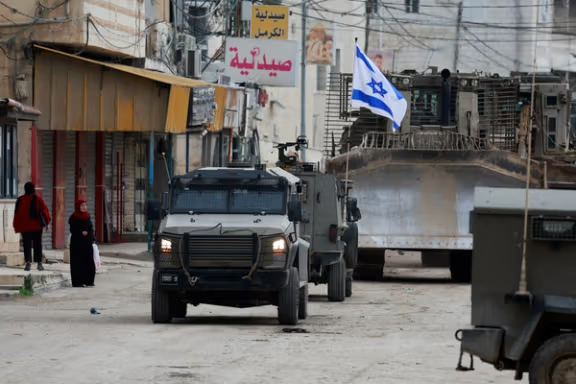
Israeli military vehicles operate during an Israeli raid in Jenin, in the Israeli-occupied West Bank, January 22, 2025.

Iran is taking advantage of the ruling Palestinian Authority's lack of political legitimacy in the Israeli-occupied West Bank to arm militants, the director of a leading research center in Ramallah told Iran International.

“Iran exploits this vacuum left by the lack of legitimacy of the Palestinian Authority (PA) and unpopularity of President Mahmoud Abbas to maintain and sustain this situation," said Khalil Shikaki, the director of the Palestinian Center for Policy and Survey Research in Ramallah.

Adding that Tehran's interference is not welcome by most of the Palestinian pubic, the veteran pollster said around 90 percent of Palestinians want the resignation of the 89-year-old president who is 20 years into his four-year term.

“Palestinians don’t like Iran because they see it interfering in domestic Palestinian politics," he said.

"But since October 7 this has started to change, but we don’t see a majority of the Palestinian public favoring Iran. They just don’t see how they can achieve their goals other than those advocated by Hezbollah and Iran which is violence," he added.

Suspicion with Iran's Shi'ite theocracy runs deep among Sunni Palestinians too.

"Palestinians see Iran as a Shia state that seeks to take advantage of the situation to advance Shi’ism in the region, exporting their ideologies as they’ve done in other countries such as Yemen and Iraq - which is unacceptable," he explained.

It comes as Israel launched an operation it dubbed Iron Wall in Jenin on Tuesday, a haven for Palestinian militants for decades where gunmen from Hamas, Islamic Jihad and the Al Aqsa Martyrs Brigade have eluded Israeli and PA forces.

The operation has already seen multiple deaths and injuries as Israel cracks down on the armed groups, according to WAFA, the PA's official news agency.

“Iran has an interest in supporting armed groups like those in Jenin or anywhere else where Hamas and such groups are interested in fighting occupation," Shikaki added. "Given the fertile ground that’s there to recruit new foot soldiers and join armed groups, Iran will continue to provide assistance.”

On Wednesday, as the violence in Jenin mounted, Israeli Defense Minister Israel Katz said the raids were aimed at curbing the influence of Tehran.

“We will not allow the arms of the Iranian octopus and radical Sunni Islam to endanger the lives of the settlers and establish an eastern terrorist front against the State of Israel. Strongly cripple the octopus's arms until they break,” he said.

Shikaki said that Iran will continue to have an avenue to interfere in Palestinian affairs as long as the occupation continues and there is a failure to come to a peaceful, diplomatic solution.

“Around 80-90% of Palestinians don’t see a peaceful solution because Isreal doesn’t want peace so that gives Iran the opportunity to exploit that.”

Earlier this month, Katz said that in the wake of the weakening of Iran-backed Hamas in Gaza and Iran’s largest military ally, Hezbollah in Lebanon, a new focus had been placed on military allies in the West Bank, compounded by the fall of Tehran’s ally, President Bashar Al Assad, in Syria.

"We are seeing increasing efforts to promote Palestinian terrorism in Israel through the smuggling of advanced weapons, funding and guidance both on the part of the Iranian axis and on the part of the radical Sunni Islamic axis that is strengthening its grip on the region after the events in Syria,” he said.

Most Viewed

Ideology may be fading in Iran, but not in Kashmir's ‘Mini Iran'
1
INSIGHT

Ideology may be fading in Iran, but not in Kashmir's ‘Mini Iran'

2
INSIGHT

Hardliners push Hormuz ‘red line’ as US blockade tests Iran’s leverage

3
VOICES FROM IRAN

Hope and anger in Iran as fragile ceasefire persists

4

Iran International says it won’t be silenced after London arson attack

5

US sanctions oil network tied to Iranian tycoon Shamkhani

Banner
Banner

Spotlight

  • Hardliners push Hormuz ‘red line’ as US blockade tests Iran’s leverage
    INSIGHT

    Hardliners push Hormuz ‘red line’ as US blockade tests Iran’s leverage

  • Ideology may be fading in Iran, but not in Kashmir's ‘Mini Iran'
    INSIGHT

    Ideology may be fading in Iran, but not in Kashmir's ‘Mini Iran'

  • War damage amounts to $3,000 per Iranian, with blockade set to add to losses
    INSIGHT

    War damage amounts to $3,000 per Iranian, with blockade set to add to losses

  • Why the $100 billion Hormuz toll revenue is a myth
    ANALYSIS

    Why the $100 billion Hormuz toll revenue is a myth

  • US blockade targets Iran oil boom amid regional disruption
    ANALYSIS

    US blockade targets Iran oil boom amid regional disruption

  • Iran's digital economy battered by prolonged blackout
    INSIGHT

    Iran's digital economy battered by prolonged blackout

•
•
•

More Stories

Khamenei denies Iran is weakened, dares enemies to find out

Jan 22, 2025, 17:29 GMT+0

Iran has not been weakened by over a year of Mideast combat with Israel, Supreme Leader Ali Khamenei said in some of his first remarks after Donald Trump returned to the White House, daring so-called enemies to test Tehran's mettle.

"That delusional fantasist claimed that Iran has been weakened," Khamenei told a group of his supporters in Tehran, without elaborating. "The future will reveal who has truly been weakened."

In the last week, US President Donald Trump, his predecessor Joe Biden and Israeli Prime Minister Benjamin Netanyahu, have all described Iran as weakened.

They cited Tehran's reduced influence in the region following the fall of its ally Bashar al-Assad's government in Syria, Israeli attacks on its air defense capabilities and the killing of leaders of its armed Palestinian and Lebanese allies.

Khamenei said former Iraqi dictator Saddam Hussein started the invasion of Iran in September 1980 and then-US president Ronald Reagan provided significant support to his regime, both "under the illusion that Iran was weak."

"They, along with dozens of other deluded individuals, ultimately met their demise, while the Islamic regime grew stronger day by day. I tell you, this experience will be repeated once again this time," he added.

His comments came two days after Trump's return to the White House and at a time when his administration is potentially weighing whether to support a possible Israeli air strike on Iran's nuclear facilities.

Asked whether Trump would support such an attack, his national security advisor Mike Waltz said: "This is a moment to make those key decisions, and we'll be doing that over the next month."

Speaking on CBS's Face the Nation on Sunday, Waltz also said Iran's regional position is under strain with its air defenses destroyed and key allies diminished. He credited Israeli attacks for what he called a strategic shift in the Middle East.

Khamenei, however, referred to the recent ceasefire in Gaza as a victory for the Iran-led Resistance Front and "a clear sign of the realization of the prediction that resistance is alive and will endure."

He emphasized that without US support, Israel would have collapsed within the first weeks after October 7, 2023, when Tehran-backed Hamas militants attacked Israel and killed 1,200 people, mostly civilians.

"Over the past year and a few months, the Zionist regime committed every atrocity it could, bombing homes, hospitals, mosques and churches in a small area like Gaza, Khamenei said.

"Yet in the end, it not only failed to achieve the goal set by its miserable and discredited leader—eliminating Hamas and governing Gaza without resistance—but was also forced to sit at the negotiation table with Hamas and accept its terms for a ceasefire."

Trump has signaled stepped-up support for Israel and a renewed hard line on Iran.

The hawkish new president is due to lift Biden's freeze on delivering 2,000-pound bombs to Israel in his first days in the White House, Israeli news outlet Walla News reported this week, citing Israel's ambassador to Washington.

"What is happening before the eyes of the world seems like a legend," Khamenei continued, "where a massive military apparatus like that of the United States, indifferent to human values, provides bunker-busting bombs to the oppressive and bloodthirsty Zionist regime."
Iran ships in key missile ingredient from China - FT

Jan 22, 2025, 13:37 GMT+0

Two Iranian cargo ships, the Golbon and the Jairan, have left China loaded with 1,000 tons of sodium perchlorate, a crucial ingredient for making solid rocket propellant, the Financial Times reported on Wednesday.

Citing unnamed security officials in two western countries, the FT said this shipment could be used to produce propellant for hundreds of Iranian mid-range missiles.

This amount of sodium perchlorate could produce 960 tons of ammonium perchlorate, which could produce 1,300 tons of propellant,enough to fuel 260 mid-range Iranian missiles such as the KheibarShekan or Haj Qassem, the officials said.

The chemicals are being shipped to the Islamic Revolutionary Guard Corps in Bandar Abbas, a port in southern Iran, according to the officials.

After Gaza truce, Israel says West Bank raids mark next front with Iran

Jan 21, 2025, 19:11 GMT+0

Days after the ceasefire in Gaza, Israel launched a major operation in the occupied West Bank on Tuesday to quash what it described as Iranian-backed terrorist groups in Jenin.

“We are acting systematically and resolutely against the Iranian axis wherever it extends its arms – in Gaza, Lebanon, Syria, Yemen and Judea and Samaria and with our hands still outstretched," Prime Minister Benjamin Netanyahu said.

Israel's longtime premier was using the Biblical names for lands on the west bank of the Jordan River seized by Israel in a 1967 war, otherwise called the West Bank.

Called Iron Wall, the operation involved the Israeli military, Shin Bet intelligence and Israel Police, with an airstrike targeting what Israel called terror infrastructure and a large ground operation.

Palestinian news agency, WAFA, reported at least four dead and 35 injuries from the raid, citing the Ministry of Health.

It follows an extensive siege carried out by the Western-backed Palestinian Authority (PA) in recent weeks which had aimed to reduce the power of groups it opposes including Hamas, Al Aqsa Martyrs Brigade and Islamic Jihad.

On their Telegram channel, Hamas said on Tuesday: "The [Palestinian] Authority's apparatuses withdrew from the vicinity of Jenin camp, coinciding with the start of the occupation's military operation, after a siege that lasted more than 48 days."

Speaking in the Foreign Affairs and Security Committee, Israel’s Defense Minister Israel Katz said on Tuesday he had given the green light to the operation.

"The Iranian axis that operated continues to operate to create terror by financing, directing and arming. I instructed the IDF to act forcefully to protect all the communities and residents [of the West Bank], and this is something that has been done and will be done in order to attack with great force in order to thwart terrorism."

Earlier this month, Israeli officials said archenemy Iran is pivoting toward arming Palestinian militants in the West Bank after the overthrow of Tehran’s ally Bashar al-Assad in Syria, and the weakening of Hamas in Gaza and Hezbollah in Lebanon.

Israel’s Defense Minister said at the time: "Judea and Samaria has become a central arena in the map of threats to Israel and we are preparing to respond accordingly.

"We are seeing increasing efforts to promote Palestinian terrorism in Israel through the smuggling of advanced weapons, funding and guidance both on the part of the Iranian axis and on the part of the radical Sunni Islamic axis that is strengthening its grip on the region after the events in Syria,” he added.

In the latest 2024 statistics, Israel’s internal security agency the Shin Bet said it had thwarted 1,040 significant attacks in the West Bank and Jerusalem during 2024, a 40 percent increase from the previous year, it said.

Since the Oct. 7 attack, dozens of Israelis and hundreds of Palestinians have been killed in the West Bank as violence continues to spiral.

Iran to top Trump's agenda in very near future, Israel says

Jan 21, 2025, 16:21 GMT+0

Israel's President Isaac Herzog said on Tuesday that the new US administration will address Iran and its nuclear program as a key priority.

“Iran will be a main issue on Donald Trump's agenda in the very near future, and it will have to be deliberated,” Herzog told CNN's Fareed Zakaria at the World Economic Forum in Davos, Switzerland.

“Iran cannot have nuclear capabilities and has to stop with its proxies and axis of evil," he said.

The rulers of Tehran, he added, are “working day in and day out even now … rushing toward the bomb and of course planning all the time terror attacks the world over and in our region."

Tensions have escalated between Iran and Israel over the past year, marked by direct military confrontations in 2024 including Iran's unprecedented missile and drone attacks on Israel in April and October.

The hostilities have raised concerns about the potential for a broader conflict between the arch enemies involving the United States, especially with President Donald Trump's return to the White House.

Saudi Arabia's Foreign Minister, Prince Faisal bin Farhan Al Saud said on Tuesday that he does not believe President Trump's return to office increases the risk of an Iran-Israel war.

A war between Israel and Iran should be avoided, bin Farhan said in Davos on Tuesday, adding that he did not see the Trump administration contributing to the risk of direct conflict.

Meanwhile, the leaders of Britain and Israel on Tuesday vowed to continue their cooperation against the threat they say Iran poses.

In a phone call, British Prime Minister Keir Starmer and his Israeli counterpart Benjamin Netanyahu “agreed to continue their close co-operation on defense and security matters in support of wider stability in the region – particularly in the face of the ongoing threat posed by Iran," according to Downing Street.

Trump puts Iran pressure front and center at Presidential rally

Jan 21, 2025, 02:08 GMT+0

President Donald Trump told hostage families he would have deprived Iran of the money to aid the Oct. 7 attack, putting the Mideast crisis at the center of his first rally since being sworn in on Monday.

"We've got to stop some wars there are some stupid things going on," Trump told thousands of supporters at an indoor gathering in Washington DC.

"Israel would've never been hit on October 7," Trump said, "Iran was broke. Anyone that bought oil from Iran ... China passed, everybody passed."

The newly-minted head of state whose sanctions piled pressure on Iran's oil revenue in his first term and hit Tehran's spending on armed allies in the region, also ordered a deadly drone strike on a top Iranian commander, Qassem Soleimani.

Since that 2020 attack, Iranian officials have blasted Trump in strong terms, but since his November re-election, some quarters have softened their tone and mooted talks.

"They were broke; they didn't have money for Hamas, and they didn't have money for Hezbollah," Trump continued, then addressing the families: "Your sons would be alive, and they certainly wouldn't be incarcerated where they are. It's such a shame."

Later in the evening Trump inked a raft of executive orders at the White House, telling reporters that Israel had weakened Iran badly over a 15-month conflict in the region.

"They're weakened in a different way, the one attack by Israel really set them back - the pagers," Trump said, referring to an attack on Hezbollah leaders' communication devices last year which maimed many and injured Iran's envoy to Lebanon.

"And others," Trump added. "The attack on air defense was a bad attack for Iran."

Israel appears to have knocked out much of Iran's anti-air capability with an Oct. 26 series of air raids in retaliation for an Islamic Republic missile attack on Israel.

Speaking before Trump at the rally, his Mideast envoy Steve Witkoff, who was instrumental in talks which led to a Gaza-Israel ceasefire last week, told rally-goers Trump could solve the region's deepest problems.

"President Trump's leadership has redefined what is possible in the pursuit of progress and stability in the Middle East. his decisive pragmatic approach ensures that even the most entrenched conflicts are met with fresh perspectives and innovative strategies."

Trump counted the so-called Abraham Accords between several Arab countries and Israel as one of the top accomplishments of his first term.

Witkoff said with Trump's leadership he "would be engaging with leaders across the region to find pathways toward sustainable peace and stability."

"Every nation deserves the right to determine its own destiny free from the interference of foreign powers," he added, in a possible reference to regional states in Iran's orbit.