• العربية
  • فارسی
Brand
  • Iran Insight
  • Politics
  • Economy
  • Analysis
  • Special Report
  • Opinion
  • Podcast
  • Iran Insight
  • Politics
  • Economy
  • Analysis
  • Special Report
  • Opinion
  • Podcast
  • Theme
  • Language
    • العربية
    • فارسی
  • Iran Insight
  • Politics
  • Economy
  • Analysis
  • Special Report
  • Opinion
  • Podcast
All rights reserved for Volant Media UK Limited
volant media logo

Iran's rainfall drops 45%, dam inflows down 29%

Jan 19, 2025, 14:08 GMT+0Updated: 11:51 GMT+0
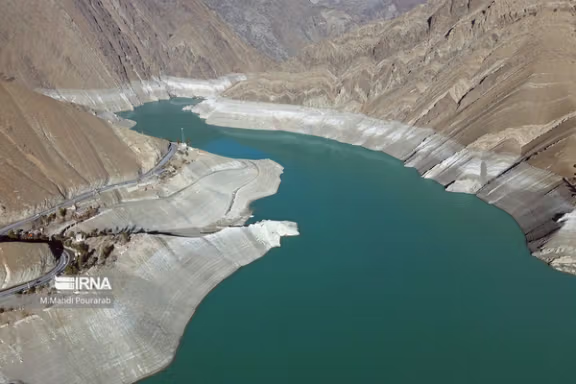
A view from Amir Kabir dam, also known as Karaj dam, on the Karaj River in the Central Alborz mountain range of northern Iran

A 45% drop in rainfall since last year and a 29% decrease in water flowing into dams compared to the five-year average have pushed Iran deeper into a water crisis, adding pressure amid the current economic crisis and high inflation.

The situation is particularly critical in Tehran, where dam levels have fallen to just 17% of capacity, Firouz Ghasemzadeh, Iran's water sector spokesman, said on Sunday.

He added that cumulative rainfall since the beginning of the current water year (roughly starting in late September/early October) until late January is down 45% compared to the same period last year.

A 57-year rainfall record analysis places this year as the 53rd driest, meaning only four years in the past 57 have been drier.

Iran is currently grappling with one of its most severe droughts in over half a century. The situation has prompted criticism of the Iranian government's environmental management.

The volume of water entering Iranian dams since the start of the current water year until January 18th dropped by 5% compared to the same period last and 29% compared to the five-year average, Ghasemzadeh added.

Many regions of the country have been grappling with water shortages for more than a decade. Farmers have been periodically staging protests, demanding changes in government policies.

Outflow from dams has also decreased by 9% compared to the five-year average, since the beginning of the water year. As a result, current reservoir levels at 44% of total capacity, represent a slight improvement compared with last year.

Ghasemzadeh expressed particular concern about the state of dams in several provinces, including Tehran, where the five main dams are only 17% full—a 21% decrease compared to the five-year average. This shortage could have far-reaching effects on agriculture and food prices, especially with inflation averaging around 40% over the past five years.

The Zayandeh Rud dam in central Iran is at a critically low 13% capacity, a 28% drop compared to the five-year average. Significant reductions in reservoir volume and inflow are also reported in the provinces of Khorasan Razavi, Hormozgan, Zanjan, Markazi, and Golestan, underscoring the urgent need for water conservation.

Iran's water woes are compounded by several factors including regional politics, such as Afghanistan’s construction of the Pashdan Dam on the Harirud River.

The dam, which significantly restricts water flow to Iran's eastern provinces, threatens over two million residents in Razavi Khorasan Province who rely on the river for drinking water.

The current drought marks the fourth consecutive year of significant water scarcity in Iran, one of the most severe such periods in over half a century.

This has led to public criticism of the Iranian government's environmental policies. Even amidst government denials, the governor of Tehran recently admitted the country is "confronting a significant challenge in the water sector," acknowledging the dwindling rainfall and depleted dam reserves.

Additionally, the United Nations Water (UN-Water) has classified Iran as experiencing “extremely high-water stress” in its annual world water development report. The report highlights that Iran, along with other countries in the Asia-Pacific region, faces critical water scarcity issues.

Most Viewed

100 days after carnage: Iran economy reels from war, inflation, unemployment
1
INSIGHT

100 days after carnage: Iran economy reels from war, inflation, unemployment

2
INSIGHT

Ghalibaf defends Iran-US talks amid hardline backlash

3
INSIGHT

A nation in limbo: 100 days after the massacre, has the world moved on?

4
ANALYSIS

From instability to influence: Pakistan’s pivotal role in US-Iran diplomacy

5
ANALYSIS

100 days on: why Iran’s January protests spread across social classes

Banner
Banner

Spotlight

  • War-hit homeowners feel abandoned as Iran’s reconstruction aid fades

    War-hit homeowners feel abandoned as Iran’s reconstruction aid fades

  • 100 days on: the anatomy of Iran’s January crackdown
    INSIGHT

    100 days on: the anatomy of Iran’s January crackdown

  • Ghalibaf defends Iran-US talks amid hardline backlash
    INSIGHT

    Ghalibaf defends Iran-US talks amid hardline backlash

  • 100 days on: why Iran’s January protests spread across social classes
    ANALYSIS

    100 days on: why Iran’s January protests spread across social classes

  • From instability to influence: Pakistan’s pivotal role in US-Iran diplomacy
    ANALYSIS

    From instability to influence: Pakistan’s pivotal role in US-Iran diplomacy

  • A nation in limbo: 100 days after the massacre, has the world moved on?
    INSIGHT

    A nation in limbo: 100 days after the massacre, has the world moved on?

•
•
•

More Stories

Retired workers protest low pensions across Iran

Jan 19, 2025, 12:36 GMT+0

Retired workers staged protests over low pensions on Sunday, which they said amount to less than one-third of the poverty line, and voiced frustration over soaring healthcare costs and inequitable pension adjustments.

Demonstrations took place across the country in cities including Tehran in the north, Ahvaz and Haft-Tappeh in the southwest, and Shush in the west, protesters demanding that pensions be raised to align with the poverty line.

Up to 50% of the Iranian population is now living below the poverty line, with retirees on fixed, low pensions among the hardest hit as inflation erodes their already limited incomes and the cost of living continues to rise.

Retirees have staged numerous protests in recent years over low pensions and unmet demands. US-based rights group HRANA reported at least 1,279 protests and strikes in Iran in 2024, highlighting public frustration with worsening economic conditions.

Iran using AI for precise missile strikes, says IRGC chief

Jan 19, 2025, 11:14 GMT+0

Iran’s Islamic Revolutionary Guard Corps (IRGC) has integrated artificial intelligence (AI) into its missile systems to improve precision, it's commander-in-chief said Sunday.

“With artificial intelligence, we have developed technology to strike targets without harming innocents,” Hossein Salami said Sunday at an event honoring Iranian medical staff who treated Hezbollah members injured in the September 2024 pager attacks.

The Israeli operation targeted thousands of pagers and hundreds of walkie-talkies used by Hezbollah members in Lebanon and Syria, killing at least 32 people and injuring over 3,250.

Salami described the pager attacks as “akin to weapons of mass destruction,” aimed at dismantling morale and creating chaos.

Last year, in a first, Iran launched two direct attacks on Israel with hundreds of missiles fired at the Jewish state, along with rockets and drones.


Bangladesh Central Bank issues warning on Iranian LPG imports

Jan 19, 2025, 07:53 GMT+0
•
Dalga Khatinoglu

Following reports on surging rebranded Iranian liquefied petroleum gas (LPG) exports to Bangladesh, its Central Bank warned all domestic banks to stay alert regarding the import of products from countries that are subject to global sanctions.

Similar instructions have been incorporated into Bangladesh Bank's anti-money laundering and terrorist financing policy, a source told local Business Standard newspaper.

LPG, a mixture of heavier gases such as propane, butane, and pentane (rather than methane or natural gas), is a petroleum product and ranks among Iran's top non-oil exports.

According to Iran’s customs statistics, the country exported $2.2 billion worth of LPG, along with $1.7 billion of pure propane, $1.1 billion of pure butane, and $1 billion of other heavy gases during the first half of the Iranian fiscal year, which began on March 21. Iran classifies these raw petroleum products as non-oil exports. Collectively, petroleum gases account for 24% of the country’s non-oil exports.

Iran exports 11-12 million tons of LPG annually, mostly to China, earning approximately $8 billion.

A day after the Central Bank’s warning, Lloyd's List reported on January 18 that, amid concerns over Chinese buyers hesitating to risk violating US sanctions, a very large crude carrier suspected of transporting Iran-origin LPG to China made an unusual U-turn in December. After spending two weeks at anchor, the vessel discharged its cargo in Bangladesh.

In October 2024, The Business Standard, a Bangladeshi publication, reported that the LPG Operators Association of Bangladesh (LOAB) had raised concerns about the growing imports of Iranian LPG. According to the report, Iran has been offering Bangladeshi buyers prices $40–$50 per ton below market rates, with monthly LPG exports to Bangladesh recently reaching 150,000 tons. This surge has enabled Iran to capture a quarter of Bangladesh's LPG market.

The newspaper published a letter from LOAB to port authorities and the central bank, listing several tankers suspected of carrying Iranian LPG in Bangladeshi waters. The letter warned that, aside from the potential sanctions-related consequences, Iran's underpricing disrupts the competitive energy market in the country.

Mahammed Jamal Hosen, representing the Bangladesh LPG Distributors and Dealers Welfare Association, said in the letter that "Many banks will face direct consequences of potential US sanctions, and in the long term, Bangladesh's reputation as a destination for foreign direct investment will be at risk."

The letter identified a dozen companies that allegedly forged Iranian LPG documents through intermediaries in the UAE, particularly Dubai, and rebranded the shipments as LPG from Iraq's Basra Gas Company before routing them to Bangladesh.

The Business Standard says “for instance, in August 2024, two local LPG companies imported over 10,000 tons of LPG on a vessel named G YMM. The documents submitted to customs and port authorities showed the liquid gas came from Basrah Gas Company in Iraq. However, The Business Standard on 6 September obtained a response from Andrew Wiper, managing director of Basrah Gas, confirming that the vessel G YMM has never loaded LPG from his company”.

Ex-president's daughter opposes religious rule, supports nukes for Iran

Jan 18, 2025, 22:00 GMT+0
•
Behrouz Turani

Some of Iran's Reformist politicians have recently called for a secular government; a notion that is in sharp contrast with the religious governing system that has been ruling in Iran since the 1979 Islamic revolution.

The most recent case is Faezeh Hashemi, a former Reformist lawmaker and daughter of a former Iranian president, who was recently released from prison in Tehran after serving part of her sentence for supporting the 2022 protests. In a YouTube interview this week, she said, "I am against religious government," and asserted her belief that "Iran needs to have nuclear bombs."

The Reformist movement, which emerged in Iran at the turn of the century, simply aspired for more respect for the rule of law, more democracy and less dogmatic rigidity, but it was considered to be part of the Islamic Republic.

Faezeh Hashemi, the outspoken daughter of former President Akbar Hashemi Rafsanjani, was a leading member of Iran's fifth parliament [1996-2001). She was popular for her ideas about women's social liberties at the time and later. She was also the publisher of the daily newspaper Zan [Woman], which was banned by the Islamic government in 1999.

Most of the issues she discussed in the interview turned out to be controversial. According to Rouydad24 website, which is a relatively moderate source, only she could have been expected to express such views.

Hashemi remarked that "The stage for the latest presidential election was orchestrated to guarantee Pezeshkian's victory." She added that, "Khamenei and Pezeshkian have reached an agreement to address some of Iran's fundamental issues."

Recommending major changes, she commented, "I believe the Iranian political system should change its doctrine about domestic political issues and some foreign policy matters about the region."

However, in a statement somewhat at odds with her reformist views on domestic politics, Hashemi declared, "I believe in possessing a nuclear bomb. While the world has embraced nuclear deterrence, why should we deprive ourselves of it?"

On a key foreign policy issue, she said: "We have to maintain relations with the United States and that will be made possible only through opening our embassies in each other's countries."

Explaining her political leanings, she said, "Like my father, I am a conservative who wants reforms." She also claimed that her father's death during an afternoon swim in January 2017, while under the watch of several IRGC officers, "was not due to natural causes." Additionally, she remarked, "I have heard that former President Raisi's family suspects his death in a 2024 helicopter crash was suspicious."

In a highly controversial statement that contradicts Supreme Leader Ali Khamenei's narrative about enemies conspiring against the Islamic Republic, Faezeh Hashemi declared, "I absolutely do not believe in enemies!" She also expressed her opposition to the imposition of religion and compulsory hijab on women, stating, "I wear hijab myself, but I support women who choose not to."

In another significant development last week, prominent reformist commentator Abbas Abdi questioned the commitment of Islamic Republic officials to the concept of a religious government. Writing in Etemad newspaper, he stated, "Republics are founded on the people's vote. What happens if the people say they no longer want a religious government?

Criticizing the ideas of Ayatollah Mesbah Yazdi, the ideological architect and patron of ultraconservative groups like the Paydari Party, which advocate for an Islamic government over an Islamic Republic, Abbas Abdi wrote: "In Iran’s current system of governance, if a significant portion of the population openly opposes a religious government, the country’s religious leader would be compelled to confront them and impose the religious government and its laws by force."
Iran's Revolutionary Guards unveil new underground naval base

Jan 18, 2025, 18:43 GMT+0

Iran's Revolutionary Guards unveiled an underground naval missile base at an undisclosed Persian Gulf location on Saturday two days before Trump's return to the White House.

The base is one of several built underground for vessels capable of launching long-range missiles and carry out distant warfare, IRGC Chief Commander Hossein Salami said after visiting the secret base during war games.

Footage released by IRGC-affiliated media and the state TV showed tunnels with long rows of "a new version of Taregh-class radar-evading speedboats which can launch cruise missiles."

The base was built at a depth of 500 meters (yards) somewhere in the Persian Gulf, according to the state TV report.

Iran started massive military exercises earlier this month that are due to last two months and have already included war games in which the IRGC defended nuclear installations in Natanz against mock attacks by missiles and drones.

The drills are held at a time when tension with the United States is widely expected to rise following Donald Trump's inauguration.

Tehran is concerned that Trump might empower Israeli Prime Minister Benjamin Netanyahu to strike Iran's nuclear facilities.