• العربية
  • فارسی
Brand
  • Iran Insight
  • Politics
  • Economy
  • Analysis
  • Special Report
  • Opinion
  • Podcast
  • Iran Insight
  • Politics
  • Economy
  • Analysis
  • Special Report
  • Opinion
  • Podcast
  • Theme
  • Language
    • العربية
    • فارسی
  • Iran Insight
  • Politics
  • Economy
  • Analysis
  • Special Report
  • Opinion
  • Podcast
All rights reserved for Volant Media UK Limited
volant media logo

IRGC official suggests Iran’s strikes on Israel lacked strategic impact
Jan 9, 2025, 17:09 GMT+0Updated: 11:54 GMT+0
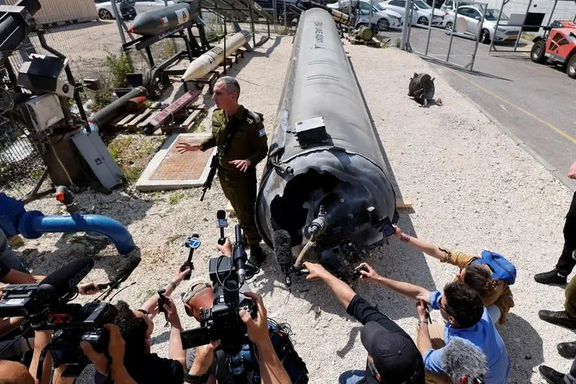
Israeli military spokesperson Rear Admiral Daniel Hagari speaks to the media as Israel's military displays what they say is an Iranian ballistic missile which they retrieved from the Dead Sea after Iran launched drones and missiles towards Israel, at Julis military base, in southern Israel April 16, 2024.

A senior official in Iran’s Revolutionary Guard appears to have acknowledged that a series of direct attacks on Israel did not achieve their intended strategic goals.

Hossein Taeb, an advisor to the IRGC Commander-in-Chief, made the comments on Wednesday during a speech discussing Iran's so-called operation True Promise 3, an attack promised by Iranian officials on Israel.

"The operations of True Promise (1), 2, and 3 should be executed when they are strategically effective," Taeb said in comments carried by state media, referring to earlier Iranian attacks against its regional arch-enemy.

Operation True Promise 1 was Iran's first ever direct military strike against Israel, conducted on April 13, 2024.

In retaliation for an Israeli air strike on the Iranian consulate in Damascus two weeks earlier, which resulted in the deaths of two Iranian generals, the Islamic Revolutionary Guard Corps (IRGC) launched a coordinated assault involving over 300 ballistic missiles, cruise missiles and drones targeting Israeli military installations.

Operation True Promise 2, conducted on October 1, 2024 saw the IRGC launched approximately 200 ballistic missiles targeting Israeli military facilities in response to the assassinations of high-ranking Iran-aligned militant leaders.

"Speeding up a war does not mean achieving success," Taeb added. "Strategic weapons must be used at the right time and in a timely manner."

The unprecedented attacks marked a significant escalation in Iran-Israel tensions, transitioning from proxy engagements to direct confrontation. But Israel's advanced air defense systems, with support from US and allied forces, intercepted the majority of the incoming projectiles, minimizing casualties and damage.

Hossein Taeb, an advisor to the IRGC Commander-in-Chief and former IRGC Intelligence Chief (File Photo)
100%
Hossein Taeb, an advisor to the IRGC Commander-in-Chief and former IRGC Intelligence Chief (File Photo)

Taeb’s remarks follow months of speculation about why Iran has delayed another retaliation to Israel after it battered Tehran-backed armed groups in the region.

Two senior IRGC generals said earlier that Iran's loss of its ally in Syria and lack of sufficient funding meant the time was not right to hit Israel anew.


Most Viewed

Iran International says it won’t be silenced after London arson attack
1

Iran International says it won’t be silenced after London arson attack

2

State media slam Araghchi's Hormuz tweet, say it let Trump claim victory

3
VOICES FROM IRAN

Hope and anger in Iran as fragile ceasefire persists

4
INSIGHT

How Tehran bends its own red lines to boost state rallies

5

Iran halts petrochemical exports to supply domestic market

Banner
Banner

Spotlight

  • Too early to tell who is winning Iran war, experts say
    PODCAST

    Too early to tell who is winning Iran war, experts say

  • How Tehran bends its own red lines to boost state rallies
    INSIGHT

    How Tehran bends its own red lines to boost state rallies

  • Iran blackout cripples freelancer, small business incomes
    VOICES FROM IRAN

    Iran blackout cripples freelancer, small business incomes

  • Ideology may be fading in Iran, but not in Kashmir's ‘Mini Iran'
    INSIGHT

    Ideology may be fading in Iran, but not in Kashmir's ‘Mini Iran'

  • US blockade enters murky phase as tankers spoof signals and buyers hesitate
    ANALYSIS

    US blockade enters murky phase as tankers spoof signals and buyers hesitate

  • Why the $100 billion Hormuz toll revenue is a myth
    ANALYSIS

    Why the $100 billion Hormuz toll revenue is a myth

•
•
•

More Stories

Iran launches hotline to discourage abortions

Jan 9, 2025, 17:06 GMT+0

Iran's health ministry has introduced a hotline aimed at dissuading citizens from having abortions as the theocratic system attempts to confront slowing population growth.

"Trained individuals help callers keep their pregnancies and decide against abortion," the head of the ministry's Center for Population Growth, Saber Jabari, said Thursday.

The initiative is part of broader efforts by the government to address declining population growth in the country.

Last weekend, Iran’s Ministry of Science called for the removal of educational content deemed to discourage childbearing.

Iran has established anti-abortion centers in 250 cities, preventing 4,700 abortions, according to a health ministry official.

Last year in October, a medical network affiliated with Iran's Islamic Revolutionary Guard Corps (IRGC) said it intervened in thousands of abortion cases, adding that the group monitors hospitals and clinics to identify couples considering the procedure.

According to the head of the IRGC-affiliated Basij Medical Society, the group's efforts prevented approximately 6,000 abortions over the past three years, reporting a success rate of 90%.

Iran's Deputy Health Minister has warned the country's population looks set to halve by the end of the century as birth rates continue to fall in spite of efforts by the government to incentivize larger families.

Iran faces another setback as US-backed Aoun elected Lebanese president

Jan 9, 2025, 16:21 GMT+0

Iran’s influence in Lebanon was dealt another blow with the election of US and Arab-backed General Joseph Aoun as the country's new president, months after Tehran's armed ally Hezbollah was mauled by Israel in a 14-month war.

Aoun, who was backed by factions seeking to reduce Hezbollah's dominance, signals a shift away from Lebanon’s political dominance by Iran via the militia.

His election marks the end of a prolonged political vacuum and a decisive moment in Lebanon's complex political landscape, raising questions about the country's future alignment in a shattered Middle East.

Former chief of Lebanon's army, Aoun has distanced himself from Hezbollah. His election, after two rounds of voting, followed years of political paralysis exposing the deep divide between Lebanon's pro-Western factions and a pro-Hezbollah bloc.

Lebanese lawmakers sit at the parliament on the day they vote to elect a president, in Beirut, Lebanon, January 9, 2025.
100%
Lebanese lawmakers sit at the parliament on the day they vote to elect a president, in Beirut, Lebanon, January 9, 2025.

In his first address to parliament, Aoun called for the Lebanese state to reclaim control over its military, signaling a possible challenge to Hezbollah.

His presidency, he added, would strive toward giving the state the exclusive right to carry arms, a statement likely aimed at Hezbollah and its vast array of weapons.

His words were met with the longest applause of the speech, though Hezbollah parliamentarians remained seated and silent, marking the national tension between Aoun’s vision and the group's interests.

In a diplomatic message, Iran's embassy in Beirut congratulated Lebanon on Aoun's election, expressing hope for stronger cooperation between the two nations.

“We congratulate brotherly Lebanon for the election of General Joseph Aoun,” the embassy said, emphasizing the importance of cooperation to serve mutual interests.

The statement did not address the status of Hezbollah's arms.

Iran says Swiss national charged with spying dies by suicide

Jan 9, 2025, 15:38 GMT+0

A Swiss national facing espionage charges committed suicide in prison, a local judiciary official said on Thursday, without identifying the individual or elaborating on the case.

Switzerland confirmed the death of one of its citizens but also provided few details.

"The FDFA confirms the death of a Swiss citizen in Iran," spokesperson Pierre-Alain Eltschinger told Iran International.

"The Swiss Embassy in Tehran is in contact with the local authorities to clarify the circumstances of the death in an Iranian prison," Eltschinger added.

The person took their own life in a prison cell, according to judicial official in Iran's northern province of Semnan.

"The Swiss detainee was held in a suite with another inmate in Semnan prison," Iran's judiciary news website Mizan quoted Mohammad Sadegh Akbari as saying.

"This morning the detainee asked their cellmate to purchase food from the prison canteen. Taking advantage of time alone in the suite, the detainee committed suicide."

"Prison officials immediately intervened to save the individual, but their efforts were unsuccessful," he added. "Suicide has been definitively confirmed."

Iran has arrested dozens of dual nationals and foreigners in recent years, mostly on charges related to espionage and security. Some have been released in deals that see Iranians with the security establishment in Tehran freed from foreign jails.

Switzerland represents American interests in Iran since Tehran and Washington broke official ties shortly after the Islamic Revolution of 1979. The Swiss government has acted as intermediary and shared messages between the two countries.

Precedents

Iran's account of the alleged suicide of the Swiss national is likely to be questioned by human rights groups which accuse Iran of mistreating inmates, especially in cases where few details are provided, not even the individuals name.

Precedent also suggests that early reports of events inside Iranian prisons can be later qualified or even contradicted.

Last November, a US-based German-Iranian national died in prison in Tehran, with conflicting reports about his death.

Jamshid Sharmahd, 68, was on death row for "endangering national security". He had been abducted by Iranian agents during a visit to the United Arab Emirates in 2020 and forcibly taken to Iran.

State media announced in October 28, 2024 that "justice was served" vis a vis Sharmahd, implying his sentence had been carried out.

A week later, Iran’s judiciary said Sharmahd had died of a stroke before his scheduled execution, contradicting previous official accounts but providing little clarity.

Amnesty International demands Tehran halt execution of Kurdish activist

Jan 9, 2025, 15:01 GMT+0

Amnesty International has condemned Iran's Supreme Court for upholding the conviction and death sentence of Kurdish activist Pakhshan Azizi, calling her trial and punishment unjust.

"Iran's authorities must halt any plans to carry out her execution and release her immediately," Amnesty said in a post on X Tuesday, adding that Azizi was sentenced in connection with her peaceful humanitarian and human rights work.

Azizi’s lawyer, Amir Raeisian, criticized the judicial process, saying the Supreme Court failed to address critical flaws in her case.

“We filed an appeal, but ... the Supreme Court reviewed the appeal and unfortunately rejected it without addressing the numerous flaws in the case, thereby confirming the death sentence,” Raeisian told Tehran-based newspaper Sharq Daily on Wednesday.

Azizi was arrested at her home in Tehran in August 2023, by state security forces who allegedly held a gun to her head.

She asserts that she was denied legal counsel during detention and was tortured to confess to things she had not done---something rights groups say is a routine tactic used by Iranian authorities against activists.

Azizi was sentence to death in July 2024 for “armed rebellion against the state” and imposed an additional four-year prison sentence for alleged membership in the Kurdistan Free Life Party (PJAK), accusations her lawyers have denied.

In a letter from prison right after her sentence, Azizi described instances of torture and harassment, including mock executions.

At least 54 political prisoners including Azizi are currently facing execution across various prisons in Iran, according to US-based rights group HRANA.

Iran has faced mounting international criticism for its use of the death penalty, particularly against political prisoners and activists.

Iran executed 901 people in 2024, including 31 women, marking a rise in capital punishment cases, the United Nations human rights office said on Tuesday.

Yakuza boss pleads guilty to attempted nuclear trafficking to Iran

Jan 9, 2025, 14:29 GMT+0

The leader of the Japanese crime syndicate Yakuza has pleaded guilty in a Manhattan federal court to conspiring to traffic uranium and weapons-grade plutonium to an informant posing as an Iranian general, according to US authorities.

Takeshi Ebisawa on Wednesday admitted to trafficking nuclear materials from Myanmar, as well as narcotics and arms charges.

US authorities charged Ebisawa in February 2024 with conspiring to supply nuclear materials to Iran for potential use in nuclear weapons development.

"As he admitted in federal court today, Takeshi Ebisawa brazenly trafficked nuclear material, including weapons-grade plutonium, out of Burma (Myanmar)," said Acting US Attorney Edward Kim for the Southern District of New York.

"At the same time, he worked to send massive quantities of heroin and methamphetamine to the United States in exchange for heavy-duty weaponry such as surface-to-air missiles to be used on battlefields in Burma and laundered what he believed to be drug money from New York to Tokyo."

US authorities said the scheme was detected and stopped through international cooperation with Indonesia, Japan and Thailand.