• العربية
  • فارسی
Brand
  • Iran Insight
  • Politics
  • Economy
  • Analysis
  • Special Report
  • Opinion
  • Podcast
  • Iran Insight
  • Politics
  • Economy
  • Analysis
  • Special Report
  • Opinion
  • Podcast
  • Theme
  • Language
    • العربية
    • فارسی
  • Iran Insight
  • Politics
  • Economy
  • Analysis
  • Special Report
  • Opinion
  • Podcast
All rights reserved for Volant Media UK Limited
volant media logo

Iranian cultural figures unveil in public to protest hijab

Maryam Sinaiee
Maryam Sinaiee

Iran International

Jan 4, 2025, 10:16 GMT+0Updated: 11:57 GMT+0
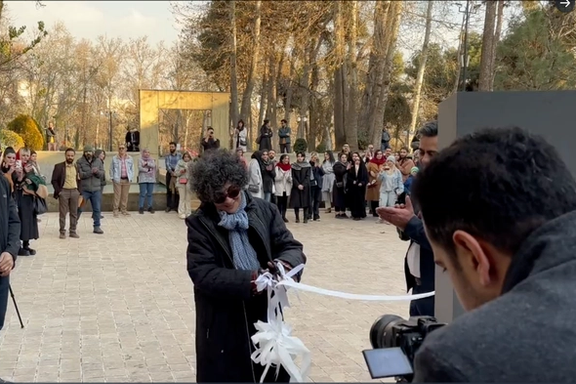
Visual artist Bita Fayazi inaugurating an exhibition in Tehran on Decmber 31

Despite the violent government crackdown on the Woman, Life, Freedom protests in 2023, Iranian women persist in defiance through unveiling, singing, and dancing in public, showing the movement's resilience.

In the past three weeks, at least three well-known female artists have made headlines by unveiling in public as an act of civil disobedience.

On December 30, renowned 62-year-old visual artist Bita Fayazi gained widespread attention on social media when she cut the ribbon to inaugurate a government-sponsored art exhibition with her scarf tied around her neck instead of covering her curly gray hair. Some other female participants at the ceremony, mostly young women, also did not cover their hair.

The Ceramic Art Biennial event was held at Niavaran Cultural Center, a bustling center of cultural activities and exhibitions governed by the Ministry of Culture and Islamic Guidance in the north of the capital.

There are no reports of ministry officials or others at the event objecting to Fayazi’s unveiling during the ceremony. She has not clarified whether it was a planned protest against compulsory hijab or an impromptu act.

The Revolutionary Guards (IRGC)-linked Fars News Agency slammed the ministry for the incident at the Niavaran Cultural Center which it described as a “de-stigmatization of unveiling”. Similarly, the Mehr News Agency, affiliated with the state-run Islamic Propaganda Organization, labeled Fayazi’s act “limitless norm-breaking”. 

A few days earlier, on December 26, Goli Emami, a prominent author and translator, walked on the stage at an event organized by an Iranian publishing house at Ivan-e Shams Hall in Tehran to receive the IranKetab Literary Award for her lifetime of literary work.

Emami, 82, who received a standing ovation from the audience, was not even wearing a token scarf around her neck when she accepted her award. 

Prominent writer Goli Emami holding her award. December 26, 2024
100%
Prominent writer Goli Emami holding her award.

Such defiance of the compulsory hijab, even at government-sponsored events, was unimaginable before the death of Mahsa Amini in the custody of Iran's morality police in September 2022.

Amini’s death sparked several months of nationwide protests. The 22-year-old Amini was arrested on the street by morality patrols, not for defiance of hijab, but because some of her hair was showing from under her headscarf.

Since then, the number of women who refuse to wear the compulsory hijab in public has grown significantly. Social media reports indicate that seeing unveiled women, even in very conservative religious cities such as Qom and Mashhad, no longer surprises anyone.

Music and dance have become powerful tools for Iranian women to challenge the Islamic governance that has prohibited solo singing and public dancing by women for over four decades.

The hijab-free concert by singer Parastoo Ahmadi on December 12 at an empty caravansary which she streamed live on YouTube, was as groundbreaking as the one-woman anti-hijab protest of Vida Movahed, a young mother of 32, on Revolution Avenue in Tehran seven years ago, that was the first symbolic act of defiance catching the public's imagination.

At her “virtual concert”, Ahmadi, 27, not only had no head covering but also wore a black gown that revealed her bare shoulders. She was arrested and arraigned but was later freed on bail.

Female actresses have been spearheading the anti-compulsory hijab movement since the Woman, Life, Freedom protests at the cost of imprisonment, being banned from working and losing their passports.

Most Viewed

100 days after carnage: Iran economy reels from war, inflation, unemployment
1
INSIGHT

100 days after carnage: Iran economy reels from war, inflation, unemployment

2
INSIGHT

Ghalibaf defends Iran-US talks amid hardline backlash

3
INSIGHT

A nation in limbo: 100 days after the massacre, has the world moved on?

4
ANALYSIS

From instability to influence: Pakistan’s pivotal role in US-Iran diplomacy

5
ANALYSIS

100 days on: why Iran’s January protests spread across social classes

Banner
Banner

Spotlight

  • War-hit homeowners feel abandoned as Iran’s reconstruction aid fades

    War-hit homeowners feel abandoned as Iran’s reconstruction aid fades

  • 100 days on: the anatomy of Iran’s January crackdown
    INSIGHT

    100 days on: the anatomy of Iran’s January crackdown

  • Ghalibaf defends Iran-US talks amid hardline backlash
    INSIGHT

    Ghalibaf defends Iran-US talks amid hardline backlash

  • 100 days on: why Iran’s January protests spread across social classes
    ANALYSIS

    100 days on: why Iran’s January protests spread across social classes

  • From instability to influence: Pakistan’s pivotal role in US-Iran diplomacy
    ANALYSIS

    From instability to influence: Pakistan’s pivotal role in US-Iran diplomacy

  • A nation in limbo: 100 days after the massacre, has the world moved on?
    INSIGHT

    A nation in limbo: 100 days after the massacre, has the world moved on?

•
•
•

More Stories

Yemen takes Syria’s place in Iran’s security doctrine, says former commander

Jan 4, 2025, 09:44 GMT+0

Yemen has replaced Syria in Iran's security doctrine after the fall of Bashar al-Assad, according to Hossein Allahkaram, a former IRGC commander and one of the founders of the paramilitary force Ansar-e Hezbollah.

"Simply put, Syria served as a kind of backbone and connector for the axis of resistance, playing an unparalleled role in any potential offensive against the northern front of Palestine. However, within the framework of the strategic ideology, this role has now been transferred to Yemen following the loss of Syria," he said.

Iran-backed militias in the region have become weaker as Israel has launched attacks on Hamas and Hezbollah, both part of what Iran calls the Resistance Axis. Meanwhile, the Houthis in Yemen have escalated their attacks. Since October 7, they have fired drones and missiles almost daily toward Israel, describing these actions as solidarity with Palestinians in Gaza. They have also made commercial traffic unsafe in the Red Sea by targeting vessels moving to or from the Suez Canal.

In September, Iran International reported that approximately 300 Palestinian and Yemeni fighters were undergoing military training inside Iran, according to a source familiar with the matter.

Last week, the United Nations Security Council warned Iran against further escalations by the Houthis, the Tehran-allied armed group in Yemen.

Why 2025 is set to be tougher for Iran

Jan 3, 2025, 21:07 GMT+0
•
Negar Mojtahedi

At the start of 2024, Iran appeared to be riding high: ever closer to the threshold of nuclear weapons, its regional allies harassed Israel on multiple fronts and its Yemeni acolytes the Houthis choked commercial traffic from the Red Sea.

85-year-old Iranian Supreme Leader Ali Khamenei's method of projecting power abroad and tightening his grip at home appeared to be working.

What a difference a year makes.

Tehran's affiliates Palestinian Hamas and Lebanese Hezbollah have been decimated by Israel while Islamist rebels hostile to Iran toppled Syria's Assad dynasty, a key ally.

Iran is now adrift in a decisive year, Kamran Matin, an international relations scholar at the University of Sussex told the Eye for Iran podcast.

“All of this has come together and created a very difficult environment for the Islamic Republic, all of which is even more difficult to deal with in light of the Supreme leader's deteriorating health and his age,” said Matin.

Iran’s regional and international strategy is closely tied to how it can control and shore up influence domestically.

Part of the modus operandi of the Iranian system is to blame domestic troubles on sanctions and regional conflicts, promising that investment in nuclear infrastructure and militant proxies can buttress its standing in a dangerous neighborhood.

That rationale, Matin said, has evaporated and the mystique of Iran’s regional strength has lost its luster.

There have been 54 anti-government protests in Iran since Dec 26 and Jan 2 of this year according to the Foundation for Defense of Democracies (FDD), a Washington DC-based think tank critical of the Islamic Republic.

Iran now faces a sobering realization of its diminished stature.

Race for a deal, or the bomb?

Up against deepening economic malaise as Iran’s currency slips to new lows, an energy crisis which has stoked protests and the loss of regional muscle which deterred enemies, Iran’s rulers now have limited options.

They are at a crossroads, with each path presenting huge risks: race toward a nuclear bomb as an ultimate security guarantee or make concessions to President Donald Trump and compromise the state's very raison d'etre as a scourge of empire.

The answer may hinge on Trump’s plan for Tehran, a country that according to American intelligence has allegedly plotted to kill him.

The president-elect, who has surrounded himself with Iran hawks for his next administration has suggested bombing Iran into “smithereens" for the alleged assassination attempt.

At the very least, Trump will likely apply maximum pressure and more economic sanctions on an already crippled economy, which would squeeze Iran's rulers further.

“It's unclear how Iran is able to negotiate with some sort of strength to be able to extract any concession from the United States and Western powers,” said Matin.

Iranian officials and state media Iran moot talks with Trump more eagerly, tamping down their former rhetoric of resistance and confrontation.

That could signal fear amongst the ruling elite and an understanding of their weakened position, said Matin.

In a speech last month after the collapse of Assad, Iran’s Supreme Leader Ayatollah Ali Khamenei addressed a somber crowd, blaming Israel and the United States for Iran not intervening to save its ally.

“Khamenei basically declared this impotence that American and Israelis had closed all the roads and so on and so forth,” said Matin on the speech, which was devoid of Khamenei's usual affirmations of strength.

The last standing in the Axis of Resistance - the Houthis

The Islamic Republic's woes may mean an opening for the Americans like never before that could force Iran to bargain away its regional satrapies, or face attack.

“Trump is much more willing to take on Iran, given how Israel has basically neutralized Iran's proxy forces,” said Matin on the changing tides.

Yemen's Houthis, Iran's last relatively robust military ally, will likely be a priority.

The Iran-backed group has fired drones and missiles towards Israel frequently for over a year, describing it as an act of solidarity with Palestinians in Gaza.

The Washington Institute for Near East Policy's Maritime Attack Tracker recently tallied 106 confirmed Houthis strikes on shipping since November 2023.

"There have been many more attacks recently on (the Houthis) by Israel and the US-led coalition," Matin said.

"So it may well be that they will also be pacified over time, especially if Iran itself is weakened. And maybe one of the elements in the future talks between Iran and the US would be Iran stopping its supply of advanced weapons to Houthis."

Indirect impact of Trump: a loss of Russia for Iran?

The return of president-elect Trump to the White House will likely mean yet more bad news for Iran’s Islamic establishment.

One of Trump’s first goals is to fulfill his promise to end the war in Ukraine.

If Trump follows through as he is forecasted to, Iran will lose leverage with key ally Russia, another partnership that helped it project power on the world stage.

That would lead to another major blow to the Islamic Republic.

“Russia is likely to restore its damaged relations with the West, with the United States in particular," Matin said. "That also means in turn that Russia does not necessarily need to accommodate Iran's demands or needs in order to keep Iran on board in terms of supplying drones and other weapons to Russia to be used in Ukraine.”

Ukraine's foreign ministry in early September said Russia had launched 8,060 Iran-developed Shahed drones at Ukraine since 2022, according to a Reuters report.

Syria, formerly an Iranian satellite state, was another issue binding Moscow and Tehran.

"Both of them were involved supporting Assad regime. Neither of them are there anymore. What really binds Iran and Russia together is this wider tension each of these countries have with the West, with the United States,” Matin said.

It seems with Iran's dwindling influence, domestic unrest and battered allies throughout the region, 2025 is poised to be a decisive year for Tehran.

To watch the full Eye for Iran episode with Kamran Matin, click on YouTube or listen on Spotify, Apple, Amazon, Castbox or any other major podcast platform.

Hardline cleric warns negotiations may backfire on Iran

Jan 3, 2025, 13:59 GMT+0

Prominent Iranian cleric Ahmad Alamolhoda warned Friday that relying on negotiations to solve Iran's problems would only encourage Iran's enemies to increase pressure.

"Do not make the mistake of believing the country's problems can be resolved through negotiations. If the enemy senses that its pressure is effective, it will persist and intensify that pressure," Alamolhoda, the Supreme Leader's representative in northeast Khorasan Razavi province, said during Friday's sermon.

His comments come as some Iranian politicians have advocated for direct talks with incoming US President Donald Trump to ease sanctions which have wrought economic crisis.

On Tuesday, one of Iranian President Masoud Pezeshkian's aides called for direct negotiations with Trump, emphasizing the need for a new foreign policy to strengthen international relations.

"We must negotiate with Mr. Trump. The country's issues cannot be left unresolved, and the entire establishment has also reached the conclusion that direct negotiations are necessary," state media quoted Ali Abdolalizadeh as saying.

In a separate interview with Etemad daily, prominent Reformist figure Ali Shakuri-Rad suggested that direct talks with the United States could help curb what he described as the outrageous behavior of Israeli Prime Minister Benjamin Netanyahu.

Syria's new leaders say they aim for inclusivity and global backing

Jan 3, 2025, 13:38 GMT+0

Syria’s Foreign Minister, Asaad Hassan Al-Shibani, told Saudi officials during a visit to Riyadh that the new leadership in Damascus aims to establish a government that includes all segments of Syrian society.

This marks the first foreign trip by a member of Syria’s new administration since the ousting of President Bashar al-Assad in early December.

"Through our visit, we conveyed our national vision of establishing a government based on partnership and efficiency that includes all Syrian components, and working to launch an economic development plan that opens the way for investment, establishes strategic partnerships, and improves living and service conditions," Al-Shibani wrote on X Friday.

Al-Shibani and Syria's defense minister met with Saudi Defense Minister Prince Khalid bin Salman to discuss the country’s future. The new government, led by Islamist rebels under Hayat Tahrir al-Sham (HTS), has sought to reassure regional and international stakeholders of its intent to govern inclusively and avoid exporting Islamist revolution.

Meanwhile, on Friday, the foreign ministers of Germany and France visited Syria to meet with its de facto leader, Ahmed al-Sharaa, signaling the European Union's cautious engagement with the new rulers.

Germany's Annalena Baerbock and France's Jean-Noel Barrot, the first EU ministers to visit since Damascus fell to rebel forces, emphasized the importance of a peaceful transition and inclusivity. The meeting with Sharaa took place in the Damascus People's Palace, but no details of the discussions have been disclosed.

"Our message to Syria's new leadership: respecting the principles agreed with regional actors and ensuring the protection of all civilians and minorities is of the utmost importance," EU foreign policy chief Kaja Kallas wrote on X regarding the visit.

Former Iranian MP says Iran not a priority for Trump

Jan 3, 2025, 10:15 GMT+0

Former lawmaker Heshmatollah Falahatpisheh dismissed Tehran’s attempts to signal readiness for talks with the incoming US administration, arguing that Iran is not a top priority for Donald Trump.

Iranian media on Friday quoted Heshmatollah Falahatpisheh as saying, "Trump is focused on domestic issues, with most of his time spent negotiating with business owners and corporate leaders in the United States. Therefore, Iran should not be viewed through the lens of players like Netanyahu. It is Netanyahu who is trying to make Iran Trump’s top priority in the Middle East."

Falahatpisheh, former chairman of the Iranian parliament's foreign relations committee during the 2010s, is a prominent and authoritative voice among Tehran’s commentators who are permitted regular media appearances. Known for his more independent and pragmatic views on foreign policy, he often contrasts with others who tread more cautiously in their remarks.

His remarks came in the wake of a call by one of President Masoud Pezeshkian's aides, who recently advocated direct negotiations with Trump, emphasizing the need for a new foreign policy to strengthen Iran’s international position.

Ali Abdolalizadeh, who headed Pezeshkian’s election campaign, said on December 31 that "We must negotiate with Mr. Trump. The country's issues cannot be left unresolved, and the entire establishment has also reached the conclusion that direct negotiations are necessary."

Falahatpisheh in his remarks emphasized that “Based on the historical experience with Trump and his associates, his close circle consistently takes a hardline stance against Iran, and Trump’s own history is defined by his policy of maximum pressure.” However, he argued that at this juncture the issue of Ukraine is the priority for the president-elect.

He voiced his opposition to attempts by certain Iranian officials to make conciliatory remarks directed at the incoming US administration. “Proactively seeking negotiations with the United States cannot safeguard Iran's national interests. I see that some of Mr. Pezeshkian's associates are talking about engaging in dialogue with Trump and are attempting to send unreciprocated signals. These very signals reflect weakness in Iran's position.”

Falahatpisheh emphasized that Iran's primary focus in the coming month should be on strengthening its national security. He highlighted the importance of addressing domestic discontent, particularly by tackling economic challenges, as a critical first step.

"I believe Trump’s approach toward Iran will involve reviving the maximum pressure policy while also presenting a proposal for negotiations. Naturally, the extent to which this proposal warrants consideration will determine how Iran shapes its foreign policy in response," Falahatpisheh said.






