• العربية
  • فارسی
Brand
  • Iran Insight
  • Politics
  • Economy
  • Analysis
  • Special Report
  • Opinion
  • Podcast
  • Iran Insight
  • Politics
  • Economy
  • Analysis
  • Special Report
  • Opinion
  • Podcast
  • Theme
  • Language
    • العربية
    • فارسی
  • Iran Insight
  • Politics
  • Economy
  • Analysis
  • Special Report
  • Opinion
  • Podcast
All rights reserved for Volant Media UK Limited
volant media logo

Arrests over Iran spy plots in Israel surged 400% in 2024, Shin Bet reveals
Jan 2, 2025, 13:54 GMT+0Updated: 11:57 GMT+0
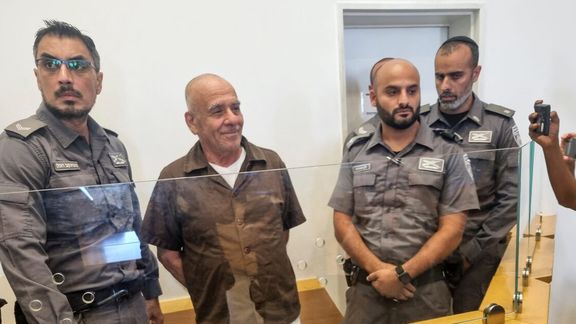
Israeli citizen Moti Maman stands in a courtroom after he was accused by Israeli security services of involvement in an Iranian-backed assassination plot targeting prominent people including Israeli Prime Minister Benjamin Netanyahu, in Beersheba District Court in southern Israel, September 19, 2024.

The number of people arrested in Israel over Iranian spy plots have shot up by 400% in 2024 in the wake of the Gaza war, according to Israel’s Shin Bet intelligence agency.

“A record was recorded in the number of detainees involved in espionage-related affairs for the Iranians, when there was an increase of about 400% of the number of detainees from 2023,” a statement said.

“During the year, 13 serious espionage affairs by Israelis were exposed and thwarted for the Iranian intelligence agencies, and serious indictments were filed against 27 Israelis.”

It also detailed attempts to smuggle weapons along with attempts to recruit Israelis to carry out missions and cyber attacks on Israeli targets.

Asher Ben Artzi, the former head of Israel’s Interpol, told Iran International, "Personally, I can say that in the past, to find Israelis who would be willing to betray the country for the sake of money, was very rare, but unfortunately today this is not the case. Iranian intelligence has acted in a smart way and succeeded in locating such Israelis."

He said that in spite of the fact many such people have been assigned smaller tasks to begin with, that is only the beginning. "We must not take lightly the simplicity of the tasks assigned to them by the Iranian operators such as spraying graffiti or taking photographs. The future tasks are always more complex."

Lior Akerman, a former Brigadier General in Shin Bet now based at Reichman University, said Iran has changed the pattern of its operations in recent years, relying on digital means to reach possible candidates.

"Due to the impossibility of meeting Israelis and recruiting them abroad, they deploy a very wide network of searches on social networks using fake profiles," he said.

"They reach out to many thousands, from whom they find a few who are willing to carry out operations for money."

Just this week, a 29-year-old Israeli man was arrested on suspicion of spying for Iran.

A joint statement from Israel’s security services and the police, said that Alexander Granovsky, from Petah Tikva, was arrested in December for his alleged involvement in a plot which had involved photographing the entrance to former defense minister Benny Gantz's residential neighborhood.

He is also accused of setting eight cars on fire around Israel and photographing a sensitive facility in the center of the country.

Granovsky had also sprayed "Children of Ruhollah” on various buildings, referring to Iran’s first Supreme Leader, Ruhollah Khomeini.

The investigation also revealed that the man’s handlers discussed with him the possibility of obtaining a rifle and grenades to shoot at houses.

Like other cases this year, he had also been asked to gather information on the residential addresses of ministers in the Israeli government, and to set fire to a police car, a bus, and a truck, but Granovsky refused to carry out the tasks.

In September, another plot was foiled to assassinate Prime Minister Benjamin Netanyahu, former Defense Minister Yoav Gallant, and Shin Bet Director Ronen Bar.

The plot escalated following the assassination of Hamas political leader Ismail Haniyeh in Tehran in July, according to Shin Bet.

The Iranian scheme also included plans to target former Prime Minister Naftali Bennett and other senior Israeli defense figures, although the details have not been confirmed.

The operation sought to exploit an Israeli businessman with extensive ties to both Turkey and Iran, leveraging his financial networks to facilitate the assassination attempts within Israel.

Although such operations have been attempted by Iran for more than a decade, since the Gaza war, efforts have increased. Iran's military allies in both Gaza and the West Bank continue to act against Israel in addition to those outside Israel's borders in Lebanon and the wider Middle East.


Most Viewed

Ghalibaf defends Iran-US talks amid hardline backlash
1
INSIGHT

Ghalibaf defends Iran-US talks amid hardline backlash

2
INSIGHT

100 days after carnage: Iran economy reels from war, inflation, unemployment

3
INSIGHT

A nation in limbo: 100 days after the massacre, has the world moved on?

4
ANALYSIS

From instability to influence: Pakistan’s pivotal role in US-Iran diplomacy

5
ANALYSIS

100 days on: why Iran’s January protests spread across social classes

Banner
Banner

Spotlight

  • War-hit homeowners feel abandoned as Iran’s reconstruction aid fades

    War-hit homeowners feel abandoned as Iran’s reconstruction aid fades

  • 100 days on: the anatomy of Iran’s January crackdown
    INSIGHT

    100 days on: the anatomy of Iran’s January crackdown

  • Ghalibaf defends Iran-US talks amid hardline backlash
    INSIGHT

    Ghalibaf defends Iran-US talks amid hardline backlash

  • 100 days on: why Iran’s January protests spread across social classes
    ANALYSIS

    100 days on: why Iran’s January protests spread across social classes

  • From instability to influence: Pakistan’s pivotal role in US-Iran diplomacy
    ANALYSIS

    From instability to influence: Pakistan’s pivotal role in US-Iran diplomacy

  • A nation in limbo: 100 days after the massacre, has the world moved on?
    INSIGHT

    A nation in limbo: 100 days after the massacre, has the world moved on?

•
•
•

More Stories

Iran in post-Assad Middle East: Will Khamenei's 2024 gamble haunt him in 2025?

Jan 1, 2025, 17:10 GMT+0
•
Shahram Kholdi

The year 2024 will be remembered as a momentous one for the Middle East, culminating in the collapse of the Assad dynasty’s 53-year rule over Syria, and ushering in a future fraught with both possibility and peril.

Assad’s ouster carries implications not just for Syria, which may now become a battleground for new proxy wars between regional powers, but for the broader Middle East, where the ripples of the fall in Damascus will be felt.

The new reality in Syria bears most heavily upon the Islamic Republic of Iran and its armed allies in the region. Assad’s downfall has disrupted the connections between Tehran, the Shia militia in Iraq, and Hezbollah in Lebanon.

A refashioned Middle East

Hezbollah’s ill-judged assault on October 8, 2023, opening a second front against Israel, hurled Iran into an unenviable strategic and financial position. Supreme Leader Khamenei wagered that Hezbollah’s arsenal might stall Israel and compel it to negotiate a ceasefire with Hamas as families of hostages led anti-Netanyahu protests. But Israel pursued its objective of dismantling Hamas and Hezbollah, the human costs in Gaza and southern Lebanon notwithstanding.

The costs for Iran were staggering as well: tens of billions of dollars invested over 30 years to build its much-hailed Axis of Resistance vanished in a single year.

Following Saddam’s ousting in 2003, Iran secured routes through Iraq and Syria, fuelling Hezbollah’s 2006 war effort. Yet Israeli strikes from July to October 2024 wiped out most of Hezbollah and Hamas’s leadership. In late October, Israel targeted several military sites in Iran, asserting that it had destroyed the country’s air defences. By November, Tehran had lost the ability to shield Assad and had to accept his defeat.

In Lebanon, Hezbollah’s diminished role has created opportunities for other political forces to reclaim influence. And in Iraq, Shia factions feel the heat as Tehran’s regional grip weaken and Ayatollah Sistani, Iraq’s most influential cleric, denounces the undue power of armed militias over the state. An anti-Iranian resurgence, once unthinkable, now emerges as a distinct possibility.

Shadow of uprising over Iran

Khamenei’s response to these setbacks was notably subdued. On December 11, 2024, he avoided mentioning Syria’s dominant faction, Hay’at Tahrir al-Sham (HTS), or its leader, Jolani. Instead, he predicted that Syria would descend into an insurgency similar to post-Saddam Iraq. This cryptic pronouncement suggests a possible strategy to exploit instability in an attempt to reclaim lost ground and restore Iran’s waning influence.

The shadow of the widespread protests in 2022 looms ominously over Tehran. Warnings against popular uprising by senior figures, including the supreme leader himself, underscores the theocracy’s unease. Khamenei’s words betray not strength, but fear.

On December 12, 2024, Netanyahu addressed the Iranian people directly— for a third time in about three months—urging them to seize the opportunity presented by Assad’s collapse. Most remarkable, perhaps, was his attempt to invoke the mantra of the 2022 uprising in Persian: “Zan, Zendegi, Azadi,” he said, Woman, Life, Freedom, which excited and repelled Iranians on social media.

Middle East peace now hinges upon Syria

Since 2012, Syria has been the stage where regional and global powers collided—America, Russia, and three coalitions: Iran and Hezbollah, Turkey, and the Persian Gulf Arab monarchies led by Saudi Arabia. United briefly against ISIS, the terror group’s decline by 2022 restored the old rivalries. Turkey, under Erdoğan, played a deft and dangerous hand, juggling conflicts with Assad, ISIS, and the Kurds, all while reviving Ottoman-like aspirations for regional dominance.

Israel’s operations against Hezbollah and Iran have shifted the balance of power and inadvertently bolstered Turkey’s ambitions. Netanyahu’s decisions, with President Biden’s support, inflicted untold suffering on Palestinians and led to an unprecedented case against Israel at the International Court of Justice. But it also tore at the Islamic Republic’s fragile Shia imperium. Khamenei’s decades-long gamble, pouring Iran’s treasure into regional ambitions since 1989, now imperils his rule.

At the beginning of 2025, Turkey and its Arab counterparts have an historic opportunity to forge a new Middle East. Erdoğan, ever wary of Israel but keen to grasp the moment, wielded Turkish intelligence to enable HTS to topple Assad. President-elect Trump described the events in Syria as an “unfriendly takeover” by Turkey, signalling apprehension over Ankara’s ambitions. But Turkey alone cannot rebuild Syria and manage the return of millions of refugees. That may require a concert of will and treasure from Saudi Arabia and the Emirates.

At this pivotal moment, regional powers must avoid focusing solely on resolving the Israel-Palestine conflict. A coordinated effort to rebuild Syria could transform the region’s fortunes. Syria under Jolani is unlikely to move toward normalization with Israel. Still, it defies belief that millions of returning refugees would yearn for renewed conflict.

These war-weary souls seek not battle, but the quiet dignity of rebuilding their homes and lives. A bold, visionary effort to uplift Syria could transform the fortunes of the region's most grievously afflicted—Syrians, Lebanese, and Palestinians alike. As for Iran, the gamble executed by Khamenei and his IRGC commanders seems to have backfired, leaving them in their most precarious position in recent memory.

Armenia takes control of border with Iran as Russian guards withdraw

Jan 1, 2025, 16:20 GMT+0

For the first time since its independence, Armenia has assumed full control over the Agarak border checkpoint along its border with Iran.

As of December 30, Armenian border guards have replaced Russian personnel who managed the checkpoint for over three decades.

Prime Minister Nikol Pashinyan announced the transition on his official Facebook page, acknowledging the service of Russian border guards and extending his wishes to the Armenian forces now in charge.

“From today on, border control is carried out only by the officers of the Republic of Armenia Border Guard Forces at the Agarak border crossing point of Armenia-Iran state border. Until now, since Armenia's independence, border control was carried out by the Russian Federation Border Guard troops officers at Agarak crossing point, and I want to thank them for their service. And I wish success and good service to our border guards who have taken over border control from today,” Pashinyan said as reported by the Newsweek.

The decision follows an agreement between Pashinyan and Russian President Vladimir Putin during an October 8 meeting. As part of the arrangement, Armenian forces will also begin managing border security with Turkey and Iran from January 1, 2025.

The move is part of broader changes in Armenia-Russia relations, which include the withdrawal of Russian guards from Zvartnots International Airport and other border locations.

Armenia’s decision to assume greater responsibility for its borders comes amid shifting alliances and a reevaluation of its reliance on Moscow, particularly after Russia’s limited response to recent conflicts involving Armenia and Azerbaijan.

In March, Yerevan called for the withdrawal of Russian guards from key locations, citing heightened tensions with its traditional ally.

The transition also reflects broader geopolitical currents. Armenia’s ties with Iran, a key regional ally, remain strong, with cooperation in energy and trade bolstering relations. The two nations share a 44-kilometer border, and Iran views Armenia as a strategic counterbalance to Azerbaijan and Turkey.

Tehran has consistently emphasized its interest in maintaining stability along its northern border, where regional conflicts often intersect with ethnic and religious divisions.

The decision has drawn criticism from Russian Ministry of Foreign Affairs, which warned that the shift could undermine Armenia’s security and economic stability. Despite these warnings, Armenian officials maintain that the change represents a step toward greater sovereignty.

The evolving dynamics in the South Caucasus suggest continued realignment. Armenia’s recalibration of its defense and foreign policy could have lasting implications, particularly as it navigates tensions with Azerbaijan and manages its alliances with Iran and the broader international community.

Iranian cleric warns of foreign infiltration in parliament

Jan 1, 2025, 14:37 GMT+0

Prominent Iranian hardline cleric Ahmad Alamolhoda, the Supreme Leader's representative in Khorasan Razavi province, has warned that foreign powers are actively recruiting members of Iran's parliament as spies.

Alamolhoda made the allegations during a meeting in Mashhad with members of the parliament’s Basij on Tuesday.

The Basij is a paramilitary volunteer force under the command of the Islamic Revolutionary Guard Corps (IRGC) that maintains a presence within nearly all Iranian state bodies, including the parliament.

He said that foreign intelligence agencies do not directly send spies into the parliament. Instead, he alleged, they identify lawmakers whose views align with their own and then recruit them through intermediaries.

"In the Islamic Consultative Assembly, people with different ideas and viewpoints enter," Alamolhoda said. "The enemy comes and evaluates these people to see which ones are close to their goals, and then recruits them through several intermediaries."

Khamenei defends Iran’s regional strategy, vows to reclaim Syria

Jan 1, 2025, 09:09 GMT+0

Iranian Supreme Leader Ali Khamenei defended Iran's involvement in Syria's civil war and his policy of power projection in the region, dismissing criticism of the country’s diminishing influence in the Middle East.

“Some people, due to a lack of proper analysis and understanding, claim that with the recent events in the region, the blood shed in defense of the shrine was wasted,” Khamenei said in a Wednesday ceremony to mark the fifth anniversary of the death of former Revolutionary Guards Quds Force commander Qasem Soleimani.

He was Iran’s most influential figure in coordinating armed allied groups in the region and was killed by the US in Iraq in 2020.

“They are making this grave mistake; the blood was not wasted,” Khamenei continued.

The defense of the shrine refers to a narrative promoted by Iran as a reason for its military presence in Syria and Iraq. This concept centers around the protection of Shi’a Islamic holy sites, particularly the Shrine of Sayyida Zainab in Damascus, Syria. Sayyida Zainab was the granddaughter of Prophet Muhammad. However, following the October 7 Hamas attack on Israel, Khamenei’s rhetoric expanded beyond shrine defense, openly advocating an all-out war against Israel.

The comments by Khamenei follow a series of regional setbacks for Iran in 2024, as its network of proxy and allied groups faced regular Israeli countermeasures.

Hamas's military power has been almost completely diminished by Israel. Israel has also intensified its campaign against Hezbollah with precise airstrikes, covert operations, and intelligence-led targeting of the group's assets in Lebanon and Syria. These actions aim to degrade Hezbollah’s capabilities, disrupt its supply lines, and prevent the transfer of advanced weapons from Iran.

In Yemen, the Houthis encountered resistance from local factions, and devastating air attacks by Israel, the US and UK. These setbacks underscore the diminishing reach of Iran’s “axis of resistance,” a strategy central to Khamenei’s regional ambitions.

In Syria, a key pillar of Iran’s influence, the Assad government fell after 13 years of Iranian support. Since the Syrian Civil War began in 2011, Iran has heavily invested in preserving Assad’s government, seeing it as vital for maintaining access to Hezbollah and projecting power across the Levant. The loss of Assad unraveled these investments and severed Iran’s land corridor to Lebanon, undermining its ability to supply Hezbollah with arms.

Reclaiming Syria

Despite these challenges, Khamenei repeated his commitment to regional interventions on Wednesday, praising Soleimani for building pro-Iran groups across the region.

In a veiled reference to Syria's new strongman Ahmad al-Sharaa, Khamenei said: “Do not be deceived by this false show; those who are strutting around today will one day be trampled under the feet of the faithful. Those who have encroached on the land of the Syrian people will one day be forced to retreat in the face of the power of Syria's youth.”

This marks the third time Khamenei has promised to reclaim Syria from its new rulers. On December 11 and 23, he made similar vows, encouraging Syrian youth to resist Assad’s successors.

He also described Houthis and Hezbollah as symbols of resistance, adding that they would ultimately prevail. Without naming specific countries, he criticized certain nations for “sidelining their faithful youth,” whom he called “pillars of stability and strength,” warning that they risk facing Syria’s fate.

Iran International analyst Morad Veisi suggested that Khamenei’s rhetoric reflects a refusal to accept regional realities. “Rather than acknowledging his mistakes, he attempts to reshape facts to align with his vision,” Veisi said, adding that this approach has drained Iran’s resources and alienated its neighbors.

These remarks coincide with admissions by Hezbollah’s Secretary-General Naim Qassem, who acknowledged that Assad’s fall has disrupted the group’s primary supply route through Syria. Meanwhile, The New York Times reported that Assad’s downfall has caused confusion among Iranian officials.

Khamenei also praised Soleimani, saying that he utilized the potential of the region's youth to revive the Resistance Front. However, his statements contrasted with a prior speech in which he denied that Iran operates proxy forces in the region.

As Iran’s influence wanes and its regional allies face mounting challenges, Khamenei’s insistence on reclaiming Syria underscores the strain on the Islamic Republic’s strategy.

Soleimani's assassination weakened Iran's regional power

Dec 31, 2024, 08:00 GMT+0
•
Morad Vaisi

Five years ago, Qassem Soleimani was killed under the direct orders of then-US President Donald Trump, in a watershed moment in the Middle East, triggering a series of setbacks for the Islamic Republic.

The decision to eliminate the mastermind behind Tehran’s expanding military and political influence from Iraq to Lebanon and Yemen demonstrated how removing a single figure can disrupt an entire system—and alter a region's dynamics.

Soleimani was a key architect of Iran’s Middle East strategy. Though not the commander-in-chief of the Revolutionary Guards, he was its most influential leader. His impact on the regime’s regional policies far outweighed that of any elected official, including Iran’s president.

The aftermath of his assassination revealed the strategic significance of Trump’s bold decision on January 3, 2020. The resulting shifts in regional power dynamics and successive defeats for Iran and its Quds Force highlighted how this single act disrupted Tehran’s ambitions.

General Kenneth McKenzie, then-head of US Central Command (CENTCOM), detailed the operation in his book Degrade and Destroy. McKenzie explained that Soleimani had been within US targeting range before, but former President Barack Obama refrained from authorizing his assassination due to fears of escalation. This restraint allowed Soleimani to consolidate his influence across the Middle East. Trump’s decisive move, however, ended that era.

McKenzie also noted that forces under Soleimani’s command carried out 19 attacks on US bases in Iraq in 2019 alone. A December 2019 strike that killed an American contractor became the immediate trigger for the decision to eliminate Soleimani.

The assassination dealt a major blow to Iran’s influence in the region, particularly to the Quds Force. It sent a clear message to Tehran: escalation would be met with decisive retaliation. Soleimani’s death exemplified this strategy and revealed vulnerabilities in Iran’s regional power structure.

Following Soleimani’s killing, Iran’s proxies, including Hamas, Hezbollah, and other militias, experienced significant operational setbacks. The regime struggled to fill the void left by Soleimani, a reality so stark that Supreme Leader Ali Khamenei publicly sought to downplay the impact. However, Iran’s diminished influence in the Middle East became undeniable.

More recently, Israeli Prime Minister Benjamin Netanyahu’s hardline policies have further altered the region’s dynamics. Tehran’s miscalculations, including encouraging Hamas’s October 7 attack on Israel, prompted an intensified Israeli campaign against Iran’s proxies.

These actions led to the defeat of Hamas, the weakening of Hezbollah, and even the collapse of Bashar al-Assad’s regime in Syria. As a result, Iran’s regional proxy network has been severely eroded, leaving its influence significantly diminished.

The decisions by Trump to eliminate Soleimani and by Netanyahu to target key Iranian and proxy leaders demonstrate how firm action against the Islamic Republic can reshape regional dynamics. Today, the effects of these decisions are evident in the weakened state of Iran and its proxies across the Middle East.