• العربية
  • فارسی
Brand
  • Iran Insight
  • Politics
  • Economy
  • Analysis
  • Special Report
  • Opinion
  • Podcast
  • Iran Insight
  • Politics
  • Economy
  • Analysis
  • Special Report
  • Opinion
  • Podcast
  • Theme
  • Language
    • العربية
    • فارسی
  • Iran Insight
  • Politics
  • Economy
  • Analysis
  • Special Report
  • Opinion
  • Podcast
All rights reserved for Volant Media UK Limited
volant media logo

Assad sought Russia’s military backing, skipped Iran - Reuters

Dec 13, 2024, 12:23 GMT+0Updated: 12:10 GMT+0
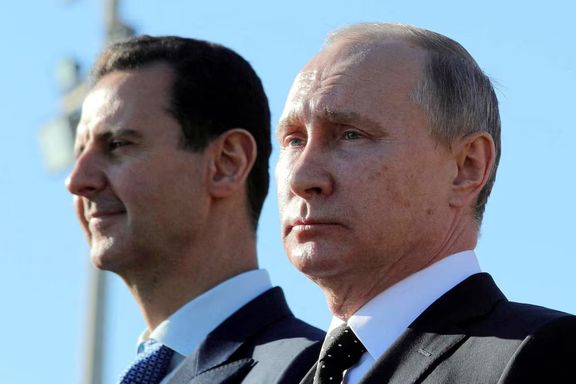
Russian President Vladimir Putin (R) and Syrian President Bashar al-Assad visit the Hmeymim air base in Latakia Province, Syria December 11, 2017.

As rebels gained in the days before Bashar al-Assad's flight from Syria, his appeal for help from Moscow was rebuffed but the veteran autocrat held off seeking Iranian military support to avoid triggering Israeli retaliation, Reuters reported.

In the days leading up to his downfall Assad sought military aid from Russia, whose intervention in Syria's civil war in 2015 swung the conflict in his favor.

On November 28, Assad traveled to Moscow to plead for military intervention following a rapid advance by Syrian rebel forces, including the capture of Aleppo by Hayat Tahrir al-Sham (HTS) Islamists.

However his request was dismissed by the Kremlin, with Russia unwilling to engage further militarily, according to three regional diplomats cited by Reuters.

Despite the rejection, Assad reportedly misled his commanders, alleging that military support from Moscow was imminent. Hadi al-Bahra, head of Syria’s opposition abroad, cited sources within Assad’s inner circle confirming Moscow had rejected the request.

The Kremlin has since said that its priority is now the conflict in Ukraine, with spokesperson Dmitry Peskov emphasizing Russia’s earlier efforts to stabilize Syria.

Four days after Assad's Moscow visit, Iranian Foreign Minister Abbas Araghchi met with Assad in Damascus.

By then, Assad’s forces were in disarray, and he admitted to Iranian officials that his army was too weak to resist the rebels. However, Assad refrained from requesting direct Iranian military deployment to avoid provoking Israeli retaliation against Iranian forces or even Iran itself, according to senior Iranian officials cited by Reuters.

The ouster of President Bashar al-Assad, whose family had ruled Syria for over five decades, dealt a significant blow to Iran, depriving Tehran of one of its oldest and most reliable allies. Damascus was a critical link in Iran's so-called "Shi'ite Crescent," which extended its influence through Iraq and Syria to its Lebanese ally, Hezbollah.

Meanwhile, the aftermath of Assad's fall has sparked rare criticism of the Iran's Revolutionary Guards and its Quds Force commander, Esmail Qaani.

Ultra-hardliners have vented frustrations in online forums like Telegram and Eitaa, questioning why flights and supply routes to Damascus were halted and why the Qods Force failed to act decisively.

Iranian politicians and media are now grappling with the implications of Assad's fall on Tehran’s future ties with Damascus. The government is also under pressure to justify Syria's significant financial and military investments since 2011.

Most Viewed

Iran negotiators ordered to return after internal rift over Islamabad talks
1
EXCLUSIVE

Iran negotiators ordered to return after internal rift over Islamabad talks

2
ANALYSIS

US blockade enters murky phase as tankers spoof signals and buyers hesitate

3
ANALYSIS

Why the $100 billion Hormuz toll revenue is a myth

4

US tightens financial squeeze on Iran, warns banks over oil money flows

5
ANALYSIS

US blockade targets Iran oil boom amid regional disruption

Banner
Banner

Spotlight

  • Hardliners push Hormuz ‘red line’ as US blockade tests Iran’s leverage
    INSIGHT

    Hardliners push Hormuz ‘red line’ as US blockade tests Iran’s leverage

  • Ideology may be fading in Iran, but not in Kashmir's ‘Mini Iran'
    INSIGHT

    Ideology may be fading in Iran, but not in Kashmir's ‘Mini Iran'

  • War damage amounts to $3,000 per Iranian, with blockade set to add to losses
    INSIGHT

    War damage amounts to $3,000 per Iranian, with blockade set to add to losses

  • Why the $100 billion Hormuz toll revenue is a myth
    ANALYSIS

    Why the $100 billion Hormuz toll revenue is a myth

  • US blockade targets Iran oil boom amid regional disruption
    ANALYSIS

    US blockade targets Iran oil boom amid regional disruption

  • Iran's digital economy battered by prolonged blackout
    INSIGHT

    Iran's digital economy battered by prolonged blackout

•
•
•

More Stories

Ex-envoy: Trump’s policy on Iran aimed at a deal, not regime change

Dec 13, 2024, 11:30 GMT+0
•
Negar Mojtahedi

Donald Trump’s maximum pressure policy was never aimed at regime change, his last special envoy for Iran told Iran International. It was about making a deal.

Achieving a comprehensive plan to halt Iran’s nuclear and regional ambitions is likely the endgame for Trump’s second presidency, said his former special representative for Iran during the first Trump administration.

Elliott Abrams, a veteran hawk, told the Eye for Iran podcast that most people remember maximum pressure but do not properly comprehend what the goal was.

“For better or worse, it was not the overthrow of the regime,” said Abrams “His criticism of the Obama deal was that it was time bound, and it was not comprehensive. It didn't deal with Iran's missile program or Iran's support for terrorism.”

The president-elect is still striving for such a deal, according to Abrams.

The former Iran envoy fears Trump’s zeal for a deal could get him dragged into meaningless negotiations which buy Tehran time to advance its nuclear program.

Tehran

“Iran will trap him [Trump] in negotiations that will go on and on and on and on and on while they are trying to advance with their nuclear program.”

Iran Foreign Minister Abbas Araghchi said that they are prepared to cooperate with the United Nations nuclear watchdog. Araghchi made the remarks during a telephone conversation with the International Atomic Energy Agency (IAEA)’s Director-Genral Rafael Grossi on Monday.

Trump’s former Iran envoy believes Iran's sudden willingness to cooperate with the IAEA after shunning its inspectors and boosting its uranium stockpile is all part of Iran’s plan to get the president-elect to the negotiating table.

Abrams sees some of Trump’s cabinet picks like senator Marco Rubio for secretary of state and Mike Waltz as national security adviser as guards against any feints by Iran. Both are seen as hawkish Republicans and long-standing critics of Iran.

“They have robust records of understanding Iran and understanding the evil of the regime. And so, they are obstacles to that happening, which is a very good thing,” he said. "I'm just hoping that people like Waltz and Rubio will say to the president when he becomes president again, this is the Iranian game. Don't fall for it.”

But the possibility of the president-elect being fooled is not inconceivable, according to Abrams, and the new administration will have some divergent voices such as Tulsi Gabbard, Trump’s pick of director of national intelligence. Gabbard has expressed sympathy for the outlooks of Syria’s former ruler Bashar Al-Assad and Russian president Vladmir Putin.

“The regime in Tehran knows this and they're very clever and they will try to play off of this,” added Abrams.

The choices the Islamic Republic faces are difficult.

With Iran’s axis of resistance clearly on the backfoot after 14 months of Israeli attacks, the loss of its most important Arab ally Syria after Assad's swift collapse and Israel's destruction of Iran’s air defense and missile facilities in October leaves Tehran with little room to maneuver.

Will Iran decide to cooperate with the US and adopt a more dovish tack? It seems unlikely to Abrams, who also worked with George W. Bush on US policy in the Mideast.

This spanned the invasion of Iraq over the threat from weapons of mass destruction which were never found, leading to the deaths of thousands of American troops and hundreds of thousands of Iraqis in a war critics say sapped US influence abroad.

A dash to become a nuclear power is the more likely and worrying scenario, he said, cautioning that the Soviet Union’s nuclear status did little to stop its collapse.

Abrams said Tehran must now ask itself in the words of Henry Kissinger: “will they decide to be a nation rather than a cause?"

To watch the full episode featuring Elliott Abrams, watch Eye for Iran on YouTube or listen on Spotify, Apple, Castbox or Amazon.
Trump considers airstrikes on Iran's nuclear facilities - WSJ

Dec 13, 2024, 11:12 GMT+0

US President-elect Donald Trump is exploring measures to stop Iran from developing nuclear weapons, including potential airstrikes, a shift from traditional diplomacy and sanctions, according to the Wall Street Journal.

"The military-strike option against nuclear facilities is now under more serious review by some members of his transition team," WSJ reported Friday.

Trump has expressed concerns about a potential Iranian nuclear breakout during recent calls with Israeli Prime Minister Benjamin Netanyahu, according to two sources familiar with their discussions, The Wall Street Journal reported, indicating he is seeking strategies to prevent such an outcome.

Also on Thursday, in an interview with Time magazine, Trump refused to rule out the possibility of war with Iran, despite his campaign statements opposing the use of force to overthrow Tehran's theocratic government.

When asked by a Time reporter about the likelihood of war with Iran, referencing allegations by US law enforcement that Iran had sought to assassinate him, Trump responded: "Anything can happen. Anything can happen. It's a very volatile situation."

The Israeli Air Force is reportedly increasing its preparations for potential strikes on Iran’s nuclear facilities, viewing the weakening of Tehran's proxies and the fall of the Assad regime in Syria as strategic openings, according to the Times of Israel. Israeli military officials see these developments as creating new opportunities to address the Iranian threat.

Meanwhile, US National Security Advisor Jake Sullivan, speaking in Tel Aviv on Thursday, reaffirmed Washington’s stance on Iran. He emphasized that the US “remains vigilant against the continuing threat from Iran, including the threat from its nuclear program.” He pointed to the US government’s commitment to ensuring that “the United States of America will never permit Iran to acquire a nuclear weapon.”

Sullivan also said that the balance of powers in the Middle East has shifted dramatically, leaving Iran and its allies in a weaker position while strengthening Israel.

“The balance of power in the Middle East has changed significantly and not in a way that Sinwar or Nasrallah or Iran had planned,” Sullivan said, adding, “We are now faced with a dramatically reshaped Middle East in which Israel is stronger, Iran is weaker, its proxies decimated, and a ceasefire that is new and will be lasting in Lebanon that ensures Israel’s security over the long term.”

Tehran defends massive spending in Assad's Syria amid calls for restraint

Dec 13, 2024, 11:07 GMT+0
•
Behrouz Turani

Iranian politicians and media are grappling with the implications of Assad's fall on Tehran's future relations with Damascus. Simultaneously, the Iranian government is attempting to justify its substantial expenditures in Syria since 2011.

Both developments are overshadowed by the broader changes and challenges Iran faces in this new geopolitical reality, which has prompted a shift in the rhetoric of some analysts and officials.

Hassan Beheshtipour, a conservative commentator who frequently appears on Iran's state TV, told Nameh News that Assad had distanced himself from Iran in recent months under the influence of the United Arab Emirates. He explained that the UAE had convinced Assad that, while Iran stood by him during the long war, his Arab neighbors could provide stronger support in times of peace.

Beheshtipour described the future of Iran-Syria relations as uncertain, warning of a rocky path ahead marked by potential instability in Syria and the region. He added that Syria's transitional period could extend for an extended and unpredictable duration.

While many Iranian commentators outside Iran, such as Ali Hossein Ghazizadeh, speaking to Iran International TV, have predicted that Iran’s Supreme Leader Ali Khamenei could be the next to exit the regional political scene, the state-monitored media in Tehran avoid discussing such scenarios. For them, analyzing the impact of Assad's fall on Iran's political future remains a taboo subject.

Meanwhile, numerous Iranian commentators outside the country, including Morad Veisi, Mehdi Mahdavi Azad, Jaber Rajabi, and Mohsen Sazegara, have highlighted widespread dissatisfaction among Iranians over the estimated $30 to $50 billion that Khamenei has allocated to support Assad in Syria. Within Iran, Heshmatollah Falahatpisheh, the former chairman of the National Security and Foreign Relations Committee in parliament, had been one of the few politicians bold enough to openly criticize Khamenei for this substantial expenditure. However, he now appears to have softened his stance, possibly due to political pressure.

In an interview with Iranian media earlier this week, widely covered by various outlets, Heshmatollah Falahatpisheh suggested that Iran should work to restore diplomatic ties with Syria as a way to reclaim the billions it has spent in the country. However, convincing the incoming government in Damascus—once formed—to repay the funds provided to the ousted president will likely prove challenging. Moreover, even if Bashar al-Assad had remained in power, Iran was unlikely to formally pursue such a claim.

Falahatpisheh also revealed that he faced insults and threats from certain Iranian politicians when a few years ago he initially spoke out about Tehran's multi-billion-dollar expenditures in Syria.

In another development government spokeswoman Fatemeh Mohajerani told the press on Tuesday that the spending in Syria was meant to serve Iran's national interests. However, she made it clear that such decisions are made by officials higher up in the system [meaning Khamenei] and the presidential administration simply carries out those decisions.

Both Beheshtipour and Falahatpisheh advised Iran to steer clear of political developments in Syria for the time being and commended the decision to abstain from military intervention to save Assad. Beheshtipour cautioned that Syria could become a quagmire for Iranian forces, while Falahatpisheh praised the restraint shown in ignoring calls from hardliners, including members of the ultraconservative Paydari Party, who last week and over the weekend urged for troops to be deployed to Syria.

Beheshtipour also suggested that Iran and the broader "axis of resistance" should explore alternative routes outside Syria for maintaining communication and logistical networks. Additionally, he proposed that Tehran work with Turkey, Russia, and the United States to establish a democratic political order in Syria. However, he did not elaborate on why these major players would be inclined to involve Iran in such a process.

Addressing the same issue, Hossein Ali Hajideligani, a conservative member of the Iranian parliament, remarked: "The presence of the conquerors of Syria poses a significant challenge for us. If we cannot continue our past activities in Syria, it is natural that they, too, will be unable to sustain their efforts in the long run."

Tehran’s hardliners turn on Quds Force over Assad’s fall

Dec 13, 2024, 07:31 GMT+0
•
Maryam Sinaiee

Some Iranian ultra-hardliners online are blaming the ouster of Tehran's Syrian allies on the Revolutionary Guards and the commander of its foreign arm the Quds Force in cautious but rare social media broadsides at a key ruling institution.

Ultra-hardliners who refer to themselves as 'arzeshi' or guardians of Islamic Republic's values were venting their frustrations against Esmail Qaani in closed groups such as the homegrown Eitaa cast platform and on Telegram.

“Why doesn’t anyone say anything? Why were Iran Air’s flights to Damascus and Iraq to Damascus halted? Why was the Lebanese border to Syria blocked? Why didn’t they let us go there [to fight]?” one user wrote, asking why has the Quds (Qods) Force - the regional spear of Iran's Islamic Revolutionary Guards had not acted or spoken up.

Deploying the hashtags Qaani and Quds Force on Tuesday, another user snapped: “Leaders of Hezbollah were martyred, the Axis of Resistance withdrew from Syria, yet no one heard anything from the Quds Force commander."

Others pointed out that Qaani was not present at the Parliament’s closed meeting with the Revolutionary Guards’ Commander-in-chief General Hossein Salami on Thursday and wondered whether he had been dismissed by Supreme Leader Ali Khamenei.

Qaani has been seen in public only rarely since October.

Commentators at the time viewed his absence as a sign of possible disfavor given huge setbacks dealt to Hezbollah by Israel including the assassination of its leader Hassan Nasrallah alongside a top Quds force commander.

The last time Qaani appeared was at a mourning ceremony on the death anniversary of Prophet Mohammad's daughter, Fatima, at Khamenei’s residence on Dec. 7. Iranian media noted that Qaani appeared in civilian clothing, unlike other military commanders at the ceremony.

Iranian Islamic Revolutionary Guard Corps (IRGC) forces and foreign militias such as the Fatemiyoun and Zeynabiyoun brigades were deeply involved in defending Assad during Syria’s civil war for over a decade.

In a speech on Wednesday about recent developments in the region, Khamenei accused the United States and Israel of orchestrating the overthrow of Bashar al-Assad.

Unusually, state television did not give live coverage of the speech and only aired two excerpts as the Islamic Republic faced some of the biggest blows to its regional influence in its near half-century existence.

Assad’s fall has presented a serious challenge to commentators who claim to be guardians of so-called Islamic revolutionary values on how to interpret the events but steer clear of questioning the system's ultimate ruler Khamenei.

Most have directed their ire toward the country’s military institutions according to a commentary titled in part, “Has the Revolutionary Current Lost Its Trust in the Military?” by the relatively independent Rouydad24 news website on Thursday.

“With the fall of Damascus and the end of Bashar al-Assad’s rule in Syria, groups in cyberspace which until now interpreted the equations in the Middle East in Iran's favor are facing an analytic crisis and blaming parts of (the Iranian) government,” the commentary added, noting that many among the arzeshi groups are silent “mostly because they do not dare to speak openly” about the matter.

Iranian authorities have stepped up censorship after Assad’s ouster.

Iran's Attorney General’s Office on Thursday warned media outlets and online activists to avoid discussions of the downfall of Tehran's ally Bashar al-Assad in Syria that could undermine domestic security. Iranian media on Thursday reported that the judiciary has indicted at least eight commentators, journalists, and activists in relation to their social media comments in this relation.

Invoking 'woman, life, freedom,' Netanyahu says Tehran is next after Damascus

Dec 12, 2024, 19:50 GMT+0

Israeli Prime Minister Benjamin Netanyahu said the downfall of Iran's Islamic rule might be around the corner in a video message to its people, days after the buoyant premier took credit for toppling Tehran's ally Bashar al-Assad in Syria.

“Woman, Life, Freedom is the future of Iran,” Netanyahu said, echoing the slogan that gained international prominence during 2022 protests in Iran against mandatory Islamic veiling.

"I have no doubt that we’ll realize that future together a lot sooner than people think.”

The video is the latest of a series of messages posted on Netanyahu’s account on X in recent months aimed apparently at wooing Iranians and fanning the flames of their discontent with their clerical rulers who are Israel's arch-enemies.

Netanyahu emphasized Iran’s largesse for armed allies abroad while millions at home suffer economic hardship.

“Your oppressors spent over $30 billion supporting Assad in Syria, and only after 11 days of fighting his regime collapsed into dust,” Netanyahu said. “You must be furious, imagining the new roads, schools, hospitals that could have been built with the tens of billions of dollars your dictators wasted backing terrorists who lose over and over and over again.”

Netanyahu’s remarks come shortly after the collapse of the Syrian government led by Bashar al-Assad. Assad was Tehran’s main ally in the region and the ripples of his fall are strongly felt in Iran.

On Monday, he took credit for Assad's downfall and said the Jewish state has overcome doubters of its war aims to dismantle the Mideast-wide axis led by Iran.

"If we were to agree to those who said time after time, we must stop the war ... we wouldn't have exposed Iran in its weakness," he told reporters in a speech. "(We) broke apart this axis, brick by brick."

Iran's exiled Prince Reza Pahlavi re-tweeted Netanyahu's message, praising his initiative to directly address the Iranian people. "Prime Minister @netanyahu's direct, repeated dialogue with the Iranian people is a positive step...I invite other world leaders, instead of engaging in useless negotiations with the criminal regime, to engage the Iranian nation directly," he wrote.

Meanwhile Iran's judiciary warned critics of the Islamic Republic’s foreign policy to avoid discussions of the downfall of Assad that could undermine domestic security.

“Media and online activists in the country should refrain from addressing topics that disrupt the psychological security of society and frighten the public about the situation,” the office of Iran’s Attorney General said on Wednesday.

The statement followed a speech by supreme leader Ali Khamenei who characterized talks of Iran’s weakening position in the Middle East as criminal.