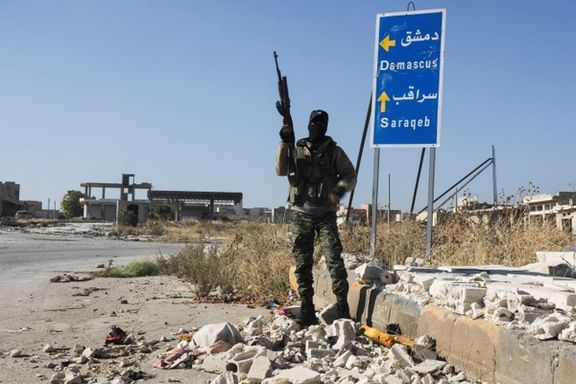
Syria’s second largest city Aleppo fell to rebel forces within a mere 48 hours of their launching a shock offensive. Now they push forward on the road to Damascus.
The hardline Islamist-led forces are unlikely beneficiaries of fallout from neighboring conflicts in which key Syrian allies Iran and Russia are sapped and distracted while uneasy neighbor Turkey presses its advantage.
Syrian president Bashar al-Assad, accused of war crimes by many Syrians and rights groups, fended off an armed challenge to his rule following Arab Spring democracy protests in 2011 with help from Iran-backed Hezbollah fighters and Russian air power.
But much has changed. The war in Ukraine has preoccupied Russia, Hezbollah limped to a ceasefire with Israel and Iran finds itself on the backfoot in a multifront confrontation with Israel in which it has lost the initiative.
“Over the last year, Hezbollah's forces inside Syria got weaker,” said Ibrahim Al-Assil, a Syrian analyst at the Middle East Institute in Washington, D.C.
Al-Assil said he was detained by the Syrian secret police in 2011 while taking part in a peaceful protest against Assad in Damascus. He said he was interrogated and tortured for four days at a Syrian military Airport.
“Now even Russia is overwhelmed and busy with the war in Ukraine,” said Al-Assil who founded the Syrian Nonviolence Movement but now predicts deadly upheaval. “The battle is not going to be easy. It's going to be bloody. It's going to be brutal."
The Israeli military has launched dozens of strikes on alleged Iran weapons facilities, smuggling routes and warehouses, curbing the ability of Iran and its allies to help.
The Israeli military announced on Tuesday in a new release that their Air Force conducted a strike in Damascus targeting Hezbollah’s representative to the Syrian military, Salman Nemer Jamaa.
Israel said Jamaa was a Hezbollah operative who was a key figure in enabling weapons smuggling to Lebanon from Syria, in a sign the Jewish state would still pound its Lebanese adversary despite the calm next door.
How far can Iran go to support Assad?
Whether Iran in its cash-strapped and weakened state can afford to come to Assad's rescue remains a key question.
“Is Syria the hill the Iranian regime is willing to die on? I don't think so,” said Hazem Alghabra, who grew up mostly in Syria was a former advisor to the US State Department on Near Eastern Affairs.
The Iranian establishment may understand its weakened position, and Hezbollah forces could be demoralized and underequipped after a punishing 14-month wrestle with the Mideast's top military power.
“The Iranian regime is not going to make big decisions while they're being chased literally by Israel and the United States. The Iranian regime moves when there's an opportunity, a weakness," Alghabra said. "They operate a bit like a virus, whenever they see a weakened immune system, they move in it."
Who are the rebel forces?
Two of the main rebel forces, Hayat Tahrir al-Sham (HTS) and the Syrian National Army (SNA), are both backed by Ankara.
HTS, known as the Organization for the Liberation of the Levant, is a former Al Qaeda affiliate that pledges to build a state based on Islamic principles.
They are made up Islamist insurgents with Jihadi ideology and former Free Syrian Army factions. They managed to take control of key places in Syria such defense factories in Aleppo, a thermal power station and an air base, according to monitors and eyewitnesses.
All met with little resistance, Greg Brew, an Iran analyst with the Eurasia Group told Iran International.
“Assad's forces have essentially melted away,” said Brew. “Turkey is largely in the driver's seat when it comes to extracting real concessions and real advantage from the situation."
Ankara, while supporting anti-government rebels, may not want Assad to fall, however.
Turkish President Recep Tayyip Erdogan may be using the Islamist insurgents to push a reluctant Assad to acquiesce to a Turkish sphere of influence in Northern Syria, allowing the millions of Syrian refugees in Turkey to return.
Weakened Syrian control over the area may aid Turkey's goal of undermining Kurdish foes further to the East who could also soon find the US military umbrella under which they have operated for years yanked away by an isolationist President Trump.
“Turkey is in a position to extract the greatest gains, the greatest advantage from this sequence of events, even if it hasn't been dictating the events, it does look likely to benefit,” said Brew.
On Tuesday, US airstrikes hit the Eastern Syria in the city of Deir Ezzor. The day before, US backed anti-Assad forces took several villages there from Iran and Iran-backed Assad forces.
While regional power politics may mean Israel and Turkey do not seek Assad's outright ouster, Syrian people trapped in the conflict are at the mercy of the country's clashing internal foes.
Syrian's suffered under the human rights abuses of their president but are likely wary of the Islamist insurgents who have pushed out his forces in recent days.
"People now are focusing on survival," said Al-Assil.
Kash Patel, chosen by US President-elect Donald Trump to lead the FBI, was recently notified by the bureau that he was a target of an Iranian hack, two sources familiar with the situation told CNN.
Hackers accessed at least some of Patel’s communications, according to one source.
“Kash Patel was a key part of the first Trump administration’s efforts against the terrorist Iranian regime and will implement President Trump’s policies to protect America from adversaries as the FBI Director,” Trump transition spokesman Alex Pfeiffer said in an statement.
Iran is witnessing a record surge in divorces, with couples citing economic hardship as the primary cause, interviews with Iran International reveal.
Their accounts align with new data showing that Iran has reached its highest-ever divorce-to-marriage ratio.
Iran’s Open Data Center, which provides public access to government-generated data, reports that from March 20, 2023, to March 20, 2024, there were 2.4 marriages for every divorce recorded.
While there were just 481,000 marriages in that timeframe, reportedly the lowest in 27 years – divorces soared up to 202,000, marking the third-highest divorce count on record.
In the 1980s, the national divorce-to-marriage ratio was under 9 per 100 marriages. Since then, it has quadrupled, now approaching 40 divorces for every 100 marriages.
In light of the Iranian government’s crackdowns on individuals speaking to foreign media, some names have been abbreviated or last names omitted.
Professor K., a sociologist, told Iran International how financial instability has driven unprecedented pressure on marriages in Iran.
“When couples can’t afford rent or constantly fear eviction, the sense of security needed to nurture a relationship vanishes,” he said. “Young families feel trapped between rising inflation and unemployment. It’s tearing them apart.”
Trapped in Tehran's rising cost of living
The challenges faced by young couples are evident in the nation’s capital, where Narges and Ali say they once dreamed of buying a small apartment after their wedding.
Today the 29-year-olds have been married for three years and say they have noticed that with each year, rising prices push that dream further out of reach.
A divorce court in Iran
Ali told Iran International that they kept hoping the next year would bring some relief to their household finances.
"But after a while, it felt like living in limbo," he said.
In March, a report from state-controlled media indicated that nearly one in three Iranians is living below the poverty line, largely due to the high inflation experienced over the past five years.
Like many Iranian families, the financial challenges confronting Narges and Ali, have seeped into their personal lives.
“We were just existing,” Narges said. “He worked day and night, and so did I, but each time we saved a little, the rent would go up again. One day, I looked at him, and we both knew—we were just surviving. There was nothing left between us.”
Some studies suggest that by the year 2051, around 26 million of the country's population, or one-quarter of the population, will be elderly.
Despite several massive budget allocations to a regeneration scheme, fewer babies are born each year.
Iran’s government has set an ambitious target to raise the fertility rate to 2.5 by 2028, but critics say the state has not been able to boost the living standards, with more than 35% considered to be living under the absolute poverty line according to official statistics and many more living in increasing hardship despite having multiple jobs.
An examination of rental prices in the capital and the ongoing housing crisis highlights why many families have downsized, relocated to less desirable areas, or are living indefinitely with their parents, as is the case with Leila and her fiancé.
Like Narges and Ali, Leila and her partner say securing a place to live together remains a distant dream for them.
In Tehran, the monthly rent for a one-bedroom apartment in central districts has surged to over 250 million rials (approximately $400), whereas the average household income is around 150 million rials (about $220).
With a master’s degree in accounting, 27-year-old Leila told Iran International that her job prospects are limited, and her savings minimal.
“We’re both working, but after covering expenses, there’s hardly anything left to save,” she says.
Her mother, Farideh, shared, “When I was her age, I was already married, and we had our own place. Now the struggle is just to live, forget about a wedding or children.”
According to the latest data, Alborz province, located just north of Tehran, recorded a rate of 61 divorces for every 100 marriages. Other provinces in the region, including Mazandaran to the north, Tehran itself, Gilan to the northwest, Semnan to the east, and Markazi to the southwest, are also experiencing similar trends.
Economic strain delays marriage in traditional regions
In regions where traditional marriage norms remain strong, divorce rates are lower.
The latest statistics suggest that Chaharmahal and Bakhtiari recorded 30 divorces per 100 marriages and South Khorasan 27 – both closer to the national average.
Meanwhile, Sistan and Baluchestan recorded the lowest rate, with just 10 divorces per 100 marriages.
People walk in Grand Bazaar, in Tehran, Iran, September 8, 2024.
But, the economic strain in these regions appears to impact overall low marriage rates.
Despite its resource wealth, Sistan and Baluchestan face significant challenges, including underdevelopment and poverty. Reportedly the poorest province of Iran, it has a population of 4 million, which includes about 700,000 Afghan nationals.
Over the past years, the region has experienced many crises, including shortage of fuel, bread, and drinking water, as well as drought, widespread unemployment and increasing poverty.
Hossein, a shop owner in the provincial capital Zahedan, explained that poverty among the youth is fueling disillusionment.
“Young men used to marry in their early 20s. Now, they wait until they can support a family – but that day seems further and further away,” he told Iran International.
Mehri, a 32-year-old teacher and mother of two from Semnan, says she struggles daily with her family’s financial burdens.
Her husband, once an engineer, was laid off, and she says they are now forced to survive and live on her modest teaching salary.
“There’s no peace in our home anymore,” she told Iran International.
Sociologists, including Professor K., caution that the continued trend of low marriage rates could lead to broader social challenges, including increased isolation.
“Marriage has always been a cornerstone of stability in our culture,” said Professor K. “As more families fracture under economic pressures, we risk losing the community bonds that marriage has traditionally helped to strengthen.”
With economic pressures showing no signs of abating, experts say the disintegration of traditional marriage patterns over the last decades will lead to long-term challenges for Iran's social fabric.
As debates in Iran continue over the possibility of negotiations with the United States, divisions have emerged. While some advocate for talks, others remain skeptical about their potential benefits or even feasibility.
Iran's embattled Vice President for Strategic Affairs and former foreign minister, Mohammad Javad Zarif, authored an article in Foreign Affairs titled "How Iran Sees the Path to Peace," stating, "The Islamic Republic is open to negotiations – including with America."
Zarif added: "Instead of increasing pressure on Iran, the West should pursue positive-sum solutions. The nuclear deal provides a unique example, and the West should look to revive it. But to do so, it must take concrete and practical actions—including political, legislative, and mutually beneficial investment measures—to make sure Iran can benefit economically from the agreement, as was promised. Should Trump decide to take such steps, then Iran is willing to have a dialogue that would benefit both Tehran and Washington."
While Zarif talked about "reviving" the 2015 nuclear deal, the United States clearly wants a totally new deal covering matters beyond the nuclear issue, including Iran's regional ambitions and its missile program which happens to be a source of concern for Iran's neighbors and European states.
Despite Zarif's overture, hardliner analyst Foad Izadi who is characterized by the Iranian state television as an expert on the United States, told conservative Nameh News website in Tehran: "We cannot say with a one hundred percent assurance whether negotiating with the United States is good or bad for Iran as we do not have access to confidential information."
Expressing distrust of the United States, Izadi accused the US, along with Turkey, of involvement in the Syrian insurgents' surprise attack on government forces allied with Iran. As evidence for his claim, he cited Secretary of State Antony Blinken, who remarked that "the United States was not surprised" by the attack on Aleppo, despite Hay’at Tahrir al-Sham (HTS), the main insurgent group, being designated as a terrorist organization by the US.
Izadi further alleged, "If the Americans did not design the attack, they were at least aware of it—and they are undoubtedly pleased with what is happening in Syria." He added, "The United States' plan is to settle scores with the Islamic Republic within the next four years, as beyond that, it will be unable to act due to Iran's membership in the Shanghai Cooperation Organization and BRICS agreements."
He further charged that Iranian supporters of negotiations with the United States are not aware that the other sides use negotiations only “to buy time, to confuse Iranian officials and to wage a psychological war on Iranians."
Iran should negotiate with the United States only when the officials can say with a high degree of certainty that the country is going to be better off after the talks, Izadi said.
Former head of the Iranian parliament's National Security and Foreign Relations Committee, Heshmatollah Falahatpisheh, told the Khabar Online website in Tehran that China and Russia favor Trump's "maximum pressure" policy against Iran. He added that Russia is also wary of any potential agreement between Iran and Europe. However, he noted that Europe’s primary goal in its negotiations with Tehran is to address its own concerns.
Falahatpisheh emphasized that the United States remains the primary actor in negotiations with Iran. He argued that Iran's best course of action is to persuade Europe not to allow itself to be leveraged by the US to trigger the 2015 nuclear deal’s snapback mechanism against Iran.
He concluded, "Trump will never engage in negotiations that do not advance the interests of the United States."
IRGC commander Javad Ghaffari in a feature from Iran's state broadcaster in Arabic, Al-Alam
An Iranian commander who led the battle to retake Aleppo from Syria’s opposition forces in 2017 has returned, Iran’s state media said, as President Bashar al-Assad faces renewed threats from armed groups bent on toppling his government.
Javad Ghaffari, a senior figure in Iran’s Revolutionary Guard Corps (IRGC) was reported to have arrived in Damascus on Sunday, Iran's state-run Al-Alam news website reported, hours after Iran’s foreign minister said Iranian forces could be deployed to Syria if requested by Assad.
Ghaffari was sanctioned by the United States in September 2024 for his role in “targeting critics of the Iranian regime abroad” as head of the IRGC Intelligence Organization’s Special Operations Division.
Previously, Ghaffari spent a several years in Syria leading forces, including Hezbollah fighters and the Afghan Fatemiyoun militia in campaigns to reclaim key central and Eastern cities Palmyra, Deir ez-Zor, and Al-Bukamal from opposition groups.
He was dubbed Butcher of Aleppo by his foes following the bloody battle over Syria’s second largest city, where thousands were killed and injured.
Despite his military successes, Ghaffari had to leave Syria in 2021, according to Times of Israel, after his actions — including attacking American forces and deploying Iranian weapons to unauthorized locations — were deemed by Damascus to have contravened Syrian sovereignty. The report was not independently confirmed.
His re-emergence underscores Iran’s enduring influence in Syria and Assad’s precarious situation following the recent advances of his adversaries.
Armed groups led by Hayat Tahrir al-Sham launched a significant offensive last week, violating a four-year-old truce and seizing substantial portions of Aleppo and its suburbs, as well as areas around the northwestern city of Idlib.
The Syrian army has responded by retreating from key positions in Aleppo to regroup in northern Hama. Reinforcements and equipment are arriving in the area, with preparations for a large-scale counteroffensive underway to reclaim lost territories.
Ghaffari’s presence signals both a renewed Iranian commitment to Assad’s survival and the high stakes of the ongoing conflict.
Chief of Staff of Iran's Armed Forces Mohammad Bagheri held separate phone conversations with Russia's Defense Minister Andrey Belousov as well as the army chiefs of staff of Iraq and Syria to discuss the latest developments in Syria, Iranian state media reported Tuesday.
In the phone calls, Bagheri warned that the ongoing offensive by armed rebels in Syria represent the first step in a dangerous scenario for the region, according to Iranian state-run media.
"The parties involved in the phone conversations agreed on unequivocal support for Syria's legitimate government and resolved to take necessary measures to support the Syrian army," the reports said.
The top military officials also called on Syria's neighboring countries to take necessary actions to prevent the support of the rebels, the readout of Bagheri's calls said, apparently referring to Turkey which is known as the main supporter of Syrian rebels who have captured the city of Aleppo over the past week.