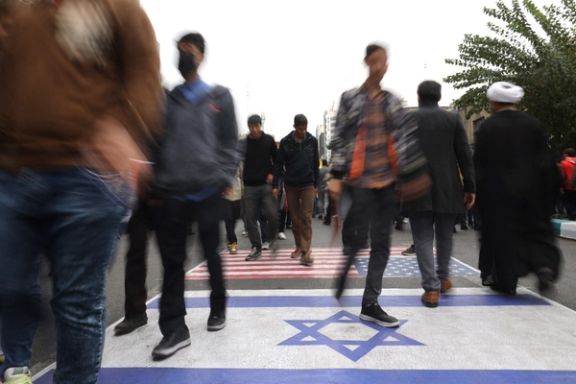
A group of Iranians walk over the flags of Israel and the US during a government-sponsored rally in Tehran
A growing number of commentators in Iranian media are criticizing hardline politicians for rhetoric they say has strained foreign relations and deepened the country's isolation.
A notable example of such remarks is former President Mahmoud Ahmadinejad's statement advocating for "wiping Israel off the map." Many believe this comment significantly escalated hostility between Iran and Israel, though it was rooted in Ayatollah Ruhollah Khomeini’s stance toward the Jewish state.
Ahmadinejad is also known for dismissive remarks about the significance of UN resolutions against the Islamic Republic, which ultimately led to economic sanctions that severely affected Iranians' livelihoods for nearly 15 years.
Former reformist lawmaker Mohsen Mirdamadi has emphasized that Iranian officials must refrain from making such statements to support and advance diplomatic efforts with the West.
Mohsen Mirdamadi
Although some Iranian officials, including Supreme Leader Ali Khamenei, do not have official spokespersons, Iranian media often publish statements by lower-ranking officials that can undermine state affairs and disrupt the leadership's plans for advancing their agenda.
The absence of an official spokesperson for Khamenei recently sparked controversy in the Iranian parliament over whether Vice President Mohammad Javad Zarif should be dismissed, as demanded by his ultraconservative lawmakers. Earlier, Mehdi Fazaeli, a senior official in Khamenei's office, quoted the Supreme Leader as opposing challenges to Zarif's qualifications. However, ultraconservatives argued that Fazaeli was not an authorized spokesperson for Khamenei, casting doubt on the statement's credibility.
In 2018, the Iranian government under former President Hassan Rouhani went without a spokesperson for 179 days—just one day short of six months. At the time, the conservative Mehr news agency sharply criticized Rouhani, claiming that his failure to appoint a spokesperson signaled an unwillingness to be accountable to public opinion.
However, it is not clear is certain provocative statements are the result of bad judgement or are designed to give mixed signals to both the Iranian public and foreign audiences.
In a recent example of issuing statements seemingly at odds with the government's broader policies, Iran's nuclear chief, Mohammad Eslami, announced, "We have begun injecting gas into several thousand advanced centrifuges, which is part of the nuclear industry's development program, and have put them into operational circuits." This remark appeared to disregard the fact that it directly contradicted a recent IAEA resolution condemning Tehran for violating its international obligations under the 2015 nuclear deal, and the government’s declarations that does not seek nuclear weapons.
The statement was made two days before a meeting with the United Kingdom, France and Germany to reduce the tensions between Tehran and European powers.
The Islamic Revolutionary Guard Corps (IRGC) has an official public relations office led by a chief who acts as a spokesperson. However, various commanders frequently make incendiary statements that do not necessarily align with the policies of the government or the IRGC itself. In recent months, while Khamenei has occasionally been cautious to avoid provoking Israel or the West, IRGC officers have repeatedly issued threats. At times, total news blackouts on military or nuclear issues suggest that orders for silence may have come from higher authorities. Yet, these periods of quiet are often short-lived, as outspoken officers tend to make remarks at any moment.
In an interview, Mirdamadi emphasized that Iranian officials and military commanders should refrain from making costly remarks, particularly on foreign policy matters. He stated, "They often chant impractical slogans, leaving the nation to bear the heavy consequences of mistakes it did not commit. In the recent incident leading up to the IAEA resolution, some politicians made unnecessary but highly damaging statements."
Mirdamadi was referring to remarks like the one made by former deputy judiciary chief Mohammad Javad Larijani who suggested that Iran can make a nuclear bomb in 24 hours.
Mirdamadi also criticized Iran's approach, stating, "We should neither underestimate nor overrate the country's capabilities. We need to be realistic and recognize that Iran cannot singlehandedly change the world order. There are matters beyond Iran's power or authority, and it is not in our interest to define the country's priorities in a way that necessitates confrontation with other nations, particularly major powers."
Ironically, Mirdamadi himself was one of the leaders of the Iranian students who occupied the US embassy in Tehran in 1979, holding over 50 American diplomats hostage for 444 days, an incident that set the country on its course of foreign confrontations.
Iranian Foreign Minister Abbas Araghchi and Syrian President Bashar al-Assad (right) meet in Damascus on December 1, 2024.
Iran's foreign minister met the Syrian president in Damascus on Sunday to express Tehran's continued support for the Bashar al-Assad government in the wake of Aleppo's swift capture by armed rebels.
"The Islamic Republic will insist on its principled stance to fully support the Syrian government, nation and army in the fight against terrorism and safeguard regional security and stability," Abbas Araghchi said in his meeting with Assad.
Assad, in turn, thanked the Iranian foreign minister for his "meaningful" visit to Syria under the current circumstances, according to Iran's readout of their talks.
Following the meeting, Araghchi told reporters that the two sides discussed "the details of the support Syria must receive."
"I conveyed Iran's message of support for Syria and for Bashar al-Assad himself... It is natural for the situation to be difficult, but the courage and spirit of the Syrian president were admirable," he said, adding that they had reached "good understandings."
Iran has played a major role in the Syrian civil war, aligning itself with Assad's government against various opposition groups since the conflict began in 2011.
Tehran provided substantial military support, including advisors, ground troops, and militia fighters from across the region, helping Assad win back much of the territory his forces had lost by 2020.
Between the March 2020 Idlib ceasefire and late 2024, frontline fighting mostly subsided. However, the recent capture of Aleppo by Hay'at Tahrir al-Sham (HTS) and its allied groups may convince Tehran to reinforce the Assad government again.
"Whether Iran will send forces to Syria again, similar to what it did in the past, depends on future circumstances and the decisions of the country's senior officials," Esmaeil Kowsari, an IRGC general-turned-lawmaker who sits on the Parliament's national security and foreign policy committee, said on Sunday. "However, the Resistance Front will definitely become active in Syria."
The Resistance Front refers to the alliance of armed militant groups sponsored by Iran, including Hezbollah, Hamas, the Palestinian Islamic Jihad, Houthis in Yemen, and Iraqi Shiite militias. For now, Hezbollah and Iraqi militia seem to be the only forces who are positioned to join the Syrian government's fight against rebels.
Iran rallying regional support for Assad
Iran's President Masoud Pezeshkian on Sunday had a phone call with Iraqi Prime Minister Mohamed Shia Al-Sudani, during which he expressed Tehran's preparedness for cooperation with regional states in the fight against armed rebels in Syria.
"These kinds of events are part of the sinister plans of the Zionist regime (Israel) to promote insecurity, discord, and conflict within Islamic countries. This issue has made the alignment and joint efforts of the Islamic Ummah to prevent the spread of terrorist trends in the region an essential task," Pezeshkian said in the phone call.
Earlier in the day, he had urged Islamic countries to intervene in Syria to prevent further internal conflict, saying that they should not allow this conflict within an Islamic country to persist.
Next stop: Ankara
After meeting Assad and dining out in a restaurant in Damascus in an apparent message of calm in Syria, Araghchi left Damascus for Ankara to discuss the Syria developments with Turkish officials.
Turkey is known as a key supporter of Syrian rebels who have captured Aleppo over the past few days, and had given a green light to the offensive, Reuters reported citing opposition sources in touch with Turkish intelligence.
Iranian dissident rapper Toomaj Salehi, who was previously sentenced to death, has been released after serving one year in prison, Iran's Judiciary announced on Sunday.
"The convicted individual, Toomaj Salehi, who had been sentenced to one year in prison for the crime of propaganda against the Islamic Republic, was released from prison on December 1, 2024, after serving his sentence," a statement released by the Judiciary's news agency Mizan said.
Toomaj, a metalworker from Isfahan in central Iran, emerged as a prominent figure in Iran's 2022 uprising, using his rap lyrics to condemn repression, injustice, and poverty.
During the height of the Woman, Life, Freedom protests on October 30, 2022, the intelligence ministry in Isfahan province violently arrested him again for his artistic activities in favor of the anti-government movement. While in custody, he was tortured severely and forced to make televised "confessions".
Toomaj was sentenced to 75 months in prison last July after the Iranian Supreme Court overturned the decision of a lower court sentencing the rapper to a death. More than a year after being arrested, he was released on bail in November 2023. Several days after his release, he published a video message alleging torture and mistreatment at the hands of intelligence agents. Almost immediately, he was re-arrested.
In April 2024, Salehi was sentenced to death by a revolutionary court in Isfahan on charges of "spreading corruption on Earth." Iran’s Supreme Court overturned the death sentence in June.
Toomaj's release came a few weeks after Iranian dissident journalist Kianoosh Sanjari committed suicide after warning he would take his own life unless several prisoners, including Salehi, were released.
Shortly after Sanjari's death, fellow activist Hossein Ronaghi began a hunger strike by sewing his lips shut. He vowed to continue his sit-in protests in this symbolic act until the late journalist and close friend’s demands to free political prisoners, including Toomaj, were met. From behind bars, Toomaj urged Ronaghi to end his hunger strike, pleading with him not to risk his life.
A rebel fighter carries a weapon as he stands at the entrance of Saraqeb town in northwestern Idlib province, Syria December 1, 2024.
The fall of Aleppo to rebels opposing President Bashar al-Assad has caused a critical situation for the Syrian government with implications that may extend to the Islamic Republic of Iran.
Opposition forces have now advanced towards the outskirts of Hama and Homs, two strategic Syrian cities on the road to Damascus. The potential fall of Damascus and the overthrow of the Assad government is more serious than ever, causing deep concerns for the Islamic Republic and its leader, Ali Khamenei.
Map of Syria (Via World Atlas)
The collapse of Assad’s rule would dismantle a cornerstone of Iran’s regional strategy against Israel. It would also threaten the survival of Iran's proxy groups, which rely heavily on Damascus for support. Without Assad’s backing, these groups could struggle to sustain their operations, jeopardizing the Islamic Republic’s influence in the region.
For Khamenei and Iran’s Revolutionary Guards (IRGC), Assad’s government is a vital pillar of the so-called Axis of Resistance. Its potential fall could even endanger the stability of the Islamic Republic itself.
The coming days are pivotal for both Assad’s government and Iran. The defeat in Aleppo dealt a major blow to the morale of the Syrian army and government, but the greater concern for Assad and the Islamic Republic is the possibility of opposition forces advancing toward Damascus after consolidating their power in the north and toppling the government.
The opposition forces now control Aleppo and Idlib near Turkey’s borders and are rapidly advancing in Hama and Homs governorates with reports that they are at the gates of the provincial capitals. Capturing the cities of Hama and Homs would give them a strategic advantage, potentially allowing a push toward Latakia, the Assad family’s power base, or Damascus.
The situation today is starkly different from 2016, when Assad, with robust support from Russia, Hezbollah, and Iran, defeated opposition forces in the battle of Aleppo. Several factors have contributed to the weakening of the Assad government and its supporters:
- Russia's involvement in Ukraine: Russia, a key ally of Damascus, is preoccupied with the war in Ukraine, limiting its ability to provide military support compared to 2016.
- Hezbollah's diminished sway: Iran-backed Hezbollah, a powerful armed ally of Damascus, has suffered significant losses in its conflict with Israel and faces domestic pressure in Lebanon to reduce its involvement in regional conflicts.
- Iran's economic constraints: Tehran’s financial woes made worse by US sanctions have restricted its ability to provide financial and military aid to the Assad government. According to estimates, Tehran has spent tens of billions of dollars in Syria but now finds it hard to continue such support.
- Erosion of the IRGC's manpower and logistics in Syria: Key IRGC commanders, including former chief of IRG's extraterritorial Quds Force Qasem Soleimani, have been killed in recent years and the replacement forces do not have the same capabilities. Additionally, proxy groups such as the Afghan Fatemiyoun Division Iraq’s Popular Mobilization Forces (PMF) are less effective than before.
A rebel fighter stands atop of a military vehicle as he carries a Hayat Tahrir al-Sham flag in Saraqeb town in northwestern Idlib province, Syria December 1, 2024.
If Assad’s falls, Iran’s regional foreign policy could face a severe crisis. Damascus plays a crucial role in facilitating the transport of weapons, logistics, and financial support to Iran’s proxy groups. Its collapse would likely lead to:
- Disruption of weapons transfers to Hezbollah via Damascus and Latakia airports.
- Reduced support for Palestinian groups such as Hamas and the Islamic Jihad.
- Destruction of smuggling networks for arms and narcotics into Jordan and the West Bank.
For Iran, preserving Assad's government is a matter of strategic survival. While Khamenei and the IRGC are likely to make every effort to prevent its collapse, their resources and influence are far weaker than in the past. Ultimately, Assad’s fall could dismantle the 'Axis of Resistance’ and pose a serious threat to the Islamic Republic’s future.
Iran's President Masoud Pezeshkian addressed parliament on December 1, 2024.
In a public appeal, the Iranian president urged citizens to conserve energy, emphasizing their role in mitigating the country’s ongoing energy shortage, a crisis that has intensified in recent months.
Speaking after a closed-door meeting between the government and members of the parliament, Masoud Pezeshkian told lawmakers, “Our need for you to continue on this path is far greater than what has been done so far,” emphasizing that overcoming the shortages in the energy sector required both government and popular cooperation.
The call comes as Iran grapples with widespread power outages, rising fuel prices, and a looming fiscal crisis.
While Pezeshkian stopped short of directly referencing potential increases in fuel prices, his remarks suggest an acknowledgment of the urgency of the situation.
The government’s longstanding narrative, which places the blame for the energy crisis on the people’s excessive consumption, has increasingly fallen flat in the face of growing public frustration.
Calls for citizens to conserve energy have become a familiar refrain, but many Iranians are growing skeptical of these appeals, seeing them as an excuse for government inaction rather than a solution.
An Iranian energy worker adjusts a valve amid heavy snowfall, highlighting the challenges of maintaining gas flow during winter months.
In September, Hassanali Taghizadeh, chairman of the Iran Electrical Industry Syndicate, dismissed claims of excessively high domestic electricity consumption, saying that Iranian households use roughly half the electricity per capita compared to European households.
"Don't blame the people. Don't falsely claim that people's consumption is high. The average per capita consumption of Iranians is 1,220 kilowatt-hours per year, while in Europe it is 2,120 kilowatt-hours," he said. According to Eurostat, the electricity consumption per capita in the household sector in the EU in 2022 was 1,584 kWh,” he said.
In his speech, Pezeshkian addressed the escalating energy shortages, claiming that they could only be corrected with the collaboration of both parliament and the people.
His rhetoric, however, appeared detached from the reality of the situation, as citizens continue to face power outages, unreliable energy supplies, and skyrocketing living costs.
The energy crisis is compounded by a widening fiscal gap, with the next year’s national budget projected to have a deficit exceeding $30 billion, or more than 30% of total expenditures.
While Pezeshkian briefly addressed the fiscal challenges in his remarks, much of the meeting appeared to be consumed by speeches and vague declarations, rather than solutions.
The government's repeated calls for the people’s help seem more like an attempt to deflect responsibility than an invitation for meaningful dialogue on energy policy reform. Other officials and commentators have argued that Iran has failed to make the necessary investments in oil, natural gas and electricity production and upkeep of the grid.
The potential increase in fuel prices, which has sparked considerable controversy in parliament, was also a central topic of discussion. Some lawmakers expressed strong opposition to the proposed hikes, warning that they could ignite political unrest, much like the 2019 protests that followed a sudden increase in fuel prices.
Adding to the skepticism surrounding Pezeshkian’s remarks, the government’s claim that Iran spends billions annually on fuel imports has been called into question.
Pezeshkian said that the country imports $5 billion worth of fuel each year, but state-run news outlets, including the IRGC-affiliated Tasnim News Agency, disputed this figure, saying that only $2 billion worth of fuel was imported in the past year.
Meanwhile, the country’s chronic problem of fuel smuggling continues to undermine the government’s narrative.
Fuel smuggling in Iran remains a significant issue, with trucks crossing border areas to illegally transport subsidized gasoline to neighboring countries.
Economist Mousa Ghaninejad recently said that an estimated 50 million liters of gasoline are being illegally exported from Iran every day—far more than previous estimates of 20 million liters. Ghaninejad’s figures point to a much larger and more organized network of smuggling, suggesting that the problem is not confined to small-scale operators along the borders, as the government has often said.
As Iran heads into the new year with a deepening energy crisis and growing political tensions, the question remains whether the government can move beyond speeches to implement meaningful reforms.
Iran’s government says it is taking steps to resolve the long-standing problem of being black-listed by the Financial Action Task Force (FATF) but hardliners still staunchly oppose accepting the watchdog's recommendations.
Q: How long has Iran been on the FATF black list:
The Islamic Republic of Iran was on FATF black lists from 2008 to 2016. In February 2020 Iran was black-listed again and has remained so to date.
Q: What does being on the FATF black list mean?
The FATF black list is officially called “high-risk jurisdiction subject to a call for action”.
Countries that fail to address deficiencies in their anti-money laundering and counter-terrorism financing regimes are described as “high-risk jurisdiction subject to a call for action”.
The FATF advises its members and financial institutions to apply “enhanced due diligence” in their dealings with black-listed countries. Enhanced due diligence makes international transactions high-risk, costly, and time-consuming for financial institutions.
Countries may also be called upon to apply “countermeasures” to protect the international financial system from money laundering, terrorist financing, and proliferation financing risks including limiting or terminating business relationships, increased monitoring and reporting, restrictions on correspondence banking relationships, prohibiting certain transactions, and increased external audit requirements, and encouraging the use of alternative payment methods.
Q: What happened in Iran's case between 2016 and 2020:
In June 2016, after the 2015 nuclear deal with world powers and the lifting of UN sanctions, FATF called on its members to suspend the countermeasures they used in their dealings with Iran for twelve months.
This meant being included in the so-called gray list and continuation of due diligence.
Q. Why was Iran put on the gray list?
Iran was temporarily removed from the black list because the country committed to implementing an action plan to address FATF’s concerns regarding the establishment of a cash declaration regime and counter-terrorism financing and anti-money laundering legislation and by-laws.
In February 2020 the FATF noted that there were still items not completed and several requiring to be fully addressed and urged member countries to once again apply countermeasures in their financial dealings with the Islamic Republic, i.e., black-listed Iran again.
Q: How does being black-listed affect Iran?
Without accession to the international financial conventions demanded by FATF, Iran cannot have full access to global banking, normal trade relations, and investments with large global companies. Being black-listed means Iran can also not have access to loans by the International Monetary Fund (IMF) and the World Bank.
Being black-listed has thus caused disruptions to Iran's international trade with most countries over the years and discouraged foreign investment. It has also damaged Iran's reputation and reinforced the impact of previous UN sanctions and sanctions by the US.
Q. How does FATF enforce its decisions?
The FATF is only an advisory body but countries, including Iran, must make their own legislation based on FATF recommendations to ensure compliance and avoid negative assessment of the health of their financial system by the task force.
Q: Is Iran cut off from SWIFT for being on the FATF black list?
Being cut off from SWIFT (Society for Worldwide Interbank Financial Telecommunication) is related both to US sanctions and being black-listed by the FATF.
Banks and other financial institutions that use SWIFT must comply with the anti-money laundering and counter-terrorism funding regulations of their respective countries based on FATF recommendations.
The United Kingdom, for instance, has several laws, such as the Money Laundering, Terrorist Financing and Transfer of Funds (Information on the Payer) Regulations, to ensure compliance with FATF regulations.
Q: What steps did Iran take towards completion of its action plan before being black-listed again in 2020:
The FATF has made 41 recommendations to the Iranian government 37 of which, including a cash declaration regime, it has accepted by passing legislation, although actual implementation remains in doubt.
In a statement in June 2018, the FATF said Iran had introduced draft amendments to its anti-money laundering and counter-terrorism financing laws but had failed to complete its action plan.
The global anti-money laundering task force, therefore, urged its members to continue to advise their financial institutions to apply enhanced due diligence to business relationships and transactions with natural and legal persons from Iran.
Q. What were the four pieces of legislation that Iran planned to introduce?
The Iranian parliament approved the following four pieces of legislation but two of these, the legislations for accession to the Palermo and CTF conventions, have not been finalized to date.
Amendments to the Law on Combating Money Laundering
Amendments to the Law on Combating the Financing of Terrorism
Accession to the International Convention on Combating Transnational Organized Crime (known as the Palermo Convention)
Accession to the International Convention on Combating the Financing of Terrorism (known as CFT)
Q: Why have the laws required for accession to the Palermo and CTF conventions not been finalized?
Iran's hardline-dominated constitutional watchdog, the Guardian Council, rejected the two pieces of legislation. The dispute between the parliament and the Council was referred to the Expediency Council in 2019 for arbitration.
The Expediency Council has stayed the matter since then and neither approved nor rejected them, purportedly due to the objection from hardliners who claim accession will be harmful to Iran's “national security” because the transparency will shed light on the country’s dealings with its proxy forces in the region among other things; exactly the reason for the existence of the international conventions.
Q. What is the approach of Masoud Pezeshkian’s government to the FATF issue?
Unlike his hardliner rivals, Pezeshkian repeatedly called for accession to the FATF’s conventions during his campaign as a crucial move to prevent the country’s financial isolation. His government says a final resolution of the matter may be near. But the presidential administration has little influence in such matters that could impact the country's foreign military projects.