• العربية
  • فارسی
Brand
  • Iran Insight
  • Politics
  • Economy
  • Analysis
  • Special Report
  • Opinion
  • Podcast
  • Iran Insight
  • Politics
  • Economy
  • Analysis
  • Special Report
  • Opinion
  • Podcast
  • Theme
  • Language
    • العربية
    • فارسی
  • Iran Insight
  • Politics
  • Economy
  • Analysis
  • Special Report
  • Opinion
  • Podcast
All rights reserved for Volant Media UK Limited
volant media logo

Beleaguered Lebanese army set to play key role in any truce

Nov 20, 2024, 12:15 GMT+0Updated: 15:19 GMT+0
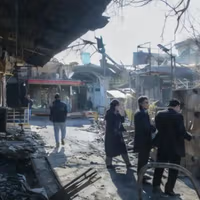
Shelling erupts between Hezbollah and Israel in South Lebanon. October 2023

Experts in Lebanon have called for international backing for the cash-strapped Lebanese Armed Forces if a ceasefire is to be sustained between Iran-backed Hezbollah and Israel.

While US envoy Amos Hochstein suggested a deal is within reach during his trip to Lebanon on Tuesday, the situation on the ground appears far more bleak.

“The army doesn’t even have money to put fuel in the patrol trucks,” said a senior Lebanese politician opposing Hezbollah. He spoke to Iran International on condition of anonymity after successive death threats from the group the US and others deem 'terrorist'.

“UNIFIL has no power militarily and it depends on the LAF [Lebanese Armed Forces], but mostly, the LAF isn’t even able to patrol with UNIFIL, which is a huge reason the latest conflict has escalated to this degree," he told Iran International.

UN peacekeeping forces, UNIFIL, were stationed around southern Lebanon since 2006 under UN Resolution 1701 after the second Lebanon war between Hezbollah and Israel.

Though first created in 1978, following the crisis of 2006 crisis, the UN Security Council strengthened the mandate of UNIFIL, allowing them to "monitor the cessation of hostilities; accompany and support the Lebanese armed forces as they deploy throughout the south of Lebanon; and extend its assistance to help ensure humanitarian access to civilian populations and the voluntary and safe return of displaced persons".

A protest in Beirut, Lebanon against Iranian influence in the country. 2019
100%
A protest in Beirut, Lebanon against Iranian influence in the country. 2019

However, the politician, who has held senior government positions, warned that without international funding and binding agreements, the LAF risks remaining a “toothless tiger,” as evidenced in recent years.

“The Lebanese economy is in collapse and the army has been one of the biggest losers, which of course, impacts the country’s security at the hands of Hezbollah which has infiltrated every institution and border areas," he said.

Though Israel has severely weakened Hezbollah since it stepped up its offensive in September, it has a barrage of firepower that continues to see dozens of projectiles fired into Israel daily.

In September, targeted air strikes saw Israel take out swathes of the group’s leadership as high as long-time leader Hassan Nasrallah, while a two-day operation saw around 1,500 Hezbollah operatives taken out of action when pagers and walkie-talkies simultaneously exploded.

UN Resolution 1701 aimed to push Hezbollah north and disarm all armed groups in a designated area of southern Lebanon. However, this was never fully implemented, with both Hezbollah and Israel accused of violating the agreement. Additionally, other armed groups, such as Palestinian Islamic Jihad, continued to operate in the region.

Lebanese army troops patrolling in Beirut. Undated
100%
Lebanese army troops patrolling in Beirut

Consisting of around 80,000 troops, the LAF has no air force and is not strong enough to take on either Hezbollah or an Israeli onslaught, its role being mostly limited to supporting civilians.

Andrew Fox, a former British paratrooper and fellow at the Henry Jackson Society, said the weakness of the LAF will be a sticking point for any peace moving forward.

Speaking to Iran International he said: "A key issue with this proposed peace deal is the lack of preparation and capability of the Lebanese Army. Even if not sympathetic to Hezbollah, they are far less well armed and motivated."

With Hezbollah still stronger and harder to control, the LAF will need to be ready for a potential re-entry of the group into southern Lebanon if a deal really forces a retreat to north of the Litani River as was proposed previously.

"This will present them with a real issue," added Fox. "If the LAF attempt to police the ceasefire and are defeated in combat, where does this leave the peace deal? It is hard to see how anything will be enforced if the IDF does not have the oversight to be able to step back in and interdict Hezbollah, should they try to reinfiltrate the South."

If a ceasefire is put into place, the Lebanese army will be expected to deploy thousands of troops south in order to maintain peace. However, with Hezbollah still significantly more powerful and better funded by its patron, Iran, the process will not be easy.

"The Lebanese army is in a situation that is sensitive and difficult. It cannot practice normal missions like the armies of other countries because there is another military force in the country," retired Lebanese brigadier general Hassan Jouni told Reuters, referring to Hezbollah.

On Tuesday, LAF chief, General Joseph Aoun, presented proposals for the first phase of a deployment in the south, sharing the army’s needs in terms of armament, logistical and financial support.

In August, the Lebanese government, which is divided on sectarian lines amid years of crisis, issued “initial approval” for Prime Minister Najib Mikati’s proposal to recruit 1,500 new troops for the army, part of a plan prepared by the army to recruit 6,000 soldiers before developing a plan for its deployment.

Ultimately, the government will have to approve the exact nature of the deployment, but in the end, the question remains as to whether Hezbollah will respect its authority.

Hezbollah affiliated Al-Akhbar said there were still significant “knots” in the negotiations. Quoting informed sources, it said problems remained around borders, which it said was “the knot of knots”.


Most Viewed

Iran negotiators ordered to return after internal rift over Islamabad talks
1
EXCLUSIVE

Iran negotiators ordered to return after internal rift over Islamabad talks

2
ANALYSIS

US blockade enters murky phase as tankers spoof signals and buyers hesitate

3
ANALYSIS

Why the $100 billion Hormuz toll revenue is a myth

4

US tightens financial squeeze on Iran, warns banks over oil money flows

5
ANALYSIS

US blockade targets Iran oil boom amid regional disruption

Banner
Banner

Spotlight

  • Hardliners push Hormuz ‘red line’ as US blockade tests Iran’s leverage
    INSIGHT

    Hardliners push Hormuz ‘red line’ as US blockade tests Iran’s leverage

  • Ideology may be fading in Iran, but not in Kashmir's ‘Mini Iran'
    INSIGHT

    Ideology may be fading in Iran, but not in Kashmir's ‘Mini Iran'

  • War damage amounts to $3,000 per Iranian, with blockade set to add to losses
    INSIGHT

    War damage amounts to $3,000 per Iranian, with blockade set to add to losses

  • Why the $100 billion Hormuz toll revenue is a myth
    ANALYSIS

    Why the $100 billion Hormuz toll revenue is a myth

  • US blockade targets Iran oil boom amid regional disruption
    ANALYSIS

    US blockade targets Iran oil boom amid regional disruption

  • Iran's digital economy battered by prolonged blackout
    INSIGHT

    Iran's digital economy battered by prolonged blackout

•
•
•

More Stories

Iranian activist says he was sexually abused during protest arrest

Nov 20, 2024, 10:39 GMT+0

An Iranian political activist has accused security forces of sexual and verbal abuse when he was arrested in Tehran on Monday.

Writing on X, Hossein Ronaghi detailed his allegations. "Inside the vehicle, they restrained both of my hands. The driver kept repeating vulgar insults about my mother. The one seated on my left grabbed my left hand and forcibly placed it on his groin, demanding that I touch him," he said.

He accused multiple officers of having inflicted verbal and physical abuse. "The officer on my left slid his hand under my shirt and commented to the one on his right, 'he's so pale, I want him to be my bride tonight in detention.' The other added, 'I'll take his mother in front of his eyes,'" he wrote on X.

Ronaghi, a 37-year-old blogger and dissident, had staged a sit-in protest to demand justice for fellow activist Kianoosh Sanjari, who committed suicide last week in protest against government oppression.

The journalist and activist had warned in a social media post that he would end his life unless several political prisoners, including Fatemeh Sepehri and Toomaj Salehi, were released.

Ronaghi used X to highlight problems faced by dissidents under the Islamic Republic's legal system, issues highlighted by international rights groups such as Amnesty International which has accused Iran of forced confessions among other practices such as torture.

"These are the same people who use such methods to extract confessions from people in Ekbatan," he wrote, referring to a neighborhood in western Tehran where security forces have been accused of coercing protesters into false admissions.

Last week, Iran's judiciary issued death sentences for six individuals living in Ekbatan accused of involvement in the killing of a Basij militia member during the nationwide protests that erupted in 2022.

Human rights organizations have repeatedly documented the systematic use of sexual violence in Iran’s prisons. Amnesty International reported in March 2023 that detained protesters, including children, were subjected to rape, groping, and electric shocks to the genitals. The organization highlighted these methods as tools to punish and extract confessions from detainees.

Ronaghi has been arrested multiple times since 2009 and has long written of torture in custody. Released on bail in November 2023 after a prolonged hunger strike, he has faced ongoing harassment from authorities.

He lost a kidney during a previous incarceration and continues to suffer from severe health complications. He has currently sewn his lips together in protest in a bid to raise awareness to the case of Sanjari.

Iran warns of complicated path with IAEA censure resolution on agenda

Nov 20, 2024, 09:35 GMT+0

Iran’s foreign minister has been reaching out to his counterparts and the head of the UN nuclear watchdog ahead of the agency's Board of Governors' expected passage of a censure resolution against Tehran.

In a phone call with South African counterpart Ronald Lamola on Wednesday, Abbas Araghchi warned that the resolution proposed by three European powers at the IAEA’s Board of Governors meeting would further complicate the situation.

The censure resolution against Iran was officially added to the Board's agenda on Tuesday night. France, Britain, Germany, and the United States are set to present the resolution during Wednesday’s meeting.

Araghchi also reiterated the sentiment in a phone call with the IAEA chief Rafael Grossi, saying that “if the other parties disregard Iran's goodwill and cooperative approach and pursue unconstructive actions by issuing a resolution at the IAEA Board of Governors meeting, Iran will respond in an appropriate and proportional manner."

In another phone call with French Foreign Minister Jean-Noël Barrot Tuesday night, he also said that if Iran's seek confrontation during the BoG meeting, the Islamic Republic will respond appropriately.

“This measure by the three European countries is in blatant contravention of the positive atmosphere created in the interaction between Iran and the Agency,” the Iranian foreign minister told his French counterpart. “It will only make matters more complicated.”

The planned censure is likely going through despite Tehran offering to cap its highly enriched uranium stock.

Previous voting patterns suggest that proposals backed by the key Western countries easily pass. A successful resolution could be a catalyst for France, Britain and Germany to trigger a so-called "snapback mechanism" to restore UN sanctions imposed on Iran before a 2015 multilateral nuclear deal.

The United States remains tightly coordinated with its European partners in advance of the IAEA Board of Governors meeting and strongly supports efforts to hold Iran accountable, State Department spokesperson Matthew Miller told Iran International, urging Tehran to cooperate with the IAEA.

What would Iran do: A race to the bomb or a deal with Trump?

Nov 20, 2024, 07:30 GMT+0
•
Negar Mojtahedi

A proposed censure of Iran for its lack of cooperation with the UN nuclear watchdog raises important questions at a critical time after Donald Trump’s reelection when Tehran faces regional weakness, economic pressure and Israel.

The planned censure is likely going through despite Tehran offering to cap its highly enriched uranium stock.

France, Britain, Germany, and the United States will introduce the resolution at Wednesday's meeting of the International Atomic Energy Agency (IAEA) Board of Governors, Iran International has learned.

Iran and nuclear experts agree on one thing: Trump’s return to the White House will have an impact on the Islamic Republic, but whether and how the incoming administration and the Islamic Republic may engage on the nuclear issue is up for debate.

The Iranian establishment has concern over the censure because of the approaching October 20, 2025 deadline for UN restrictions to be fully lifted. That’s when most restrictions against Tehran's nuclear program will be removed under the UN Security Council Resolution 2231, and the West will no longer be able to apply “snapback” sanctions.

A prior censure was made in June of this year, but it didn't seem to make any difference, however, experts point out the political climate was different a few months ago.

The Europeans could activate or trigger the mechanism, bringing back all of the previously lifted UN sanctions. 

Sina Azodi, a professor and researcher at George Washington University, told Iran International that the Islamic Republic would try to avoid internationally mandated sanctions from a political standpoint because it doesn’t serve their interests.

“Iran is under sanctions, but they are US unilateral sanctions. They are not internationally mandated sanctions of the United Nations. From a political standpoint, Iran would try to avoid a snapback of UN sanctions, especially since they're less than a year away from those sanctions to be completely lifted,” said Azodi who specializes in Iran's nuclear and foreign policies. 

Iran’s Foreign Minister Abbas Araghchi made comments on Iranian State TV Saturday suggesting that a diplomatic route on Iran’s nuclear ambitions still exists.

"We believe the window for diplomacy is still open, albeit for a short time, provided the other parties demonstrate genuine willingness. Without such commitment, we will pursue an alternative course, "said Araghchi.

Araghchi also said that Iran’s intentions were conveyed to the IAEA chief Rafael Mariano Grossi during his latest trip to the Islamic Republic last week. Iran offered not to expand its stockpile of uranium enriched up to 60% during his visit.

Gregory Brew, an Iran analyst with the Eurasia Group, noted that while Iran appears to signal a willingness to make concessions, it insists on doing so strictly on its own terms.

“Iran will deal, but only if they get what they want—sanctions relief—without having to make sweeping concessions on either their program or other elements of their foreign policy,” said Brew.

Despite the rhetoric, Iran’s actions are proving otherwise.

Tehran has increased its stockpile of enriched uranium to near weapons-grade levels, according to the Associated Press, which viewed a confidential report by the United Nations' nuclear watchdog Tuesday.

Uranium enriched at 60% purity is just a short step away from weapons-grade levels of 90%.

With Trump’s second term around the corner – and Iran’s deterrence proxies Hamas and Hezbollah taking a severe blow by Israel – that leaves Tehran in a predicament.

Does it double down towards nukes or try to deal with the future president, which US intelligence reports say Iran tried to assassinate?

Brew said Trumps’ return was always an element of thinking for Iran, but they are still playing it the same as with the Biden-Harris administration, wanting sanctions relief and will - as he described it - play it nice - until 2231 resolution expires. Then Iran can likely negotiate without JCPOA commitments.

Andrea Stricker, the Deputy Director and Research Fellow at FDD’s Nonproliferation & Biodefense Program, told Iran International that if Tehran makes concessions, it’s because of the incoming US president's use of peace through strength and maximum pressure.

“Tehran sees the writing on the wall that with Trump coming back into office and the E3 also prepared to increase pressure against the regime, that snapback is likely inevitable. It will seek to evade restored sanctions with the help of its patrons Russia and China, and its partner North Korea,” said Stricker.

Stricker said Trump’s maximum pressure will force Iran to tone down its nuclear ambitions and aggression in the region and that if a deal is possible, it would only be due to maximum pressure and fear of Trump.

She said Iran is fearful of Trump who ordered the assassination of General Qasem Soleimani in a targeted strike in Iraq in 2020, withdrew from the Iran nuclear deal, and re-imposed sanctions aimed at cutting Iran's oil sales to zero.

The reported enrichment of uranium stockpiles, Stricker views, as a form of blackmail to the West to prevent the censure and the snapback on UN sanctions.

“It's too little, too late,” she added.

Azodi told Iran International that Tehran has historically reacted with anger to IAEA resolutions. Based on Iran’s behavior, Azodi sees a strong possibility that Tehran would expand their nuclear program to increase the number of centrifuges and inaugurate a new centrifuge center, but he refers to it as a diplomatic play – and not a serious ploy for a bomb.

He’s doesn’t believe Iran would go for a bomb, citing that Israel and the US would do everything in their power to prevent it.

Israeli Prime Minister Benjamin Netanyahu and Trump have repeatedly said that they would not allow Iran to become a nuclear power.

With that knowledge, Azodi said a dash for the bomb would put Iran in a position of an attack - a risk he believes the Islamic Republic would not take for its own survival. Rather, some sort of a deal is more likely.

The Financial Times recently reported that Trump intends on bankrupting Iran to force Tehran to drop its nuclear program and stop funding regional proxies.

Prior to winning the US presidential election, Trump appeared on an American podcast show with host Patrick Bet-David saying he would like Iran to be successful.

“I would like to see Iran be very successful. The only thing is, they can't have a nuclear weapon,” said Trump.

Stricker believes Tehran's rulers are intimidated by Trump, seeing the potential for a deal through his strategy of maximum pressure. Azodi, on the other hand, argues that Trump's interest in striking a deal with Iran is not driven by diplomatic or ideological motives but by a desire to secure his place in history.

Tehran summons UK envoy to protest sanctions on Iran’s aviation, shipping sectors

Nov 19, 2024, 22:46 GMT+0

Iran's Foreign Ministry on Tuesday night summoned the British chargé d’affaires to protest the latest UK sanctions on Iran’s shipping and aviation industries over Tehran’s alleged missile transfers to Russia.

Iran's Foreign Ministry on Tuesday night summoned the British chargé d’affaires to protest the latest UK sanctions on Iran’s shipping and aviation industries over Tehran’s alleged missile transfers to Russia.

The British envoy was told that Iran's defense cooperation with Russia is legitimate and legal and is not against any third party, according to Iran’s state TV.

The UK envoy was summoned hours after the ambassador of Hungary, the rotating president of the EU, was summoned to receive Iran’s strong protest over similar sanctions imposed by the EU against the Islamic Republic.

The Iranian Foreign Ministry slammed the British and EU sanctions as illegal interference in Iran’s domestic affairs, saying it is not acceptable in any way.

The sanctions, introduced on Monday, targeted several Iranian entities and individuals including the Islamic Republic of Iran Shipping Lines (IRISL) as well as Iran’s flagship carrier Iran Air.

Iran’s Foreign Minister Abbas Araghchi said on Tuesday the EU and the UK have accused Iran of supplying ballistic missiles to Russia and imposed sanctions on Iran’s airlines and shipping without presenting any evidence.

“At the same time, based on documents submitted to court, British media today reveals that the UK, fully aware that its arms and F-35 components are used by Israel in grave violations of international humanitarian law, continues to export these weapons. The UK's justification? Maintaining ties with the US and NATO. This contradictory behavior exposes their double standards and abdication of responsibility toward human rights,” Araghchi tweeted.

Earlier in the day, Iran’s Foreign Ministry spokesman had called the EU and British sanctions “unjustified”, saying they were imposed based on false claims of missile transfers to Russia.

"Iran considers the imposition of new sanctions by the European Union and the United Kingdom against a number of Iranian individuals and legal entities on the false claim of sending ballistic missiles to Russia as an unjustified act that contradicts the norms of international law," Esmail Baghaei said.

Baghaei accused the European parties of violating international law, including the freedom of navigation and maritime trade, via sanctions.

In September, the United States, citing intelligence shared with its allies, reported that Russia had received ballistic missiles from Iran for use in its ongoing conflict in Ukraine. In response, Washington imposed sanctions on the vessels and companies involved in facilitating the weapons transfers.

The new sanctions, imposed on the 1,000th day of the Ukraine war, are part of a wider strategy to economically and diplomatically isolate Iran.

How Iran's drones supercharged Russia's 1,000-day fight in Ukraine

Nov 19, 2024, 20:37 GMT+0

As Russia's full-scale invasion of Ukraine hits the 1,000-day mark and North Korean troops take to the field to support the campaign, Iran International revisits the key role Iranian drones have played in the Russian war effort.

When did it start?

The first reports of Iran supplying drones to Russia emerged in July 2022. On July 11, US National Security Adviser Jake Sullivan revealed intelligence saying Iran was preparing to send several hundred drones to Russia, including those with combat capabilities.

“Our information indicates that the Iranian government is preparing to provide Russia with up to several hundred UAVs, including weapons-capable UAVs on an expedited timeline,” he told reporters.

By mid-October 2022, Ukrainian forces began identifying Iranian-made Shahed-136 drones in Russian attacks, confirming their deployment in the conflict.

Sullivan’s statement marked a pivotal moment, as it was among the earliest public indications of this emerging military collaboration. The level of specificity in the intelligence, including remarks that Iran planned to send hundreds of drones, surprised many.

How many drones were supplied?

According to the Council on Foreign Relations (CFR), Iran has supplied Russia with up to 3,000 drones - primarily the Shahed-136 model - though the exact number remains uncertain.

“Estimates vary on how many Iranian drones Russia has acquired, ranging from 600 to more than 3,000. While this number might seem large, these munitions are often used in waves, so a supply of a few thousand can be depleted in a matter of days or weeks,” the CFR wrote in October 2022.

Russia’s drone manufacturing facility

In June 2023, US intelligence alleged Iran was aiding Russia in building a drone manufacturing facility in Yelabuga, within the Alabuga Special Economic Zone on the steppes of the Tatarstan region.

The plant focuses on producing Shahed-136 drones domestically, which Russia rebranded as the Geran-2. The collaboration aims to manufacture approximately 6,000 drones by mid-2025, ensuring a consistent supply for Russia's military needs.

A satellite image shows possible planned location of UAV manufacturing plant in Russia's Alabuga Special Economic Zone, as evidence of new Russian-Iran cooperation, in this handout acquired June 9, 2023.
100%
A satellite image shows possible planned location of UAV manufacturing plant in Russia's Alabuga Special Economic Zone, as evidence of new Russian-Iran cooperation, in this handout acquired June 9, 2023.

Iran has provided the technical expertise, blueprints, and potentially key components for the Yelabuga plant.

This facility reflected a strategic shift, allowing Russia to bypass sanctions and reduce its dependency on direct imports from Iran.

The project, however, has faced challenges, including labor shortages and logistical hurdles, prompting Moscow to scramble for workers including from among African students in the country according to the Associated Press.

How does Russia use Iranian drones?

Russian forces utilize drones like the Shahed-136 for kamikaze strikes. It means that the drones crash into fixed targets, delivering explosive payloads to damage energy grids, command centers, and supply depots.

The drone swarms are also deployed to overwhelm Ukrainian air defenses, forcing them to expend costly missiles on relatively inexpensive UAVs.

Their frequent use, particularly in nighttime attacks, creates fear among civilians and military personnel.

Iranian drones rely on GPS-guided navigation rather than first-person view (FPV) systems. This makes them cost-effective weapons but limits their adaptability to dynamic combat scenarios. Their payload capacity of approximately 40-50 kilograms and range of up to 2,500 kilometers enable strikes deep into Ukrainian territory.

Russia strategically uses drones to deplete resources, meaning drone swarms force Ukraine to expend high-value air defense missiles. Once defenses are exhausted, more advanced missile systems can reach their targets with fewer losses.

The drones also help map Ukrainian air defenses, revealing gaps for exploitation.

These tactics underscore the drones' dual role as both offensive weapons and tools for battlefield intelligence.

Efficiency and cost

Iranian drones like the Shahed-136 are considered cost-effective. Production costs range from $20,000 to $50,000 per unit, significantly cheaper than most precision-guided missiles. However, foreign buyers such as Russia pay far more—up to $290,000 per drone in smaller shipments. This pricing discrepancy reflects the added value of technology transfer and production rights.

The Shahed-136 relies on GPS for navigation, making it vulnerable to jamming. Pre-programmed flight paths limit their adaptability to dynamic combat scenarios and Ukrainian forces have increasingly intercepted these drones using advanced air defense systems, electronic jamming, and counter-drone measures.

While the exact terms of compensation remain unclear, reports suggest that Russia has made payments in cash, gold, and possibly other forms of material exchange.

In November 2022, Sky News reported that Moscow transferred €140 million in cash and captured Western weapons to Iran.

International repercussions

Iran's drone exports to Russia have drawn widespread condemnation and punitive measures, mostly from the United States and its European allies.

The US Treasury Department has sanctioned several entities involved in the production and export of Iranian drones, including Shahed Aviation Industries. Additional restrictions target logistics networks facilitating the transport of drones to Russia.

The engine of an Iranian-made drone downed over Kyiv in October 2022.
100%
The engine of an Iranian-made drone downed over Kyiv in October 2022.

The EU has also imposed similar sanctions, focusing on Iran's drone manufacturers and individuals linked to their deployment in Ukraine. Travel bans and asset freezes have been applied to Iranian officials and companies overseeing these operations.

The controversy has led Ukraine to downgrade its diplomatic ties with Iran. Ukrainian President Volodymyr Zelenskyy has accused Tehran of complicity in Russian war crimes, while Western nations have sought to hold Iran accountable for violating arms embargoes under United Nations resolutions.

By supplying advanced UAVs and aiding domestic production, Tehran has bolstered Moscow’s capabilities in its war in Ukraine. However, the partnership has also drawn intense scrutiny, resulting in stepped-up international sanctions and heightened tensions between Iran and Western nations.