• العربية
  • فارسی
Brand
  • Iran Insight
  • Politics
  • Economy
  • Analysis
  • Special Report
  • Opinion
  • Podcast
  • Iran Insight
  • Politics
  • Economy
  • Analysis
  • Special Report
  • Opinion
  • Podcast
  • Theme
  • Language
    • العربية
    • فارسی
  • Iran Insight
  • Politics
  • Economy
  • Analysis
  • Special Report
  • Opinion
  • Podcast
All rights reserved for Volant Media UK Limited
volant media logo

Iran to hike subsidized aviation fuel prices 11-fold
Nov 5, 2024, 06:25 GMT+0Updated: 15:27 GMT+0

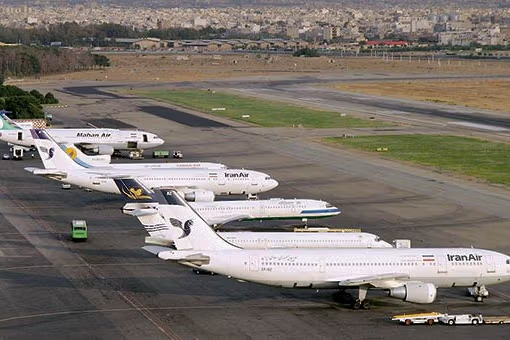
Iran is set to increase the price of aviation fuel, a move that could significantly impact airfares for domestic flights while the government is testing waters for raising regular gasoline prices.

According to the head of Iran’s Airlines Association, the government’s proposed budget for the next Iranian year (which starts March 21) includes a plan to raise fuel costs for airlines from 6,000 rials (less than one US cent) to 70,000 (about 10 cents), potentially leading to higher operating costs and, consequently, higher ticket prices for passengers.

Airlines in Iran receive heavily subsidized fuel, which contributes to lower ticket prices. The aviation fuel is subsidized more than twice as much as gasoline and diesel sold for passenger cars, buses and trucks.

Even with such cheap fuel, most Iranians cannot afford to buy flight tickets. The average cheapest domestic return ticket for one person costs between 40,000,000 and 60,000,000 rials, roughly half of a typical wage earner's monthly salary. One US dollar currently trades for almost 700,000 rials.

However, the government now aims to reduce this subsidy and increase revenue.

Maghsoud Asadi Samani said that the 11-fold raise means the impact of the each liter of aviation fuel on the total cost per seat hour will increase from 240,000 rials (about 34 cents) to 2,800,000 rials (about $4).

Last month, as President Masoud Pezeshkian presented his government’s first budget outline to the parliament, he told lawmakers that the production cost of each liter of gasoline—excluding crude oil—stands at approximately 80,000 rials (about 11 US cents). Furthermore, imported gasoline costs between 300,000 and 400,000 rials per liter (about 40 to 60 US cents).

Speculation is mounting over a potential gasoline price hike, as the government wavers on implementing these politically charged plans.

In response to comments by some lawmakers that the budget bill includes a 40% increase in gasoline prices, the spokesperson of the Planning and Budget Organization recently said: "There is no provision for a gasoline price hike in the 1404 budget.”

Mojgan Khanlou noted that the budget and budgeting system in Iran are fundamentally not the place to set gasoline prices. "Setting the prices of petroleum products requires decision-making at the highest levels of national management, and any adjustment or pricing needs to be discussed thoroughly across various levels."

She added, "The policy of the Planning and Budget Organization is that any adjustment in this area should be made with collective consensus, and the government’s proposed budget has avoided sudden changes and shock decisions that could impact other markets."

However, lawmakers argue that although there is no specific mention about raising fuel prices, the government has envisioned a significant rise in its revenues from fuel sales.

Hossein Samsami, a member of parliament's economic committee, said this week that the upcoming budget projects over 200 trillion rials (about $300 million) in revenue from gasoline sales, which could lead to a 40% increase in gasoline prices.

Iran's heavily subsidized gasoline costs just 2 cents per liter (or less than 10 cents per gallon), making it one of the cheapest in the world. However, this subsidy comes at a steep price for the government, which spends billions annually to sustain it.

For most Iranians, who earn about $200 per month, a large increase could push an already struggling population to the brink. Violent protests shook Iran in November 2019, when the government suddenly tripled gasoline prices.

On Monday, the CEO of the National Iranian Oil Products Distribution Company, Keramat Veis-Karami, announced a record-breaking surge in gasoline consumption in the Iranian month of Shahrivar (August 22 –September 21), saying that gasoline imports reached 9 million liters per day in this time span.

While Iranian officials frequently assert that gasoline consumption is rising, reports from Iran International reveal that a significant portion of the daily gasoline sold is actually smuggled to neighboring countries due to the stark price disparity.


Most Viewed

Iran negotiators ordered to return after internal rift over Islamabad talks
1
EXCLUSIVE

Iran negotiators ordered to return after internal rift over Islamabad talks

2
ANALYSIS

US blockade enters murky phase as tankers spoof signals and buyers hesitate

3
ANALYSIS

Why the $100 billion Hormuz toll revenue is a myth

4

US tightens financial squeeze on Iran, warns banks over oil money flows

5
ANALYSIS

US blockade targets Iran oil boom amid regional disruption

Banner
Banner

Spotlight

  • Hardliners push Hormuz ‘red line’ as US blockade tests Iran’s leverage
    INSIGHT

    Hardliners push Hormuz ‘red line’ as US blockade tests Iran’s leverage

  • Ideology may be fading in Iran, but not in Kashmir's ‘Mini Iran'
    INSIGHT

    Ideology may be fading in Iran, but not in Kashmir's ‘Mini Iran'

  • War damage amounts to $3,000 per Iranian, with blockade set to add to losses
    INSIGHT

    War damage amounts to $3,000 per Iranian, with blockade set to add to losses

  • Why the $100 billion Hormuz toll revenue is a myth
    ANALYSIS

    Why the $100 billion Hormuz toll revenue is a myth

  • US blockade targets Iran oil boom amid regional disruption
    ANALYSIS

    US blockade targets Iran oil boom amid regional disruption

  • Iran's digital economy battered by prolonged blackout
    INSIGHT

    Iran's digital economy battered by prolonged blackout

•
•
•

More Stories

Top cleric argues for Iraqi monopoly on arms in rebuke to Iran-linked groups

Nov 4, 2024, 20:20 GMT+0

Iraq’s foremost Shia cleric Grand Ayatollah Ali al-Sistani has urged Baghdad to limit armed power to the government and protect its sovereignty from external interference, in an apparent veiled rebuke of Iran's influence on armed groups.

Meeting Monday with Mohamed al-Hassan, head of the UN Assistance Mission for Iraq (UNAMI), al-Sistani was quoted by the official Iraq News Agency as saying Iraq's progress depends on putting weapons in the state's hands and checking outsiders.

Iraqis must "exert their utmost efforts to overcome their failures, working diligently toward achieving a better future for their country where everyone enjoys security, stability, progress, and prosperity,” INA reported him as saying.

This will be achieved by "preventing foreign interference in all its forms, enforcing the rule of law, restricting arms to the state, and combating corruption at all levels," al-Sistani said, adding: "But it seems that the Iraqis have a long way to go until they achieve this, may God help them."

Al-Sistani is Iraq's preeminent Shia religious authority and an influential voice on public affairs. Along with populist cleric Moqtada al-Sadr, he has been a longtime skeptic of Iranian influence in the country since a US-led invasion in 2003.

However, al-Sistani's 2014 call for armed defense against the expansion of ultra-hardline Sunni Islamic State militants led to the formation of the Popular Mobilization Forces, a grouping of armed factions including some backed by Iran.

His remarks come as Iraq is caught in the middle of broader regional conflicts and hosts US troops at the same time Tehran arms and funds powerful Shia militias.

Iranian-aligned armed groups in Iraq, some of which have publicly expressed support for the so-called ‘resistance axis’ aligned with Gaza, have launched missiles and drones toward Israel, though these attacks have had minimal impact.

The term ‘resistance axis’ was coined by the Islamic Republic to describe its regional proxy forces, including Palestinian militant groups, the Syrian government under Bashar al-Assad, the Lebanese group Hezbollah, Yemen's Houthis and others.

Meanwhile, Shia cleric Ali al-Amin in Lebanon has also called on Lebanese citizens to avoid sectarian divisions and support national unity, asserting that government institutions must protect citizens without partisan or sectarian affiliations.

According to a recent report in The Wall Street Journal, Iran is preparing a retaliatory response to Israel’s latest attacks, potentially involving Iraqi territory as a staging ground and using its conventional military forces.

Iranian officials, briefing Arab diplomats, suggested that their response would focus on Israeli military sites “much more aggressively than last time.”

Iranian President Masoud Pezeshkian also declared that "Iran will in no way leave any violation of its territory and security unanswered."

Israeli-Iranians caught in standoff, mourn execution of Jewish Iranian

Nov 4, 2024, 19:18 GMT+0

The execution of an Iranian Jew on Monday has drawn criticism from a top rights monitor and highlights the anguish of the community as it is increasingly torn between the Islamic Republic and Jewish state.

Director of Iran Human Rights group, Mahmood Amiry-Moghaddam, said the symbolism must not be overlooked as Israel awaits potential retaliation for the October 26 aerial attacks across Iran.

“In the midst of the threats of war with Israel, the Islamic Republic executed Arvin Ghahremani, an Iranian Jewish citizen”, he said, adding that the legal case had “significant flaws.”

Arvin Nathaniel Ghahremani was executed after he was convicted of murder, although his defense argued that the death was accidental and he was defending himself.

Iran’s security apparatus are alleged to have pressured the victim, Amir Shokri’s family not to accept a financial settlement, or blood money, to prevent the execution, as per Iranian laws. Mizan, the news agency of Iran’s judiciary, said the family refused to give consent to the deal.

Iranian-born Yossi Avrahami, who moved to Israel aged 17, told Iran International: “This is just another straw to break the camel’s back for the Jewish community who live a very tough life in Iran."

“Many are leaving and the exodus will continue under the systemic antisemitism of the government to seek a better life elsewhere. It’s heartbreaking but we are being forced out of our homeland.”

Avrahami has family in the US and Israel. “Really, the only safe place for us as Jews now, is Israel, in spite of the threats from Iran.”

Iran’s Jewish community, now numbering around 8,000, is the largest in the region outside Israel, though they live under government oppression. Before 1979, the community was over 100,000 strong, but most fled after the revolution, primarily to Israel and the United States.

Sara Babajani, whose father was born in Iran before moving to Israel, said her family still long to go to their homeland. “To my father, who lived there until he was 15, it’s his home, but it’s not safe for Jews to live under an oppressive, antisemitic regime where sharia law rules,” she told Iran International.

“No Jew is free or safe and until the regime is toppled, we are all trapped in exile. Non-Jews don’t understand why having one Jewish state in the world is so important for us, and this case couldn’t make this answer more clear.”

The Islamic Republic bans Jews from contacting family in Israel or supporting Israel in any way, in spite of the land of Israel being the very essence of the spiritual texts, and prayers directed towards Jerusalem.

"Still in control"

Jason Brodsky, policy director at United Against a Nuclear Iran, said Iran “wants to send a message at home that it is still in control despite its losses against Israel” after last month’s air attacks which destroyed swathes of Iran’s air defenses.

However, Iranian-born Beni Sabti, a security analyst who now lives in Israel, told Iran International: “I don’t think that it had something to do with Israel because his crime was not related to espionage or something against the regime, so maybe yes they chose the timing for now, but we cannot know for sure.”

As the case was not related to Israel, he said the symbolism is less relevant than the fact the death penalty is being given out in record numbers in the wake of the 2022 uprising. Last year alone, Iran topped the world’s rankings with the most executions with 74 percent of the world’s total, according to Amnesty International.

“In the end, the Jews will have to leave and should, as soon as possible. Israel is no doubt the safest place for them. Many have left, but those who remain choose to be hostages to the regime,” Sabti added.

Dissidents chide Iran for gaslighting student who stripped on campus

Nov 4, 2024, 18:30 GMT+0
•
Azadeh Akbari

Prominent activists and human rights advocates have condemned Iranian authorities for labeling a young female student from Tehran's Azad University as mentally ill after she stripped in apparent protest at an assault by security forces over her clothing.

Footage circulated widely on Saturday showing the woman in her underwear on campus, with officers seen taking her into custody by force. A university official said the student had been sent to a police station for “severe psychological distress,” mirroring claims from media linked to the IRGC that she had mental health issues.

"This student appeared in class wearing inappropriate clothing," the Islamic Revolutionary Guards Corps-linked Fars News agency reported at the time.

"After being reminded by university security to follow dress code regulations on campus, she undressed and walked around the university grounds without clothing," it added, denying that she had faced any violence.

Amir Kabir Newsletter, a student group on Telegram which has covered student dissent for years, reported she had disrobed after being harassed and beaten for not wearing a headscarf.

Nobel laureate Shirin Ebadi condemned Iranian authorities on Monday for gaslighting the student, whose identity remains unknown and whom Iran International was unable to reach.

"Labeling protesters as mentally ill is the regime’s longstanding method for suppressing dissent," Ebadi said on Instagram, adding that such tactics are used to silence opposition. "If the protesting student at Azad University was 'ill,' why was she arrested? Is the security apparatus responsible for citizens' medical care?"

Iranian activist Azam Jangravi shared a personal account of how similar pressures affected her during her imprisonment for anti-hijab protests.

"My family was pressured to declare me mentally ill, even being taken to a forensic doctor … My family didn’t do it, but many families under pressure do, thinking it’s the best way to protect their loved ones. This is how the Islamic Republic tries to discredit women by questioning their mental health," she said in a post on Instagram.

Shima Babaei, an exiled activist and recipient of the 2023 Women’s Rights Award of the Geneva Summit for Human Rights and Democracy, shared her experience: "When I removed my headscarf in the street and was imprisoned, I heard sarcastic remarks: You are part of a project, you are crazy, and you just want attention."

Iranian journalist and women’s rights activist, Masih Alinejad, also highlighted the Iranian government's repeated use of mental health accusations to undermine female protesters.

Recalling past experiences, Alinejad said: "In 2014, when I launched the My Stealthy Freedom campaign against compulsory hijab, the regime claimed I had a mental breakdown and used fabricated stories to discredit me."

Nobel laureate Narges Mohammadi, currently detained in Tehran's Evin Prison, also expressed solidarity with the student and denounced the authorities' actions.

"The regime cannot force protesting women, who have made their bodies symbols of dissent and defiance against misogyny and tyranny, into retreat by labeling them as 'mentally unstable,' 'sexually deviant,' or 'misled.'"

The incident and the subsequent labeling of the student have drawn widespread criticism and underscored the ongoing struggle of Iranian women against the enforcement of compulsory hijab laws.

Calls for her release and demands to stop the suppression of women's rights have resonated across social media and rights groups.

The International Federation of Journalists on Monday condemned Iran for arresting the student, who is being identified by Iranian media reports as Ahou Daryaei," saying the girl "protested against the country's draconian dress code by stripping to her underwear."

The IFJ also called on the Iranian government to "urgently review its systemic attempts to trample women's rights and violate freedom of expression, and to release all prisoners including all journalists."

As the student’s identity remains unconfirmed and no updates have followed her arrest, activists have expressed concern for her well-being in custody.

Father of slain Iranian protester on hunger strike over denied medical leave

Nov 4, 2024, 12:59 GMT+0

The father of a protester killed in Iran’s 2019 demonstrations has been on a hunger strike for over a week, protesting his continued detention and lack of access to critical medical care.

Manouchehr Bakhtiari was sentenced to 18 years and 74 lashes in January for his calls for accountability after his son Pouya, 27, was killed during the anti-government protests of November 2019.

His family has reported that he is being denied medical leave for serious health issues, including the need for hernia and prostate surgeries, despite forensic recommendations supporting his request.

Bakhtiari’s son, Pouya, sustained a fatal gunshot wound to the head in Karaj amid security forces’ crackdown on protests, during which hundreds of demonstrators were killed.

Since Pouya’s death, Bakhtiari and his family have called for investigations into what they say is state-sanctioned violence against citizens.

Bakhtiari’s daughter, Mona, recently took to social media to express the family’s alarm over her father’s worsening health. According to her statement, Bakhtiari “collapsed inside the prison, but authorities refused to transfer him to an outside hospital, only moving him to the prison infirmary.”

In her post, she appealed to human rights organizations, activists, and the Iranian public to stand up for her father. The Bakhtiari family has called for his immediate release.

Before starting his hunger strike eight days ago, Bakhtiari sent an audio message from prison, saying, “From October 28 until my release from prison, I will be on hunger strike, and the Islamic Republic is responsible for whatever happens to me.”

Many prisoners in Iran are forced to resort to hunger strikes as a last resort to achieve their demands, including delays in case processing and violations of their rights as prisoners, often putting their lives at risk.

Nahid Shirpisheh, slain protester Pouya Bakhtiari's mother (Undated)
100%
Nahid Shirpisheh, slain protester Pouya Bakhtiari's mother

Bakhtiari’s wife, Nahid Shirpisheh, who has also publicly advocated for accountability, is currently serving a five-year sentence in Zanjan Prison. Her charges likewise stem from efforts to seek justice for their son Pouya.

Iran says it rejects nuclear weapons but will defend itself by all means

Nov 4, 2024, 12:31 GMT+0

Iran’s Foreign Ministry said on Monday it remains committed to a peaceful nuclear program but asserted Tehran would prepare whatever it takes to defend itself against Israel.

“The official stance of Iran in rejecting weapons of mass destruction and regarding the peaceful nature of the Islamic Republic of Iran’s nuclear program is clear," said Foreign Ministry spokesperson Esmail Baghaei.

"As emphasized in the recent speech by the Supreme Leader of the Islamic Revolution, we will equip ourselves to the extent necessary for the defense of Iran," he added.

For weeks, Iranian officials have ramped up their narrative that Tehran possesses the capability to produce nuclear weapons, asserting that only Khamenei's religious fatwa prevents it from doing so.

Baghaei also claimed that the country will use all its "material and spiritual resources to respond to the recent aggressions by the Zionist regime."

This statement comes as Iran’s leadership intensifies its stance amid escalating tensions with the United States and Israel.

Khamenei has called on officials to make every necessary preparation to defend the country against the US and Israel.

"We are fully committed to preparing the Iranian nation in every necessary way to confront arrogance," Khamenei said on Saturday.

He added that both military readiness and political efforts are integral to this approach.

On October 1, Iran launched more than 180 ballistic missiles in two waves, targeting sites within Israel. The attack was presented as a response to the recent assassinations of several key figures allied with Iran, including Hamas leader Ismail Haniyeh in Tehran, and Hezbollah leader Hassan Nasrallah. While Israel reported intercepting most of the missiles, the strikes have led to further deterioration in already fraught relations between the two arch enemies.

Israel’s October 26 retaliation included airstrikes on Iranian missile facilities and air defense systems, resulting in the deaths of four Iranian soldiers and one civilian, according to Iranian sources. While Iran has not disclosed details of potential further responses, its leadership has said it will give a harsh response.

Experts have noted that Iran's strategic defense capabilities have been severely compromised by Israel, casting doubt on the credibility of Khamenei’s promised responses.

In response to the attacks between Israel and Iran, the country has experienced further economic turmoil, with the US dollar now trading at 710,000 rials—the steepest decline in the value of the national currency to date.

Iran's President Masoud Pezeshkian (Undated)
100%
Iran's President Masoud Pezeshkian

On Monday, Iran’s President Masoud Pezeshkian drawn attention to the economic pressures facing the nation, saying the country faced an economic war rather than a purely military one.

Pezeshkian warned that economic hardships could pose a more significant threat to Iran than external military aggression, suggesting that economic resilience is now a primary focus of his administration.

“Today, we are facing an all-out economic war. What can bring us to our knees are economic problems, and our enemies are pursuing this goal, but we must not be defeated,” he said.

According to Pezeshkian, Iran’s missile capabilities are to deter aggression rather than provoke it. He explained that these weapons serve as a warning, ensuring that no nation could launch an attack on Iran without facing serious consequences.

"We developed missiles so that, like Gaza, Israel cannot bomb anywhere, anyone, at any time it wishes," Pezeshkian added.

On October 7 last year, Iran-backed Hamas launched a large-scale attack on Israeli border areas, killing hundreds of civilians and taking scores hostage. Israel responded with extensive airstrikes targeting Gaza.