• العربية
  • فارسی
Brand
  • Iran Insight
  • Politics
  • Economy
  • Analysis
  • Special Report
  • Opinion
  • Podcast
  • Iran Insight
  • Politics
  • Economy
  • Analysis
  • Special Report
  • Opinion
  • Podcast
  • Theme
  • Language
    • العربية
    • فارسی
  • Iran Insight
  • Politics
  • Economy
  • Analysis
  • Special Report
  • Opinion
  • Podcast
All rights reserved for Volant Media UK Limited
volant media logo

CENTCOM chief in Israel as US bolsters defenses for Iran retaliation
Nov 3, 2024, 13:18 GMT+0Updated: 15:28 GMT+0
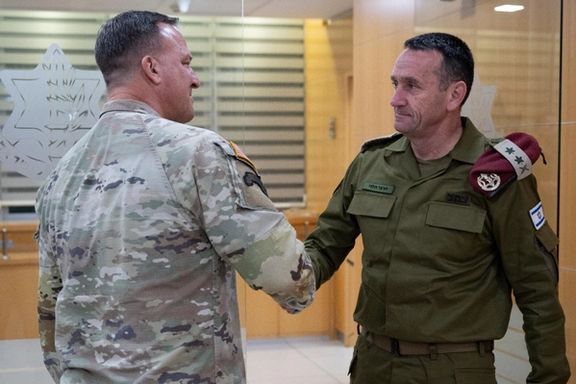
US CENTCOM chief Gen. Michael Kurilla (left) meets with IDF Chief of Staff Lt. Gen. Herzi Halevi, in a handout image published November 3, 2024.

The head of CENTCOM visited Israel as the US bolsters defenses for the Jewish state in preparation for the expected retaliation for last week’s Israeli air attacks across Iran.

On Thursday, the Commander of US Central Command General Michael Kurilla, met with Israel’s Chief of the General Staff, LTG Herzi Halevi.

“The Chief of the General Staff and the Commander of CENTCOM held a situational assessment on strategic security issues and joint regional preparedness, as part of the response to threats in the Middle East, with a focus on Iran,” the Israeli military said in a statement Sunday.

During General Kurilla’s visit, he visited the American THAAD aerial defense battery, recently deployed to Israel to strengthen defenses against the next Iranian strike which Iran's Supreme Leader Ali Khamenei this weekend warned would be a "crushing" attack.

In addition to sending 100 troops and the THAAD aerial defense battery earlier this month, the US has this week sent more warships and B-52 bombers to Israel as the Jewish state awaits an imminent retaliation to last week’s aerial strikes across Iran.

Last week, in the wake of a four-hour mission involving around 100 pilots, the Israeli military said it had caused significant damage to Iran’s air defense systems, allowing them scope “to do much more”, according to Halevi last week.

Two days ago, Pentagon Press Secretary Pat Ryder said that the additional bolstering of troops and defenses is “in keeping with our commitments to the protection of US citizens and forces in the Middle East, the defense of Israel, and de-escalation through deterrence and diplomacy”.

Ryder said that the Secretary of Defense, Lloyd Austin, had ordered the deployment of “additional ballistic missile defense destroyers, fighter squadron and tanker aircraft, and several US Air Force B-52 long-range strike bombers to the region. These forces will begin to arrive in coming months as the USS ABRAHAM LINCOLN Carrier Strike Group prepares to depart”.

He said it builds on the recent decision to deploy the Terminal High Altitude Area Defense (THAAD) missile defense system to Israel as well as the sustained Amphibious Ready Group Marine Expeditionary Unit (ARG/MEU) in the Eastern Mediterranean, with additional deployments taking place at short notice around the region as new intelligence emerges.

“Secretary Austin continues to make clear that should Iran, its partners, or its proxies use this moment to target American personnel or interests in the region, the United States will take every measure necessary to defend our people,” Ryder said.

Israel’s war of attrition with Iran escalated in April when Iran launched its inaugural direct attack on Israel with 350 drones, missiles and rockets. It said the attack was a retaliation for an alleged Israeli airstrike on the Iranian consulate compound in Damascus which killed at least one Quds Force commander and multiple high ranking IRGC chiefs.

It came amid a war launched by Iran-backed Hamas on October 7, since which time, Iran’s militias around the region have acted in allegiance with the Gaza based group, designated globally as terrorists. It has seen Israel fighting Iran-backed groups on seven fronts including Yemen, Syria and Iraq.

On October 1, Iran launched nearly 200 ballistic missiles at Israel, following a series of high-level killings including the leader of Iran’s largest militia, Hezbollah in Lebanon, and the humiliating killing of the Hamas political leader in an IRGC compound in Tehran.


Most Viewed

Ghalibaf defends Iran-US talks amid hardline backlash
1
INSIGHT

Ghalibaf defends Iran-US talks amid hardline backlash

2
ANALYSIS

From instability to influence: Pakistan’s pivotal role in US-Iran diplomacy

3
ANALYSIS

100 days on: why Iran’s January protests spread across social classes

4

War-hit homeowners feel abandoned as Iran’s reconstruction aid fades

5

Iran says no decision yet on talks as Pakistan prepares to host US team

Banner
Banner

Spotlight

  • The politics of pink: how Iran uses cuteness to rebrand violence
    ANALYSIS

    The politics of pink: how Iran uses cuteness to rebrand violence

  • Bread shortages, soaring prices strain households in Iran, residents say
    VOICES FROM IRAN

    Bread shortages, soaring prices strain households in Iran, residents say

  • War-hit homeowners feel abandoned as Iran’s reconstruction aid fades

    War-hit homeowners feel abandoned as Iran’s reconstruction aid fades

  • 100 days on: the anatomy of Iran’s January crackdown
    INSIGHT

    100 days on: the anatomy of Iran’s January crackdown

  • Ghalibaf defends Iran-US talks amid hardline backlash
    INSIGHT

    Ghalibaf defends Iran-US talks amid hardline backlash

  • From instability to influence: Pakistan’s pivotal role in US-Iran diplomacy
    ANALYSIS

    From instability to influence: Pakistan’s pivotal role in US-Iran diplomacy

•
•
•

More Stories

Top commander hails defiance of US, Israel on embassy takeover anniversary

Nov 3, 2024, 09:15 GMT+0

A top Iranian military commander celebrated the anniversary of a student takeover of the US embassy in 1979 and said Tehran and its armed allies in the region would use all available means to confront its enemies.

Hossein Salami issued a statement on Sunday saying, "On the anniversary of the heroic seizure of the American spy den in Tehran, we issue a warning to the number one enemy of the Iranian people and its rabid dog, the criminal Zionist regime.”

Iran’s clerical rulers observe the "national day of the fight against global arrogance" and commemorate the "anniversary of the historic seizure of the American spy den," marking the November 1979 seizure of the US embassy in Tehran and the 444-day hostage crisis involving its staff.

Salami added, “The Resistance Front and Islamic Iran will equip themselves with all that is necessary for a victorious confrontation with the enemy, undeterred by the threats and posturing of the tyrants in Washington and Tel Aviv."

In recent days, a host of Iranian officials have threatened to retaliate against Israel’s October 26 air strikes that targeted Iran’s air defenses and missile installations but avoiding nuclear and energy facilities.

Washington directly warned Tehran on Saturday against launching another attack, saying it will not be able to restrain its ally this time, Axios reported citing an American official, amid reports of Iran's preparations for another strike on Israel.

Iran’s Supreme Leader Ali Khamenei said on Saturday that "the United States and the Zionist regime (Israel) will certainly receive a crushing response."

The Israeli Army Radio, citing unnamed American officials, reported that Washington has recorded military movements in Iran in preparation for an attack on Israel.

In a direct message sent to Iran through the Swiss, the Biden administration warned the Islamic Republic that Israel's response to a possible Iranian attack will not be as limited as the one launched last Saturday.

"We won't be able to hold Israel back, and we won't be able to make sure that the next attack will be calibrated and targeted as the previous one," a US official told Axios.

The US Central Command announced late Saturday, in both English and Persian, that B-52 Superfortress bombers deployed a day earlier have arrived in the Middle East. This can deter Tehran from a serious escalation, or possible attacks on US and other non-Israeli targets. Islamic Republic officials have repeatedly blamed the United States for Israel’s air strikes, saying that Washington supplied both the weapons and intelligence.

Don’t attack Israel: US warns Iran it can't restrain its ally again - Axios

Nov 2, 2024, 22:59 GMT+0

The United States has directly warned Tehran against launching another attack against Israel, saying it will not be able to restrain its ally this time, Axios reported citing an American official, amid reports of Iran's preparations for another strike on Israel.

In a direct message sent to Iran through the Swiss, the Biden administration warned the Islamic Republic that Israel's response to a possible Iranian attack will not be as limited as the one launched last Saturday.

"We won't be able to hold Israel back, and we won't be able to make sure that the next attack will be calibrated and targeted as the previous one," a US official told Axios.

On October 1, Iran launched its largest direct missile strike to date in the ongoing Iran–Israel conflict. In retaliation for the strike, Israel responded on October 26 with airstrikes targeting Iranian missile facilities and air defense systems, resulting in the deaths of four Iranian soldiers and one civilian, according to Iranian sources.

Iran’s Supreme Leader Ali Khamenei said on Saturday that "the United States and the Zionist regime (Israel) will certainly receive a crushing response."

The Israeli Army Radio, citing unnamed American officials, reported that Washington has recorded military movements in Iran in preparation for an attack on Israel.

The Biden administration estimates that Iran will respond to Israel's October 26 airstrikes, but "it is not clear when and how," Israel's public broadcaster Kan News reported Saturday, confirming the Israeli Army Radio's report about "initial movements" indicating preparations for an attack.

A NOTAM was issued on Saturday for gun firing exercises near Hamedan, Iran, scheduled daily from November 4 to November 6, 2024, between 0230 and 1830 UTC. The affected area spans from ground level up to 10,000 feet AMSL.

The NOTAM has been issued amid reports of an imminent strike against Israel; however, Tehran did not issue any NOTAMs during its previous attacks on Israel in April and October.

Esmail Kowsari, a member of Iran’s parliament and a former IRGC general, said Saturday that Iran’s Supreme National Security Council (SNSC) has authorized a military strike against Israel. He said the response would be much harsher than the October 1 missile barrage that saw Iran launch nearly 200 missiles at targets in Israel.

“While certain government officials may believe we should not retaliate, these individuals, whether within or outside the government, do not make the decisions… This decision for a military response to the Zionist regime was made by the SNSC. Almost unanimously, or rather all members of the SNSC have agreed on a military response by Iran to Israel” he said in an interview with a Tehran website on Saturday.

The SNSC's decision came after Khamenei was briefed on the extent of the damage from the Israeli strikes and felt that the deaths and the scale of Israel’s attack necessitated a response to avoid being seen as admitting defeat, The New York Times reported citing three officials familiar with Tehran’s war planning.

Israeli air strikes over the weekend knocked out Iran's last three Russian-provided S-300 air defense missile systems and has left the country "naked", Fox News reported citing US and Israeli officials.

The surface-to-air S-300s were the last in the Islamic Republic's arsenal after one was destroyed in an attack in April also likely carried out by Israel, Fox News quoted a senior US official as saying. The strikes were launched from US-provided F-35 jets, the official added.

In an internal phone call, President Biden's adviser for the Middle East Amos Hochstein said "Iran is essentially naked", according to the US news channel.

With the US warning of an even harsher response from Israel, it remains unclear how Iran will withstand 'unrestrained' airstrikes from the Jewish state without its Russian-provided air defenses.

Iran’s security council approves retaliation against Israel: MP

Nov 2, 2024, 16:38 GMT+0

Iran’s Supreme National Security Council (SNSC) has authorized a military strike against Israel, aiming to intensify its response to recent escalations, according to Esmail Kowsari, a member of Iran’s parliament.

Kowsari, a former IRGC general, added that the response would be much harsher than the October 1 missile barrage that saw Iran launch nearly 200 missiles at targets in Israel.

“While certain government officials may believe we should not retaliate, these individuals, whether within or outside the government, do not make the decisions… This decision for a military response to the Zionist regime was made by the SNSC. Almost unanimously, or rather all members of the SNSC have agreed on a military response by Iran to Israel” he said in an interview with a Tehran website on Saturday.

On October 1, Iran launched its largest direct missile strike to date in the ongoing Iran–Israel conflict, which Tehran labeled Operation True Promise 2. The attack, involving more than 180 ballistic missiles fired in two waves, was presented by Iranian officials as a response to the assassinations of key figures allied with Iran, including Hamas leader Ismail Haniyeh in Tehran, Hezbollah leader Hassan Nasrallah, and Iranian General Abbas Nilforoushan. Israeli officials said to have intercepted most of the missiles, reporting minimal damage to infrastructure.

In retaliation for the strike, Israel responded on October 26 with airstrikes targeting Iranian missile facilities and air defense systems, resulting in the deaths of four Iranian soldiers and one civilian, according to Iranian sources.

“The plan, timing, and objectives of this action are left to the planners,” added Kowsari.

He also dismissed recent reports from the CNN, suggesting Iran might strike before the US elections, describing them as speculations.

“We make our own decisions and conduct actions, and no one has detailed information about the timing, location, or manner of the response.”

Regarding the collaboration between Iran’s military and regional resistance groups against Israel, Kowsari said that these groups may coordinate with Iranian forces ahead of the attack.

“The resistance groups in the region are aligned with our military forces in responding to the Zionist regime. Members of the Resistance Front may have input or suggestions before the operation, and this will be considered before the final decision. Therefore, Iran's military response to the Zionist regime, in coordination with the resistance forces, is certain, and we will definitely take action,” he added.

The Resistance Front refers to the alliance of armed militant groups sponsored by Iran, including Hezbollah, Hamas, the Palestinian Islamic Jihad, Houthis in Yemen, and Iraqi Shiite militias.

Iran plays Russian roulette in conflict with Israel

Nov 2, 2024, 14:00 GMT+0
•
Jamshid Barzegar

Iranian officials have raised the stakes, suggesting another strike on Israel. The United States has issued a stern warning against such a move, while Israel stands ready with an intensified response if it occurs. Is Tehran bluffing—or playing Russian roulette?

Ongoing confrontation with Israel—and the U.S.—carries grave risks, seemingly at odds with the Islamic Republic’s enduring commitment to survival. Iran's first Supreme Leader, Ruhollah Khomeini, declared that “preserving the system” is “the most obligatory of obligations.” For him, clerical rule was essential; without it, he argued, religion itself would perish. In this view, power is paramount, taking precedence even over religious edicts, let alone public welfare.

Khomeini’s dictum has been the cornerstone of Iran’s theocracy for four decades. It has led his successor, Supreme Leader Ali Khamenei, to step back from the brink before, and it may very well compel him to back off again in the weeks to come. But the voices coming out of Tehran this week say otherwise.

On October 31, the three most senior commanders of Iran’s Revolutionary Guards (IRGC) promised an attack on Israel. Even Khamenei’s typically reserved chief of staff joined their chorus, calling for a response that would leave the Israelis regretting their air strike. Hours later, Axios and the New York Times ran stories of an impending Iranian attack. “Likely before the US election,” one source was quoted saying.

Khamenei himself in a speech on Saturday indicted that Israel and the United States will face a harsh response to Israel’s October 26 air strikes.

It may be bluster—or another “True Promise,” the IRGC's code name for its two massive missile attacks against Israel this year. Both actions are hard to rationalize, especially the latest one on October 1, given the genuine risks involved. Decision-makers in Tehran understand their adversary isn’t just Israel, but a U.S.-backed Israel. They’re acutely aware of Iran’s struggling economy and the mounting frustration among Iranians. An all-out war could be suicidal, threatening to dismantle the very system meant to stand above all else.

Could this be a simple yet catastrophic miscalculation? Or do they possess knowledge that fuels a sense of invincibility? Perhaps they’re driven by an external influence, feeling they have no viable—or favorable—choice.

Iran and Russia have drawn ever closer in the past few years. A war in the Middle East may not be what Moscow wants, but it won’t be all bad news if an Iranian attack drags the US into yet another quagmire and divert its attention from Ukraine. An Iranian attack on Israel before November 5 could benefit Donald Trump. Leaders in Tehran may be wary of that, but Russia’s president Vladimir Putin likely doesn’t mind.

On Friday, the Pentagon ordered more bombers and warships to the Middle East, perhaps in anticipation of a new Iranian attack on Israel and a likely escalation.

In his Saturday speech, Khamenei cited “international logic” as a justification for an attack. Whether this implies aligning with shifting global power dynamics remains to be seen.

Iran’s belligerent messaging may be bluster. If it’s not—if it turns out to be yet another True Promise—then those calling the shots in Tehran may find themselves on a path they can’t back away from, one that serves Moscow’s interests more than their own.

PODCAST: Iran’s proxy strategy falters—will it double down or shift course?

Nov 2, 2024, 10:52 GMT+0
•
Negar Mojtahedi

Iran created proxies to protect the Islamic government and now they're engaged in a direct conflict with Israel to protect their proxies, leading to a failed strategy, said one former spokesperson for the government of Israel.

Eylon Levy, the former voice of the Israeli government during the October 7 Hamas invasion, discussed Israel's latest strike in Iran, and how Iran's failed strategy is impacting the next front in this seemingly never-ending saga on Eye for Iran.

Levy, who in his previous role attended high-level meetings with Israel’s top decision-makers, has a deep understanding of Israel’s strategic planning and calculations. He viewed Israel’s October 26 counterstrike as both powerful and effective in targeting Iran’s military capabilities, yet measured in its restraint.

Levy, who with his former job attended high level meetings with leading decision

Levy noted that understanding the Islamic Republic’s strategy is challenging, as he believes the government operates with a strong influence of theological motivations.

"I don't think it's unthinkable we could end up in spiral of escalation," said Levy.

He said the proxies Iran created to combat Israel and maintain their power in the greater region has proven to be a liability for Iran's leadership.

"Because Hamas' leaders went rogue on October 7th and invaded Israel in the hopes of sparking a regional war that has now dragged Iran into it. Iran is seeing direct Israeli air strikes which would have been unthinkable a while ago."

In light of Israel's resolve and the recent setbacks to its proxies, will Iran double down on its current objectives, or choose steps toward de-escalation?

Levy stated that the next move is up to Iran, with the ball now firmly in its court. Some Israeli parliament members have noted that Israel has yet to respond to Hezbollah's drone attack on Prime Minister Benjamin Netanyahu's seaside residence last month, with some even calling for a second retaliatory strike against Iran.

However, Iran has vowed to strike back against Israel with what they describe as a painful response for the October 26th air strikes.

Current intelligence indicates that Iran may be preparing an attack on Israel in coming days, according to multiple news reports.

Defense Secretary Lloyd Austin announced Friday that the US is sending additional bomber aircraft and Navy warships to the Middle East to bolster America's presence in the region.

Levy doesn't see an end to the conflict between Iran and Israel unless the current establishment is overthrown in Iran.

As an Israeli citizen who sheltered while Iran launched nearly 200 ballistic missiles on Oct 1, he understands that Iran's direct aggression is a red line for the government of Israel.

"That's not going to become the new normal in a way that we were told rockets from Hamas and Hezbollah were," said Levy.

"Oct 1 was a red line for them and they wouldn't allow Iran's direct ballistic missiles to be new normal, that was intention of Israel's response to uphold deterrence," he added.

As the world awaits to see what Iran's next move is, Levy points out that if people take Iran's leadership by their word, then a further escalation and potential for things to get out of control, could be happening soon.

For the full episode, you can watch it on Youtube or listen to it on Spotify, Castbox, Apple, Amazon or Spotify.





