• العربية
  • فارسی
Brand
  • Iran Insight
  • Politics
  • Economy
  • Analysis
  • Special Report
  • Opinion
  • Podcast
  • Iran Insight
  • Politics
  • Economy
  • Analysis
  • Special Report
  • Opinion
  • Podcast
  • Theme
  • Language
    • العربية
    • فارسی
  • Iran Insight
  • Politics
  • Economy
  • Analysis
  • Special Report
  • Opinion
  • Podcast
All rights reserved for Volant Media UK Limited
volant media logo

US pushes for Lebanon ceasefire as Iran and Israel hold firm on tough stance

Oct 21, 2024, 07:50 GMT+1Updated: 15:35 GMT+0
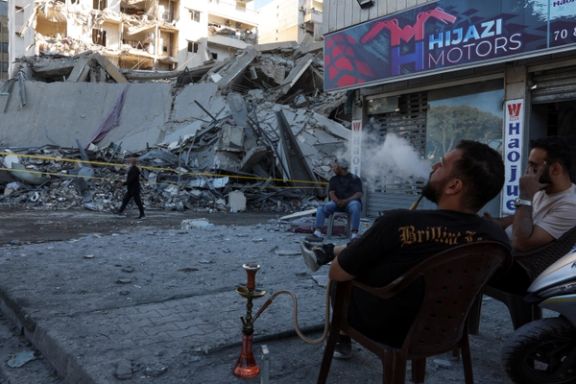
A man smokes a shisha, near a damaged site, in the aftermath of Israeli airstrikes on Sunday that hit several branches of a financial institution linked to Hezbollah in Beirut, October 21, 2024.

As a senior US diplomat visits Beirut on Monday to discuss the potential for a ceasefire between Hezbollah and Israel, Iranian state media continues to tout the "victorious" attacks carried out by Tehran-backed militias.

US envoy Amos Hochstein will visit Beirut on Monday for discussions with Lebanese officials regarding conditions for a ceasefire between Israel and Hezbollah, according to two sources in Lebanon, Reuters reported. The talks come as Israel intensified its air campaign against Hezbollah, targeting several of the group's assets overnight.

Late Sunday, Israeli airstrikes hit multiple branches of a financial institution linked to Hezbollah in Beirut, southern Lebanon, and the Bekaa Valley, though no casualties were immediately reported.

According to a report from Axios, Israel has presented the US with a document outlining its conditions for a diplomatic resolution to the conflict in Lebanon. Among Israel’s demands is the ability for its forces to conduct "active enforcement" to ensure Hezbollah does not rearm or rebuild military infrastructure near the border, the report noted, citing Israeli and US officials.

A US official told Axios it was highly unlikely that Lebanon and the international community would agree to Israel's conditions.

Iran’s government news website, IRNA, on Monday published a lead report highlighting comments by an Arab pundit saying that all militias loyal to Iran are preparing for a “war of cities” by launching a major simultaneous barrage of missiles and drones.

Tasnim news website, affiliated with the Revolutionary Guard, highlighted “victories by Hezbollah,” including multiple rocket attacks on Israeli military targets and border area towns.

Rouydad-24, a relatively independent website highlighted the difficulty for Iran to reduce tensions. “Abbas Araghchi, our Foreign Minister, is constantly traveling and consulting with regional countries, but analysts believe the situation is too complex for him to achieve a diplomatic formula to reduce tensions and establish a ceasefire through these consultations.”

In reality, Araghchi's extensive regional tour last week was primarily focused on advocating for a ceasefire in Lebanon and Gaza, where Israeli military pressure remains relentless. Additionally, he aimed to leverage the influence of Arab countries to help mitigate the looming threat of an Israeli retaliatory strike against Iran.

Israel said its air force overnight attacked dozens of sites in Beirut and southern Lebanon used by Hezbollah to finance its operations, with reports that hundreds of Beirut residents fled their homes after multiple explosions in the Lebanese capital.

An Israeli military spokesperson said earlier in a statement posted on social media platform X that it "will begin attacking infrastructure belonging to the Hezbollah Al-Qard Al-Hassan Association - get away from it immediately." The so-called Islamic banks operate outside the Lebanese banking system and are supposed to be benevolent lending institutions for the needy.

Al-Qard al-Hassan - which the US has said is used by Iran-backed Hezbollah to manage its finances - has more than 30 branches across Lebanon including 15 in densely populated parts of central Beirut and its suburbs.

Asked by journalists whether the branches could be considered military targets, a senior Israeli intelligence official said: "The purpose of this strike is to target the ability of Hezbollah economic function both during the war but also afterwards to rebuild and to rearm ...on the day after."

Most Viewed

Iran International says it won’t be silenced after London arson attack
1

Iran International says it won’t be silenced after London arson attack

2

State media slam Araghchi's Hormuz tweet, say it let Trump claim victory

3
VOICES FROM IRAN

Hope and anger in Iran as fragile ceasefire persists

4
INSIGHT

How Tehran bends its own red lines to boost state rallies

5

Iran halts petrochemical exports to supply domestic market

Banner
Banner

Spotlight

  • Too early to tell who is winning Iran war, experts say
    PODCAST

    Too early to tell who is winning Iran war, experts say

  • How Tehran bends its own red lines to boost state rallies
    INSIGHT

    How Tehran bends its own red lines to boost state rallies

  • Iran blackout cripples freelancer, small business incomes
    VOICES FROM IRAN

    Iran blackout cripples freelancer, small business incomes

  • Ideology may be fading in Iran, but not in Kashmir's ‘Mini Iran'
    INSIGHT

    Ideology may be fading in Iran, but not in Kashmir's ‘Mini Iran'

  • US blockade enters murky phase as tankers spoof signals and buyers hesitate
    ANALYSIS

    US blockade enters murky phase as tankers spoof signals and buyers hesitate

  • Why the $100 billion Hormuz toll revenue is a myth
    ANALYSIS

    Why the $100 billion Hormuz toll revenue is a myth

•
•
•

More Stories

No one can blame Israel for hitting back hard at Iran - Trump

Oct 20, 2024, 21:40 GMT+1

Former US President and current Republican candidate Donald Trump said Sunday Iran is in great danger as Israel prepares for a retaliatory attack in response to Tehran's October 1 missile barrage.

"Iran is now probably in danger, maybe more so than they'd have thought a month ago, with what's happening," Trump said in an interview with Al-Arabiya. "It's in a lot of danger right now, which is very bad. I don't want to see people killed."

The comments come as Israel's security cabinet is meeting on Sunday night in Tel Aviv to deal with Israel’s response to Iran, The Times of Israel reported citing an Israeli official.

The meeting is being held one day after two US intelligence documents on Israel's preparations for a possible attack on Iran were leaked on the pro-Iran Telegram channel Middle East Spectator.

Another development that could possibly change Israel's attack plans was a Hezbollah drone strike against the residence of Prime Minister Benjamin Netanyahu, which reportedly prompted calls in Israel for an even stronger response to Tehran.

Israel's Channel 11 cited an Israeli official as saying that the country is preparing for a "very significant" attack on Iran. "Israel already understands that Iran cannot refrain from responding to this attack, so there are special preparations in this regard."

Last week, the United States authorized the deployment of a Terminal High-Altitude Area Defense (THAAD) battery and personnel to Israel, reaffirming its strong commitment to Israel's defense and the protection of US citizens in Israel from further missile threats. The THAAD system, which complements Israel's existing Patriot missile defenses, can intercept threats at ranges of up to 124 miles.

Three THAAD systems are now operational in Israel, Al-Arabiya reported Sunday, citing unnamed sources.

Iran warns Israel

On Sunday night, IRGC-affiliated Tasnim News cited a military source as saying that a potential Israeli attack on Iran's nuclear sites will not only trigger Iran's response but will also convince the country to "consider nuclear policies."

The military source said if the attack only targets Iran's military positions, Tehran's response will be both "certain" and "beyond the Zionists' estimates."

The source added: "And if the potential action affects facilities and infrastructure in any way, Iran is certainly not committed to maintaining the previous scope, type, or intensity of its response."

"This is a clear message to the Zionists, and they will definitely understand its meaning! Iran neither hesitates nor rushes, but it does not shelve the 'punishment' of madmen in a way that will surprise them more each time," the report added citing the military source.

On Friday, US President Joe Biden said he has insight into "how and when Israel is going to respond to the missile attacks by Iran," though he refrained from providing further details.

This prompted Iran's Foreign Minister Abbas Araghchi to warn that anyone aware of the timing and manner of an Israeli attack on Iran must be held accountable.

In his Sunday interview with Al-Arabiya, Trump criticized Biden's handling of US-Israel relations, particularly regarding Netanyahu. He said that Biden had initially given Netanyahu instructions to hold back on military action, leaving Israel vulnerable. However, Trump now believes Israel faces less danger.

"Netanyahu is going to do what he wants to do [against Iran], and I think he has to do that. Israel was under great danger. They're under much less danger right now than they were one month ago, let's face it," he remarked.

Commenting on Israel's military response to recent tensions, Trump defended the country’s actions, stating, "You can't blame Israel for hitting back hard, much harder than anyone would have thought. Now everyone's waiting for Israel to make a move" in response to Iran's missile attack.

Tensions between Israel and Iran have escalated sharply since October 1, when Iran launched 181 ballistic missiles at Israel in retaliation for Israel's assassination of Hamas chief Ismail Haniyeh in Tehran and Hezbollah's leader Hassan Nasrallah in Beirut.

Iranian medical students protest as tuition triples

Oct 20, 2024, 18:23 GMT+1

Iranian medical students are protesting a sudden tuition hike at Islamic Azad University taking fees to triple the price while the country endures an economic crisis.

The students in faculties of medicine, dentistry, pharmaceuticals and veterinary science, already grappling with inflation and rising costs of living, took to the streets in protest of the hike which is usually closer to 10-25% annually.

"Someone help us! The 300 million rial (about $500) tuition for medical science programs has suddenly tripled, and now we are stuck with no way forward or back," one medical student at a protest rally on Saturday said, summing up the frustration felt by many.

Medical students stage protest in Tehran over abrupt tuition hikes, October 20, 2024.
100%
Medical students stage protest in Tehran over abrupt tuition hikes, October 20, 2024.

Over the past week, students have staged several protests in front of key government buildings including the Ministry of Health, the Secretariat of the Supreme Council of the Cultural Revolution, and the Presidential Office. Placards carried by demonstrators asked questions like, "Why wasn’t the threefold increase announced? Is Azad University for elites or the wealthy?"

The protests began after tuition fees for medical students surged from 300 million rials (about $470) to 900 million rials (about $1400) per semester without prior notice.

Nazanin Abbasi, the secretary of the student council at Islamic Azad University in Mashhad, voiced her concern, stating, “The tuition has suddenly tripled to 900 million rials per semester, amounting to roughly 20 billion rials (over $31,000) for the entire program. This is in stark contrast to the monthly salary of a medical resident, which is only 15 million rials ($235)."

In response to the outcry, Mohammad Ghorbani, the spokesperson for Islamic Azad University, tried to justify the tuition increase and denied it was tripled. "Tuition increases at Islamic Azad University typically range between 10 to 25 percent, but this time, the increase for medical sciences was nearly double. The reason for the increase is tied to annual inflation and the high costs of educational infrastructure and medical equipment." His comment contradicts the information provided by students.

He added that over 70% of students have already paid their fees, while only 5-6% are protesting. Despite this, the discontent is palpable among the student body, especially considering the deteriorating state of the Iranian economy.

Ali Shirazi, a journalist speaking to Iran International, explained that as families already struggle with inflation and daily necessities, the abrupt tuition hike places an additional burden on them. Over one third of Iranians have been pushed below the poverty line since in the latest recession which has seen the currency massively devalued.

"This increase comes without any additional benefits for the students," Shirazi said. "There’s no new technology, no international professors, and the infrastructure remains outdated due to ongoing sanctions."

The Progressive Students group condemned the tuition hike, criticizing the commercialization of education. "What is happening now is unprecedented. The corrupt officials at Islamic Azad University have rushed to exploit high-demand medical fields, suddenly tripling already high tuition fees," the group stated.

They calculated that medical students will have to pay around 20 billion rials over seven years to become doctors, a figure far out of reach for the majority of families in Iran.

Students and experts alike argue that this move prevents working-class families from accessing medical education, making it a field reserved for the elite.

Niyayesh Nowruzadeh, another medical student, pointed out that the tuition last year was 320 million rials, and they had been expecting a 25-30% increase. Instead, they were shocked when the university announced the new 900 million rials fee.

Members of Iranian healthcare professional community (Undated)
100%
Members of Iranian healthcare professional community

Adding to the students' frustration, the Iranian government recently issued a directive prohibiting the sale of 'service obligations' that would allow graduates to pay off their mandatory service years. The move is seen as a way to hold graduates' diplomas hostage and prevent them from leaving the country, as many young professionals are looking for better opportunities abroad due to Iran’s economic, social, and political instability.

100%

At a protest on Saturday in front of the Ministry of Health, students voiced their discontent with the new directive. "The government is taking actions to take the university degrees of the graduates hostage to prevent their exodus from the country," said Mohsen Moheimani, an expert on Iranian affairs, in an interview with Iran International.

"The health ministry has announced that the service obligation of the students to serve in hospitals must not be sold to them anymore, using this trick to prevent them from leaving as the healthcare system faces a shortage of staff."

Meanwhile, the Tehran Prosecutor’s Office has vowed to take action against institutions facilitating student emigration.

Valiollah Mahboudi, the Deputy Prosecutor of Public Rights in Tehran, announced that “a list of unauthorized student emigration agencies had been compiled and sent to the police, promising strict action against any violations.”

A member of Iranian healthcare professional community (Undated)
100%
A member of Iranian healthcare professional community

The crackdown on these institutions comes as more Iranians seek to study abroad. Many are disillusioned with the economic situation, and the exodus of skilled professionals is becoming a growing concern. According to the head of the Iranian Medical Council, up to 3,000 doctors left Iran in 2022, driven by low salaries, poor working conditions, and economic instability.

With no relief in sight and the costs of education soaring, many young Iranians feel trapped, unable to advance their careers or leave the country in search of better opportunities.

Slain teen protestor’s father reportedly hospitalized after hunger strike in Iran prison

Oct 20, 2024, 15:06 GMT+1
•
Azadeh Akbari

Reza Salmanzadeh, the father of slain teen protester Mehdi Salmanzadeh, has reportedly been transferred to a hospital after a hunger strike and losing consciousness in Ghezel Hesar prison, in Karaj, west of Tehran.

“The authorities have not said where they have taken him from the prison… It’s not clear which hospital he is in …The family hasn’t been informed where he is and haven’t been able to see him,” a source close to the family told Iran International on condition of anonymity on Saturday.

An Instagram account associated with Salmanzadeh reported Friday night that he had fallen into a "coma" due to a hunger strike and that "an ambulance was on its way to Ghezel Hesar prison." However, it is not clear if he lost consciousness for a while or he is in complete coma. Some sources called it a state of "semi-coma."

Salmanzadeh began his hunger strike last Tuesday, protesting the lack of medical care for his worsening health conditions, including prostate issues, according to the source. The hunger strike allegedly caused his blood pressure to drop dangerously low, making him unconscious.

“He experienced severe bleeding, and they didn’t take him to the hospital, so he went on a hunger strike,” the source added.

Intelligence agents are said to be pressuring the family, adding to their distress having already lost a young family member during Iran’s 2019 protests and the father being imprisoned in the aftermath of his advocacy for justice, according to the source.

Arrest and charges

After his arrest in May by intelligence agents at his family home, Salmanzadeh was subsequently held in Tehran’s Evin Prison, Ward 209.

A court in Tehran had previously sentenced Reza Salmanzadeh to three years and eight months in August 2022 on charges of “propaganda against the regime” and “membership in an unlawful group to act against national security,” according to US-based Human Rights Activist News Agency (HRANA). This case was closed in February 2023 following a clemency directive.

However, while in prison, authorities brought new charges against Salmanzadeh in a joint case involving Evin prison inmates for which he is now serving a sentence of seven years and 74 lashes related to the case.

In September 2023, Salmanzadeh was transferred to Ghezel Hesar prison alongside 12 other prisoners. Following their transfer the prisoners were kept “in a cramped 12 square meter room in the high-security Unit 3 of Ghezel Hesar prison, in difficult conditions and without access to basic amenities such as hot water and telephones,” Kurdistan Human Rights Network reported.

Systemic denial of medical care in prison

At the end of July this year, HRANA warned that Salmanzadeh was deprived of proper medical care in Ghezel Hesar prison despite his poor physical condition.

He had previously gone on hunger strike as part of the weekly ‘No to Execution’ campaign protesting the Islamic Republic’s execution spree across Iran’s prisons.

At least 34 political prisoners, including Salmanzadeh, have been "systematically denied access to proper medical services" as a form of state retaliation for being outspoken critics of the surge in executions in Iran, according to a report by the US-based Center for Human Rights in Iran (CHRI) in August.

CHRI noted that "vocal critics of Iran’s surging executions and unjust imprisonments have become particular targets for state abuse," reflecting a broader pattern of deliberate neglect and mistreatment.

Salmanzadeh’s son found hanged in family home after attending 2019 protests

Salmanzadeh’s 14-year-old son, Mehdi, was found dead in their family home in December 2019 after attending the protests marking the 40-day memorial for those killed in the November 2019 nationwide demonstrations, as documented by US-based rights group Abdorrahman Boroumand Center (ABC).

The November 2019 protests, often referred to as Bloody November, initially erupted due to a significant increase in fuel prices, quickly transforming into demands for government overthrow and opposition to Supreme Leader Ali Khamenei. At least 1,500 protestors were killed by security forces, according to figures reported by Reuters at the time.

Mehdi’s mother found his son's “naked body hanging from the wall closet”, according to the rights group United for Iran, citing a video interview with Reza Salmanzadeh in December 2019.

In the interview, he said that doctors and detectives suspected Mehdi was killed before being hanged, but Iran’s intelligence police dismissed the case as suicide, despite CCTV footage showing the suspected killer. The case was quickly closed without further investigation.

ABC’s Omid Memorial, which documents human rights abuses by the Islamic Republic, describes Mehdi's death as an "extrajudicial execution" and says his father's efforts to seek justice resulted in his arrest and conviction.

Reza Salmanzadeh at his son Mehdi Salmanzaeh's burying place
100%
Reza Salmanzadeh at his son Mehdi Salmanzaeh's burying place

The case underscores a broader crisis within the Islamic Republic’s judicial and prison system and the authorities' systemic abuse of slain protestors' families as reported by Amnesty International in 2023 and the United Nations Human Rights Council’s Fact-Finding Mission on Iran's latest report this year.

Iranian president slams parliament amid economic crisis

Oct 20, 2024, 13:46 GMT+1

In a rare outburst, Iranian President Masoud Pezeshkian has lambasted Iran's parliament for its role in Iran's economic crisis.

In a speech on Sunday during National Exports Day, Pezeshkian criticized the commitments imposed by parliament, arguing that they have placed excessive burdens on the state and contributed to the country's economic challenges.

"The commitments that the parliament has imposed on governments do not align with reality," Pezeshkian said, adding, "On one hand, they have created a debt-ridden government with imbalances in banks and funds, and then they say, 'Solve it.'"

His remarks come as Iran continues to grapple with the economic consequences of US oil export and banking sanctions, which have driven the country into a financial downturn.

"We are at war—a war that these dishonorable people [the West] have imposed on us, worsening the situation day by day. Today, it's not a missile war, but a war of ideas and production," he stated, in what appeared as a political jab against hardliners, who have the majority at the parliament.

Amid such admissions, criticism of the government’s handling of the economic crisis has intensified, particularly from the media affiliated with Iran's Islamic Revolutionary Guard Corps (IRGC). One of the primary targets of this criticism is Abdolnaser Hemmati, Iran’s Minister of Finance, who has come under fire for mentioning sanctions as the greatest economic issue for the country.

In a report by the IRGC-affiliated Tasnim news website, Hemmati was described as the wrong choice for minister of economy. The report accused him of acknowledging the effects of Western sanctions, which the agency claims reveals Tehran's empty hands to its adversaries.

Hemmati, who recently tweeted that “implementing economic reforms and efforts to reduce sanctions is the key to solving the country’s problems,” was further lambasted by Tasnim.

Iran's Economy Minister Abdolnasser Hemmati (Undated)
100%
Iran's Economy Minister Abdolnasser Hemmati

"Mr. Hemmati, who apparently knows more about media than economics, last night posted a tweet that seemed more like a dangerous signal and message of weakness to the enemy, emphasizing his inability to solve economic problems without lifting the sanctions. It appears that he has mistakenly occupied the position of minister of economy,” Tasnim wrote.

Iran’s economy has been impacted by US-led sanctions, which have crippled its oil revenues, devalued the rial, and driven annual inflation to above 40%. The national currency reached a near-historic low on Sunday, with the US dollar trading at 646,000 rials, marking an increase of close to 10% since August.

The stock market, too, reflected the broader economic instability, with Tehran’s exchange losing approximately 19,000 units on Sunday, on top of 24,000 on Saturday, standing at nearly 2 million points.

Iranians walk down a market street in Tehran, Iran November 14, 2021.
100%
Iranians walk down a market street in Tehran, Iran November 14, 2021.

As the country’s financial situation worsens, fears of a regional conflict with Israel have prompted Iranians to safeguard their wealth by converting assets into more stable investments like gold. The price of gold coins has surged, with values reaching nearly 560 million rials—an increase of 22 million rials in just one day.

Reza Gheibi, an economic expert, told Iran International that the shift to gold and foreign currency is a direct result of public fears over the future of the Iranian economy. "Iran’s relentless regional aggression and its deeply ingrained ideological perspectives will prevent the country from finding a way out of this crisis," Gheibi said.

Meanwhile, Arash Azarmi, an economic journalist, predicted that as the economic crisis deepens, internal tensions between Pezeshkian and the hardline opposition aligned with Supreme Leader Ali Khamenei will become more pronounced.

An Iranian counts US dollar bills in front of a currency exchange board displaying foreign exchange rates. (Undated)
100%
An Iranian counts US dollar bills in front of a currency exchange board displaying foreign exchange rates.

In an interview with Iran International, Azarmi also noted that any economic reforms are unlikely to succeed under US sanctions. "As long as these sanctions are in place, Iran’s trade is illegal and unofficial. BRICS and Shanghai Cooperation Organization cannot offer a solution," he remarked.

As economic tensions rise and Iran remains isolated from the global market, the country’s leadership continues to face growing pressure with critics both inside and outside the government voicing their frustrations.

Hacking or sabotage? US probes 'top secret' leak of Israel's plan on Iran

Oct 20, 2024, 13:18 GMT+1

As Washington investigates a top-secret document leak regarding Israel's retaliation plans to Iran’s recent aerial attack, questions have emerged over whether it was the result of a security breach or an Iran-backed cyberattack.

Two US intelligence documents, meant to be shared exclusively among the 'Five Eyes' nations, were leaked on the pro-Iran Telegram account Middle East Spectator, just as Israel prepares to retaliate for the October 1 barrage of 181 ballistic missiles. The platform's account on X lists its location as the Islamic Republic of Iran.

In a press statement, Middle East Spectator said the channel had no connection to the original source “which we assume to be a whistleblower within the US State Department."

The "top secret" documents, dated October 15 and 16, began circulating online Friday, meant only to be seen by Australia, Canada, New Zealand and the United Kingdom. Several options are now being discussed, including internal strategic leaks and possible state-backed hacking.

Holden Tripplet, a former FBI counterintelligence official, told Iran International: “The leak, if done without official sanction by the US government, may have been intended to dissuade an Israeli strike or at least limit the overall retaliatory response.”

However, Tripplet, who spent 15 years in the FBI, said it could also be the tip of the iceberg. “There may have been other documents leaked along with those which would likely indicate someone in the US government upset with US policy towards Israel in general,” he added. “They may be trying to harm the overall relationship.”

Jason Brodsky, head of policy research at United Against Nuclear Iran, wrote on X that the documents, which had been US surveillance of Israeli military activity in preparation for the retaliation, “risks eroding trust between the US and Israel at a sensitive moment”, the documents “of high value to Tehran as it plans a defense”.

Speaking to CNN, Mick Mulroy, former deputy assistant secretary of defense for the Middle East and a retired CIA officer, said: “If it is true that Israeli tactical plans to respond to Iran’s attack on October 1 have been leaked, it is a serious breach”, he too warning that future coordination between the US and Israel could be challenged as a result.

“Trust is a key component in the relationship, and depending on how this was leaked that trust could be eroded,” he added. CNN cites officials who have verified the authenticity of the documents.

One of the documents , which says it was compiled by the National Geospatial-Intelligence Agency, says it has observed Israel moving munitions around.

Another says it is sourced to the National Security Agency and outlines Israeli air force exercises involving air-to-surface missiles, also believed to be in preparation for a strike on Iran.

The reports also detail preparations of Israeli drone units, transfer of advanced munitions at Israeli air bases and air force exercises involving intelligence planes and fighter jets.

US President Joe Biden has said he will support Israel’s retaliation, but not an attack on Iran’s nuclear facilities.

In 2012, a leak of Israeli plans to attack Iran's nuclear facilities drew speculation that it was a deterrence to the Jewish state which has also destroyed nuclear facilities in enemy states Iraq and Syria.

Brodsky pointed out that “there are many possible culprits: from a hack to a leak. The Iranian regime, with assistance from Russia and perhaps China, has been perfecting its cyberwarfare skills in this regard.”

Only last month, a US grand jury indicted several Iranian nationals and IRGC employees on charges related to hacking efforts targeting Donald Trump’s 2024 presidential campaign.

They were charged with a conspiracy "with others known and unknown to hack into accounts of current and former US officials, members of the media, nongovernmental organizations, and individuals associated with US political campaigns”.

The Justice Department said the activity was “part of Iran’s continuing efforts to stoke discord, erode confidence in the US electoral process, and unlawfully acquire information relating to current and former US officials that could be used to advance the malign activities of the IRGC, including ongoing efforts to avenge the death of Qasem Soleimani, the former commander of the IRGC – Qods Force.”

The latest leak also raises serious questions about internal security among the most senior officials in the US. Brodsky added: “After a series of incidents that have raised serious questions, many people have been concerned about possible Iranian influence and infiltration in the US government, not to mention those with animus towards a key US partner Israel.”

Last year, US Iran envoy, Robert Malley, was suspended after what was described as his mishandling classified information. Malley was placed on unpaid leave and had his security clearance suspended, with the State Department still blocking all efforts to gather further information on the case.

Two influential congressmen suggested in May that Malley lost his security clearance because he had transferred classified documents to his personal email and cell phone, and the documents were then stolen by a hostile cyber actor.

It raises possible questions about the team he had around him who remain in place while the FBI investigates Malley.

Also last year, highly classified Pentagon documents were leaked online, once again risking relations with the country’s allies such as Israel, South Korea and Ukraine, revealing information about how the US spies on allies and foes alike.

Axios reported that US officials said the breach was extremely concerning for Washington.

On Sunday, Israeli officials were declining to comment on the matter while the country continues to fight Iran’s proxies across its borders.