• العربية
  • فارسی
Brand
  • Iran Insight
  • Politics
  • Economy
  • Analysis
  • Special Report
  • Opinion
  • Podcast
  • Iran Insight
  • Politics
  • Economy
  • Analysis
  • Special Report
  • Opinion
  • Podcast
  • Theme
  • Language
    • العربية
    • فارسی
  • Iran Insight
  • Politics
  • Economy
  • Analysis
  • Special Report
  • Opinion
  • Podcast
All rights reserved for Volant Media UK Limited
volant media logo

PODCAST: Does Yahya Sinwar’s killing change Iran-Israel equation?

Negar Mojtahedi
Negar Mojtahedi

Iran International

Oct 19, 2024, 08:50 GMT+1Updated: 15:36 GMT+0

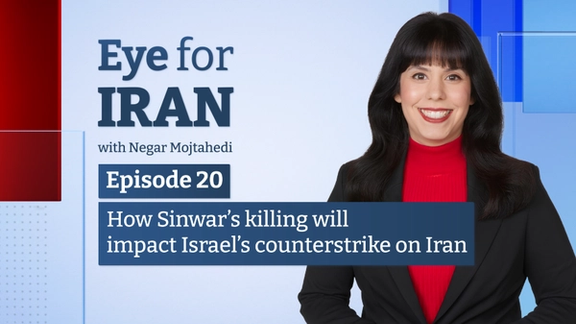
Amichai Stein, a journalist with Israel's Public broadcaster Kan news, joined ‘Eye for Iran’ to discuss the impact of Yahya Sinwar’s death and what it means for the fate of the hostages and the Middle East going forward.

As Iran’s Foreign Minister conducted regional tours to strengthen ties with Arab states, Iran's leadership is reportedly sending backchannel messages to the US, urging them to convince Israel to scale back its counterstrike, according to an Israeli reporter.

Since July, Israel has targeted some of the most prominent figures in Iran’s proxy network. On July 31, Hamas political leader Ismail Haniyeh was killed in Tehran, an operation widely attributed to Israel, though they have not officially confirmed or denied it. Last month, Hezbollah leader Hassan Nasrallah was eliminated in Beirut, a strike confirmed by Prime Minister Benjamin Netanyahu. Most recently, Yahya Sinwar was taken out in Gaza.

Iran’s proxies are not out, but severely weakened with a significant decrease in its capabilities, and this may push the Iranian establishment to want de-escalation for its own survival, says Stein.

“Iran is conveying messages that if response if limited they won’t respond to Israel. Iran is trying to scale down the response to Israel,” he adds.

Israel's Counterstrike on Iran

Stein characterized the Biden administration as being “okay” with Israel’s plan to attack Iran after it launched a barrage of ballistic missiles on Oct 1st in retaliation for the killing of Nasrallah and Haniyeh.

US President Joe Biden says he has a good understanding of how and when Israel plans to respond to Iran, making the remarks Friday while being pressed by reporters during a visit to Germany.

Biden declined to share any details, but Stein, based on his intelligence as a journalist in Israel, believes the attack will be limited to military strikes.

The Iranians may be fearful after Sinwar’s death and hope to signal to the Americans that they will not retaliate if the Israeli’s stay away from striking oil, gas and nuclear sites, says Stein.

Persian Gulf region Arab states are also lobbying Washington to stop Israel from attacking Iran’s oil sites because they are concerned for their own oil facilities.

Israel's Prime Minister has repeatedly said all options are on the tables.

After reports surfaced of military targets, Israel’s Energy minister Eli Cohen, said on Friday that Israel was "committed to preventing the Iranians from acquiring nuclear weapons, and therefore, all options are on the table, including attacking nuclear facilities".

While Benjamin Netanyahu has sent bold messages to the Iranian establishment for decades, politics may hold him back for how far he can go.

“For Netanyahu, Iran is the main enemy of Israel. He always talked about the nuclear, nuclear, nuclear but in the end also Netanyahu knows what the limits are,” says Stein.

“The idea that Netanyahu will now use the opportunity to go for the nuclear sites and do what he's talking about for 15 years, I have a bit doubt it, but let's see,” he adds.

Sinwar’s death may delay – not prevent - Israel’s planned reprisal in Iran, according to Stein.

He believes it may cause Israel to focus on Gaza with their being an opportunity with no clear leadership in place to push for a ceasefire and the release of the remaining 101 hostages.

When asked about his behind-the-scenes conversations with Israeli government officials on this topic, he said some of them believe the Gazan people will revolt against Hamas.

“I think some of Israeli officials are surprised that people in Gaza haven't revolted yet. But again, the end it's the Hamas civil structure that is still operating over there. That's why the civilians need them. If this collapses and other things collapse, then things change.”

A moment Israelis have been waiting for

Stein recalled the moment when he found out about Sinwar’s death, describing the mood among Israeli's as "complete happiness."

“In my neighborhood people went out with alcohol bottles and whiskey and poured glasses. We always waited for this moment and it finally arrived.”

As an architect of the Oct 7 killing of more than 1,000 Israeli citizens that sparked the war in Gaza, Sinwar was also responsible for negotiations with other political leaders on the hostages, and controlled Hamas’ day-to-day operations. Even if a new leader is named, that person will not have specific control over the hostages, says Steins.

With the absence of a clear leader, Israel's strategy is to provide amnesty to individuals – whether they are Islamic Jihad or Hamas – to surrender the hostages and walk free, said Stein about Netanyahu ‘s next move.

“The dictator is dead. There’s a chance individuals will try to save their lives by releasing hostages. This is the idea right now” says Stein.

To find out how Israelis are feeling about a potential strike on Iran, and much more from Stein's conversation on Eye for Iran, Watch the full episode on YouTube or listen on Spotify, Castbox, Apple or Amazon.

Most Viewed

Iran negotiators ordered to return after internal rift over Islamabad talks
1
EXCLUSIVE

Iran negotiators ordered to return after internal rift over Islamabad talks

2
ANALYSIS

US blockade enters murky phase as tankers spoof signals and buyers hesitate

3
ANALYSIS

Why the $100 billion Hormuz toll revenue is a myth

4

US tightens financial squeeze on Iran, warns banks over oil money flows

5
ANALYSIS

US blockade targets Iran oil boom amid regional disruption

Banner
Banner

Spotlight

  • Hardliners push Hormuz ‘red line’ as US blockade tests Iran’s leverage
    INSIGHT

    Hardliners push Hormuz ‘red line’ as US blockade tests Iran’s leverage

  • Ideology may be fading in Iran, but not in Kashmir's ‘Mini Iran'
    INSIGHT

    Ideology may be fading in Iran, but not in Kashmir's ‘Mini Iran'

  • War damage amounts to $3,000 per Iranian, with blockade set to add to losses
    INSIGHT

    War damage amounts to $3,000 per Iranian, with blockade set to add to losses

  • Why the $100 billion Hormuz toll revenue is a myth
    ANALYSIS

    Why the $100 billion Hormuz toll revenue is a myth

  • US blockade targets Iran oil boom amid regional disruption
    ANALYSIS

    US blockade targets Iran oil boom amid regional disruption

  • Iran's digital economy battered by prolonged blackout
    INSIGHT

    Iran's digital economy battered by prolonged blackout

•
•
•

More Stories

Khamenei vows Sinwar's death won't halt the 'Axis of Resistance'

Oct 19, 2024, 07:56 GMT+1

Iran's Supreme Leader offered his condolences and vowed continued support for anti-Israel forces, nearly two days after Israel announced the death of Hamas military leader Yahya Sinwar.

"The Resistance Front, just as it did not halt its advance with the martyrdom of its prominent leaders in the past, will not experience the slightest pause with the martyrdom of Sinwar either,” Ali Khamenei said in a statement released on Saturday morning.

The term "Resistance Front" was coined by the Islamic Republic of Iran to describe militant groups and organizations across the region that receive financial and military backing from Tehran. This network includes Hezbollah in Lebanon, Hamas in Gaza, the Houthis in Yemen, and Shiite groups in Iraq, forming the core of Iran's proxy forces in the region.

Khamenei described Sinwar's death as "painful" for anti-Israel militant groups but stressed that it will not stop their efforts. “This front did not halt its progress with the martyrdom of prominent figures like Sheikh Ahmed Yassin, Fathi Shaqaqi, Rantisi, and Ismail Haniyeh, and it will not experience the slightest pause with the martyrdom of Sinwar either, by God's will. Hamas is alive and will remain so,” the 85-year-old ruler of Iran said.

However, Iran itself is facing the specter of an Israeli attack since October 1 when it lobbed more than 180 ballistic missiles at Israel, in the second such barrage in six months. Prime Minister Benjamin Netanyahu and other Israeli leaders have vowed to retaliate, but so far it seems Jerusalem is negotiating with Washington about which targets to strike. The White House opposes an attack on Iran’s nuclear centers or its oil industry.

On Friday, the Iranian Foreign Ministry issued its first response to the assassination of Hamas leader Yahya Sinwar, saying that it will not weaken the fight against Israel and that others will rise to take the place of the slain militant leader.

"Undoubtedly, the physical elimination of fighters on the path of dignity and human honor will not undermine the school and path of resistance," the Foreign Ministry's statement read.

However, Khamenei's Islamic establishment has seen both Hamas and Hezbollah significantly weakened since the outbreak of fighting following Hamas’s October 7, 2023 attack on Israel, which killed over a thousand civilians. Israel has focused on eliminating key leaders of Khamenei’s militias. Ismail Haniyeh was killed in Tehran in July, and Hezbollah leader Hassan Nasrallah was taken out in a major Israeli airstrike in Beirut in September. Sinwar’s death could potentially throw Hamas into disarray.

Tehran, finding itself in a weakened position, has recently signaled that if Israel's retaliation remains limited, it will hold back from responding and allow the cycle of tit-for-tat strikes to cease.

Israel says attack on Iran's nuclear sites still on the table

Oct 18, 2024, 22:10 GMT+1

A senior Israeli cabinet minister revived the prospect of an attack on Iranian nuclear sites after media reports had suggested the United States had convinced its ally to focus its fire on Iranian military infrastructure.

Energy minister Eli Cohen, a former foreign minister, said on Friday Israel was "committed to preventing the Iranians from acquiring nuclear weapons, and therefore, all options are on the table, including attacking nuclear facilities".

He made the remarks in an interview with Israeli news website Walla News three days after a CNN report said Israeli officials, including Prime Minister Benjamin Netanyahu, had assured the US that any retaliatory strike on Iran would be confined to military targets.

A Tuesday report by The New York Times citing sources confirmed that nuclear enrichment sites are not among Israel's targets

"Even if Israel avoids Iran’s nuclear enrichment and oil sites, it could still hit a wide array of military targets," the American daily wrote. "They include missile and drone launchers, missile and drone storage sites, missile and drone factories, as well as military bases and major government buildings."

Citing two Israeli officials, the report said: "Israel could also strike nuclear research laboratories, even if it avoids Iran’s subterranean nuclear enrichment sites."

In his Friday interview, Cohen said, "There is no military facility or infrastructure or person in Iran who is immune from an Israeli attack in response to Iranian aggression."

"We proved that we know how to go anywhere, with a large variety of armaments. By the way, we have not yet shown even 10% of our unprecedented armament and intelligence capabilities," he added.

Tensions between Israel and Iran have mounted since October 1, when Iran launched 181 ballistic missiles towards Israel in response to the Jewish state's killing of the leader of Hezbollah Hassan Nasrallah in Beirut and Hamas political leader Ismail Haniyeh in Tehran.

Israel’s air defenses intercepted most of the missiles, but several struck military and civilian targets, causing minor damage. This convinced the Pentagon to deploy a THAAD missile defense battery to Israel this week for protection against Iran's possible retaliatory attack.

'Chance for de-escalation'

While it is not yet clear when the Israeli strike on Iran will take place, US President Joe Biden told reporters on Friday he has an understanding of how and when Israel was going to retaliate. He declined to elaborate, but also said there was a chance for a ceasefire.

"There's an opportunity in my view and my colleagues agree that we can probably deal with Israel and Iran in a way that ends the conflict for a while. That ends the conflict, in other words, that stops the back and forth," Biden said.

Biden added that he believed there was a possibility of achieving calm in Lebanon but that such efforts would be harder in Gaza.

Earlier on Thursday, Biden referred to the Israeli killing of Hamas leader Yahya Sinwar, calling it an opportunity to free hostages held by the militant group and end the year-long Gaza war.

Yahya Sinwar, the mastermind behind the October 7 attack, was believed by US and Israeli officials to be the main obstacle to reaching a hostage deal.

While Biden has long pushed for a ceasefire deal to secure the release of Israeli hostages, an imminent Israeli strike on Iran could further enflame the region, denying Biden the truce he would like to add to his legacy as his presidency draws to a close.

Persian Gulf islands outrage showcases rare Iranian unity

Oct 18, 2024, 19:15 GMT+1

A joint statement by the European Union (EU) and the Gulf Cooperation Council (GCC) urging Iran to relinquish control of three islands in the Persian Gulf has sparked anger in Iran spanning the country's entrenched political divides.

The naming and sovereignty of the body of water and its islands are a deep-felt issue inside Iran and among its diaspora and stands as one of the few political themes uniting the Iranian people.

The EU-GCC joint statement on Wednesday described three Iranian-controlled Persian Gulf islands disputed between the Islamic Republic and the United Arab Emirates as "occupied" and urged Iran to relinquish control.

Greater Tunb, Lesser Tunb, and Abu Musa islands have been held by Tehran since 1971 after the withdrawal of British forces from the Persian Gulf.

"Iran's territorial integrity is not a subject for foreigners to dare discuss," government spokesperson Fatemeh Mohajerani said in a post on X.

"(The islands) are inseparable parts of Great Iran. The European Union and the Persian Gulf Cooperation Council are in no position to comment on the great land of Iran," she added.

Iran’s foreign minister Abbas Araghchi, who just completed a diplomatic tour of the Arab world to shore up support ahead of a likely Israeli attack, condemned the move as a colonial practice but spared Arab states.

"The three islands have always belonged to Iran and will forever remain as such. The era of European malign 'divide & rule' interference in our region is long over," he wrote on X.

The spokesperson for Iran’s Ministry of Foreign Affairs went further, characterizing the statement as a violation of the international system's core principles.

"This is a clear indication of the member states' lack of commitment to the principles and objectives of the United Nations Charter, especially the principle of respect for national sovereignty and the territorial integrity of states,” Esmail Baghaei said.

Iran maintains that the islands have been an intrinsic part of its sovereign territory, asserting that it has never ceded ownership. The UAE counters that throughout the 19th century, the islands were under the jurisdiction of the Qasimi sheikhs and that their claim was transferred to the UAE upon its establishment in 1971.

The islands came under British administration in 1921, but on November 30, 1971—one day after British forces withdrew and just two days before the UAE's official formation—Iran's then-monarch, Mohammad Reza Shah, ordered the Iranian navy to take control of all three islands.

Iranian military forces have remained on the islands ever since, with Abu Musa being the only one inhabited by a civilian population which numbers fewer than two thousand.

The Prince's speech

The Shah's son, exiled Prince Reza Pahlavi - one of the most prominent Iranian opposition figure - also weighed in harshly.

"If the European Council were serious about addressing the threat of the Islamic Republic, it would designate the IRGC a terrorist organization and back UN sanctions on the regime," he said, referring to the Islamic Revolutionary Guard Corps.

"Instead, it insults the Iranian people by supporting perversions of history and colonialist violations of Iranian territorial integrity. Iran's sovereignty over the islands of Greater Tunb, Lesser Tunb, and Abu Musa is not up for debate."

Iranian social media accounts too were ablaze with anger, with many users ranging from government supporters to dissidents arguing for Iran's sovereignty over the islands.

Political activist Fariborz Karami Zand, who has over half a million followers on X, directed his ire at Josep Borrell, the EU’s High Representative for Foreign Affairs.

"The UAE’s claims over these islands have no historical or legal foundation. Any discussions about Iran’s territorial integrity must be based on historical facts, not on groundless fantasies."

The EU-GCC joint statement represents a growing international trend of supporting the UAE's claims to the islands. In recent years, key international players, including the United States, Russia, and China, have leaned towards supporting the UAE in this dispute.

China expressed its support for the UAE's claims during a meeting in June, while Russia backed the UAE's position during a summit with GCC ministers in December last year. The moves have left Iran feeling increasingly isolated on the international stage regarding the issue.

Iran's standing in the West has been increasingly marred by its alignment with groups such as Hezbollah and Hamas, as well as its deepening military cooperation with Russia since its full-scale Ukraine invasion.

Video statements link Sinwar, Soleimani and Supreme Leader

Oct 18, 2024, 17:40 GMT+1

Yahya Sinwar and Ismail Haniyeh were Israel's main Palestinian adversaries whose close links with Iran's top leadership are highlighted in videos of the slain Hamas leaders retrieved and translated by Iran International.

Sinwar, the de facto chief of Hamas and the mastermind of the October 7, 2023 attack which rocked Israel, was killed by Israeli forces in Gaza this week.

Ismail Haniyeh was his predecessor as the Iran-backed group's political chief and was killed in an explosion targeting his guesthouse in Tehran in July in a likely Israeli attack.

The two men traveled to Tehran in 2012 as part of Hamas delegation to meet Supreme Leader Ali Khamenei in which their party was seen striding through an official compound alongside late senior Iranian general Qassem Soleimani.

Soleimani headed the Islamic Revolutionary Guard Corp's elite Quds Force until he was killed in an American drone strike in Baghdad in 2020.

Following Haniyeh's assassination, Khamenei's office released footage of the 2012 audience in which Haniyeh singles out Sinwar for an introduction to the Supreme Leader, citing his two and half decades behind bars in Israel.

In a 2017 speech broadcast by Lebanese pro-Iranian TV channel Al Mayadeen, Sinwar confirmed that Soleimani had offered Hamas all means at Iran's disposal to aid their cause while offering no conditions on the group's methods.

Soleimani, Sinwar said, told him during his 2012 visit to Tehran that all capabilities would be deployed to advance the Palestinian struggle to win Jerusalem as their capital.

Iran's currency plunge signals deeper trouble for struggling economy

Oct 18, 2024, 17:11 GMT+1
•
Mardo Soghom

Iran’s currency, the rial, has plunged near historic lows as the threat of direct confrontation with Israel looms, raising concerns about soaring inflation and adding pressure on the government to manage its economic challenges.

On Thursday, October 17, the rial briefly traded at 640,000 per US dollar, down from 590,000 in August, before Israel began its punishing attacks on Iran’s proxy, the Lebanese Hezbollah, and eventually killing its leader, Hassan Nasrallah. This led to an Iranian retaliation with ballistic missiles on October 1. Since then, Iran has been expecting a retaliatory strike by Israel.

With inflation hovering around 40% over the past five years, the government has little room to maneuver on economic issues, compounded by a massive budget deficit. US sanctions imposed in 2018 have significantly cut Iran's oil export revenues, which typically account for about half of the government’s budget.

This year, the government faces a budget deficit exceeding $14 billion according to the minister of economy, out of a total budget of roughly $40 billion. One way to deal with the deficit is to raise income, however, despite maximizing oil exports to its sole buyer, China, revenues are falling 26% short of estimates. Another source of income would be taxes, but the government has already increased taxes last year and it cannot raise more revenue in this way while the economy remains stagnant.

Another likely solution is to borrow more funds from the central bank, but that would mean printing more money, which will fuel higher inflation. The extensive borrowing in recent years has resulted in a staggering liquidity level of 83,540 trillion rials (approximately $139 billion), which has doubled since 2021. This surge in liquidity has contributed to an annual inflation rate exceeding 40% in recent years.

Reducing expenditures could help lower the budget deficit, but it's a difficult task in a state-controlled economy where the private sector has largely vanished from major industries. Loss-making government factories and companies rely heavily on state financing and subsidies to stay afloat. Without this support, they would be forced to close, further exacerbating unemployment in an already high-inflation environment.

Corruption among government insiders is also a heavy burden, woven into the fabric of the political and economic system. Former officials and pundits who are allowed to speak raise the alarm, but the ruling system is unable to make fundamental changes without democratic accountability.

The government's biggest financial burden comes from direct and indirect subsidies, which are politically risky to eliminate. Gasoline is sold for under 10 US cents per gallon, with similarly low rates for electricity and natural gas. These subsidies cost the state about $60 billion annually. However, when the government last raised gasoline prices in 2019, it triggered widespread unrest and protests. The authorities responded with military-level force, resulting in the deaths of around 1,500 protesters.

Experts have proposed more rationality in budget planning and the gradual elimination of subsidies, but the system is running on its own inertia, unable to make the necessary reforms.

Ultimately, Iran’s foreign policy and its controversial nuclear program, which have triggered crippling international sanctions, have further destabilized the already struggling state-controlled economy. The most immediate threat is the rapidly falling currency, leading to swift inflationary pressures and potential political instability.







