• العربية
  • فارسی
Brand
  • Iran Insight
  • Politics
  • Economy
  • Analysis
  • Special Report
  • Opinion
  • Podcast
  • Iran Insight
  • Politics
  • Economy
  • Analysis
  • Special Report
  • Opinion
  • Podcast
  • Theme
  • Language
    • العربية
    • فارسی
  • Iran Insight
  • Politics
  • Economy
  • Analysis
  • Special Report
  • Opinion
  • Podcast
All rights reserved for Volant Media UK Limited
volant media logo

Controversial ultra-hardliner claims Khamenei endorsed his path

Maryam Sinaiee
Maryam Sinaiee

Iran International

Oct 13, 2024, 09:49 GMT+1Updated: 15:39 GMT+0
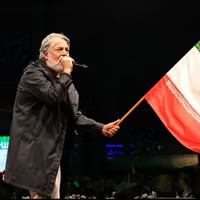
Controversial ultra-hardliner politician Ali-Akbar Raefipour with supporters.

A controversial politician popular with ultra-hardliner youth has sparked social media controversy by claiming Iran’s Leader wants him to continue in his path “with determination”.

Ali-Akbar Raefipour, a prolific speaker and social media activist, claimed in a speech on Thursday that Supreme Leader Ali Khamenei had responded to a "fifteen-page letter" he sent a month ago. Raefipour’s critics quickly took to social media, accusing him of fabricating Khamenei’s support and demanding that he publish both the letter and the alleged response. They argue that Khamenei rarely responds personally to politicians, especially outside of state matters, making Raefipour’s claim implausible.

In his speech, Raefipour said he had asked Khamenei if he was displeased with him, as his critics suggested, and offered to cease his political activities if the Leader disapproved. According to Raefipour, Khamenei denied the accusation, urging him to continue his work "with determination."

In response to a journalist who accused Raefipour of falsely claiming Khamenei responded to his letter, one of his supporters argued in a tweet Friday that he would not have made such a claim at this time if he wanted to hide behind the Leader. Instead he would have sought Khamenei's support when he was accused of laundering money through his so-called ‘cultural institute’ by Parliament Speaker Mohammad-Bagher Ghalibaf’s supporters.

Raefipour is best known for his allegiance to the ultra-hardliner former nuclear negotiator Saeed Jalili whom he and his young ‘revolutionary’ followers supported in the presidential elections against other conservative candidates and Masoud Pezeshkian.

The views expressed by Raefipour, his supporters, and allies including the Paydari (Steadfastness) Party often mirror the apocalyptic religious and anti-Western political views of the controversial cleric Mohammad-Mahdi Mirbagheri that are sometimes even more extreme than Khamenei’s.

Raefipour established Jebhe-ye Sobh-e Iran (Iran Morning Front) shortly before the March parliamentary elections. His political party, which is often referred to as MASAF, formed an alliance with the Paydari and other ultra-hardliners against Ghalibaf, and the two sides fought a fierce battle on social media during the campaign.

In the snap presidential elections which followed the suspicious death of Ebrahim Raisi in an air crash in May, Raefipour and his followers focused their attacks on Ghalibaf again. The Speaker’s supporters retaliated with corruption and money laundering allegations against him and demanded that his party be banned.

Iran's ultra-hardliners were seen as the main losers when the establishment allowed Pezeshkian to run for president and win the election. Their leader Jalili has been silent after his loss, although observers expect the radicals to become active again if Pezeshkian's position weakens due to numerous intractable economic and other challenges.

Raefipour’s fall from favor was signaled by brigadier general Ebrahim Jabbari, a former commander of Khamenei’s security team, who strongly criticized Raefipour a few months ago for attacking top state officials including former President Ebrahim Raisi, Ghalibaf, and Chief Justice Gholam-Hossein Mohseni-Ejei and implied that Khamenei was unhappy with Raefipour’s conduct.

Jabbari also accused him of refusing to publicly condemn the former President Mahmoud Ahmadinejad who fell from Khamenei’s favor over a decade ago. A leaked audio file of his talk against Raefipour was widely posted on various social media platform.

Most Viewed

Ghalibaf defends Iran-US talks amid hardline backlash
1
INSIGHT

Ghalibaf defends Iran-US talks amid hardline backlash

2
VOICES FROM IRAN

Bread shortages, soaring prices strain households in Iran, residents say

3
ANALYSIS

From instability to influence: Pakistan’s pivotal role in US-Iran diplomacy

4
ANALYSIS

100 days on: why Iran’s January protests spread across social classes

5

War-hit homeowners feel abandoned as Iran’s reconstruction aid fades

Banner
Banner

Spotlight

  • Is Iran entering its Gorbachev moment?
    INSIGHT

    Is Iran entering its Gorbachev moment?

  • Iran crackdown reaches cemeteries as graves of slain protesters defaced
    EXCLUSIVE

    Iran crackdown reaches cemeteries as graves of slain protesters defaced

  • Iran diplomacy wobbles as factions compete to avoid looking soft on US
    INSIGHT

    Iran diplomacy wobbles as factions compete to avoid looking soft on US

  • The politics of pink: how Iran uses cuteness to rebrand violence
    ANALYSIS

    The politics of pink: how Iran uses cuteness to rebrand violence

  • Bread shortages, soaring prices strain households in Iran, residents say
    VOICES FROM IRAN

    Bread shortages, soaring prices strain households in Iran, residents say

  • Ghalibaf defends Iran-US talks amid hardline backlash
    INSIGHT

    Ghalibaf defends Iran-US talks amid hardline backlash

•
•
•

More Stories

Iranian president faces protests at Tehran University, avoids key issues

Oct 13, 2024, 07:00 GMT+1

During his speech at the University of Tehran on Saturday, President Masoud Pezeshkian was repeatedly interrupted by protesters. Despite earlier promises, he avoided addressing the dismissal of students and professors involved in protests.

As Iranian media reported, one student interrupted Pezeshkian at the beginning of his speech, protesting the lack of opportunity for students to voice their opinions. “A student doesn’t disrupt the event—let me finish my speech, and we’ll see what happens next,” Pezeshkian responded, offering to leave if the protests continued. He then asked the students to appoint a representative to speak on their behalf.

The president stepped down from the podium to listen to a student protester from the Basij, a hardline paramilitary organization. The student called for Pezeshkian to participate in a December 7 revolutionary ceremony in the university. However, moments after Pezeshkian resumed his speech, the session was disrupted again, this time by a university employee, escalating the tension.

“You, who can’t maintain order, mean we still haven’t reached the understanding to follow the rules,” Pezeshkian said to the employee, criticizing his behavior. He added, “If university staff have something to say, hold a meeting for them, and we’ll talk together.”

Two years ago, during the Woman, Life, Freedom protests, Iranian universities became hubs of unrest, with students openly protesting against the government, including Supreme Leader Ali Khamenei. Pezeshkian’s speech, which was broadcast live on state television, was a reminder of the divide between the government and the student body.

Iran's President Masoud Pezeshkian (center, taking notes) and Science Minister Hossein Simayi Sarraf (sitting to his right) during a ceremony on October 12, 2024.
100%
Iran's President Masoud Pezeshkian (center, taking notes) and Science Minister Hossein Simayi Sarraf (sitting to his right) during a ceremony on October 12, 2024.

Despite the mounting frustration, Pezeshkian continued his speech, stressing, "Why should we fight? Whether left or right, religious or non-religious, bring a valid argument, and we’ll accept it.”

Notably absent from Pezeshkian’s speech was any mention of the ongoing crackdown on academic freedom. In recent weeks, the government has expelled more students for participating in protests, intensifying the scrutiny on Iran’s higher education system. While Pezeshkian previously criticized such dismissals, his silence on the matter at the University of Tehran was significant.

In an indirect response to earlier calls for reinstating expelled students during Pezeshkian campaign, Mostafa Rostami, the Supreme Leader’s representative in universities, made clear that such efforts would not be tolerated. Following his remarks, two more students were officially banned from continuing their education, reinforcing the control of security bodies over universities.

The financial challenges facing Iran’s higher education sector also loomed large. Iran’s Science Minister, Hossein Simayi Sarraf, underscored the situation during the same event, stating, “The total budget for our universities and educational centers is less than the budget for a single top university in the world.” Sarraf emphasized that the education budget has halved in foreign currency terms since 2011, warning of an academic exodus as students and professors seek better opportunities abroad.

Pezeshkian, however, focused on the need for Iranian universities to generate their own income, sidestepping Sarraf’s concerns. "Abroad, universities either receive government funding or generate their own income. If we want to solve our problems, university professors must help us address societal issues,” Pezeshkian said, suggesting that Iranian universities adopt similar financial strategies.

Ali Shirazi, an Iranian affairs expert, told Iran International that Pezeshkian’s remarks revealed a divide between him and the science minister. “When the science minister talks about the budget shortage, Pezeshkian counters by saying universities, like those abroad, must generate their own income,” Shirazi explained. “He doesn’t acknowledge the vast differences between the situation in Iran and universities in other countries.”

Iran’s university crisis is compounded by controversial policies, such as admitting members of Iraq’s Popular Mobilization Forces (PMF) into Iranian universities without entrance exams. Student activists have objected, vowing to resist the militarization of academic institutions.

Ex-Iran official dismisses trade efforts under sanctions as gimmick

Oct 12, 2024, 17:50 GMT+1
•
Niloufar Goudarzi

The former head of Iran’s Chamber of Commerce, recently sentenced to prison and fined, has dismissed the government's claims of free trade with Eurasia as empty rhetoric, pointing to the ongoing effects of sanctions.

Hossein Selahvarzi, in an interview with ILNA on Saturday, pointed out that “over the past two years, significant attention has been devoted to the notion of free trade with the Eurasian Union, which has frequently been used for political and promotional purposes. This has gone hand-in-hand with efforts to advocate for Iran’s membership in other international groups like BRICS and the Shanghai Cooperation Organization”.

He emphasized that “none of these efforts have translated into concrete economic gains for Iran.” He attributed this lack of progress to the continuation of international sanctions and Iran’s failure to comply with the Financial Action Task Force (FATF) requirements, which has kept the country on its blacklist.

As a result, Selahvarzi argued that agreements made with other nations are, in practice, unrealizable.

On Friday, Mohammad Ali Dehghan Dehnavi, Deputy Minister of Industry, Mines, and Trade, announced that Iran and the Eurasian Economic Union (EAEU) are in the final stages of negotiating a free trade agreement. He expressed optimism that the agreement will “facilitate and increase the volume of trade exchanges,” potentially giving Iran a much-needed economic momentum.

Selahvarzi remains skeptical, noting that the current administration rose to power on a platform of slogans, including promises to lift sanctions and remove Iran from the FATF blacklist. Despite the government’s promotion of bilateral and multilateral agreements, Selahvarzi argues that as long as sanctions persist and Iran remains non-compliant with international financial regulations, these agreements will be largely ineffective.

The FATF, an international financial watchdog, has long pressed Iran to meet global standards for combating money laundering and terrorism financing. However, Iran's refusal to comply has kept it isolated from the global financial system. Hardline factions within Iran's power structure see FATF compliance as a threat, fearing it would hinder their ability to finance proxy groups like Hezbollah and Hamas, both central to Iran’s regional strategy.

Meanwhile, the chances of lifting sanctions through negotiations with the West seem increasingly unlikely, especially as regional tensions rise. Hardliners in the government continue to advocate for a more aggressive approach, particularly regarding Iran’s nuclear program—a key factor behind the sanctions. On Saturday, MP Mohammad Manan Raeisi claimed Iran could develop nuclear weapons within six months, heightening tensions further. Just days earlier, 39 Iranian lawmakers called on the Supreme National Security Council to reassess the country’s defense doctrine, including the potential pursuit of nuclear weapons, as hostilities with Israel intensify.

Selahvarzi's longstanding criticism of the government's economic policies has consistently placed him at odds with the political establishment. His election as president of Iran's Chamber of Commerce in June last year was immediately met with pushback by hardliners and state media. Selahvarzi, known for his outspoken presence on social media, has often criticized government officials and their policies. The recent verdict against him appears to be largely based on his tweets, especially those supporting protesters and condemning authorities during the 2022 demonstrations.

One of his notable tweets reads, "Sometimes, the pain is so overwhelming that your entire being cries, except for your eyes," accompanied by hashtags referencing the teenage girls killed during the protests.

In 2022, EcoIran reported that the Tehran deputy prosecutor general issued an indictment against Selahvarzi, accusing him of insulting the founder of the Islamic Republic, Ruhollah Khomeini, and Supreme Leader Ali Khamenei. After nearly a year of conflict following his election, Selahvarzi was ultimately dismissed from his position as head of the Chamber of Commerce. In September 2023, Mizan News Agency, affiliated with Iran's judiciary, reported that the Tehran Court of Appeals sentenced him to six months in prison and imposed a fine for “spreading lies.”

Rift widens in Iranian opposition over likely Israeli attack

Oct 12, 2024, 14:10 GMT+1
•
Majid Mohammadi

The prospect of an Israeli attack on Iran has sparked new tensions within Iran’s opposition. Over 360 leftists, woke activists, and former Islamist/religious-nationalist figures have issued a statement titled "No to war, no to the Islamic Republic."

They argue that both the Islamic Republic’s policies and Israel's actions in the current Middle East conflict should be rejected. In contrast, constitutional monarchists, who have launched the "Stand by Israel" campaign on social media, believe that Iranians should support Israel in this ongoing conflict. There are also independent voices supporting Israel.

In terms of public attitudes toward Tehran’s foreign policy, approximately 65% of the population opposes the slogan "Death to Israel," while 23% support it. Meanwhile, 64% agree with the slogan "Neither Gaza nor Lebanon, I sacrifice my life for Iran," with 24% opposing it. Additionally, 73% back a common slogan about the Iranian government being the people’s enemy, and not the United States. These figures reflect significant public disagreement with some of the Islamic Republic's key foreign policy tenets.

At least 50% of ordinary Iranians are reportedly dissatisfied with the country's current state, as evidenced by consistently low voter turnout in recent elections. Many have also refrained from demonstrating public support for the government's missile strikes on Israel. Social media images have shown citizens celebrating the deaths of Hamas leader Ismail Haniyeh and Hezbollah’s Hassan Nasrallah by distributing sweets. Due to the lack of independent polling, it’s unclear what drives public opinion on these issues, but well-known figures inside and outside Iran have voiced support for both sides of the debate.

Arguments of opponents of an Israeli attack

The common denominator of the arguments of the opponents of supporting Israel in a possible war can be seen in the statement they issued:

1. "The one-year bombing of the people of Gaza ordered by the Netanyahu administration... is a clear manifestation of genocide."

2. "The claim of Israeli fundamentalists to impose a "new order" in the Middle East is only an invitation to more conflict, killing and destruction in the region."

3. "Israeli bombs will not bring peace, democracy, and freedom to Gaza, Lebanon and Iran."

4. "Both sides of this inhumane war of attrition are fueling the increase in tension and the spread of war in the region, and the result is nothing but death and destruction, displacement, intensification of repression and suffocation, the growth of extremism and insecurity."

They conclude from the above four arguments that it is necessary to "prevent the spread of the war to new fronts and stop the war by increasing the pressure on all sides of the conflict and trying to establish an immediate ceasefire in the region."

Argument of Israel supporters

The common denominator of the points that Israel's supporters make in its current war with the Islamic Republic are as follows:

1. There is a long-standing historical connection between Iranians and Jews dating back to the era of Cyrus the Great, and Iranians have no significant motives or grievances for hostility toward Jews or their government. The current conflict is driven by the Islamic Republic, not the Iranian people. Today, the enmity toward Israel largely reflects the ruling elite's agenda, not the sentiments of the broader population.

2. The tension between Iran and Israel stems largely from Islamist ideology, which seeks to eliminate Israel for reasons unrelated to Iran's national security or interests. This ideological stance, rather than any direct threat to Iran, drives the conflict and animosity toward Israel.

3. The Islamic Republic and its supporters are not only enemies of Israel, but enemies of Iran and Iranians. For this reason, Israel is an ally of the Iranians in people’s fight against the Islamic government and they should stand by it.

4. After the fall of the current government, Israel could become Iran's strongest democratic ally in the region, as there is no geopolitical rivalry or conflict of interest between the two nations. In contrast, Iran faces significant issues with its Arab, Turkish, and Afghan neighbors. A free Iran and Israel could collaborate on key issues like water management, information technology, military strategy, and agriculture, fostering a mutually beneficial relationship.

5. Tehran's nuclear program not only targets Israel but also drains Iran's national resources, costing tens of billions of dollars and causing hundreds of billions in losses from sanctions and missed revenues. Many Iranians opposed to the government see no benefit in continuing this costly program, just as Israel does. For them, the nuclear agenda serves neither Iran's interests nor its future, but instead deepens the nation's economic struggles and global isolation.

6. Instead of Gaza, Lebanon, Yemen, Syria, and Iraq, Iran's resources should be spent on Iranians, 90% of whom live near or at poverty levels. It is in the interest of the Iranian people that Israel weakens or removes the Islamic government from the region.

7. Iranians do not expect Israel to change their government for them. The focus of cooperation between Iranians and Israelis is on confronting common enemies and addressing shared security challenges, rather than promoting democratic reforms or government transitions.

Asharq Al-Awsat: Tehran tells Israel it won't respond to a limited attack

Oct 12, 2024, 09:50 GMT+1

Diplomatic sources revealed on Friday that Iran has finally conveyed a message to Israel, through European intermediaries, regarding its potential response to any future Israeli attack, Asharq Al-Awsat reported.

According to the sources, “the Iranian communication, primarily addressed to Israel in an indirect manner, indicates that Tehran would be prepared to overlook a limited Israeli strike and refrain from retaliation, despite the implied threat.”

The sources further explained that the real concern lies in the latter part of the message, where Iran warns that “Tehran would have no alternative but to respond decisively, crossing previously established red lines, should it face a significant strike aimed at its critical oil infrastructure or nuclear energy facilities.”

Iran’s government is reportedly highly nervous, engaging in urgent diplomatic efforts with Middle Eastern countries to assess whether they can limit the scope of Israel’s potential response to its missile attack earlier this month, according to sources familiar with the matter cited by CNN.

The sources indicate that Tehran’s anxiety stems from uncertainty over whether the US can persuade Israel not to target Iranian nuclear sites and oil facilities. They also highlight concerns about the weakening of Hezbollah, Iran’s key proxy in the region, which has been significantly affected by recent Israeli military operations.

US-based analyst Alex Vatanka told Iran International's Eye for Iran podcast this week that the Islamic Republic is extremely concerned about an attack on its nuclear facilities, because the atomic program is its only major accomplishment in 45 years.

Iran, anticipating a retaliatory strike from Israel, has been urging its Arab neighbors not to permit Israel to use their airspace, two Arab diplomats told NBC News on Friday.

“The Gulf Cooperation Council (GCC) is not interested in being caught in a crossfire,” one diplomat said. “Our focus has been on de-escalation.”

Many Arab nations, including Jordan and the UAE, host US bases and critical oil facilities, raising regional concerns that these sites could become targets. However, the second diplomat noted that it was unlikely any Arab nation would agree to allow Israel to use its airspace for a strike on Iran.

Earlier in the week reports emerged that regional countries and the United States were discussion an overall ceasefire deal, but the US State Department denied these reports on Wednesday. “There isn’t such a plan or proposal to my awareness. I obviously can’t speak to what other countries may or may not be developing on their own, which is not to say that it’s happening, but certainly no one has reached out to the United States about such a proposal, and we’re not in talks with any countries about such a proposal," the Department spokesperson said.

Trump asks for military protection amid Iran threat

Oct 12, 2024, 08:15 GMT+1

Donald Trump's campaign has reportedly requested the use of military aircraft and vehicles to provide security for the former president as he campaigns during the final weeks leading up to the election, according to reports in US media.

Following two recent assassination attempts and reports of alleged threats from Iran, Donald Trump's campaign has requested additional security, including military aircraft and vehicles, as he continues his presidential bid.

The US Secret Service confirmed that the former president is receiving "the highest levels of protection" but acknowledged the campaign's request for further measures. President Biden stated that Trump is being protected as if he were a sitting president, adding that if Trump's request aligns with those protections, it should be granted.

Politico reported that US officials now recognize the severity of the Iranian threat to Donald Trump and his former foreign policy team, particularly those involved in the decision to target and kill IRGC General Qasem Soleimani in January 2020.

Iran's attempts to target Donald Trump and former US officials involved in the Soleimani strike are far more aggressive and expansive than previously known, multiple officials aware of the situation told Politico. US authorities have acknowledged the seriousness of the threat, with Iran showing clear determination to retaliate against those it holds responsible for Soleimani's death.

While numerous Iranian officials and government media have threatened Trump and his former team since 2020, Tehran officially denies any such intentions. Right after Soleimani’s killing, Iran’s Supreme Leader Ali Khamenei threatened revenge. That promise was taken up by several Iranian officials who translated Khamenei’s words to issue direct threats against Trump.

Following Khamenei’s proclamation of a “harsh revenge”, his official account on X (then Twitter) published an image of Trump on a golf course under the shadow of a drone, hinting at his targeting. That post has since been deleted. Khamenei’s official website also released an animation with the same theme, showing IRGC forces killing Trump using a robot.

On the anniversary of Soleimani’s assassination, his successor, Ismail Qa’ani, hinted at the intention to target Trump in an address to Iran’s parliament. “American agents involved in the assassination of martyr Soleimani should learn the secretive life of Salman Rushdie because the Islamic Republic will avenge his unjustly spilled blood.” Other threats by former Iranian president Ebrahim Raisi and his foreign minister followed.

In February 2023, Amir Ali Hajizadeh, the IRGC Aerospace Commander, appeared on a TV program to explain Iran’s actions to avenge Soleimani. He said, “We did not intend to kill [US soldiers]. God willing, we will kill Trump, Pompeo, [Frank] McKenzie, and the military commanders who ordered [Soleimani’s assassination].”

Donald Trump's campaign has reportedly contacted White House Chief of Staff Jeff Zients and Acting Secret Service Director Ronald Rowe to request military support for security during the presidential campaign, as he faces Vice President Kamala Harris in the upcoming election. Citing insufficient protection, the campaign said it has had to adjust or cancel events, according to The New York Times. Additionally, The Washington Post reported the campaign requested expanded flight restrictions and ballistic glass at rallies in key battleground states.