• العربية
  • فارسی
Brand
  • Iran Insight
  • Politics
  • Economy
  • Analysis
  • Special Report
  • Opinion
  • Podcast
  • Iran Insight
  • Politics
  • Economy
  • Analysis
  • Special Report
  • Opinion
  • Podcast
  • Theme
  • Language
    • العربية
    • فارسی
  • Iran Insight
  • Politics
  • Economy
  • Analysis
  • Special Report
  • Opinion
  • Podcast
All rights reserved for Volant Media UK Limited
volant media logo

Israel duty-bound to retaliate against Iran’s missile attack - Netanyahu
Oct 5, 2024, 23:45 GMT+1Updated: 15:42 GMT+0
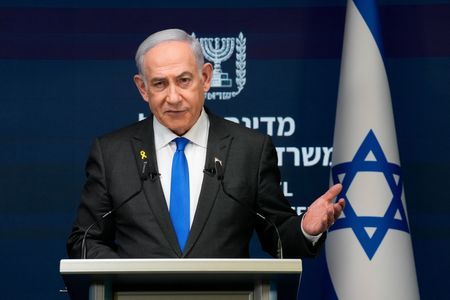
Israeli Prime Minister Benjamin Netanyahu speaks during a news conference in Jerusalem, September. 2, 2024.

Israeli Prime Minister Benjamin Netanyahu says his country will retaliate against Iran following what he called one of the largest missile attacks in history.

Scores of ballistic missiles were launched by Iran toward Israeli cities and military targets last Tuesday. Since then, the entire region has been anticipating an Israeli response to Tehran's second direct attack on Israel since April.

“Iran has twice fired hundreds of missiles at our territory and our cities — ballistic missile attacks among the largest in history,” Netanyahu said in a video statement recorded in his office in Tel Aviv after the Rosh Hashanah weekend.

The Israeli prime minister said no country in the world would accept such an attack on its cities and citizens, and the Jewish state will not either. “Israel has the duty and the right to defend itself and respond to these attacks — and we will do so.”

Netanyahu portrayed the missile attack as part of a broader Iranian strategy to fuel a multi-front war against Israel, using its proxy forces across the Middle East, including Hezbollah in Lebanon and Hamas in Gaza. “As Israel fights the forces of barbarism led by Iran, all civilized countries should stand firmly by Israel's side,” he declared, calling for international support in Israel's fight against Iran.

Hossain Aghaei, an analyst of international relations and strategic affairs, said in an interview with Iran International that "the Iranian government’s efforts to establish deterrence through its proxy groups are futile."

The analyst said the Islamic Republic does not even have a strategic ally in times of danger, and "relying solely on proxy groups will not lead to any success."

Meanwhile, in a broadcast to mark one year since Hamas’s October 7 attack, Israeli President Isaac Herzog underscored that the nation remains vulnerable, with hostages still held by Hamas and residents displaced due to ongoing conflict. He highlighted Iran’s role in supporting militant groups that continue to threaten Israel, stating, "It is in the ongoing threat to the Jewish state by Iran and its terror proxies, who are blinded by hatred and bent on the destruction of our one and only Jewish nation state."

Israel’s Foreign Minister Israel Katz also issued a warning to Iranian Supreme Leader Ali Khamenei on social media, urging him to withdraw Iranian proxies from Lebanon. “Khamenei, take your proxies and leave Lebanon,” Katz wrote in a post on X, alongside images of slain Hezbollah leader Hassan Nasrallah and his likely successor Hashem Safieddine, who is believed to have been targeted by Israeli forces.

Israeli military spokesman Rear Adm. Daniel Hagari also stated on Saturday that his country's response to Iran's "disgraceful attack" will be carried out "in the manner, at the location, and at the timing which we decide."

He acknowledged the strikes but stressed that the Israeli Air Force (IAF) remains fully operational. “There were several impacts in the center of the country, in civilian areas, and there were also impacts in airbases, in Nevatim and Tel Nof,” Hagari said, while assuring that “these impacts did not hit planes and did not harm the Air Force’s competence. The airbases, both Nevatim and Tel Nof, are fully functioning.”

Iran responds to Israeli threats

Iranian officials have not backed down in response to Israel's warnings. IRGC Navy Commander Alireza Tangsiri in a statement on Saturday vowed that Iran would resist any Israeli action.

“The message of peace and friendship to our friends is that ‘we can,’ but the message to our enemies is that if they want to play with fire in the region, we will stand against them decisively,” Tangsiri said. He added that Iran is preparing for any situation, and that “the Leader of the Revolution and the Commander-in-Chief of the IRGC always emphasize the need for full readiness and vigilance to face both normal and exceptional circumstances in the region.”

In a press conference held in Syria, Iranian Foreign Minister Abbas Araghchi also promised a stronger response to any Israeli aggression. “Our response to any Israeli aggression will be clear and direct. Every action will be met with a similar, proportional, and even stronger reaction,” Araghchi stated. “This is something we have repeatedly proven, and they are welcome to test us.”

CENTCOM chief in Israel as tensions mount

As tensions between Israel and Iran continue to rise, US CENTCOM chief Gen. Michael Kurilla arrived in Israel on Saturday for high-level meetings with Israeli defense and military officials. Kurilla’s visit underscores the United States' commitment to its ally Israel as both countries prepare for potential escalation in the aftermath of the Iranian missile attack.

Israel is coordinating its preparations for a retaliatory attack on Iran with Washington, an Israeli official told the country's state broadcaster, adding that "all scenarios" are on the table.


Most Viewed

State media slam Araghchi's Hormuz tweet, say it let Trump claim victory
1

State media slam Araghchi's Hormuz tweet, say it let Trump claim victory

2

Iran International says it won’t be silenced after London arson attack

3
INSIGHT

How Tehran bends its own red lines to boost state rallies

4
VOICES FROM IRAN

Hope and anger in Iran as fragile ceasefire persists

5

Iran halts petrochemical exports to supply domestic market

Banner
Banner

Spotlight

  • Too early to tell who is winning Iran war, experts say
    PODCAST

    Too early to tell who is winning Iran war, experts say

  • How Tehran bends its own red lines to boost state rallies
    INSIGHT

    How Tehran bends its own red lines to boost state rallies

  • Iran blackout cripples freelancer, small business incomes
    VOICES FROM IRAN

    Iran blackout cripples freelancer, small business incomes

  • Ideology may be fading in Iran, but not in Kashmir's ‘Mini Iran'
    INSIGHT

    Ideology may be fading in Iran, but not in Kashmir's ‘Mini Iran'

  • US blockade enters murky phase as tankers spoof signals and buyers hesitate
    ANALYSIS

    US blockade enters murky phase as tankers spoof signals and buyers hesitate

  • Why the $100 billion Hormuz toll revenue is a myth
    ANALYSIS

    Why the $100 billion Hormuz toll revenue is a myth

•
•
•

More Stories

War seems inevitable and yet we cling to hope

Oct 5, 2024, 20:55 GMT+1
•
Tehran Insider

Iran's missile attack on Israel has reignited talk of war, leaving many anxious. Some hope an Israeli strike could free them from the Islamic government. But most remain silently apprehensive—numbed, perhaps, or resigned to their helplessness.

"Some people are in denial, but the war is at our doorstep," says Shayan, a 28-year-old artist who makes a living by teaching painting. "I immediately Googled for shelters in Tehran after the missile attack was announced, but found none. We’re on our own. The authorities don’t even bother to inform or reassure the public."

He refers to reports that Iran's missile attack on October 1 occurred before Iranian airspace was closed. "They launched ballistic missiles while passenger flights were still in the air. Human life holds no value, neither for Khamenei nor for Netanyahu."

Iranian reactions to military actions are often reflected at gas stations. Mere minutes after the missile strike, long lines were formed at gas stations across the country. I’m not sure why. Perhaps a full tank is a slight assurance that you can go somewhere safer if things heat up. I was guilty of this collective rush that night, reaching the actual pump after an hour in line. The attendant asked if I wanted to fill it up. I said please. “I’d do it for free if Israel hits them," he joked.

The killing of Ismail Haniyeh in Tehran led many Iranians to believe that Israel can ‘take out’ anyone it wants—and with precision. This belief was strengthened after the attack on Hezbollah HQ in southern Beirut. Strangely enough, not much was reported about civilian casualties in that operation. Many don’t seem to note that several residential blocks were bombed to rubble, most likely with hundreds in them.

The day after Nasrallah was killed, I overheard a conversation in a pharmacy. "I wonder when they’ll cut off the head of the snake," a young man asked an older man, both waiting for their prescription. “Soon, God willing,” was the response, “and hopefully they’ll be precise like with the last two.” No names were mentioned, but all present knew what was meant by ‘head of snake’ and ‘the last two’.

“People hoping for Israel to attack think it will only wipe out the regime. I don’t believe that’ll be the case.” This was Nasrin, 46, an Instagram ‘influencer’. She’s annoyed by what she calls “casual warmongering” of some people around her. “We all hate the Islamic Republic, but we also love Iran; we don’t want to see it ruined,” Nasrin says. “Those here who cheer for an Israeli attack are either delusional or have no recollection of war like I and many in my generation do.”

That’d be two-thirds of Iran’s population. The war that broke out following Iraq’s invasion of Iran in 1980 ended in 1988. Only a third of Iranians are old enough to remember the sirens and the Soviet-made Scud missiles raining on Iran’s urban centers in the war's latter years—known as the War of Cities.

Iraq fired Soviet-made missiles at Iran's capital Tehran in 1986
100%
Iraq fired Soviet-made missiles at Iran's capital Tehran in 1986

This is not to suggest that those younger than Nasrin look forward to an Israeli attack. Far from it, in fact. Shabnam is a 36-year-old lawyer who grapples with the “societal consequences” of a theocratic state every day. “I detest the Islamic Republic and its allies. But I abhor Israel too. Hezbollah holds meetings under residential buildings to make it harder for Israelis to strike. But Israel bombs everything including the kitchen sink. And the Islamic Republic retaliates with 200 missiles, firing while Iran’s airspace is open. They’re all fanatic criminals with no regard for human life.”

Shabnam’s friend, Sadra, enters the conversation. “The world revolves around power. If you can, you do. And that’s not changing anytime soon.” Sadra is 34 and out of work. “Humanitarian law is obsolete in times of war. So are the institutions tasked to preserve it. But that’s all we have for now. What I think is really dangerous is for rogue states like Iran and Israel to undermine the UN or its watchdogs because they don’t like their rulings or findings.” We’re nearing a “complete dog eat dog” world order, he fears.

Around me, I see people growing less indifferent to the situation in the Middle East. More are becoming wary—or at least more alert. As conflicts that once felt distant inch closer to home, many are increasingly attuned to words like displacement and famine.

A few days after Nasrallah was killed, I asked my 70-year-old neighbor if he was worried about a potential war. “There won’t be a war because the Islamic Republic is afraid of war,” he said with no detectable hint of humor. I asked him again the day after Iran fired missiles at Israel. “I stand by my word dear: there won’t be a war,” he replied. Time might prove him right. But for now, most here would tell you he’s wrong.

Australia summons Iranian envoy over praise for Nasrallah

Oct 5, 2024, 17:05 GMT+1

Iran's ambassador to Australia Ahmad Sadeghi was summoned Friday by the Australian government for the second time in two months after a social media post praising late Hezbollah chief Hassan Nasrallah.

Following Israel's announcement of Hassan Nasrallah's death in an airstrike in Beirut's southern suburbs, Ahmad Sadeghi took to X, referring to him as "a great personality... and an unparalleled leader."

“However, his path in the struggle against the oppression and occupation of the criminal Zionist regime will continue to have many followers," the ambassador wrote last week.

Sadeghi was summoned to meet with Australia's Acting Secretary and Protocol Chief at the Department of Foreign Affairs and Trade, where he was “reminded of his obligation to respect Australian law and avoid interference in domestic matters,” according to The Daily Telegraph.

Prime Minister Anthony Albanese, the opposition, and Jewish organizations condemned Sadeghi’s comments. Albanese stated, "We condemn any support for terrorist organizations like Hezbollah."

In August, Sadeghi referred to Israel as a "Zionist plague" and called for the "wiping out" of Israelis in the "holy lands of Palestine" by 2027, sparking outrage from Australia's opposition leader, Peter Dutton, who called for his immediate expulsion. Dutton said, "The comments by the Iranian ambassador are completely and utterly at odds with what is in our country’s best interest."

His remarks also led to a diplomatic rebuke from Albanese, who labeled the comments as "abhorrent, hateful, and antisemitic."

Also in December, the Australian government condemned Sadeghi after he called for "an end" to Israel, labeling it "the world’s most notorious killing machine." His comments were made following Hamas' attack on Israel on October 7 last year, which led to the deaths of around 1,200 Israelis and foreigners, the worst single-day loss of life since Israel's founding in 1948. More than 240 people were also taken hostage.

Israeli military preparing retaliation against Iran - reports

Oct 5, 2024, 14:25 GMT+1
•
Niloufar Goudarzi

The Israeli army is "preparing a response" following Iran’s missile attack on Israel earlier this week, an Israeli military official told local and international media on Saturday.

"The IDF [Israeli military] is preparing a response to the unprecedented and unlawful Iranian attack on Israeli civilians and Israel," the official, speaking anonymously due to lack of authorization to discuss the matter publicly, told AFP. However, he provided no further details regarding the nature or timing of the potential Israeli retaliation.

Israel’s newspaper Haaretz cited military sources confirming that the planned response would be "significant."

"The IDF is preparing for a significant strike in Iran following this week's missile attack from Tehran," the paper reported. Additionally, Haaretz noted that the military has not ruled out the possibility of further missile launches from Iran after Israel retaliates.

The Iranian missile strike on Tuesday involved around 180 missiles targeting Israel, marking Iran’s second direct assault on Israel in less than six months.

A former IDF spokesperson suggested that Israel’s response could include high-profile targets such as "regime symbols," including the residence of Supreme Leader Ali Khamenei and key Iranian officials. Though these actions carry significant risks, they remain possible options, according to the retired Lt. Colonel Jonathan Conricus. In an episode of the podcast Eye for Iran this week, Conricus, now a senior fellow at the Foundation for Defense of Democracies (FDD), indicated that Israel is likely to retaliate strongly, but many strategic factors will influence the final decision.

An Iranian oil installation in Khuzestan province, southwest. Undated
100%
An Iranian oil installation in Khuzestan province, southwest.

Since Iran's attack, unconfirmed reports have surfaced suggesting that the potential successor to the late Hezbollah leader Hassan Nasrallah, killed last week, has been unreachable since Friday, following an Israeli airstrike that allegedly targeted him, according to a Lebanese security source on Saturday.

Meanwhile, Israel’s Channel 12 has reported that Esmail Ghaani, the commander of the IRGC's Quds Force, was likely present and injured in the Israeli strike in southern Beirut aimed at Hashem Safieddine, head of Hezbollah's executive council. Although the hardline website Mehr initially dismissed these reports, the content has since been removed from their site.

Despite rising tensions, Iranian Oil Minister Mohsen Paknejad expressed confidence on Saturday, stating he was "not worried" about a regional conflict, even after reports suggesting an imminent Israeli strike on Iran. Speaking to the ministry’s Shana news site, Paknejad said, "I am not worried about the crises that the enemies of the revolution are creating, and this trip is considered a normal work trip."

Paknejad made these remarks during a visit to Assaluyeh, a major hub for Iran’s exploitation of the world’s largest offshore gas field, which it shares with Qatar in the Persian Gulf.

US officials remain divided on the recommendations they offer Israel regarding potential targets in Iran. President Joe Biden, who initially ruled out endorsing strikes on Iran’s nuclear facilities, later extended this caution to include Iran’s oil infrastructure. This shift in stance has led analysts to speculate that the administration may be signaling a preference for targeting Iran's military bases, steering away from actions that could escalate into broader economic or environmental fallout.

“It appears that his unspoken intentions are more revealing than his words. Suppose oil or nuclear facilities are off-limits as potential targets. In that case, the logical focus will shift to military assets,” Kamran Matin, Senior Lecturer in International Relations at the University of Sussex, told Iran International TV.

“I believe the Biden administration may not only refrain from condemning but could implicitly endorse Israeli strikes on missile bases, production facilities, or even on the leadership and strongholds of the IRGC's Quds Force,” he added.

The Biden administration would prefer no major shock to oil prices four weeks before presidential elections, which could hurt the chances of Vice President Kamala Harris.

Reuters also reported that, according to numerous experts, including over half a dozen former military, intelligence, and diplomatic officials from the US and the Middle East, Israel is less likely to target the oil facilities that form the backbone of Iran's economy or its nuclear sites.

Meanwhile, former President Donald Trump, in an interview with Fox News on Friday, criticized President Biden’s stance, asserting that it was a mistake for the administration to signal that the United States would withhold support for an Israeli strike on Iran’s nuclear program.

Criminal charges filed in Tehran for 'inciting fear' on social media

Oct 5, 2024, 10:55 GMT+1

The Tehran Prosecutor's Office has filed criminal charges against individuals accused of "creating fear to harm the psychological security of society" and "spreading lies" on social media, state media reported on Friday.

Iranian citizens lack the freedom of speech enjoyed in democratic countries. Without independent courts, the government and its judiciary can interpret laws or issue regulations with minimal accountability, particularly on political or religious matters.

According to the Iranian judiciary’s Mizan News Agency, in recent days, certain social media accounts on platforms like X (formerly Twitter), Telegram, and other online activists have been involved in spreading such content. However, no concrete examples or clear definitions of "false news" or "creating fear" have been provided. Some individuals have faced legal action, while others have been warned following monitoring of online activities, Mizan reported.

The latest announcement came in the wake of Iran's missile attack on Israel on Tuesday night, after which the Revolutionary Guards warned that social media posts interpreted as "support for Israel" would be treated as a crime.

This is not unprecedented. The Islamic Republic's judiciary has previously pursued legal cases against citizens, journalists, and media outlets for commenting on events such as the death of Hassan Nasrallah, Hezbollah’s chief, Ismail Haniyeh, the death of Iranian President Ebrahim Raisi, and the ongoing conflict between Iran and Israel.

Although Khamenei declared a five-day period of national mourning for Nasrallah, videos obtained by Iran International revealed a contrasting public reaction. Some Iranians were seen celebrating his death, distributing pastries in the streets and raising toasts. Similar defiance appeared on social media, where users openly challenged the state’s narrative, underscoring a sharp divide between public sentiment and the official line.

Also, in the aftermath of Raisi's death, dozens were arrested for "insulting" officials and "disturbing public opinion" as many celebrated the helicopter crash that killed him and his companions. The government and state media portrayed Raisi and his companions as "martyrs," while trying to suppress any criticism after the crash amid a leadership crisis.

A notable example of narrative control and pressure on free expression occurred in August when blogger Hossein Shanbehzadeh was sentenced to 12 years in prison for posting a single dot in response to a tweet by Supreme Leader Ali Khamenei. His post, which received more likes than Khamenei’s tweet, resulted in his arrest weeks later.

Iran faces 26% oil revenue deficit despite surging exports

Oct 5, 2024, 09:38 GMT+1

Iran’s Supreme Audit Court reports that despite a surge in oil exports, the projected revenues from these exports in recent months have not been met in the national budget.

The report states that in the first five months of the current Iranian fiscal year (starting March 21), 26% of the projected oil export revenues remain unachieved. By comparison, during the same period last year, half of the budgeted oil export revenues had not been met. However, the Supreme Audit Court did not provide figures in US dollars, and it is not clear what the monetary figure of the shortfall is.

Iran's customs data indicates that in the first five months of the current fiscal year, the country exported $20 billion worth of oil and petroleum products, 45% of which should be allocated to the government budget.

The 26% shortfall in the share of oil revenues allocated to the government budget during the first five months of the current fiscal year persists despite both the volume of oil exports and global prices exceeding the projections in the national budget.

The budget bill for this year anticipated daily exports of 1.35 million barrels of oil and condensates. Furthermore, Iran also exports 240,000 barrels of fuel oil daily, bringing the total daily oil exports to 1.6 million barrels.

The budget also set the price of oil at €65 ($70) per barrel.

Tanker-tracking data reveals that Iran exported at least 1.85 million barrels per day of crude oil, condensates, and petroleum products (including fuel oil) during this period. Additionally, OPEC reports show that the average price of Iranian oil exceeded $80 per barrel. Given these figures, Iran should not only have avoided a shortfall in oil revenues allocated to the budget but should have exceeded its projected revenues by one-third.

The reason for this deficit is attributed to Iran's substantial expenses in bypassing US sanctions, including offering discounts to Chinese buyers.

Additionally, part of Iran’s fuel oil exports is bartered for gasoline, as Iran has faced a gasoline shortage for the past two years.

Data from Kpler, a commodity data company, also shows that during the first five months of the current fiscal year, 50,000 barrels per day of Iranian oil were sent to Syria, a country that has been receiving free oil from Iran for the past decade.

Previously, the government's budget share of oil export revenues was 45.5%. However, with the new government led by Masoud Pezeshkian and a request for help from the supreme leader Ali Khamenei to cover the budget deficit, it was decided recently that the National Development Fund's share of oil export revenues would be halved to 20%, while the government’s share would increase to 65.5%.

Additionally, 14.5% of oil revenues are allocated to the National Iranian Oil Company (NIOC).

Iran’s Oil Exports

According to the annual report of the Organization of the Petroleum Exporting Countries (OPEC), Iran’s oil export revenues reached about $72 billion after the 2015 nuclear deal (JCPOA). However, following the US withdrawal from the agreement, this figure fell below $8 billion in 2020.

With the election of Joe Biden as US president, Iran’s oil export revenues have increased annually, surpassing $41 billion in 2023, without considering oil discounts and the costs of circumventing sanctions.

100%

However, Iran's customs statistics reported oil export revenues of $35.87 billion for the previous Iranian year, revealing that over $5 billion was lost in the process of bypassing sanctions. Additionally, Iranian customs reported that oil export revenues for the first half of the current fiscal year totaled just over $23 billion. Yet, given the export of 1.85 million barrels per day and an average price of $80 per barrel, revenues should have exceeded $27.5 billion during that period.

OPEC statistics show that the total volume of Iran's crude oil, condensates, and petroleum products exports last year averaged about 1.73 million barrels per day, which is two and a half times higher than when Joe Biden took office.

This figure, before US sanctions imposed in 2018, was around 2.5 million barrels per day.