• العربية
  • فارسی
Brand
  • Iran Insight
  • Politics
  • Economy
  • Analysis
  • Special Report
  • Opinion
  • Podcast
  • Iran Insight
  • Politics
  • Economy
  • Analysis
  • Special Report
  • Opinion
  • Podcast
  • Theme
  • Language
    • العربية
    • فارسی
  • Iran Insight
  • Politics
  • Economy
  • Analysis
  • Special Report
  • Opinion
  • Podcast
All rights reserved for Volant Media UK Limited
volant media logo
ANALYSIS

What Pezeshkian can and cannot do in New York

Behrouz Turani
Behrouz Turani

Iran International

Sep 24, 2024, 15:01 GMT+1Updated: 17:03 GMT+1
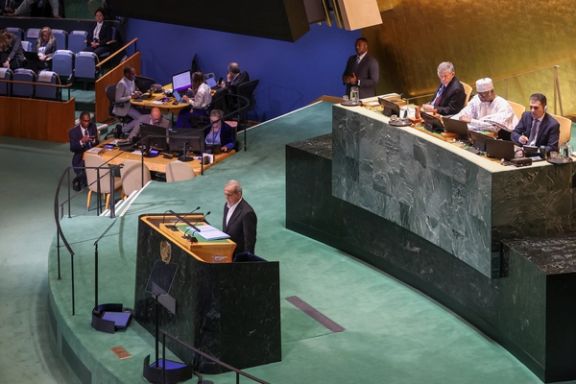
Iran’s President Masoud Pezeshkian speaking at the UN’s Summit of the Future 2024 on September 23, 2024

Iranian President Massoud Pezeshkian's current stay in New York for the UN General Assembly will be the shortest of any of his predecessors, lasting just three days.

This short stay could explain his limited media exposure and help mask his communication weaknesses. Over the past few months, Pezeshkian has shown he’s not a strong speaker, often repeating himself multiple times in the same interview or speech.

Even when reading from a prepared text, he tends to lose his place. On several occasions, he’s even cut speeches short, claiming the audience appeared bored.
Although Pezeshkian’s first appearance in New York took place behind closed doors in a meeting with a group of journalists, labeled by his team as "media managers," it is likely that he will delegate interviews with US and international media to his vice president for strategic affairs, former Foreign Minister Mohammad Javad Zarif. Zarif is expected to convey the message that Iran has changed and is ready to engage with the world.

Pezeshkian has described his mission to New York as "telling the world that Iran is more secure and free than you think." However, this message may be difficult to convey, given recent events.

Just recently, Hamas leader Ismail Haniyeh was assassinated in Tehran, and as in previous years, Iranian expats continue to face the risk of being taken hostage on fabricated charges.

Beyond security concerns, the state of freedom in Iran is also under scrutiny, particularly with Nobel Peace Prize laureate Narges Mohammadi, who has spent years in prison for defending the rights of other prisoners and is expected to serve even more time behind bars.
Pezeshkian's activity in New York may be limited to a 20-minute speech at the UNGA on Tuesday and a brief five-minute address on advocating global peace. Given Iran's involvement in conflicts across the Middle East and accusations of arming Russia against Ukraine, the Iranian president may have little to contribute to the forum initiated by the UN Secretary-General.

Iranian Foreign Minister Abbas Araghchi arrived in New York a couple of days before Pezeshkian with his own entourage, possibly to give the President an opportunity to pretend that unlike previous presidents he has travelled to New York as the head of a delegation of 40 people including his daughter and son-in-law. Many on Iranian social media demanded an explanation for why the couple is accompanying the President.

As of Monday evening, Araghchi had only given interviews in Farsi with Iranian state TV and the official news agency IRNA, where he expressed his willingness to resume negotiations over Iran's controversial nuclear program.

However, he quickly acknowledged that this would be difficult to achieve. It remains unclear whom he would engage with, even if Supreme Leader Ali Khamenei has given him the green light.

President Joe Biden is largely inaccessible with less than two months before he leaves the White House, and the next president, whose identity remains unknown until the election concludes, won't take office until January.

Pezeshkian, Araghchi, and their entourage are set to meet with a group of Iranians living in the US, where Pezeshkian plans to invite them to invest in Iran. Ironically, many of those invited are university students and academics—not exactly known for their wealth—even if they could trust the officials after enjoying a meal of rice, broad beans, and lamb shank washed down with yogurt drink. Previous Iranian presidents have made similar appeals in past years, all without success.

Convincing Iranians that their country is safe for investment will be even more challenging than persuading foreigners. They know firsthand why they or their families left, often after having their assets confiscated, with little hope of recovering their rights. These experiences make any assurances about security and stability difficult to believe.

The views expressed are the contributor's own and do not necessarily represent the views of Iran International or its staff.


Most Viewed

Hardliners push Hormuz ‘red line’ as US blockade tests Iran’s leverage
1
INSIGHT

Hardliners push Hormuz ‘red line’ as US blockade tests Iran’s leverage

2

Iran International says it won’t be silenced after London arson attack

3
VOICES FROM IRAN

Hope and anger in Iran as fragile ceasefire persists

4

US sanctions oil network tied to Iranian tycoon Shamkhani

5

Iran halts petrochemical exports to supply domestic market

Banner
Banner

Spotlight

  • Hardliners push Hormuz ‘red line’ as US blockade tests Iran’s leverage
    INSIGHT

    Hardliners push Hormuz ‘red line’ as US blockade tests Iran’s leverage

  • Ideology may be fading in Iran, but not in Kashmir's ‘Mini Iran'
    INSIGHT

    Ideology may be fading in Iran, but not in Kashmir's ‘Mini Iran'

  • War damage amounts to $3,000 per Iranian, with blockade set to add to losses
    INSIGHT

    War damage amounts to $3,000 per Iranian, with blockade set to add to losses

  • Why the $100 billion Hormuz toll revenue is a myth
    ANALYSIS

    Why the $100 billion Hormuz toll revenue is a myth

  • US blockade targets Iran oil boom amid regional disruption
    ANALYSIS

    US blockade targets Iran oil boom amid regional disruption

  • Iran's digital economy battered by prolonged blackout
    INSIGHT

    Iran's digital economy battered by prolonged blackout

•
•
•

More Stories

Iran uses UN General Assembly to conduct influence operation in US

Sep 24, 2024, 14:50 GMT+1
•
Jason M. Brodsky , Kasra Aarabi

The circus is back in town. A new Iranian president arrives at the United Nations as a smiling mask to an undeterred adversary of the United States and too many credulous media and policy elites in this country cheer on the pageant. This needs to stop.

United Against Nuclear Iran (UANI) has obtained a video in which Iranian foreign minister Abbas Araghchi tells the UN Special Envoy Geir Pedersen that he met with “old friends” from American think tanks the previous evening.

From 2013 to 2021, when he was chief nuclear negotiator, Araghchi – an affiliate of the designated terrorist group Islamic Revolutionary Guard Corps (IRGC) – was part of a core network of officials cultivating individuals and entities in the West to promote the Islamic Republic’s narrative, influence policy debates, and infiltrate key institutions without any public disclosure.

Araghchi indicates that he met these think tankers in the past and seems keen on reviving the relationships now that he has regained power. The United States and its allies must be ready to counter this renewed Iranian regime lobbying campaign aimed at easing international pressure, at a time when the IRGC plots terror attacks on American soil and Tehran interferes in the U.S. election.

This sets the scene for the arrival in New York of the Islamic Republic’s new President Masoud Pezeshkian for the opening of the U.N. General Assembly (UNGA).

Iran follows a well-worn playbook to promote its new presidents in New York: they place an op-ed by a senior official in a major U.S. newspaper, pledging engagement and mutual respect while seeking sanctions relief to enable its malign activities. Tehran offers an interview with the new president to ‘safe’ television networks and anchors in exchange for such access.

Additionally, the regime schedules meetings with former policymakers, think tankers, and others to influence their analyses of Iran’s policies, banking on these individuals using their media platforms to amplify these exclusive connections.

Inevitably, some participants in these discussions will become champions of a “golden opportunity” for rapprochement between the U.S. and Iran. Like Pezeshkian and Araghchi, whom they will label as “moderates,” these Western voices will use this narrative to express Iran’s desire for renewed nuclear talks and ultimately advocate for sanctions relief for the regime.

Araghchi and his Foreign Ministry cohort Javad Zarif and his deputy, Majid Takht-Ravanchi, played starring roles in leaked email correspondence revealing a significant information operation, dubbed “the Iran Experts Initiative,” to influence American and European policy to better serve the Islamic Republic’s interests.

This modus operandi is not restricted to UNGA or America. While passing a warning from an Iranian embassy to one of the authors of this article that they should not be so outspoken, a European think tanker described how they always attain sign-off from an Iranian ambassador prior to publishing content on Iran – a process they recommended to avoid any future warnings. Iranians who live in the West are uniquely susceptible to such threats from Tehran.

A broader circle of academics and former officials in Iran, backed by its intelligence apparatus, also engage leading Western think tanks under the guise of Track II diplomacy, which the regime greenlighted resuming in early 2023.

In fact, the Islamic Republic’s Foreign Ministry has allocated resources for Track II initiatives with the aim to create a “lobby” in the West for relations with Tehran. These are written into Iranian government documents. One Track II participant is Nasser Hadian, a professor at the University of Tehran and known for having extensive ties to the sanctioned Intelligence Ministry.

The Iranian Mission to the United Nations will ensure that aspects of Pezeshkian’s personal biography are showcased during his program in Manhattan to make him more accessible and sympathetic to an American audience. Specifically, that he is a cardiologist and a widower, whose wife and child died in a car crash—mirroring President Joe Biden’s life story. There will be a heavy emphasis on Pezeshkian the “reformist,” despite widespread electoral suppression and his own role in suppressive hijab enforcement

Pezeshkian’s speech before the U.N. General Assembly this week will likely feature the hallmarks of the Islamic Republic’s foreign policy—seeking to further stoke an international consensus against Israel in its war against Hamas He will also resurrect and repackage concepts that previous Iranian presidents championed like a “World Against Violent Extremism” and “a Middle East free of weapons of mass destruction.”

This is all gaslighting to provide space for the IRGC to continue the advancement of the regime’s nuclear program and regional aggression, including via its terrorist proxies, while thwarting international coercive measures in the delusional hope of empowering so-called “moderates” in Iran.

But the regime in Iran won’t just export smiles to UNGA. Last year, members of the Islamic Republic’s delegation threatened and physically attacked U.S.-based Iranian journalists in New York. It was later revealed that one of the perpetrators – granted a visa to attend UNGA by U.S. authorities - was a longstanding member of the Intelligence Ministry, which supports Iran’s terrorist operations abroad.

These aggressive and intimidatory actions are common tactics the Islamic Republic uses against its critics when it travels across the West.

During a Track II diplomacy conference in a European capital, one of the authors of this article had surveillance conducted on him by regime operatives after the Islamic Republic’s delegation was made aware of his presence by participants closely aligned with Tehran.These acts of transnational repression on Western soil cannot be ignored.

The Iranian regime’s nefarious information operations in the U.S. are on a par with China’s and Russia’s. Last week’s joint statement from U.S. authorities revealed Iran’s regime has escalated its efforts to interfere in November’s presidential elections with intent to “stoke discord and undermine confidence in the U.S. electoral process.”

The statement described these efforts as a “direct threat to the U.S.” that “will not be tolerated.” Yet, instead of denying the Iranian delegation entry to the U.S., Tehran is receiving red-carpet treatment in New York.

The Biden administration should issue a similar statement warning about the influence operations happening this week in New York and immediately deport the visiting Iranian officials.

Iran seeks to reengage West, but its threat won't diminish, analysts say

Sep 24, 2024, 14:32 GMT+1

Iran is signaling its desire to resume nuclear negotiations with the West, as indicated by the Foreign Minister on Monday, as the country’s President arrived in the US for the UN General Assembly.

Speaking to domestic media, Iran’s top diplomat, Abbas Araghchi, stated that Tehran is prepared to initiate discussions this week, provided “the other parties are ready.”

Iranian President Masoud Pezeshkian’s first trip to the West comes just six weeks before the November 5 US presidential election—and amid mounting regional instability in the Middle East. Reuters reported last week that the country’s new president is set to meet with European leaders while in New York, although there is little sign of any breakthrough.

Iran expert Ali Fathollah-Nejad says that this aligns with Pezeshkian’s so-called mission to seek talks with the West in order to obtain sanctions relief. “Pezeshkian’s so-called mission is also supported by the power center in Iran, by Supreme Leader Ali Khamenei and the IRGC whose daily Javan had even celebrated Pezeshkian’s presidential victory,” said Fathollah-Nejad, who is the director of the Center for Middle East and Global Order (CMEG).

While some analysis in Western media has lauded the "reformist" new President as a potential bridge between Iran and the West, others remain unconvinced. “Pezeshkian is nothing more than a moderate façade for the regime to ward off Western economic sanctions and pressure. The West seems to have little strategic memory that the regime has used this tactic repeatedly throughout its 45-year history,” Andrea Stricker, the Deputy Director and Research Fellow at FDD’s Nonproliferation & Biodefense Program, told Iran International English.

According to Reuters, which cited three Iranian officials, Pezeshkian is set to deliver a message that "Tehran is open to diplomacy," with one Iranian official reportedly saying that "Iran's rulers believe that the tense standoff with the West over Iran's nuclear program should end... but through negotiations from a position of power, not pressure.”

Stricker argues that the emphasis on "power, not pressure" highlights the regime's understanding that it can leverage nuclear coercion and blackmail to secure Western concessions. These range from the US easing oil sanctions, allowing unprecedented Iranian oil exports, to avoiding strikes on Iranian military assets despite attacks on US interests or global shipping, and the West's failure to hold Tehran accountable at the IAEA for its nuclear violations. “All of this permits the regime to increase its malign regional activity with impunity,” Stricker said.

Pressure on Iran has also been mounting from some corners to respond to the widely believed Israeli operations—including the killing of Hamas leader Ismail Haniyeh and the latest series of strikes on Hezbollah members in Lebanon. Iran’s reluctance to respond, Fathollah-Nejad argues, is because there is a strategic preference by the regime for Pezeshkian to secure “sanctions relief that is considered vital by Iran’s power center, for regime stability reasons.”

Fathollah-Nejad also notes the uncertainty surrounding the upcoming weeks in Tehran's diplomatic efforts to re-engage with the West. He suggests that for the regime, it would be favorable if Kamala Harris wins the US presidency, as there is significant anxiety in Tehran about Donald Trump's potential return to the White House. While he says that it is difficult to predict what the next weeks will look like, Iran might agree to freeze its nuclear program in exchange for sanctions relief from the US.

“This would, of course, be a temporary measure, regardless of the fact that there is a need to broaden Iran policy, not least in the regional geopolitical dimension,” Fathollah-Nejad said.

Regardless of who wins the US presidency, Stricker argues that further rounds of fruitless nuclear talks are merely a tactic to "prevent the West from shifting to a pressure strategy aimed at penalizing, deterring, and rolling back Iran's nuclear advancements." “Just as nearly two years of nuclear talks under Biden were ultimately futile, we should expect the same of any talks that are not backed by severe Western pressure and a credible threat of military force. The current dynamic is the result of a failure of US and European strategy and their fear of escalation,” she said.

The Biden administration has seemingly deprioritized negotiations with Iran, focusing on other issues, and with the 2015 nuclear deal effectively defunct, future diplomatic efforts are likely to be more challenging and less effective. Both European diplomats and US officials have suggested in various reports that while Washington is not ready for serious negotiations, Iran may seek engagement with Europe independently.

Whether there will be a new nuclear deal or not, Stricker and Fathollah-Nejad seemingly agree that it will not address the growing threats Iran poses. “The 2015 nuclear deal is obsolete and set to expire in a few short years. It permitted the expansion of Iran’s nuclear program over time, in any case, and legalized the situation we face now with Tehran’s nuclear program,” Stricker maintained, saying the JCPOA was never a long-term solution.

While some have voiced that the West may not have any more tools left to restrain Tehran, Stricker argues the opposite. “It is well past time for the West to revert back to pressure—and to sustain it, backed by a strategy to weaken and destabilize the regime—if there is to be a negotiated solution, but ideally, a free Iran,” Stricker said.

She suggests the West enforce US oil sanctions on Iran by targeting Chinese importers, interdicting shipments, destroying Iranian military assets to restore deterrence, and reimposing UN sanctions expiring in 2025 to reinstate global missile, military, and nuclear restrictions on Tehran. “America, Europe, and Israel can also decisively support the Iranian people in their struggle to rid the country of the root of most Middle East woes—the Islamic Republic regime.”

Iran seeks to calm Iraqi infighting over spy row as region flares up

Sep 24, 2024, 13:46 GMT+1

Iran's Quds Force commander told Iraqi political leaders last week to ease criticism of the prime minister who has been embroiled in a row over spying allegations, sources said, seeking to steady a regional ally as conflict in the Middle East flares.

Esmail Qaani made the request during a visit to Baghdad, according to seven Iraqi sources, including people in political parties whose leaders the Iranian commander met. A regional diplomat confirmed the account. All the sources asked not to be named because the meetings were held in private.

The move to avert any weakening of Prime Minister Mohammed Shia al-Sudani reflects concerns in Iran about instability on its doorstep in Iraq, where Tehran has long wielded influence via a range of Iran-backed armed groups and Shiite Muslim parties.

Tehran is keen to avoid further pressure on its regional alliances after the almost year-long Gaza war, which has hammered Hamas, and amid an escalating conflict in Lebanon that has put huge pressure on Tehran's key regional ally, Hezbollah.

The Quds Force is the overseas branch of the Iranian Revolutionary Guards Corps (IRGC). The IRGC and Iran's Foreign Ministry did not immediately respond to requests for comment.

Qaani told Iraqi leaders in the Coordination Framework, a grouping of Shiite Muslim parties that picked Sudani for the job, not to undermine the prime minister amid allegations his office spied on top Iraqi officials and politicians. Qaani said stability in Iraq was vital amid the regional violence.

The spying allegations, which have been denied by advisers to Sudani and for which no evidence has been publicly presented, were aired by lawmakers and major media organisations last month and have caused a stir in Iraq.

Parliamentary elections next year

Loyalists and independent observers say prime minister Sudani's political opponents stoked the allegations to try to weaken him before parliamentary elections next year. Parties critical of him say the allegations are serious.

Iraq's judiciary has opened a probe into the matter overseen by Faiq Zaidan, the head of the Supreme Judicial Council, and some Iraqi officials said the results of the probe could determine whether the prime minister continues in his job.

For Sudani, the dispute comes at a delicate moment. He is seeking to rebuild the economy after decades of conflict ahead of elections and to balance the influence of well-armed, Iran-backed factions while negotiating a drawdown of US-led forces in Iraq, where Washington has maintained a contingent for years.

Renad Mansour at the London-based Chatham House think tank said Iran wanted to prevent tensions in Iraq, where rivalries have often turned violent, before parliamentary polls in 2025.

"At a crucial moment for Iran when it's trying to respond to Israeli aggression, the Iraqi groups are infighting in a way that's destabilising. The last thing Iran wants now is a political mess in Iraq," Mansour said.

It's not the first time Qaani has intervened in Iraq in a moment of crisis.

In February, he asked armed factions that Iran backs in Iraq to cease attacks on U.S. forces after a strike by one group on a US base in Jordan, on Iraq's western border, killed three US troops, Reuters reported at the time.

There were no attacks for months afterwards.

(Report by Reuters)

Sweden accuses Iran's IRGC of hacking text service to incite against Quran burnings

Sep 24, 2024, 13:13 GMT+1

Swedish authorities said on Tuesday that Iran hacked a messaging service last year, sending thousands of messages urging Swedes to retaliate against Quran burners.

Last year, there were several instances in Sweden where Islam's holy book was publicly burned, triggering widespread outrage across the Muslim world and sparking concerns of potential jihadist attacks.

“The security police can establish that a cyber group acted on behalf of the Iranian Revolutionary Guard to carry out an influence campaign,” the Swedish Security Service stated.

“The purpose was, among other things, to paint the image of Sweden as an Islamophobic country and create division in society,” it added.

In a separate statement, the Swedish Prosecution Authority confirmed that its investigation had determined the Iranian state, through the Iranian Islamic Revolutionary Guard Corps, was responsible for the data breach.

The authority noted that while they had identified the hackers involved, they would not proceed with pressing charges.

“Since the perpetrators are acting for a foreign power, in this case Iran, we assess that the conditions for prosecution abroad or extradition to Sweden are lacking,” the statement read.

Last year, the US State Department named Iran as the world's number one state sponsor of terror.

Following the Quran burnings, Sweden heightened its terrorism alert last year. The desecration led to widespread protests across several Muslim-majority countries, including a large demonstration outside the Swedish embassy in Baghdad. Iran's foreign ministry summoned Sweden’s charge d’affaires in Tehran. Also, Morocco recalled its ambassador in protest. At the same time, Turkey’s foreign minister condemned the incident, stating that it is “unacceptable to allow anti-Islam protests in the name of freedom of expression.”

The US also weighed in on the matter, with the deputy spokesperson for the State Department, Vedant Patel, noting in a briefing that burning religious texts is “disrespectful and hurtful.” He added, “What might be legal is certainly not necessarily appropriate".

In May, Sweden’s domestic security agency revealed that Iran had been planning terror plots in Sweden targeting dissidents and the country's Jewish and Israeli community.

The Swedish Ministry of Foreign Affairs said the revelations showing Iran was using Swedish crime gangs were being taken "very seriously".

In June, Iran and Sweden exchanged prisoners in a controversial swap. Iran freed Johan Floderus, a Swedish diplomat, and Saeed Azizi, a dual citizen. In return, Sweden released Hamid Nouri, an Iranian official convicted of war crimes for his role in the 1988 mass executions. Human rights groups have strongly criticized the exchange, calling it an act of "hostage-taking" by Iran.

Pressure mounts to release dissident rapper ahead of Pezeshkian's UN speech

Sep 24, 2024, 12:15 GMT+1

Ahead of Iranian President Masoud Pezeshkian's address at the UN on Tuesday, calls for the release of dissident rapper Toomaj Salehi have intensified, driven by growing pressure from his family, legal team, and human rights organizations.

Human rights advocates are using Pezeshkian’s visit to New York as an opportunity to highlight Salehi’s continued imprisonment and Iran’s broader human rights violations.

In a joint statement from his legal team at Doughty Street Chambers, Index on Censorship, and the Human Rights Foundation, they emphasized that Salehi's music and activism have been pivotal to the "Woman, Life, Freedom" movement, challenging corruption and exposing human rights abuses by Iranian authorities. The statement also underscored that, in retaliation for his outspoken work, Salehi has faced over three years of judicial harassment, including imprisonment, beatings, and torture.

The "Woman, Life, Freedom" movement, sparked by the death of 22-year-old Mahsa Amini while in police custody in 2022, saw months of nationwide protests. Human rights organizations estimate that at least 551 protesters were killed, including 68 children and 49 women, in the violent crackdown by state security forces. In March, the UN Fact-Finding mission’s report concluded that the suppression of these protests and systemic discrimination against women and girls amounted to severe human rights violations, with many acts constituting "crimes against humanity."

Salehi was first arrested in September 2021 following the release of his track “Mouse Hole,” and was detained again in October 2022 during the "Woman, Life, Freedom" uprising, facing charges including “corruption on earth,” which led to a death sentence in April.

While the death sentence was overturned by Iran's Supreme Court in June, Salehi remains imprisoned, with new charges tied to his music and activism. According to the statement, authorities have denied him adequate medical care, leaving him in severe pain from injuries sustained under torture.

Two urgent appeals have been filed with the UN on Salehi's behalf. In May, his legal team submitted an appeal to two UN Special Rapporteurs, and in July, the Human Rights Foundation lodged an individual complaint with the UN Working Group on Arbitrary Detention.

In the statement, Salehi’s family and friends also voiced concerns over his continued detention. Negin Niknaam, his friend and social media manager, highlighted that "Toomaj remains unlawfully [detained] in Dastgerd prison despite the absence of an arrest order and is in urgent need of medical care to prevent permanent disability." She called on UN Member States to hold Iran accountable and push for his immediate release.

Salehi's cousin, Arezou Eghbali Babadi, added that "international solidarity has been key in overturning Toomaj’s death sentence" and urged the global community to pressure the Iranian president for his release "before it’s too late."