• العربية
  • فارسی
Brand
  • Iran Insight
  • Politics
  • Economy
  • Analysis
  • Special Report
  • Opinion
  • Podcast
  • Iran Insight
  • Politics
  • Economy
  • Analysis
  • Special Report
  • Opinion
  • Podcast
  • Theme
  • Language
    • العربية
    • فارسی
  • Iran Insight
  • Politics
  • Economy
  • Analysis
  • Special Report
  • Opinion
  • Podcast
All rights reserved for Volant Media UK Limited
volant media logo

Pundits pessimistic about Pezeshkian's government, predict failure

Sep 24, 2024, 06:03 GMT+1Updated: 15:52 GMT+1
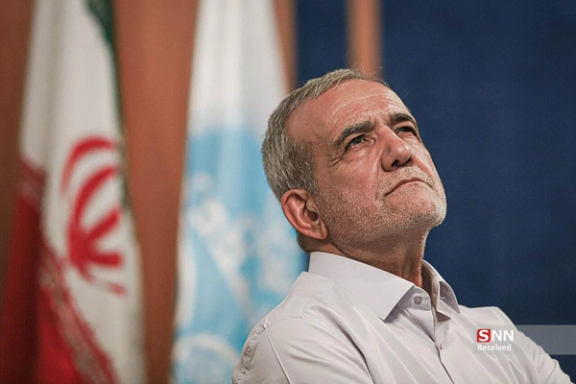
Iranian president Masoud Pezeshkian - File photo

A prominent Iranian "reformist" journalist has warned that the Pezeshkian administration is doomed to fail due to negative coverage from state TV, Iran’s hardline media, and foreign-based Persian outlets.

In an interview with centrist Ham Mihan daily which was widely carried by other Iranian media, Ahmad Zeidabadi said "What Pezeshkian is doing is like competing in a speech contest while his mouth is kept shut!"

He pointed out that while Masoud Pezeshkian was holding a news conference in Tehran earlier this month, the state TV was conducting a poll showing negative attitudes toward the President and his cabinet.

Zeidabadi noted that official state media is not supposed to oppose the government's policies, pointing to the hardline rhetoric of state TV, which is intended as a public relations tool for the administration. Despite the challenging media landscape in Iran, Zeidabadi argued that the role of scrutinizing the government's performance should fall to independent media.

He also criticized the state TV's monopoly on broadcasting in Iran. "The presidential administration does not have an exclusive media platform of its own and at the same time it is being targeted by sinister propaganda from the most important state-owned media outlet," the journalist observed.

Iranian commentator Ahmad Zeidabadi - File photo
100%
Iranian commentator Ahmad Zeidabadi - File photo

Iran’s state TV is indirectly controlled by Supreme Leader Ali Khamenei through high-level appointees. Currently, well-known hardliners control programming at the sprawling organization, which employs around 40,000 people, with a constantly growing budget, while public services and schools suffer from serious financial problems.

Zeidabadi also accused Persian-language media outside Iran, whose popularity he attributed to the inefficiency of Iranian state TV, of aggressively broadcasting anti-government propaganda into the country. "In such an environment, the Pezeshkian administration stands no chance of success," he reiterated.

In fact, organizations such as the BBC Persian Service and Iran International simply play the role of a non-governmental Iranian media, in the absence of press freedom within the country.

Zeidabadi further said, presumably addressing the state TV, that the time for highlighting the problems is over and it is now time to offer solutions. He stressed that if the state TV does not change its approach, Pezeshkian and his cabinet will certainly fail.

In a debate on the YouTube Channel of Free-Thinking School, former deputy Parliament Speaker Mohamad Reza Khatami, a brother of former "reformist" President Mohammad Khatami and conservative Iranian sociologist Parviz Amini held a debate entitled, "Is the national accord government likely to fail?"

In the debate, Mohammad Reza Khatami emphasized that Iran's new generation no longer cares about the actions or statements of former leaders like Rafsanjani and Khatami. He noted that the younger generation sees these figures as part of the government that has ruled for the past 45 years. Khatami argued that if national accord is truly the goal, the government should at least offer meaningful gestures, such as improving internet access and addressing women's issues. He added that if officials want even critics of the government to participate in elections, they must create an environment where voters can expect real change in governance.

He urged the government to recognize the growing disconnect between its views and those of the new generation.

Parviz Amini argued that the composition of Pezeshkian's cabinet is not the key issue, suggesting that national accord isn’t achieved by simply appointing individuals from different groups to government roles. He emphasized the need for a central, cohesive vision, explaining how the administration plans to tackle issues like inequality and energy consumption. Amini stressed that Pezeshkian’s focus should be on social development, addressing poverty and inequality, particularly in education and healthcare.

He further noted that even past presidents with clear ideas and plans failed, warning that Pezeshkian, lacking a concrete plan, could face an even worse fate.

Comments under the video were far less restrained. One user bluntly stated that Pezeshkian is doomed to fail, while another argued that reforming the current system is impossible. A third commenter, rejecting the conservative-reformist divide altogether, warned, "We'll send all of you—reformists and conservatives—straight to hell!"

Most Viewed

Ghalibaf defends Iran-US talks amid hardline backlash
1
INSIGHT

Ghalibaf defends Iran-US talks amid hardline backlash

2
INSIGHT

A nation in limbo: 100 days after the massacre, has the world moved on?

3
ANALYSIS

From instability to influence: Pakistan’s pivotal role in US-Iran diplomacy

4
ANALYSIS

100 days on: why Iran’s January protests spread across social classes

5

War-hit homeowners feel abandoned as Iran’s reconstruction aid fades

Banner
Banner

Spotlight

  • War-hit homeowners feel abandoned as Iran’s reconstruction aid fades

    War-hit homeowners feel abandoned as Iran’s reconstruction aid fades

  • 100 days on: the anatomy of Iran’s January crackdown
    INSIGHT

    100 days on: the anatomy of Iran’s January crackdown

  • Ghalibaf defends Iran-US talks amid hardline backlash
    INSIGHT

    Ghalibaf defends Iran-US talks amid hardline backlash

  • 100 days on: why Iran’s January protests spread across social classes
    ANALYSIS

    100 days on: why Iran’s January protests spread across social classes

  • From instability to influence: Pakistan’s pivotal role in US-Iran diplomacy
    ANALYSIS

    From instability to influence: Pakistan’s pivotal role in US-Iran diplomacy

  • A nation in limbo: 100 days after the massacre, has the world moved on?
    INSIGHT

    A nation in limbo: 100 days after the massacre, has the world moved on?

•
•
•

More Stories

Khamenei appoints economic kingpin Mokhber as aide

Sep 23, 2024, 19:47 GMT+1

Iran's Supreme Leader Ali Khamenei appointed a former top official and economic kingpin in charge of the Ayatollah's sprawling economic interests and Iran's COVID-19 response as a formal advisor.

The decision highlights the persistent role of Mohammad Mokhber in the theocratic system's inner circle following the death of President Ebrahim Raisi - under whom he served as vice president - in a helicopter crash earlier this year.

In his appointment decree, Khamenei said Mokhber's responsibility would be to continue the Raisi’s administration's "prudent policies ... (especially) identifying and utilizing young and elite talents".

The precise scope of Mokhber’s duties as the Supreme Leader’s assistant remains unclear, but his appointment comes as part of efforts by Khamenei to further consolidate control over the executive branch.

Mokhber, a stalwart personal ally of Khamenei, previously managed several large economic entities for over a decade.

Mokhber’s role in COVID-19 response

Mokhber’s career took on a higher profile during the COVID-19 pandemic, when he served as the head of the Execution of Imam Khomeini's Order (EIKO), an organization that oversees vast economic interests in Iran. Under his leadership, EIKO took charge of producing Iran’s domestically developed COVID-19 vaccine, COVIran Barekat and monopolized the import of COVID-19 test kits.

Ali Khamenei said to be receiving an Iranian Covid vaccine (Undated)
100%
Ali Khamenei said to be receiving an Iranian Covid vaccine (Undated)

During the pandemic, Mokhber introduced his daughter Tayebeh as the first recipient of the Barekat vaccine, to emphasize its safety. However, the domestic vaccine rollout was widely criticized.

According to official reports, 136,166 Iranians died from COVID-19 between February 2020 and February 2023. A scientific study published after the pandemic concluded that if Iran had not insisted on using the Barekat vaccine and instead used available international vaccines, an estimated 50,000 lives could have been saved.

The first phase of the Iranian Barekat COVID-19 vaccine trial began with an injection given to the daughter of the head of the Execution of Imam Khomeini's Order Tayebeh Mokhber On December 29, 2020
100%
The first phase of the Iranian Barekat COVID-19 vaccine trial began with an injection given to the daughter of the head of the Execution of Imam Khomeini's Order Tayebeh Mokhber On December 29, 2020

Although Mokhber left his role at EIKO after the pandemic subsided, his involvement in the state’s pandemic response including the monopoly on test kit imports and the domestic vaccine’s development, may define his legacy.

His transition into the position of Khamenei’s assistant highlights the trust placed in him despite the controversies surrounding his pandemic-era leadership.

Rise to power

Born in 1955 in Dezful, Mokhber hails from a religious family. His father, Abbas Mokhber, was a local preacher and held various roles after the 1979 revolution. In 1995, Mokhber founded an institute in his father’s name which remains under the management of relatives.

Before the revolution, Mokhber was a member of the Mansouroun group, a faction that eventually became part of the Mojahedin of Islamic Revolution Organization. Some have accused the group of involvement in a deadly arson attack on a cinema in Abadan which outraged Iranians in the run-up to the Islamic Revolution.

Mokhber’s rise to power began in the 2000s, when he joined the Foundation for the Oppressed, an economic organization under the control of Khamenei. Working under Mohammad Forouzandeh, another member of the Mansouroun group, Mokhber was involved in the foundation’s commercial and transportation sectors.

His ascent continued with his role in the exclusion of Turkish telecom giant Turkcell from the Irancell project. Mokhber reportedly played a role in convincing the Iranian parliament to replace Turkcell with South Africa’s MTN, positioning himself as a key figure in the economic and political decisions. Shortly afterward, in 2007, Khamenei appointed him as the head of EIKO, an organization with vast financial resources and little transparency.

Mokhber’s economic influence

During his 14-year tenure at EIKO, Mokhber expanded its economic reach, particularly through the Barkat Pharmaceutical Group, a conglomerate of 20 pharmaceutical companies, some of which had been confiscated from private owners.

The Barkat group became central to Iran’s pandemic response, even before the development of the COVID-19 vaccine, as it monopolized the importation of COVID-19 test kits.

Mokhber’s family connections have also come under scrutiny. His son, Sajjad Mokhber, has been named in reports linking him to debts and privileged positions in companies connected to the Pasargad Bank, another entity reportedly tied to EIKO.

Leaked documents in early 2024 implicated Sajjad in oil trading deals, raising questions about the extent of the Mokhber family’s influence in Iran’s economy.

Iran wants peace, Israel wants war - Pezeshkian at UN

Sep 23, 2024, 19:30 GMT+1

Iran’s President Masoud Pezeshkian accused Israel of seeking to stoke an all-out war in remarks on the sidelines of the United Nations General Assembly meeting on Monday, hours after Israeli airstrikes against Hezbollah killed more than 35 people in Lebanon.

"We want to live in peace, we don't want war," Pezeshkian was quoted as saying by Reuters. "It is Israel that seeks to create this all-out conflict."

“They are dragging us to a point where we do not wish to go,” Pezeshkian told the delegation from the US media, referring to recent Israeli attacks including explosions targeting Hezbollah’s communication infrastructure last week and the assassination of Hamas leader Ismail Haniyeh in Tehran last month.

For that attack, Pezeshkian said Iran would "respond at the appropriate time and place, in an appropriate manner".

The event on Monday was followed by a public "correction" from Iran's foreign minister Abbas Araghchi, after reporters present said Pezeshkian had talked about reducing tensions with Israel.

"I deny reports from some media outlets claiming that the president said Iran is ready to de-escalate tensions with Israel," Araghchi said in a statement. "Mr. Pezeshkian has made no such statements at all."

Araghchi did not name the outlet, nor did he cited the quote he was denying. But it appears that he was referring to a sentence cited by some of the attendees including America journalist Laura Rozen.

“We are willing to put all of our weapons aside so long as Israel will do the same,” Rozen quoted Pezeshkian in her newsletter. “Let’s try to resolve tensions through dialogue."

More than 356 were killed in Lebanon on Monday, including 21 children, according to the country’s health ministry, as Israel hit hundreds of targets in southern Lebanon in the deadliest day in the country since the Lebanese civil war ended in 1990.

The air strikes have heightened concerns that the conflict between Israel and Hezbollah could spiral into a larger regional war, with Hezbollah’s ties to Iran at the center of tensions.

Pezeshkian is scheduled to meet several world leaders at the sidelines of the UN General Assembly in New York. The crisis in Lebanon and Gaza is expected to dominate his bilateral meetings and discussions, especially with Turkish President Recep Tayyip Erdoğan, Jordan’s King Abdullah II, and French President Emmanuel Macron.

Pezeshkian’s trip to the United States has raised hackles on Persian social media, where users have criticized the size of his delegation of about 40 including his two sons, daughter, and son-in-law.

The group also includes the three key figures of Iran's nuclear negotiating team in 2015: former foreign minister Mohammad Javad Zarif and now a vice president; the foreign minister Abbas Araghchi; and Majid Takht-Ravanchi, Araghchi’s deputy.

The trio are proponents of normalization with the West and will likely convey a conciliatory message from Iran’s new administration whilst in New York.

Araghchi would not meet anyone from the Biden administration, he was quoted as saying by Iranian state media, calling such an encounter "not expedient".

Female prisoners to launch hunger strike for Pezeshkian UNGA speech - sources

Sep 23, 2024, 18:29 GMT+1
•
Azadeh Akbari

Forty-seven female political prisoners in Iran's notorious Evin Prison plan a day-long hunger strike to coincide with President Masoud Pezeshkian's debut address at the United Nations General Assembly on Tuesday, sources familiar with the situation told Iran International.

The prisoners are protesting the escalating number of executions in Iran and calling for the release of all political and ideological detainees, added the sources, who spoke on condition of anonymity due to the sensitivity of the matter.

Dissidents and rights groups have criticized the Iranian government’s ongoing crackdown on political dissent and human rights violations which persist under the new Pezeshkian administration.

Iranian activists are due to protest outside UN headquarters and are calling on UNGA attendees to walk out during Pezeshkian’s speech.

"Hosting Masoud Pezeshkian, a known affiliate of the IRGC, at the United Nations General Assembly grants unwarranted legitimacy to a regime responsible for systemic human rights violations over decades," several Iranian activist groups said in a joint statement on Monday.

"Such recognition not only undermines the demands of the Iranian people for justice and regime change but also signals international tolerance of these atrocities. We respectfully urge all dignitaries to take a principled stand by walking out during Pezeshkian’s speech".

Crackdown on slain protesters' families a day before Pezeshkian's UNGA address

Pezeshkian’s UNGA address in New York comes amid a sharp increase in state repression back home around the second anniversary of the Woman Life Freedom uprising sparked by the death of Mahsa Amini in police custody in September 2022.

On Monday, Iranian security forces surrounded the home of Gohar Eshghi, mother of Sattar Beheshti, a blogger who died under torture in 2012.

Eshghi had announced plans for a sit-in at the UN office in Tehran to protest the Islamic Republic's continued pressure on the families of slain protesters. Security forces blocked her from leaving her home, illustrating the Iranian government’s intensified efforts to silence dissent.

In a show of international solidarity, a group of Iranian expatriates gathered outside the Swedish Parliament in Stockholm to support families like those of Gohar Eshghi and Mina Soltani, the mother of slain Iranian protestor, Shahryar Mohammadi who remains in detention. The protestors called on global leaders to stand with the victims of state violence in Iran.

Iran’s security forces on Monday arrested Amirhossein Haghjouyan, the cousin of the executed dissident Reza Rasaei, in Sahneh, Kermanshah Province. Rasaei's execution in August was the first protest-related execution since Pezeshkian took office.

Two mothers of victims of Iran's November 2019 protests, Mahboubeh Ramezani and Rahimeh Yousefzadeh, were also sentenced to 18 months and one day in prison, their lawyer Reza Shafakhah announced on Monday.

“The government is escalating pressure on the victims' families through collective arrests and summoning grieving families by security agencies, aiming to prevent them from commemorating their lost loved ones—a move it fears could trigger further unrest,” US-based Abdorrahman Boroumand Center warned in a statement on X Monday.

New President, old problems

Under Pezeshkian’s administration, executions in Iran have surged.

There was been a marked increase in executions and in August 2024 alone over 50 people were executed including a mass execution of 22 prisoners in Ghezel Hesar Prison.

While Pezeshkian has criticized the methods of the morality police during his campaign, the enforcement of strict hijab laws continues under his administration as officials insist hijab patrols will persist.

Last week, the UN Fact-Finding Mission on Iran highlighted persistent human rights violations, particularly targeting women.

The Center for Human Rights in Iran (CHRI), a US-based group, said in a statement on Monday that Pezeshkian must be questioned on the country's rights abuses at the UNGA, which the UN has described as "crimes against humanity.”

“The president of Iran is free to travel to New York, while his government keeps thousands behind bars for peacefully criticizing the state’s repressive policies,” said Hadi Ghaemi, executive director of the Center for Human Rights in Iran (CHRI).

“The world must not allow its attention to be diverted from the human rights crisis in Iran, or more women, children and men will remain unjustly imprisoned, face torture, and be sent to the gallows,” Ghaemi added

Apart from human rights concerns, Pezeshkian faces criticism over deepening economic inequality, widespread poverty and poor workers' rights.

As he prepares for his UN speech from a $1,000-per-night hotel, Iranians mourn the loss of over fifty coal miners in an explosion in Tabas on Sunday, whose combined wages for five months equal just one night of his stay, sparking renewed debate among Iranians over workers' rights and economic justice in the country.

Religious minorities have also expressed criticism, with the Baha’i International Community (BIC) issuing a statement on Monday expressing concern over the ongoing persecution of the Baha’i community in Iran.

While acknowledging Pezeshkian’s recent promises to respect the rights of ethnic and religious minorities, the BIC pointed out that no meaningful action followed, citing ongoing arrests, raids, and the exclusion of Baha’is from universities.

“The president’s words of unity and equality ring hollow while Baha’is continue to face systemic discrimination and repression,” said Simin Fahandej, the BIC’s representative.

Iranian hardline daily warns Pezeshkian against meeting US officials at UN assembly

Sep 23, 2024, 17:07 GMT+1

In a Monday editorial, the hardline Kayhan newspaper, closely aligned with Iran's conservative establishment, warned President Masoud Pezeshkian against meeting with American officials during the UN General Assembly.

The editorial, penned by Hossein Shariatmadari, managing editor of Kayhan and representative of Supreme Leader Ali Khamenei at the newspaper, claimed that the reformist figures who advised President Pezeshkian to hold such "humiliating meetings" with US leaders might be plotting against him.

Shariatmadari also criticized media outlets aligned with “reformists” for suggesting that Pezeshkian meet with US presidential candidates Donald Trump and Kamala Harris.

Pezeshkian, who arrived in New York on Sunday for the 79th session of the UN General Assembly, emphasized his commitment to “diplomacy and global peace” in a statement upon his arrival. He stated, "Instead of bloodshed and war, we must create a world where all people can live comfortably."

In his editorial, Shariatmadari linked the proposal to a broader critique of US actions against Tehran, citing the killing of former IRGC Quds Force Commander Qasem Soleimani, ongoing sanctions, Washington's withdrawal from the JCPOA, and its failure to acknowledge Pezeshkian’s election. He suggested that the advice might be motivated by a desire to take "revenge for Ebrahim Raisi's revolutionary positions."

President Masoud Pezeshkian addressed Iranian reporters upon his arrival at John F. Kennedy International Airport on September 22, 2024
100%
President Masoud Pezeshkian addressed Iranian reporters upon his arrival at John F. Kennedy International Airport on September 22, 2024

The editorial also accused a faction within Iran of seeking to align the country with the US and Western powers, even 45 years after the 1979 revolution. Shariatmadari described these individuals as "Western puppets hiding within the Islamic Republic."

However, Pezeshkian said that his trip to New York was focused on “promoting values that the UN itself claims to uphold.” He challenged the organization “to demonstrate its commitment to these values through actions, not just words.” Pezeshkian also added that his objective at the UN is “to counter negative portrayals of the Islamic Republic.”

Pezeshkian said that “Iran is much safer and freer than its critics suggest,” adding that he would engage with the Iranian diaspora and work to “neutralize” what he described as a misleading image of Iran that is presented in the West. "Reality is not what they present through television screens, podiums, or international forums," Pezeshkian stated.

On Saturday, some news websites including Modara and Tejarat News reported that Pezeshkian was accompanied by a delegation, consisting of 35 to 40 individuals, including his two sons, daughter, and son-in-law.

Fada-Hossein Maleki, a member of Iran's Parliamentary National Security and Foreign Policy Committee, suggested that Pezeshkian’s interviews with Western media during his visit to New York could influence the US elections.

Before departing for New York, Pezeshkian accused the UN of “failing to fulfill its responsibilities,” particularly in addressing what he called "Israel’s crimes."

Iranian Foreign Minister Abbas Araghchi, who arrived in New York ahead of Pezeshkian, participated in meetings on the sidelines of the General Assembly, focusing on the ongoing conflict between Israel and Gaza. Araghchi met with high-level officials from Kuwait, Bahrain, and the Gulf Cooperation Council, discussing regional stability, security, and Israel’s actions in Gaza and southern Lebanon. He also held talks with representatives from the UN, including officials responsible for humanitarian aid to Gaza, the International Committee of the Red Cross, and the UN’s Syria envoy.

On September 19, Reuters, citing three Iranian officials, reported that Pezeshkian, on his first trip to the West since his election, would carry a message signaling that "Tehran is open to diplomacy", while emphasizing that Tehran will not bow to pressure.

The report anticipated that Iranian and European officials at the UN would discuss potential pathways for returning to diplomatic efforts concerning Iran's nuclear program, while also aiming to ease tensions with Israel. However, there has been no indication of interest from Europe or the US in resuming negotiations.

Pezeshkian is set to address the UN General Assembly on Tuesday during the opening day of the high-level General Debate session.

Accession to anti-money laundering group divides Iran elite

Sep 23, 2024, 16:39 GMT+1
•
Maryam Sinaiee

Iranian President Masoud Pezeshkian's call for accession to the international money laundering watchdog FATF conventions during his first press conference has ignited a fresh wave of opposition among Islamic Republic’s loyalists.

Pezeshkian reiterated that joining the Financial Action Task Force (FATF), reviving the 2015 nuclear deal (JCPOA), and improving international relations are crucial for removing barriers to foreign investment and trade. He emphasized that these steps are essential for achieving the goals outlined in Iran's 20-year Vision Plan (2005-2025). Pezeshkian also pledged to formally request that the Expediency Council prioritize FATF accession on its agenda.

Without accession to several international financial conventions demanded by FATF, Iran cannot have full access to global banking, normal trade relations and investments by large global companies.

In 2018, the Parliament approved two pieces of legislation that the FATF required to take Iran off of its black list. The hardline Constitutional watchdog, the Guardian Council, however, rejected the legislation and the issue was referred for arbitration to the Expediency Council which has has not acted to date. Two other laws were never approved by parliament.

Iran has been on the money-laundering watchdog’s blacklist since February 2020.

Hardliners, ultra-hardliners, and their supporters in the parliament, media, and across social media platforms have reacted forcefully to Pezeshkian’s remarks. A political analyst in Tehran told Iran International that powerful individuals whose financial interests will suffer from transparency are the main driving force behind the opposition to accession to FATF. They also prefer economic sanctions to remain in place because as regime insiders they make money by circumventing trade and banking restrictions.

Babak Zanjani on trial
100%
Business magnate Babak Zanjani on trial for embezzlement of government money

Iranian media and politicians often refer to individuals who make huge profits from selling Iran's oil in international black markets as “profiteers of sanctions”. The extent of such dealings, and profits involved, was revealed in 2013 when business magnate Babak Zanjani was arrested for withholding at least $2.7 billion of the proceeds of sanctioned oil sales on behalf of the Oil Ministry.

Authorities claim Zanjani whose death sentence was commuted to twenty years in prison in April “with the approval of the Supreme Leader” has returned the embezzled money.

“Khamenei did initially oppose Rouhani’s insistence on the necessity of accession to the FATF but without his consent, the parliament could not have passed the two pieces of legislation in 2018 despite the extreme opposition of hardliners,” the political analyst said.

He also pointed out that at the time, Parliament Speaker Ali Larijani told lawmakers expressly that there was no objection from the Leader’s Office to the controversial legislation.

“Oligarchs like Zanjani are now many. Bloomberg’s recent revelation of the role that Hossein Shamkhani is now playing as the top seller of sanctioned oil in global markets is very telling of the extent of these individual’s influence,” he added.

Former National Security Council Chief Ali Shamkhani and his son Hossein
100%
Former National Security Council Chief Ali Shamkhani and his son Hossein

Ali Shamkhani, Hossein Shamkhani’s father, served as Iran's National Security Council for almost a decade until May 2023.

In a speech at the Parliament on September 17, Mahmoud Nabavian, an ultra-hardliner Paydari Party lawmaker, claimed that the international money-laundering watchdog requires Iran to “announce” that the “Qods Force's, [slain commander Qasem] Soleimani, the people of Gaza and Hamas, Yemen and all resistance forces are terrorists.”

Nabavian, an ally of Saeed Jalili who ran against Pezeshkian in the recent elections also insisted that FATF accession means that information on all of Iran's financial activities and trade should be provided to the US and other countries.

“This means identification and full obstruction of all the trade paths of the Iranian nation,” he said.

Speaking to Mehr news agency Tuesday, Mostafa Mirsalim, a hardliner politician and member of the Expediency Council, contended that joining the FATF would be more damaging than not joining it unless the US, which has listed the IRGC and “resistance front” as terrorist organizations, lifts its sanctions and “ends its hostility” with the Islamic Republic.

In one of the election debates in June, Mostafa Pourmohammadi, a conservative candidate, alleged that then secretary of the Supreme National Security Council (SNSC), Saeed Jalili, had been the major force behind the rejection of accession to financial conventions since 2016.

Pezeshkian’s hardliner predecessor, Ebrahim Raisi, in whose government Jalili wielded much influence from behind the scenes also criticized the Rouhani administration, claiming that trade problems were better solved by relying on “neighbors and friendly countries” including China and Russia, and scraping the use of the dollar.

While also emphasizing trade and good relations with “neighbors and friends”, Pezeshkian and his government appear to be determined about joining the FATF.