• العربية
  • فارسی
Brand
  • Iran Insight
  • Politics
  • Economy
  • Analysis
  • Special Report
  • Opinion
  • Podcast
  • Iran Insight
  • Politics
  • Economy
  • Analysis
  • Special Report
  • Opinion
  • Podcast
  • Theme
  • Language
    • العربية
    • فارسی
  • Iran Insight
  • Politics
  • Economy
  • Analysis
  • Special Report
  • Opinion
  • Podcast
All rights reserved for Volant Media UK Limited
volant media logo

US agrees to withdraw all forces from Iraq by end of 2026: Report

Sep 6, 2024, 23:30 GMT+1Updated: 15:58 GMT+0
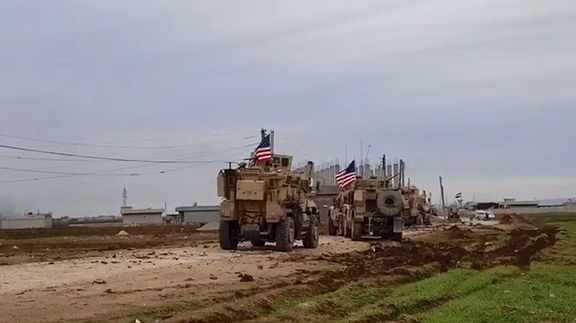
FILE PHOTO: A convoy of US military vehicles near Qamishli, Syria, February 2020.

The United States and Iraq have reached a preliminary agreement for the full withdrawal of US-led coalition forces from Iraq by the end of 2026, Reuters reported on Friday, amid continued attacks by Iran-backed militants against American troops.

The plan envisions hundreds of troops leaving by September 2025, with a full withdrawal by the end of 2026, the Reuters report said citing multiple sources familiar with the matter. The deal requires a final go-ahead from both capitals, but the details have been broadly agreed.

"We have an agreement, it’s now just a question of when to announce it," a senior US official confirmed. The final announcement has been delayed due to regional tensions related to Israel's war in Gaza.

Discussions between Baghdad and Washington, which began in January, focused on transitioning to a new advisory relationship, allowing some US troops to remain in Iraq for security cooperation after the drawdown.

Farhad Alaaldin, foreign affairs adviser to the Iraqi prime minister, noted that technical talks had concluded, paving the way for "a new level" of bilateral relations.

The agreement comes amid ongoing attacks by Iran-backed Iraqi armed groups on US forces, which have resulted in casualties and retaliatory strikes.

Last month, several attacks on US bases in Iraq and Syria injured multiple Americans. Seven US personnel were injured when two rockets hit Ain al-Asad Airbase in Iraq on August 5. Several US and coalition personnel also suffered "minor" injuries in an August 9 drone attack on Kharab al-Jir base in Syria's al-Hasaka.

The current US presence includes around 2,500 troops in Iraq and 900 in Syria, originally deployed to fight the Islamic State. The drawdown will initially see forces leaving key bases in Anbar and Baghdad by 2025, with the last remaining troops stationed in Erbil until the end of 2026.

This withdrawal would mark a significant shift in Washington's military posture, though US officials acknowledge that their presence in Iraq serves not only to counter the Islamic State but also to monitor Iranian influence in the region.

The phased exit is seen as politically beneficial for Iraqi Prime Minister Mohammed Shia al-Sudani, as it aligns with Iraq's balancing act between the US and Iran while addressing ongoing instability. However, it might also signal a victory for Iran and its proxies in the Arab country which have long been pushing for the full withdrawal of US and coalition forces from both Iraq and Syria.

Most Viewed

Iran International says it won’t be silenced after London arson attack
1

Iran International says it won’t be silenced after London arson attack

2
VOICES FROM IRAN

Hope and anger in Iran as fragile ceasefire persists

3

Iran halts petrochemical exports to supply domestic market

4
INSIGHT

How Tehran bends its own red lines to boost state rallies

5

US arrests Iranian national over alleged Basij-linked visa fraud

Banner
Banner

Spotlight

  • Hardliners push Hormuz ‘red line’ as US blockade tests Iran’s leverage
    INSIGHT

    Hardliners push Hormuz ‘red line’ as US blockade tests Iran’s leverage

  • Ideology may be fading in Iran, but not in Kashmir's ‘Mini Iran'
    INSIGHT

    Ideology may be fading in Iran, but not in Kashmir's ‘Mini Iran'

  • War damage amounts to $3,000 per Iranian, with blockade set to add to losses
    INSIGHT

    War damage amounts to $3,000 per Iranian, with blockade set to add to losses

  • Why the $100 billion Hormuz toll revenue is a myth
    ANALYSIS

    Why the $100 billion Hormuz toll revenue is a myth

  • US blockade targets Iran oil boom amid regional disruption
    ANALYSIS

    US blockade targets Iran oil boom amid regional disruption

  • Iran's digital economy battered by prolonged blackout
    INSIGHT

    Iran's digital economy battered by prolonged blackout

•
•
•

More Stories

Iran forces relocation of its Kurdish opposition groups inside Iraq

Sep 6, 2024, 19:41 GMT+1
•
Shahed Alavi

Three Iranian Kurdish armed groups have been relocated to a "less accessible" camp in Iraqi Kurdistan after months of pressure from Tehran on both the Kurdistan Regional Government and Iraq’s central government.

Iran has long accused the semi-autonomous Kurdish government in northern Iraq of harboring groups, all under the Komala name, which Tehran labels as terrorist organizations. The Iranian Revolutionary Guard Corps (IRGC) has frequently launched attacks on their bases, claiming these groups pose a threat to the security of the Islamic Republic.

In March 2023, the governments of Iran and Iraq signed a ‘border security’ agreement that was, in essence, a plan to curb the activities of Iran’s Kurdish opposition groups in Iraq. The agreement led to partial evacuation of Komala bases in September 2023. The move now seems to have been completed, with the three Kurdish parties, with military wings, leaving their camps in the Zirgwez region near Sulaymaniyah and settling in camps in Suwardash near Dukan.

The new location is in fact closer to the border with Iran but less accessible, according to Komala sources who talked to Iran International on condition of anonymity. “The ability to transport and maintain weapons, especially the semi-heavy and heavy weapons of the Peshmerga forces, has effectively been taken from them,” one member said.

A map of the Iraqi Kurdistan with old and new Komala camps
100%
A map of the Iraqi Kurdistan with old and new Komala camps

He added that by forcing a move of the Komala inside another country’s territory, Iran's government has sent a “clear message” that it can do “whatever it wants” and neither the Iraqi central government nor the Kurdish Regional Government of Iraq can stop it.

The groups say they oppose the clerical regime in Iran, but many Iranians also view them as separatists, who harbor designs on Iran's Kurdish populated areas in the west.

Iran’s government, through its IRGC Quds Force, enjoys considerable sway over authorities in Iraq, both in Baghdad and Erbil, the Kurdish regional capital. On occasions, however, the relationship has bittered over IRGC attacks on Kurdish groups.

Tehran Erbil security cooperation

Nechirvan Barzani, the President of Iraq's Kurdistan Region, made an unexpected visit to Iran in May, where he met with top leaders, sparking strong criticism from opponents of the Iranian regime.

During his visit, Barzani engaged with key figures of the government, including Supreme Leader Ali Khamenei, heads of executive and legislative bodies, the commander-in-chief of the IRGC, the foreign minister, and the secretary of the Supreme National Security Council.

The timing and nature of Barzani's visit, coming months after the IRGC's missile attack on the Kurdistan Region, raised questions about its motives. The high-profile meetings suggest that the discussions likely focused on mutual security concerns.

In January, the Iraqi government recalled its ambassador from Tehran after an IRGC missile attack on Erbil killed four civilians and injured six others. The attack caused a popular outrage in Iraqi Kurdistan and thousands took to the streets denouncing the IRGC's ‘free hand’ in their region.

The IRGC claimed the target had been an Israeli “spy headquarter” in the Kurdistan region of Iraq, but the Kurdish prime minister Masrour Barzani categorically denied the claims and called the attack a “crime against the Kurdish people.”

Biden and Haley named as targets in Iranian plot to kill Trump

Sep 6, 2024, 09:09 GMT+1

New details have emerged surrounding the Iranian plot to kill ex-President Donald Trump, claiming that Iran targeted "politicians, military people or bureaucrats" including President Joe Biden and former Republican presidential candidate Nikki Haley.

Senator Chuck Grassley released whistleblower information from FBI records amid Trump’s latest presidential bid and in the wake of a failed assassination attempt against Trump just weeks ago, which Iran denied links to.

In a statement, Grassley said: ”Bad actors are determined to wreak havoc on our country, and American political leaders across both parties are sitting squarely in the crosshairs.

“In this extraordinarily heightened threat environment, federal agencies ought to be laser focused on building up public trust and reassuring the American people of their efforts to carry out their protective missions."

He vowed he will not "stop pressing for answers until Congress and the American people are afforded the transparency they deserve.”

Asif Merchant, a Pakistani with known ties to Iran, has been charged for his involvement and according to the FBI documentation, provided evidence to the FBI in a plea deal. He was arrested just one day before the July assassination attempt.

Asif Merchant (file photo)
100%
Asif Merchant

According to the FBI records, Merchant believed he was in for a kill-for-hire scheme that would offer him a cut of $50,000 for successful completion. He had told FBI interrogators that there were options for shooting former President Trump at both indoor and outdoor speaking engagements.

The Pakistani, 46, told investigators that he could hit a target up close or from further away, that a pistol would be best for indoors, but a rifle was necessary otherwise. He is said to have believed he had about a 50% chance of success.

English language notes were smuggled by Merchant’s family members to communicate with his handlers in Iran.

While the FBI has still not commented on the July assassination attempt on Trump by Thomas Matthew Crooks, while investigations continue, the option of it having been an Iranian plot has not been ruled out.

Security had been increased in June based on intelligence suggesting plots to kill him as Iran continues to vow revenge for Soleimani, killed in a drone strike in Iraq in 2020, ordered by Trump for his involvement in terror targeting US troops.

According to the justice department's indictment, Merchant arrived in the US from Pakistan in April after having spent time in Iran, when he contacted someone he thought would help him enact the plot. The unnamed contact reported him to the authorities.

Merchant had apparently told the contact he would leave the US before the killings, staying in contact only through code words.

FBI director Christopher Wray called the scheme a "dangerous murder-for-hire plot... straight out of the Iranian playbook".

Last year, the US listed Iran as the world's number one state sponsor of terrorism while plots to kill dissidents, Israeli and Jewish targets around the world have become increasingly more common.

Demanding transparency from security agencies, Grassley said that a DHS-FBI briefing from earlier this week "yet again failed to provide full transparency, necessitating this letter and the public disclosure of the unclassified proffer.”

Iran’s UN envoy again dodges responsibility in Ukraine conflict

Sep 5, 2024, 12:37 GMT+1

Iran’s Ambassador to the UN, Amir-Saeid Iravani, has once again dismissed international claims about Tehran’s supporting Russia's war on Ukraine as “baseless and misleading.”

Rejecting a statement by the United States, the United Kingdom, and France, the move is consistent with Iran’s long-standing strategy of denying responsibility for its provision of drones used on civilian populations in Russia's war on Ukraine.

In a letter to the President of the Security Council and the UN Secretary General, Iravani attempted to redirect the blame, accusing the US and its allies of "fueling the flame of war" by providing Ukraine with advanced weapons.

Iravani specifically stated that the representatives of France and the UK had invoked United Nations Security Council Resolution 2231 (2015) to back their accusations against Iran.

He also accused the US of spreading similar false claims and of labeling Iran as a supporter of terrorism, asserting that such remarks are "misleading and baseless", in spite of Iran's support of terror proxies around the Middle East.

The denials ring hollow given the growing body of evidence that suggests Tehran has been actively supplying military hardware to Moscow, including Iranian-made drones.

The drones, including the Shahed-136 and 131 kamikaze models, have been deployed to attack civilian infrastructure and overwhelm Ukrainian air defenses, with hundreds of such drones being used since October 2022. Most recently, a large-scale assault involved around 100 Iranian Shahed drones.

Reports from late 2023 indicate that Tehran has also supplied ballistic missiles to Russia. Despite initially denying that it had supplied drones to Russia, the Iranian government later admitted to the transfers but claimed the equipment had been sent before Russia’s invasion of Ukraine.

Over the last 18 months, Iranian-backed plots across Europe have also been foiled as Tehran exports its terror beyond the Middle East to countries including the UK, Belgium, Greece and Sweden.

The head of the UK's MI5 intelligence agency also named Iran as one of the country's biggest domestic threats, while last year, the US named Iran as the world's number one state sponsor of terrorism.

The man who predicted Hamas's Iran-backed invasion of Israel

Sep 5, 2024, 10:28 GMT+1
•
Benjamin Weinthal

Exactly one year ago, Iran International published an article featuring Middle East expert Yigal Carmon’s prediction that an Iranian regime-backed terrorist group would attack Israel in the fall of 2023.

The Iran International report titled “Will Iranian Proxies Target Israel In September Or October?” was the only open source news report prior to October 7 that defined a specific time period in which the Islamic Republic’s proxy Hamas would unleash its massacre in southern Israel.

A little over four weeks after publication of the Iran International article, the horrific violence of the US-designated terrorist movement Hamas produced mass rape, the murder of nearly 1,200 people and the abduction of over 250 people in southern Israel.

Iran International sat down with Carmon to revisit his article and hear his current thoughts about the Iranian regime-animated conflict that has engulfed the Middle East.

“It will not end as long as America stands by its enemies and not its allies,” Carmon said in his typically blunt fashion.

He continued, “The Obama administration sought to promote Iran’s role in the Muslim world. The policy has not really changed despite the fact that Iran’s proxies, Hezbollah, Iraqi militias, Houthis, in addition to Hamas and Palestinian Islamic Jihad, are actively fighting the United States.”

Yigal Carmon, the founder of the Middle East Media Research Institute (MEMRI)
100%
Yigal Carmon, the founder of the Middle East Media Research Institute (MEMRI)

Carmon observed, “To add insult to injury, Qatari authorities have repeatedly stated they would not permit the US to launch any attack on Iran from the CENTCOM base at Al Udeid Air Base. This reflects the administration’s broader Middle East policy of distancing itself from its allies while appeasing its adversaries."

For Carmon, America’s allies in the region are the anti-Iran regime opposition within Iran, Bahrain, Saudi Arabia, the United Arab Emirates, Egypt, Jordan and Israel.

Carmon, who speaks fluent Arabic and served as the counter-terrorism advisor to two Israeli prime ministers, has long had a singularity of purpose about exposing the world’s worst state-sponsor of terrorism—the clerical regime in Iran—and its Islamist strategic partners, including the Sunni regime in Qatar.

In January, the The Wall Street Journal wrote about Carmon and his institution in an article titled “When Terrorists Talk, They Listen. Memri, the Middle East Media Research Institute, fights Hamas by telling the world what its leaders are saying.”

The roots of Carmon’s forecast about the Hamas-Iran-Qatar troika invasion of Israel can be found as early as 2018 in his essay titled Is Gaza In Need Of Qatar's Aid?

In it, he wrote regarding Qatar’s funding of Hamas “the destructive results of which are bound to come sooner or later.”

A view of Gaza before the war. Undated
100%
A view of Gaza before the war

While many Mideast experts could not envision an alliance between a Sunni Islamist state like Qatar with the revolutionary Shi’ite regime in Tehran, Carmon laid out in plain terms that “Islamist ideology” serves as the common denominator for the rogue regimes across the region. Religious ideology matters greatly when it comes to what drives human and state behavior.

“Qatar is a supporter of the Muslim Brotherhood, Hamas and the Islamic Movement in Israel, and an ally of Turkey, which considers itself an enemy of Israel and which under President Erdoğan adheres to the Islamist ideology that seeks to annihilate it, as well as an ally of Iran,” he wrote in his 2018 essay.

Carmon said regarding the October 7 attack that “Iran provided the training, tactics and weapons. Everything that has to do with the actual attack.”

When asked about the reactions to his analysis before October 7, Carmon said, “Generally, it was not taken seriously. It was contrary to everything they heard from intelligence to the media, from research institutes and think tanks in Israel headed by former chiefs of intelligence.”

He said his article went “contrary to the NGOs, who visited Gaza and told them Gaza is like the Brazilian favelas or worse while in reality Gaza was a thriving Mediterranean city developing immensely.” MEMRI ran a series of articles with video footage in January and February this year that debunked the notion that Hamas-controlled Gaza was immersed in a “Suffocating occupation” and a “Humanitarian disaster” prior to October 7. Carmon noted that Gaza Strip contained “institutes of higher education, malls, towers, five-star hotels, luxury restaurants, water parks, hospitals, automobile dealers for luxury cars, zoos and a musical center.”

He stressed that his warning contrasted with the views of the Israel Defense Forces. “The military told everybody that they [Hamas] were deterred. So it was perceived as a political attack rather than a professional assessment based on evident material from open sources that everyone can see.”

When asked who listened to his analysis, he said the people in MEMRI and Iran International. Carmon said the strengths of his analysis “is taking open sources seriously. And here I have to say something very important. And the arguments against it were primarily racist. The argument goes as follows: Arabs just talk and are not to be taken seriously. Arabs are for sale. We are buying them. Arabs are fools. We can help them [in Gaza] to be a counter to the Palestinian Authority.”

Regarding the Hamas psyche, he said, “It is not hard for me to go into the heart of a killer.”

Carmon seems to have insight into human psychology—a sort of sixth sense—that he attributes to his understanding of empathy.

In short, he jumps into the heads of the Islamist enemies of the West.

He said the consensus racist argument also pooh-poohed Arab military capabilities: “They can’t operate mobilized units because they are primitive.”

Carmon said, “Now we know they attacked with 6,000 people [on October 7].”

“I took them seriously and I believe they mean it. I believe this group of extremists is not for sale. I believe they are not stupid. They have advanced capabilities. I could see it in the videos.”

Carmon asks: “Is it necessary to know Arabic? No. But it is always good to know languages” and, he stresses, “to have an open heart” about out-of-box thinking that goes against mainstream beliefs.

Jerry Coyne, Professor Emeritus at the Department of Ecology and Evolution, Committee on Evolutionary Biology at the University of Chicago, met with Carmon and this writer in September 2023. He would, in January 2024, blog about the meeting, Carmon’s prediction and the Iran International article.

Coyne issued his own early warning for the West in his piece: “If intelligence officials in the West aren’t reading MEMRI on a regular basis, they’re making a mistake. As you see, even the Biden administration has been gulled by the Middle East, and this happens pretty regularly. [Secretary of State] Antony Blinken is an especially notable victim, and he passes his gullibility on to [President Joe] Biden.”

Is the US losing the battle against Iran-backed Houthis?

Sep 4, 2024, 10:59 GMT+1
•
Negar Mojtahedi

The United States and its Western allies seem unable to curb the increasing Houthi attacks in the Red Sea, and a Navy commander may have offered some insight into the reason: not to anger Iran.

On Ward Carroll's YouTube episode, titled 'Admiral Tells the Real Truth about battling the Houthis in the Red Sea," a US Navy commander from the Dwight D Eisenhower Carrier Strike Group, said he suggested more aggressive strikes on the Houthis, but reportedly he was told to avoid that by higher command.

The alleged instruction was to avoid large- scale counterstrikes against the Iranian proxy force due to "the balance of deterrence" with the Islamic Republic of Iran.

Rear Adm. Marc Miguez was the commander of the strike group during an eight-month deployment to the Red Sea that defended commercial ships. Iran International has reached out to Rear Adm. Miguez, the US Navy and US CENTCOM for comment and was not able to secure an interview in time for publication.

Miguez appeared to suggest during the podcast episode that they needed to take Iran's response into consideration.

"There are definite strategies that were put forward, but our National Command Authority decided that those - I would call more aggressive postures and more aggressive strikes - was not something we wanted to challenge," Miguez said during the interview with the YouTuber on August 26.

That aggressive posture does not align with the risk-aversion strategy the Americans appear to be taking when it comes to the Islamic Republic of Iran, with the Biden administration hesitant to challenge Tehran.

“We have a deterrence deficit with Iran. They have been attacking our forces. They have been attacking commercial vessels, with impunity since October 2023,” said Jason Brodsky, the policy director for United Against Nuclear Iran (UANI).

The root of the problem, said Brodsky, are US policy makers advocating for risk aversion.

From October 2023 to June 2024, Miguez told Carroll the carrier strike group launched seven deliberate, coordinated attacks with partners like the UK on Houthi targets. A couple of the strikes were integrated with the Air Force.

Because of all constant missile and drone attacks by the Houthis who even fired at US Navy vessels, the strike groups' destroyers ran out of anti-air missiles, taking them at least three days to reload, he said. 

While Israel targeted the Yemeni strategic port of Hodeida, after the Iran-backed rebels carried out a deadly drone attack in Tel Aviv in July, the Americans have limited their targets.

“Deterrence against the Houthis has failed, “said Brodsky.

“The United States is aiming at radars, drones, missile launchers and that kind of material without going after more strategic targets like the port of Hodeida that Israel bombed after the Houthis sent a drone that exploded in Tel Aviv," he added.

Are the Houthis winning and the US losing?

A former Royal Navy Commander, Tom Sharpe, wrote an article in the British news outlet Telegraph recently, alleging that the Houthis had defeated the US Navy.

Sharpe wrote that since January of 2024, Houthi attacks increased, and have added more to their arsenal, with the usual drones and cruise missiles now came hijackings and ballistic missiles.

"I understand the desire to not escalate with Iran which is why the Poseidon Archer strikes were focused and quite limited (especially when compared to current Israeli strikes in Yemen) even if I don’t entirely agree with it," wrote Sharpe in the Telegraph article.

The US Central Command said Yemen's Iran-backed Houthi rebels attacked two crude oil tankers - the Saudi-flagged Amjad and the Panama-flagged Blue Lagoon I - in the Red Sea on Monday with two ballistic missiles and a one-way attack uncrewed aerial system, hitting both vessels.

“There are no casualties onboard, and the vessel is proceeding to its next port of call,” British maritime authorities said at the time.

The Saudi shipping firm Bahri said on Tuesday its tanker Amjad was not targeted. The Houthis did not claim responsibility for that, although they admitted to attacking the Blue Lagoon.

Amid continued ship attacks by the Houthis in the Red Sea, Republican Senator Tom Cotton said on Tuesday "Joe Biden and Kamala Harris have ceded the Red Sea to Iranian-backed terrorists. Our enemies do not take the Biden-Harris administration seriously.”

Republican Senator Joni Ernst also weighed in, and said the “the Biden-Harris administration continues to turn a blind eye as the Iran-backed Houthis disregard the law and terrorize the Red Sea.”

The EU naval mission in the Red Sea announced Tuesday that the salvagers have abandoned attempts to tow away the burning oil tanker, Greek-flagged Sounion, which was attacked by Yemen’s Houthi rebels according to the Associated Press.

On August 29, Houthis rebels released a video showing them planting explosives aboard the Sounion, which had been abandoned after multiple attacks the prior week.

The footage then cuts to a long shot of the vessel as the explosives detonate, while the Houthis chant their slogan: “God is the greatest, death to America, death to Israel, curse the Jews, victory to Islam.”

Richard Golberg, a Senior advisor at the Foundation for Defense of Democracies (FDD), said the White House's current course of action is obviously not working.

"There is an intelligence ship that the Iranians have, near the Red Sea that provides the targeting intelligence data to the Houthis to support all these attacks. We've never taken out that ship. That would seem to be an obvious next step in the escalation ladder."

Secretary of State Antony Blinken delisted the Houthis as both a foreign terrorist organization and as specially designated global terrorists in February 2021, as one of the first foreign policy acts of the Biden administration.

The White House said it was trying to make it easier to get food and humanitarian aid into Yemen. However, in the face of Houthi attacks, they re-enlisted them back on the specially designated list in 2024, though they are still not on the foreign terrorist list.

Goldberg said the Biden administration strongly believes that if Houthis have access to money and economic capital, they will hold back from serious attacks, and somehow become normalized in Yemeni society. He finds that theory to be nonsense.

“Either they're a terrorist organization or they're not. Either we’re going to treat them like we would treat a terrorist organization or we're going to treat them like some sort of negotiating partner. They're trying to do both at the same time,” said Golberg.